
Of wonky tape measures.
16th March 2025
That's my excuse and I defy anyone to say otherwise.
I'm hoping to make this week a quick one as I feel like I need the sleep. The early part of the week was largely occupied with administrative matters. I thought I had finally identified the correct air filter element for the W H Davis loco (it had an enclosure but nothing inside so I don't have one to identify it from) so ordered said filter on Monday and planned to pick it up on Thursday when I already had a trip scheduled in to Chesterfield. Late on Tuesday we drew the train back and swapped the scrap skips around, ready for a collection, but so far that hasn't happened.
So on Thursday after a meeting I popped in to the filter supplier but the air filter hadn't arrived: needless to say it turned up later in the day and I went back on Friday and proudly brought it home. My identification was based on (a) what I thought I had measured and (b) that its principal use in my catalogue (vintage 1993) was on Cummins engines. But it seems that I must have been using a wonky tape measure or I was mesmerised by the fact that it suited a Cummins - because when I tried to install it was too big. I have measured the enclosure again and had another go and turned up another element that seems to be about right on paper and this too is for a Cummins. Can I get it wrong again?
Andrew reckons that the one I got would suit the slightly larger enclosure fitted on Grace (and we have at least one spare enclosure of this type fit for use - sorry upcycling - later so it isn't a complete waste.
The big minilok has taken up some of my time and brain cells. Having abandoned the idea of using the existing cabling within the minilok to form the new link between footpedal and throttle unit, I had resorted to three thin loose cables straddling across the floor and out the driver's cab door, so needed everything uplugging and stowing away when it was parked up. To tidy things up I thought of routing a new piece of cable around the cable tray under the cab and hunted out a length of 4 cored armoured (recycled from the Hatramm) to do it with.
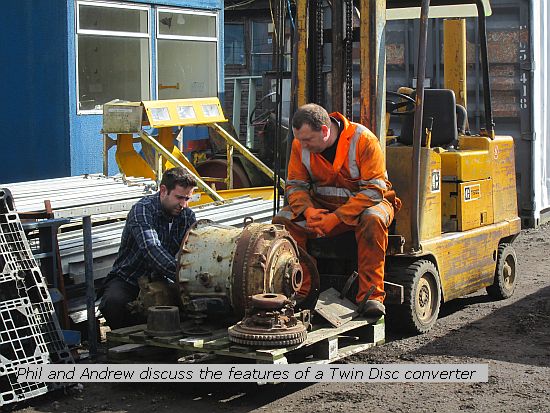
Saturday morning though Andrew had a rush on, as Phil C was coming to collect an engine and torque converter for the EE that he had bought from him. To make this possible we had to draw the train back and move the minilok so that the forklift could bring out a pallet and the engine and the crane could swing these round and extend forward to the transport, when it arrived - not aided by the presence of the scrap skip which we had expected would be gone. But before that we wanted to shift one of the TfL trolleys from in front of the little minilok as - and I'm loathe to say it too loud in case it puts the mockers on it - I'm hoping to have it mobile shortly and it was hemmed in.
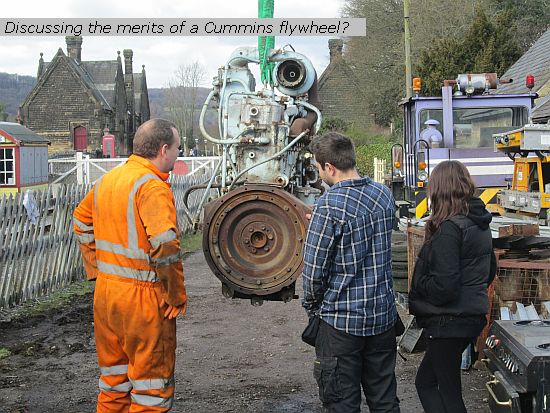
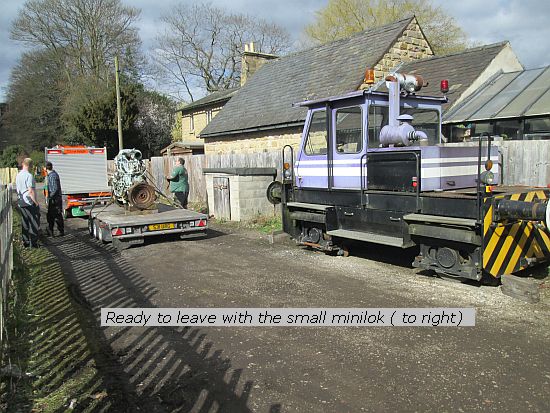
Much to-ing and fro-ing with the forklift eventually moved things around and Phil C turned up and transfered the smaller parts into his van. A bit after noon a lorry and trailer arrived, backed as close as he could and with the crane set at almost its maximum extension the engine was lowered on to the trailer and secured followed by the converter in front.
But I've got ahead of myself. When I came to move the minilok the steering had got very hard, indeed I was having to use both hands on the steering wheel and even then it was reluctant to turn. But to my right is a lever control - actually it is the valve (valves - there are three, the other two being guidewheel controls) which operates the steering when in radio control but can be manually operated as well. So I gave up on the steering wheel and steered with that like a joystick and wondered what I had done wrong. The problem had started so suddenly - since I had played around with the wiring for the throttle - that it was all too easy to assume that I had disturbed something electrical and maybe that jumpered pin I had deduced must be in one of the multi-pin plugs was behind it all.
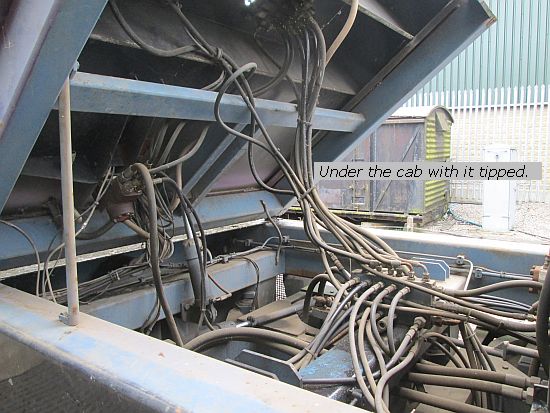
Once Phil C was away and the minilok had been moved back, Andrew had to go so I set about re-wiring the throttle control. On a traditional loco to get at the cabling underneath the cab I would have had to crawl under, but minilok is not a traditional loco, and the cab is pivotted at the front and bolted down at the back. Remove the two securing bolts and you can raise the cab either from the main engine pumps or by a local hand pump. I did start hand pumping but decided that it was too slow so fired up the engine and raised it under power.
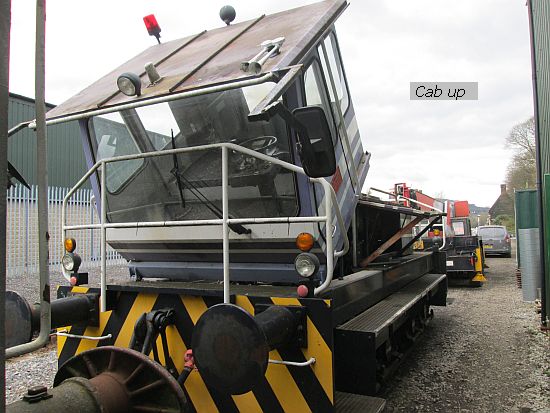
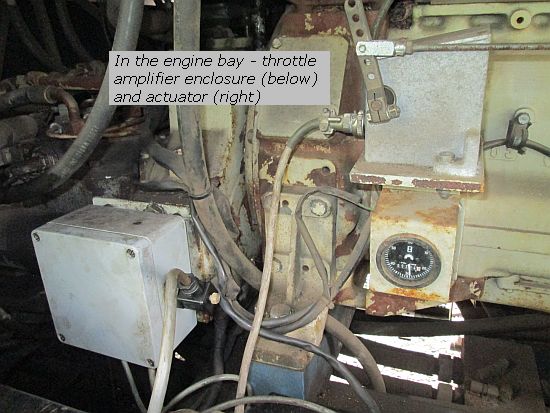
Of course, anything loose in the cab slides forward under gravity and I did overlook a couple of objects that gave me panics as they crashed forward, but no harm resulted. Anyway, it was now easy to thread the piece of 4 core around the cable tray, up into the cab, make off the plug end at the throttle amplifier and after lowering back down, re-make the 4 core at the cab end on to the pedal wires. The throttle amplifier itself was now re-mounted back on its original plate in the original minilok enclosure. Satisfied that all was wired correctly I fired the engine up, and immediately the throttle went to nearly full revs and stayed there. Crestfallen I assumed I had managed to cross a wire over and went back through, belling each one end to end, but they were all correct.
The meter told me that with power on the pedal returned a steady 4.4V irrespective, but with the signal wire disconnected I then had the correct rise and fall. So it seemed that substituting the 4 core cable (with its wire armour) for the smaller diameter loose cables caused the problem - and the original minilok cabling that I had tried to re-use before (with similar result) had much the same characteristic. Thus it would appear, (and anyone with knowledge of the electronic principles involved please educate me) that the amount of cable in some way affects the function of the device. To firm up this theory I did tests on the 3 wires I had tried before (and where I was thinking I had another device related to steering connected) and found that there was no voltage and nothing discernable connected to those 3 wires after all: it was just their very properties that screwed things up.
Sunday: Tony S was due and overnight I had decided to re-wire the throttle pedal, junction the wires underneath and make a new cable with the thin loose ones from there back to the amplifier unit plug. Thus the total cable length of metal volume would be substantially less than when the cables lay across the cab floor and all should be well. When Tony arrived I was under way on this, the loose cables being spiral wrapped and generally protected, with the cab raised again. Tony hoped to fit the disc brake assembly at last to his Baguley railcar, but yet again it didn't quite fit and I can only assume that I used the same wonky tape measure as I had for the air cleaner, but it's nearly there.
Later on we moved over to the other Baguley, and opted to fire up the engine. We hadn't planned to do this last time and today initially it wouldn't crank, but a stud on the starter motor is loose and after a wiggle it suddenly reacted and the Perkins ran, producing a reasonable oil and converter pressure - oh and a lot of smoke. What it didn't afford was any air pressure or alternator output (though the warning light was out so maybe it's just a duff bulb or the voltage regulator has gone down). No air means no power brake so no attempt to make it move today, and no immediate signs of escaping air from drains or valves, so for the moment that remains a mystery.
And that's about it. I've a transport job or two scheduled this week, I must order (another) air cleaner element, hopefully a Deutz expert turns up with his laptop ready to breathe life into the little minilok and no doubt some more crises will befall which I have yet to find out about. In between, somewhere there are suppliers to visit and drawings to complete, a loco to inspect and measure up (must leave the wonky tape measure behind) and clearly I'll be busy. How much - come back next week. See ya then.