
Of oils, throttles and deliveries
9th February 2025
As usual, a bit of a mish-mash.
It's been a tough job starting to write tonight's edition. I've actually begun composing a lot later than usual and if my fairy godmother offered to 'let me off writing it' tonight I would probably have taken her up on it. I can't put my finger on why, just a sense of unease over various unrelated things, I suppose. Back at the beginning of the week I had the last vestiges of the month end's paperwork to complete and to take my mind off mulling over financial issues (VAT return, invoicing and paying Income Tax makes it hard to overlook), I decided it was time to put together some bits of electronics for a variable throttle control.
I have the units working now for use with radio or other remote functions, (like using a PLC to ramp the engine up after a start to build air up instead of allowing a driver to 'give it full welly' on a cold engine) but I was looking for an alternative control set up to give a smooth, analogue lever control for the driver at the desk. The need for an alternative goes back to when we first had Libby (the Yorkshire 0-6-0DH) running up at Rowsley. The control card I had developed in YEC days was no longer an option, and I wanted to be able to run the throttle electrically rather than using a push-pull cable. At some point, years ago, I bought a Hall effect sensor from Penny & Giles, and there developments petered out for a few years until it came to the surface again and although I have doodles around a solid state chip, Chris H suggested a Weidmuller interface to use with the sensor and donated me one. And there again things rested as other priorities like shed building, etc, intervened. The big minilok has brought the matter to the surface again.
On a minilok, a footpedal operates two switches. Press the pedal to the floor, and the 'up' switch closes and the engine speed ramps progressively up. Move your foot to about half way and the up switch opens so the throttle remains at that level until you bring your foot up further whereupon the 'down' switch closes and the throttle progressively ramps down again to idle, or until you depress your foot to one of the other positions. Not long before the big minilok was parked up at Long Marston I had had a report that periodically the throttle wouldn't ramp down. That might be a little disturbing but actually all you do is push the direction control into neutral and everything ramps down anyway and brings you back to rest, but I couldn't make it fault for me so couldn't investigate further. Once here at Darley Dale, we found the root cause - the 'snap action' limit switch wasn't operating properly so I put it down to old age and bought a replacement. But that isn't any better yet there is no adjustment on the switch mounting and no apparent wear or other play that might account or it not functioning correctly.
Now, I have got a working throttle control, and it is suited to the ramp up/down system and I would go on using that with radio control as there it is a joystick switch which you operate with your hand. But for manual operation the minilok pedal assembly always seemed inappropriate - every driver expects a throttle pedal to be proportional to how far you push your foot down on it, not being 3 position. I returned to the two lumps sat on my desk (under several inches of accumulated paperwork) and decided it was time to give it a go. After half an hour of tweeks, I was quite satisfied - turn the shaft of the sensor through 180 degrees and the output on the meter, rose steadily and evenly from 4 to 20 milli-amps. All I had to do, was engineer the sensor in to the footpedal assembly instead of the switches and with a linkage that will turn the shaft through 180 degrees - simples.
Ah, but I always like to think I am doing a job like this with an eye to the future. Could I still get this particular sensor? P&G have been taken over and relocated, and nothing like this appears on their website any more. I consulted Chris H, who confirmed that the Weidmuller interface has gone too, but suggested other units that are still in production. All this was pushing my brain in different directions. Sure the sensor/interface combo was a solution to engineer next time I am doing a desk throttle system but surely with all the fly-by-wire options and EVs now around in the automotive industry, wasn't the answer for a minilok not to re-invent the pedal? After a bit of a search I have ordered a unit which is intended for off-highway EVs and should, I think, be compatible with the electronic throttle unit I've been playing with these last few weeks. Andrew expressed delight that we could dispense with two of the many relays in the minilok's 'Verteilerkasten' (yes, but it will still need one to changeover from manual to radio) and I look forward to driving the minilok 'properly' (at present it takes two, one to operate the throttle and the other to steer) even if the wiring is a temporary set up.
In mid January I ordered a set of belts for the big minilok, but they never showed up and this week, UPS, who were the carriers, came up with a PoD (Proof of Delivery) complete with a photograph of the package left on the windowsill next to the front door and a date of 16th January. The only snag is that it is in fact a proof of non-delivery, as the door is black (ours is well-white-ish) and has a big number 1 on it. As I have I think said before, we are too 'posh' to have a house number, merely a name. Actually I can see no. 1 from our kitchen window, I don't know who lives there - I haven't seen anyone going in or out lately so it might be unoccupied - but I suppose I might wander over and enquire. In the meantime a fresh belt set has been ordered for delivery to their local drop-off point as clearly they don't employ driver's with the integrity to do their job right. At the other extreme, a friend of ours occupies a house on what was a quiet cul-de-sac before develpers moved on to the field behind and created a set of houses there that virtually back up to the Peak Rail line. Although they are not all finished, some are already occupied and their new residents have been ordering things for delivery. I suspect though that the satnav systems the couriers employ have yet to update with the new road and the houses on it. Our friend's house is next to the entry road and so far he has been the recipient of eleven packages intended for the new houses. Just 'delivered' to his doorstep and left: well it was 11 as at last Wednesday, it may be more by now.
Oh yes, the van had a new NOx sensor last Thursday and now when it starts up there are no bleeps and threatening messages. I gave it a little run with some bits for delivery and it was back to its normal self.
Friday Andrew and I were at the shed. The rake sat on Track 1 was moved away, the big minilok started up and driven behind it. The crane was a bit reluctant but moved some other clutter and itself so that the forklift could get past and Andrew began a bit of tidying and re-arranging. This included moving the Terrypicker back out of the shed and into one of the containers, having first emptied said container and partly refilled it afterwards. This took us up to lunchtime, and not long after, an artic straddled the end of the lane. Andrew had agreed to store some bits temporarily for the Rail Trolley Trust, and once they had been unloaded and the lorry had gone on its way, we repositioned them a bit further up the yard and then moved crane, minilok and train back to their original positions. Longer term the plan is that the big minilok can move the train from the Rowsley end rather than Louise from the Matlock one.
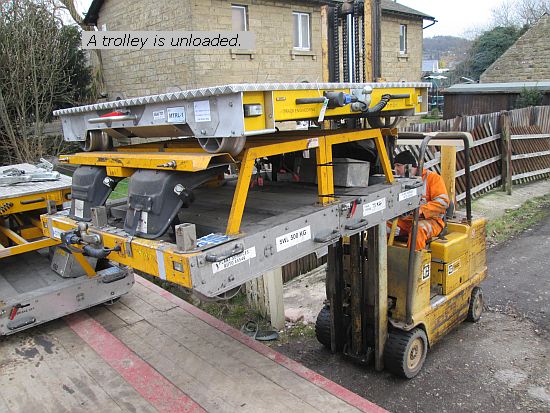
The wind was bitingly cold and having been out in it rather more exposed than Andrew I was in favour to calling it a day at that point but it was nearly five p.m. anyway.
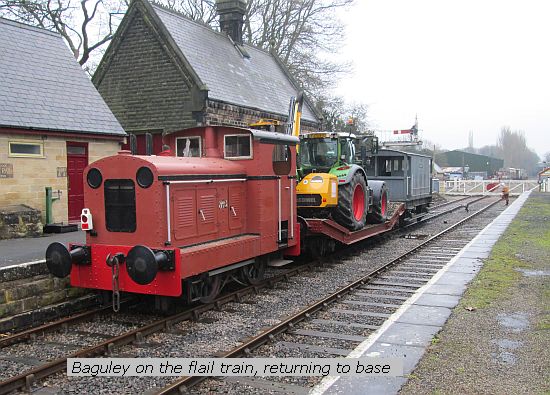
Tony S last week had given me guidance as to how to drain and fill the gearbox on the lathe with oil and during the week I had consulted my oil supplier and been guided as to what to use. I had no idea what the capacity was but checking our oil store I found we had most of a 20 litre drum of the right stuff so decided that on Saturday I would start by draining it via the elbow and plug as Tony had instructed. I set up a drum and a funnel and removed the plug, but what came out wasn't all that much and was clear and 'proper'. unlike the yellowey stuff I had observed before. I got on with some other jobs, leaving it to drain, but came out at the sound of a works train; Mark Sealey's Baguley 0-4-0DM being in charge of a flail train.
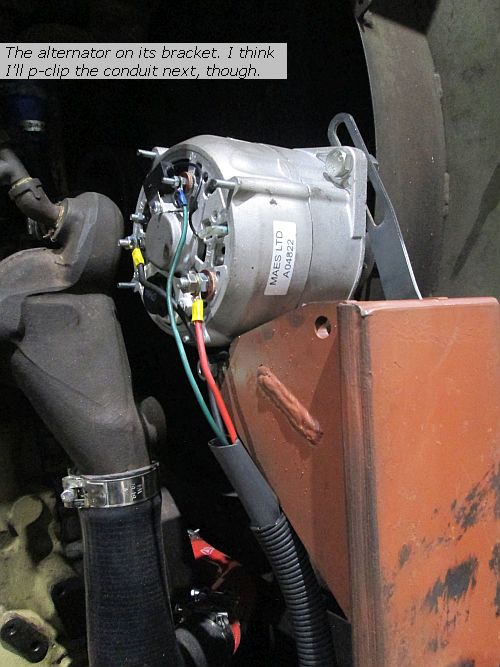
My time otherwise was on Davis's Barclay, including modifying the new alternator bracket so that the alternator wasn't quite touching the engine oil cooler and terminating the wires to it. It ought now to light up the charge warning lamp on the desk when I put the batteries on but it doesn't - maybe the bulb has had it.
Sunday: I replugged the drain and set to work to fill the lathe's gearbox through the upper elbow, as per Tony's guidance. Having only drained some 3 or 4 litres of clean oil I was telling myself it was 'low and that what we had thought was water contamination was in fact air. I had put about 7 or 8 litres in when there was an oily 'giddle-de-bump' noise from somewhere underneath. I stopped pouring and looked under, and sure enough oil was dribbling down on to the floor - from somewhere. I couldn't find a drip tray slim enough to go under so resorted to throwing granules to try and contain it but merely formed piles. So I switched on the band saw and made myself a tool from a piece of plank that could then push the granules to where they were needed, though by now the flow had stopped.
I went back on to Davis's Barclay, trying to reconnect gauge lines to the duplex gauge, and only succeeding by undoing the other ends of the rigid copper pipes in order to get the gauge ends to line up. Late in the afternoon Matt H turned up to collect a couple of buffers. With the aid of his endoscope we tried searching for where the oil had come out. Unsuccesful, we pulled out the swarf tray from under the bed, and searched again, and then added more oil to see if we could find where the leak was. We did. It was an overflow pipe from what Matt had thought was the coolant tray. He had been trying to source info on this lathe (as he wants to use it and was instrumental in our getting it) now he tried again and clicked on to an on-line manual. This revealed that the coolant tray also had the oil reservoir, and the method to empty it was to disconnect the delivery line from the pump, run the lathe and let the pump vacuate it all. Oh and the capacity is 45.5 litres. This bit of news turned my previous information on its head and meant I had nowhere near enough oil to refill it anyway. That will be on the list for later this week, or the weekend
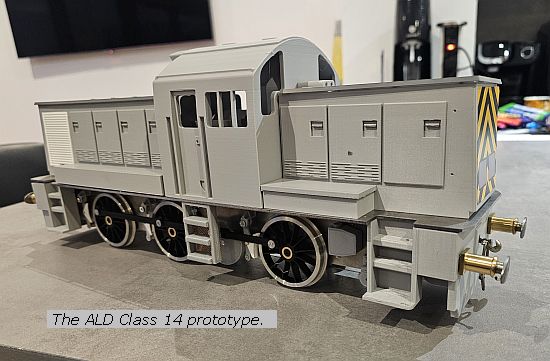
I'll wrap up the week with a preview of the Gauge 3 class 14 that Alistair is developing. Since I saw it last week (while they were measuring up 14 901) it has gained brake rigging which will in due course be 'operable' with a solenoid (whether it actually brakes the train remains to be seen). There's a lot of detailing still to do (one of the issues with larger scale models is that while you have the size to faciltate creating the detail, that same size means that you can't leave it out) but it should be quite an impressive beast when it is finished. As for me once again I have no idea how the week is going to pan out. Come back next time and find out. See ya then.