
Of token movements
15th December 2024
Token, train staff, whatever you want to call it.
Andrew was off to Chasewater first thing Monday. The haulier had told him the wagon (a rigid with HIAB and a drawbar trailer) would be 'there first thing' and a time of nine-thirty was mentioned. I didn't like the sound of that. I have dealt with enough hauliers to know that 'first thing' usually means 7 a.m. or thereabouts, especially this time of year when they want to make best use of daylight. But I said nothing as Andrew estimated they'd take about 90 minutes to load so would be on their way by about eleven and in to Darley Dale by one in the afternoon. At least that gave me the morning to get on with some admin.
A slightly frustrated Andrew spoke with the driver later that morning to gather that he was still unloading in Birmingham and 'there first thing' from the office had been the equivalent of 'the cheque's in the post' - though honestly, do you still write cheques, let alone post any? I can remember when first and second class mail started, it was 3p for first and 2.5p for second... (drifts into old man reminiscing mode).
Anyway, the vehicle finally arrived Chasewater at about noon and proceeded to load one 20ft container on the trailer and one Baguley Drewry railcar on the rigid. By about half one the loads were on and shortly after they set off north. About three o'clock I ambled down to the shed to open up and draw the token ready for shunting. I parked the van in the station car park (so as not to get in the way), fired up Louise and after setting the crossover, drew about half of road 1 out on to the main, cleared the turnout, and reversed back up towards Darley Dale station. That sounds simple, but the rails in the yard area were exceptionally slippery and I had to stop and hand-sand on more than one occasion. By contrast, once out on to the main line (where PR trains had run the previous day,) the adhesion was far better.
The far end vehicle in this motley collection was one of the German flat wagons; though this had the pre-fab ramp on it on Monday it had previously carried the container that Andrew had bought, and that had overhung at both ends, apart from being out of gauge if we tried taking it under (i.e. through) the road bridge by Warney Brook. By quarter to four I had gone as far as I could, and the light was fading fast. At ten to four the lorry arrived, and as Andrew had given him some sort of plan to work to, proceeded to drop the trailer in the station car park. Shortly after, Andrew arrived.
Unfortunately these momentous events went unrecorded on film as the darkness was fast descending and cameras don't function too well. Anyway, we were working as fast as we (safely) could to get the vehicle unloaded and there was no time to stop and admire. Having extricated the spreader beam from under the railcar, it was lifted off and lowered on to Peak Rail tracks with the 95% alarm bleeping on the HIAB. Then he took the rigid back across the road and transfered the container from the trailer to the rigid, while Andrew fired up his crane and lifted the pre-fab ramp off the german flat and put it on the ground (for now). Back came the rigid, with container on board, after which it was lifted off and placed on the german flat. This was a shorter container so we got it roughly in the middle of the wagon with enough space to open the doors at one end if required. The rigid went back, collected the trailer and departed. It was now heading toward six p.m. and pitch black. Back on Louise, I shunted forward to collect the Baguley railcar, and pulled the ensemble back down towards Warney Brook, where we dropped off the railcar. Thereafter I continued south until the end of the train cleared the turnouts, and set back into our yard and returned to road 1. Then uncoupled, it was back to collect the railcar which was taken across onto road 3A, stopping carefully so as not to squash it between Louise and RS8.
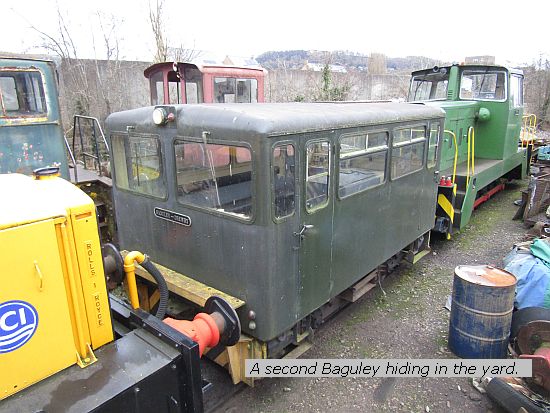
All this shunting was achieved with the correct light signals with only one recourse to mobile phone (which, with the noise levels prevalent in Louise's cab, is of dubious benefit). After all this we cleaned up, returned the token to the block post cupboard and wound our weary ways homeward. And what do we want another Baguley railcar for? After all, we have two 0-4-0DH Yorkshires and despite years of co-existence, like Pandas, they still won't breed. Well, other than a plan to expand the scope of equipment we can provide to Peak Rail, I haven't been informed. Nobody seems to know whether it is operational or not. (The previous owner is deceased, I gather). Like the already resident example, it is one of the first batch with hinged doors (the MoD discovered that, as they have a number of loading tracks where platforms are at both sides, and the floors are below platform level, exiting was not always possible. The second batch of railcars had sliding doors). Unlike the already resident example, this one has received a substantial bumper bar at buffer height which made shunting in the dark with Louise rather less stressful than it might have been, but an inspection to see if it is all there and whether the engine turns, etc, might be undertaken over Christmas.

For now we can dream of 2 railcars, coupled back to back with a flat trailer between, a smiling p/way crew spread out on the railcars' seats with their tools and materials in the middle, setting off from Rowsley under a clear blue sky to while away the hours changing sleepers or dredging drains. Well maybe.
Wednesday, and after something of a lull I had a day's work to shift 2 class 37 bogies about. T1 is just too short to take them both in one go and the legality could be a bit iffy, so I met Jeff at 08.00 (yeah, first thing) only to find the first bogie wasn't in position to load yet. So we had a bit of a natter while the bogie made sedate progress from the other end of the site, finally got to load it and by about 09.40 we were on our way. The destination was Barrow Hill, and normally when I get there the gates are closed but the padlock unlocked, giving me time to open, get in and change into hivi before the lorry arrives. This time it wasn't and some calls had to be made: consequently I had barely parked and turned the engine off when Jeff drove in. The bogie rolled off satisfactorily but as there as no shunting loco around (and the vital coupling bar was still in use with the other bogie) we pole-shunted it clear to get the unit back on to T1.
We would normally back out of the site and turn so as to set off forwards in the desired direction, but a double-decker and a van were parked on that side of the entrance so Jeff turned within the car park and headed back, with me in pursuit. The second bogie awaited us and the coupling bar was alongside, but as I waited for Jeff two other vehicles arrived, one artic and one rigid. I spoke to the former and he kept clear of our route in but the rigid pulled up where it suited him and was unstrapping as Jeff appeared and I tactfully arranged that he shift over a bit. The second bogie and bar were loaded and off we went again, though I was a little behind Jeff and only got to Barrow Hill just as he had lined up. A fitter threw the coupling bar over his shoulder and set off on foot - somewhere. A while later, as the second bogie was now on the track adjacent to the first, an 08 appeared, complete with the aforementioned coupling bar aboard, attached itself and disappeared off with the first bogie. I considered pole shunting the second aside, but Jeff, who had earlier been apprehensive about getting both done in a day(light), was now laid back in his cab listening to the radio. Eventually the 08 returned, collected the second bogie, and we reassembled with T1 to head homeward.
In my case, I was headed first to a suppliers, only to find a 4-way traffic lights at what had been a roundabout but was for now a single carriageway chicane, was causing massive queues in all directions. I got to the suppliers but took another course home. Thursday it was a run over to Manchester and little else, and Friday was getting ready for the weekend.
Saturday, again no prospect of Andrew getting away from his home-improvements: (he has told me that on Saturday he was fixing loose floorboards ready for the carpets to arrive when, unwittingly, he screwed straight through a central heating pipe that had been laid in a notch chiselled out of a joist so that the pipe was immediately underneath. The system leaked and tripped an RCD). On arrival, Gerry was the day's blockman at Darley Dale and he flagged me down as I backed in.'Had we returned the token on Monday?' he enquired accusingly. I assured him we had, confident that Andrew, who had marched off into the darkness, had done so because I had told him where I had placed the keys. Where did we put it then?, Gerry continued, apparently unconvinced. Back in the cupboard, I assured him, offering to ring Andrew to check, but Gerry seemed reassured by my confidence and returned to the blockpost. A good job I didn't ring Andrew, actually, because a PR Director already had! Where was the token? Somewhere around Matlock, it seems. Network Rail claim the token whenever they have engineering work that needs access to the lines north of Matlock station, thus preventing the prospect of a Peak Rail train sneaking up out of the darkness and going 'Boo!' to their Engineers. They just hadn't got about to returning it.
So I spent the day quietly pulling wires through on the WHD loco. Saturday felt like 2 steps forward and one back. I got the clutch detection switch mounted and cabled. and continued with the torque converter temperature switch and sensor. The former gave me concerns. Whatever make of switch it had been, it had been 'gobbed up' with a tube-worth of epoxy resin and that makes you wonder whether the resin had seeped into the switch movement and jammed it. I certainly couldn't put fresh cables on as those existing emerged from the epoxy, so I decided to remove it altogether. About now it sunk into my dull brain that this wasn't the only thing wrong. While we had reconnected the hoses as they clearly had been before (and the fittings I don't think had come off the the converter) the temperature switch was sited on a tee on the input line to the converter, not the output. Thus the converter would only be protected if the temperature of the fluid returning from the cooler reached shutdown temperature, at which time the temperature of the fluid inside could well be off the scale. This required alteration to detect the fluid temp coming out but was a distraction from wiring which came to a halt at about this time. At regular intervals during the day though I continued toddling out to wave at the happy smiling passengers on the Santa Specials, as requested on the staff Thursday circular.
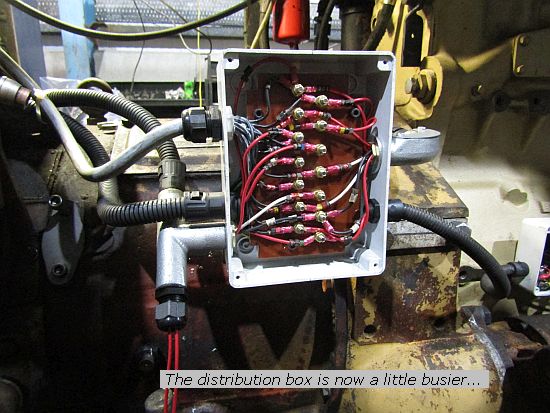
Sunday, back down again, this time moving from the back of the power unit to the front, setting up conduit and pulling cables through from the distribution box as far as the coolant temp switch (which isn't there yet). A lot of climbing on and off, going around to pick up a tool from the other side of the loco, or a spanner from the tool cabinet, chop a bolt off shorter and in between kneel on the footplate sliding cable numbers and crimps on to wire ends. Getting at the fuel shut-off solenoid is going to be fun - it is up hiding with the engine block on one side and the oil filters on the other. That is one for another day though. Andrew turned up at half three to cut some bits of wood and discuss plans for the next couple of days. I turned my attention to the new throttle control module for the big minilok. Off came the cables from the old enclosure, but the glands had been fitted in to holes tapped in the thick enclosure walls and I had no nuts for these or other small glands so the job rather stopped itself
Next couple of days are planned for workshop work, and as the world starts to wind down for Christmas I'm not expecting anything too mind-boggling to occur, but you never know. Come back next week and I'll clue you in. See ya then.