
Of discrimination and brake valves
10th November 2024
..and an important role played by 2mm thick steel discs.
Just a short edition I think. It had been a quiet week here at the Briddon Country Pile.
On mundane matters, I ordered a new hob (this time electric induction instead of gas), a relatively cheap one that plugs into a 13Amp socket yet the suppliers' computer system said that they couldn't install it as it needed a qualified electrician. What is the world coming to when it needs a qualified electrician to push a plug into a wall socket? (I jest - someone didn't program it to discriminate between plug in and wire in ). Anyway, the hob was an 'industry standard size' so I thought nothing about it, and when it arrived (Tuesday) took out the old gas one, capped off the gas feed pipe, (probably should have a had a gas-safe person to do this) and found the new hob wouldn't fit in the hole. Why? Well the two hobs may be to 'industry standard' but the kitchen fitters cut the aperture in the worktop to suit the gas hob. I put a call in to Andrew who dutifuly popped in with the jigsaw and a transformer and waited while I opened up the 'ole and lowered the new hob in. I had previously carried out a quick check of our cooking utensils and didn't expect too much trouble - we found one pan that was definitely aluminium (so wouldn't work) but the hob itself disagreed and refused to recognise various pans, especially stainless-y ones. Faced with replacing a large number of pans at short notice, it came to my mind - inducted, I suppose - that what the hob wanted was sufficient ferrous to do its magnetic thing. At the workshop were a couple of 2mm thick steel discs - why not let it heat one of these up and stand the unrecognised pan on top? The hob is happy, the pans function and I can replace a few of them when convenient rather than together in a panic.
The main activity this week has involved 873 (I'm using the shorthand for Bagnall the Barclay again). Andrew came one evening to sort the direction change valve, having found a similar spring to replace the broken one - the valve is leaking slightly but the delivery to the reverse output is unrestricted. He also ground off the weld from the lever at the back and removed it from the shaft. I envisaged fitting it on Saturday but later in the week Andrew had an email from Mark Sealey asking him to hurry up and get the loco back in traffic. So Friday morning, after a few other matters had been sorted, I drove in to Rowsley, and, swearing and cursing, (mostly accusing the fitters of Kilmarnock of being below average intelligence with regard to their routing of steel pipes with little or no give in places that prevent any honest citizen from getting a spanner on the Ermeto joints at their ends) returned the valve to its home. The lever no longer being there to operate them, the 3 ganged-together limit switches were detached and for now, allowed to hang their heads in shame at the end of their wiring, and the two relays below, held to the desk column with jubilee clips, were also detached so that, somewhere in the not too distant future, the plates of steel I bought a year ago to enclose the desk can finally get fitted.
But with the gearchange valve in and quickly tested, I headed off to visit some suppliers, including my current provider of lubricants. I generally call and collect, having ordered a day or so in advance, so my first stop is at the office and they phone through to despatch to get my order out ready. I was beginning to think the young lady with the bright red hair was recognising me by now, I gave her my registration and she disappeared off to phone, returning to say 'They're ready, but aren't you facing the wrong way?' I inevitably looked back at my van, parked facing the door and the tanker on the other side of the road. 'No' I assured her and pointed to the van. 'Oh', she admitted 'I thought yours was the tanker' and dashed back into the office to phone despatch and change whom to expect. When she returned to me I thanked her for thinking I looked young enough to be driving a tanker.
(Earlier in the week I attempted to hire a van from my local hire company to collect a bookcase which might have just got in to my old van but certainly wouldn't fit my newer one. The hire company informed me that they won't hire to anyone over 69 as the insurance premium is too high. It is my understanding that insurance companies can discriminate, but I am not so sure that hire companies can practice age discrimination on the back of it.)
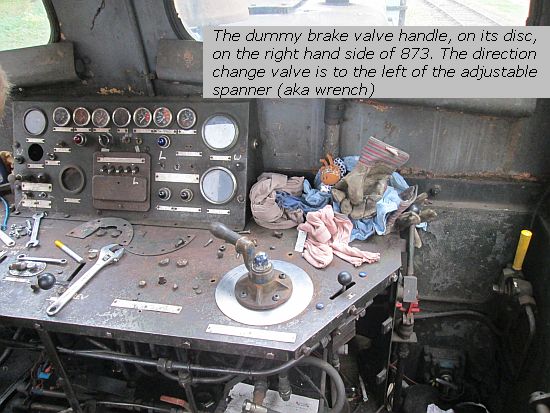
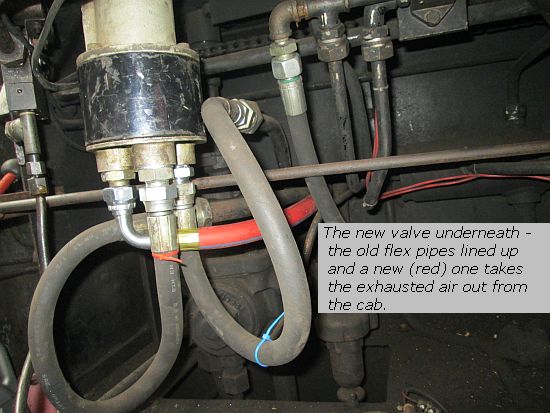
Saturday and I met Matt up at Rowsley armed with a SA-one-and-a-quarter brake valve mounted in a disc of 2mm plate, and a dummy handle also in a disc. First task was to identify the two flex pipes going into and out of the Type W brake valve with a couple of coloured cable ties, then the valve itself was recovered. Thanks to the flex pipes, the new brake valve was able to find a space (had they been steel ones I'd have had to make new flexes going back through the bulkhead to wherever the steel pipes were next jointed) and the new valve was positioned, back-marked and its mounting disc drilled to suit the holes in the desk.
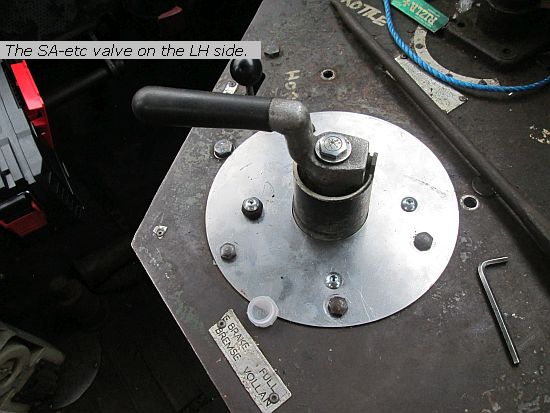
The valve was duly mounted and connected, and a new flex pipe made up (red) to take the exhausted air out into the engine bay. So far so good, and as we had all the neccessary tools out, we fitted the dummy handle on the other side. At this point I presented a cross linkage up and whilst it was 3 or 4 inches too short, it showed that it could pass from one side to the other, thanks to those pesky limit switches being out of the way. Testing however showed up some leaks at the gearchange valve, so I gave Matt the opportunity to curse the presence of those steel pipes as he had to undo a couple in order to tighten up the ones that were leaking. We packed away, took the cross shaft and the neccessary dimensions to alter it, and returned to Darley Dale and lunch.
In the end we made up a longer cross linkage using the ends (modified) with a longer length of 1/2 inch bore pipe welded between, and returned to Rowsley. 873 wasn't where we'd left it. Someone had wanted to use it and rung Andrew (on the excuse that he didn't have my number) who had given the OK, and it was shunting Waleswod and Cathryn to provide some shed space for an afternoon's restoration work. (This wasn't as serious a matter as it might sound, we had left the loco in running condition and we hadn't applied any 'Not to be Used' or similar signage. It rather demonstrated how popular the loco is compared to what else was available and why Mark had been pressing for its return to use. I was actually surprised it was still unused at Saturday morning.) We took posession after a few minutes and fitted up the cross linkage. It requires a little fettling - one end swings just outside the desk edge and a little more clearance under the gearchange valve would be advantageous - but at least you can drive from either side and operate the brakes
For my next trick, I will produce direction detection and put lights into the desk so you know which way the gearbox is going to take you.
Back at Darley we spent what was left of the afternoon on the miniloks, refitting the cover plate on the small one and manually assisting the guide wheel on the big one, but this, while it now gave the forwards and backwards LEDs lighting up on the direction panel, didn't give us any traction. This is disconcerting as (a) we drove it into its present position and (b) we can't get the forklift past it where it is. The troublesome guide wheel, incidentally, now goes up and down quite happily but maybe needs a bit of grease into strategic places lest it sticks again. Matt pointed out that the sight gauge has had an additional red level line added higher than the min on the sight gauge and our oil level was below it - might the red indicate someone had had a similar problem before and diagnosed the issue? Knowing the thoroughness of my old friends in Germany and the number of miniloks that preceded this one, I doubted it, but agreed I'd top it up next day.
Sunday. Tony S was due to carry out more work on his railcar but I got down with a quuanity of burnables in the van and set about starting a bonfire. Having no foreseeable use for the gas lighter now that the hob was changed, I brought this with me and found that, when it comes to starting bonfires, an old (and ideally greasy) rubber glove and a gas lighter are quite effective. By the time Tony arrived I had flames two or three feet high, certainly well out the oil drum we use as a brazier, and we spent some time feeding it until the essentials had vanished and a collection of lesser twigs added thereafter had tidied the area somewhat. Tony then went to work on the railcar while I started hunting out parts required for a service job tomorrow with not as much success as I'd hoped. Seems I must think about replenishing a stock of float switches which I thought I had but are nowhere to be found. Andrew arrived late afternoon, with faithful hound, expecting to fill the back of my van with the forklift (by use of - the forklift itself won't fit), but although I had raised the oil level above the red lines on the tank side the big minilok made no attempt to move. The german inscriptions on the control electronic display will probably reveal the answer but my german is a bit rusty, though Andrew did make the obvious suggestion that the emergency stop button loop has failed. The buttons themselves on both miniloks are completely seized and I was anticipating replacing them from stocks I hold. The german for emergency stop loop is 'Not aus' which always makes me think of cricket. But it was too late to go into it further today and we all packed up and went our seperate ways.
Like last Sunday, I don't know what's on this week aside from a couple of domestic issues, so once again you'll have to return and find out. See ya then.