
Of misguided electrons
1st December 2024
More electronic frustrations.
Sometimes there seems no point in planning a week as events just don't pan out like you'd want them to. There had been thoughts of spending time down at the shed on Monday and I did, though it wasn't very productive. It was nice though to see 873 coming by on the p/way train and to see if, on the return run, the driver was aware that there are now two working brake handles(!).
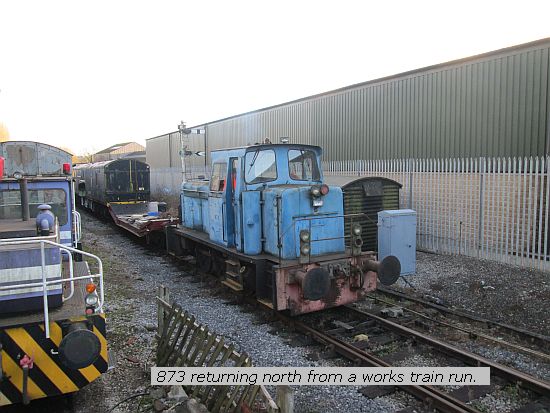
Jordan was spending some days there as a holiday so I spent a while with him and opened and locked up the next couple of days. Tuesday Andrew wanted me to go up to Euroauctions to view a lot of jacks. That's what they were described as, as indeed they were, but they were not your average Hydralite but rather the type of double-acting jack that is part of a re-railing kit. How these 5 came to be orphaned (i.e, for sale without a control panel or power unit) we may never know. But there they were and, Andrew hoped, ordinary buyers might be put off by their lack of integral pump and reservoir - that in other words, there wasn't a handle and nowhere to put it. Tuesday was the final viewing day before the auction commenced and the car park was full to the brim. I didn't notice many foreign numberplates but there were plenty of East European (I think) being spoken and machines being fired up, booms extended and buckets rotated. It is a large site and I saw a lot of plant as I walked round, too proud to ask directions, or perhaps, unable to get the attention of staff membrs as they whizzed by on forklifts.
So why did these jacks need inspection? Well to see if they looked as good as they did in the photos, and secondly to determine what rating jack head they were - and the answer to that was the big ol' so-and-so's - 120tons each on initial ram and 60 on the secondary ram. So in theory we could lift the likes of Charlie on one single jack - if you could find one single point to do it from. Anyway, while there the secondary plan was to take a look at a genset with a 6-cylinder Rolls engine. That was found but was a bit of a disappointment - the pictures on line had inferred it was a C6N but in reality it was a SF65CN and moreover someone had removed the lifting eyes from each end of the block (fairly recently as the exposed bolt shank wasn't rusted) meaning that the cylinder heads weren't tightened down at the outer ends. Given also an exhaust pipe stuck straight up with no cover after our recent snows and it did begin to look a bit of a risky buy. Still the genset was incomplete so it might not attract interest and even a running SF65, especially if it was actually a C6 block, might serve to get the Yorkshire James back into operation.
Andrew has decided that the C6S engine in James is overpowered (and anyway it's defective).. Yorkshire used the 233bhp gross rating (giving, they declared, 220 bhp nett to traction) on a loco that is only 30 or possibly 32tons whereas the BR Class 02 that was essentially the same design but BR-ified, was only 179 gross on 28tons. With a higher gear ratio (13.2:1 to the BR 02s 11.5:1) Andrew felt the starting t.e. was a bit too high for a short wheelbase 0-4-0 and it would benefit from a reduction in input torque and possibly suit what torque converters he has available better.
Thus 'do not exceed' bids were derived and later filed with the auctioneers on commission as neither Andrew nor I could be sure to be available to bid on line. On the return trip the profilers were on the itinerary and a quantity of parts collected, including some for 3.5 inch gauge loco kits, plus the parts for the parking disc brake assembly being installed on the Baguley railcar.
Wednesday and after opening up for Jordan I headed over to Manchester. I hoped to sort out L173 and leave it in Alstom's capable hands. I got there in good time and after a bit of a hassle fitting the potentiometer back in its enclosure, we opened the shed doors, fired the loco up and I had my fingers crossed that the throttle problem would go away. It didn't. Now I could get about 1400 rpm with the amplifier unit wound right to max and a meter in the control loop revealed it was seeing an 18mA signal out of the 20 maximum it should see. Nothing I could do seemed to make any improvement. We tried a pair of wires straight to the amplifier but again 18 was all I could get. There was nothing sticking in the linkage from actuator to engine, and manually you could rev the engine higher. The actuator wasn't working in quite its most efficient sweep but it was on maximum radius at the actuator and minimum hole on the fuel pump, so to change the linkage position would only loose engine revs, not increase them.
In the end I had to make a tactical withdrawal while I thought of more options. On the way home one serious possibility did occur: the actuator is an electro-magnet, moving by repelling itself from a like pole. As such it is a coil of wire like a traction motor armature, and it has been on that loco 20 years and not used that much until the last few months. Is the coil insulation breaking down and so not creating the required force? A resistance test might tell me, but what readings should I be looking for? Amid all of this I had the minilok to think about with the dual issues of what about its throttle and why won't it move? In addition, when I turned the key it was refusing to crank and giving me the impression that the keyswitch might be a dud. Andrew suggested temporarily borrowing the keyswitch from the little DH60 so that I could get the defective one out and a replacement organised . Equally he was pressuring me to get the minilok moving again as sat where it is we cannot get the forklift round to load things into my van, nor shift that lathe in to the space that Jordan had cleared for it in the workshops. He was also stressing that he wanted the Davis loco finished and out before Christmas, so that Cheedale can come home.
I had Covid and flu jabs booked for Thursday lunchtime so in the end spent the day at the Briddon Country Pile scouring for answers to these problems. The manufacturer of the amplifier units can no longer be traced - he has either sold up, retired or simply disappeared. He also made the ramp generator on the minilok. One of the suppliers I approached, who specialise in interfacing modules, when I explained what I wanted suggested that I needed a 'mini-PLC' to do something like that. Then one of my internet searches threw up a hit on an overseas electronics firm who had a module that did just what I was looking for. In fact it was configuerable to do more than I wanted and at a price I couldn't have matched commissioning something of our own. As I searched their product range, they also had a DC 'motor controller' that it seems has the output power and facility to drive the actuator, and could be driven by the interface unit from them. This might just be the answer, and an order has been placed. Hopefully I'll not need Santa's assistance to get it here.
Friday - oh yes, Andrew got the jacks (which went for less than his bid ceiling) but not the Rolls; which exceeded it. By Saturday I was trying to get the maintenance manual for the Alstom loco completed, which involved taking the old YEC wiring diagrams and updating them to what I had changed and writing many pages of text to explain how each bit did what it did, where to check whether it was, together with all the wire numbers, PLC locations, etc etc so that, were I not here, they can identify and rectify whatever problem they encounter in the future. (Yes, the PLC should tell them the fault but human nature is not to believe the 'black box' until they have confirmed it for themselves.) The tome is not as long as War and Peace, for that matter not as long as 'The Railway to Merhead' (still available and a great birthday or Christmas present) but still takes a chunk of time to put together. And all this with two sore arms from having needles pushed into them on Thursday.
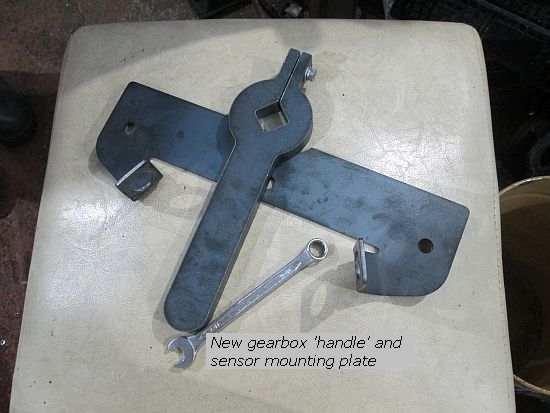
Sunday. Tony S was coming over and at last I had pieces for him for his disc parking brake on the railcar. The caliper bracket though was awaiting welding by Andrew and the disc, though I had measured carefully twice, didn't seem to fit on the flange. Two of the profiles that I had collected earlier are for the Barclay 0-6-0 873 to start putting direction indication by reference to the gearbox rather than the (now non-functional) direction control lever. The gearchange shaft, where it emerges from the gearbox top has a square so the thick profile is a handle to clamp to it and form a juicy target for the sensors. The latter will mount in a thinner bracket (underneath in the picture) that bolts to the top of the gearbox and if my dimensions are all reasonably near, I can set the sensors to read the handle when it comes within their 5mm range but not actually hit them. Here are the parts after I bent the tabs up to hold the sensors and drilled and tapped a clamp screw for the handle. I'll trial fit them, and if all is OK give them some paint before going on to fit permanently and wire them up.
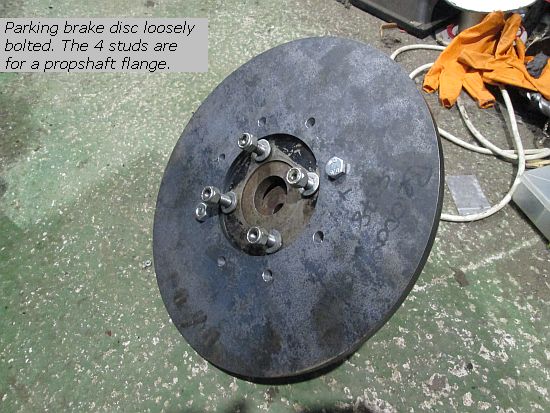
When Tony arrived I presented him with his embryo brake disc and sure enough he spotted a blemish where the laser had entered through to cut the inner hole and once filed, the disc dropped over the hub and he set too to drill the holes for bolting it up. Here it is later in the day.
I went over to the DH60 and raided its keyswitch, before returning to the big minilok and installing it in its place, but to my chagrin it made no difference. Most of the control system logic on minilok is contained within a box called DIGAN, and as Arnold originally conceived it, it was to have half-a-dozen control cards (PCBs) that would carry out all the functions of the minilok systen, with 5 or 6 relays underneath to switch those functions with current loads beyond that which the cards could cope with. (True story: back at Hills our Electrical Design Engineer took to PCBs and produced one which controlled the clutch and gearbox, much as I did later. But he failed to consider what might happen with a fault, and when one did occur, the PCB burnt out before the 'protective fuse' blew.)
Sadly Arnold's concept failed to allow capacity for changes made in the light of experience and although still essential in the function of most miniloks, a seperate relay box with another 20 plus relays became the norm. I had been monitoring DIGAN with regard to the emergency stop loop and had earlier disproved that the problem lay there, but my german is so rusty that the abbreviated terms (by red or green LEDS) don't mean as much as they once did. Today I was watching DIGAN and suddenly noticed that when another red LED was lit, the starter didn't respond, but if I kept turning the keyswitch off and on, eventually the red LED didn't come on and the engine would fire up. At this point Andrew arrived and with this observation, spotted that the lights labelled 'zuruck' (reverse) were coming on and when they did so, the red LED prevented my starting it. If they stayed off, the RED light also stayed off and the engine fired. This may suggest a fault at the direction switch or maybe a fault in a DIGAN control card, but didn't get us nearer to moving as once started, the zuruck or 'vor' (forwards) lights weren't coming on.
One of the features of Arnold's concept that was useful though is that there is an emergency plug that substitutes for the DIGAN box and makes everything work (regardless!). When we delivered the DH90 for Sellafield, this plug was entrusted to me and I thought it ought to work on this minilok too, but I don't know if I still have it. That I had it in the first place was because at some point or other, the decision was taken that it should not be mounted to the minilok itself so that the BNFL operators could not be tempted to misuse it. As some of these memories came back it suddenly registered that the plug mounted underneath the DIGAN, which I had looked at several times before WAS the emergency plug in its usual (non-BNFL) position. The DIGAN cable was stiff and wouldn't twist, so we unbolted the plug and put it on in mid air. The minilok started, and when we selected direction, moved. For now, it still needs a proper throttle control and we won't be moving it straight away but later this week it will move aside for the lathe to get in. Andrew has now decreed that I can shortly enjoy setting up a PLC to replace DIGAN - much as Holger did later with new miniloks. Lets hope I can find sufficient information to identify all the wires...
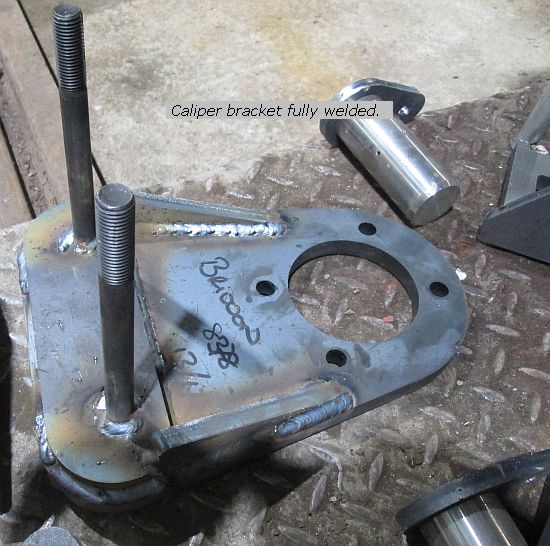
The shed reverberated to the sound of welding in progress, as various brackets and pins were joined. The caliper bracket was tacked and Tony and I checked it in place and that it didn't foul anything, before passing it back for Andrew to weld thoroughly. All it needs now is a caliper assembly.
So what's in store this week? Maybe a return to Manchester, certainly a trip up to Euroauctions and a couple of lumps arriving from Chasewater. Come back next week to find out what they are. See ya then.