
Of batteries and battles
7th July 2024
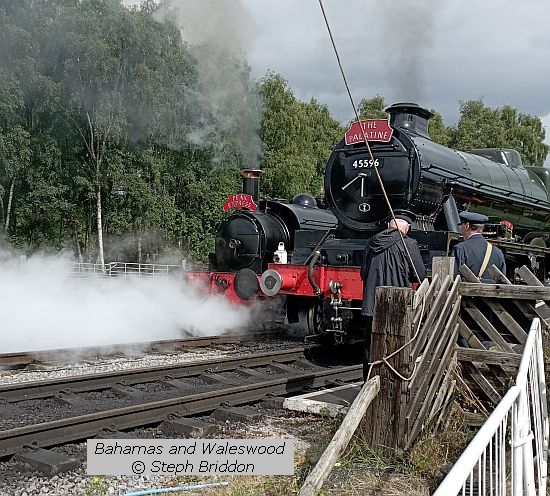
The last time I saw a tender engine regularly going up and down Peak Rail (as opposed to a quick foray in at the head of a special) was when the 8F group did a few turns before they fell out with a certain PR MD and took the loco away. It is not as though PR needs big express locos - barely 4 miles with an overall 25mph speed limit is more suited to tanks or maybe 2MTs at most - but their grace and size do capture the public's attention. I'm starting off in this manner because Bahamas arrived at Rowsley in the early hours of one morning this week. Bahamas started its preserved life as a resident of Dinting and of course RS8 was based there too. I have no doubt that RS8 dragged Bahamas outside for steaming a few times and a 'proper' reunion might be on the cards.
It would be nice, I thought, if RS8 was sat awaiting at the top of Darley Dale Yard when Bahamas came up from Matlock, ready to serenade it by, but given that it was taking place at about 4 in the morning and I needed my sleep, as would the occupants of the new estate that is being completed next to us at Darley, I relegated that idea to the 'nice but not going to happen' pile.
Over in Uttoxeter T2 has been receiving TLC and whilst it may continue to look a trifle scruffy from the outsde, a cursory glance underneath will show where all the parts and labour have been expended. It needs to come back to us for rails, ramp materials, shackling down chains and of course those other essentials, the winch and its power pack. At the beginning of the week I concentrated on the various profiles required so that the locomotive can come up the ramp rails, and change from them to the rails that will live on the deck.The neck on T2 is much much bigger than T1 and in consequence, whereas on T1 these pieces are welded permanently in place, they cannot on T2 as the neck is greater than 1500 in width, so the fabricated rail and bracketry that anchors the ramp to the deck must itself be un-boltable and slide to one side for travel. On Adam's 4 axle, the rails merely sat on the deck and it was not unusual for a loco to get to the end of the ramp and instead of climbing up, push the ramp, and thus the deck rails, ahead of it. It tended to happen with a loco whose axles aren't mechanically coupled, e.g, an 0-6-0 with its side rods off.
Anyway, with winch base, and numerous odd shapes that will make brackets and ledges, the order was placed but the profilers are presently hoping to finish them on Monday. The two new air valves for controlling the locking pins on T2 arrived during the week - they are cheap Chinese things but it's not as if we'll be using them umpteen times a day. Advertised as having 1/4 BSP ports, they came with 1/4BSP push-in pipe connections (which I abhorr) and 1/4 BSP silencers for the exhaust ports. Not much good through, when the main ports are indeed 1/4 BSP but the exhaust ports (2 per valve) are only 1/8. Still, I now have four 1/4BSP silencers that'll come in handy one day.
We were due to move a loco on Thursday - the DAF had been having a new compressor which was expected to take up Monday and Tuesday keeping Wednesday for eventualities. There were some but it was ready Wednesday night and I set off from the Country Pile first thing Thursday only to get a call before I was 200 yards up the road. The DAF was back at the repairers: it had travelled about the same distance when all the warning lights came on and it went into limp mode. They diagnosed a new widget was required that they did not stock (because of the price!) and would have to be ordered. By Friday afternoon it was resolved and we're squeezing the Thursday job in to this coming week instead.
Andrew was only able to be across briefy this weekend, sufficient that we moved the crane and scrap skip to one side, and lifted off the winch and a power pack from the Hatramm, oh and a spare wheel for T2, although this requires a puncture repair. Steph meanwhile has spent the entire weekend at Rowsley, operating a stall for the 1940s event She was on hand to grab my header photo of Bahamas and Waleswood side by side and witness the battle, which could be heard from Darley Dale!
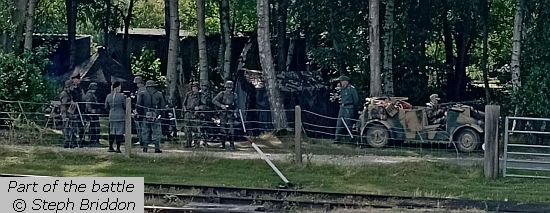
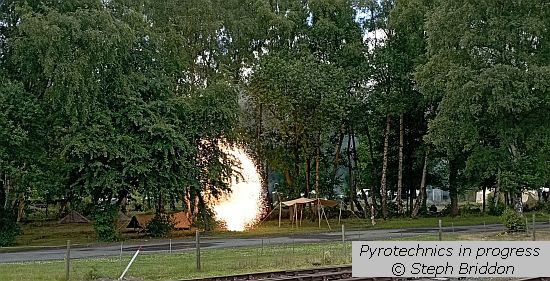
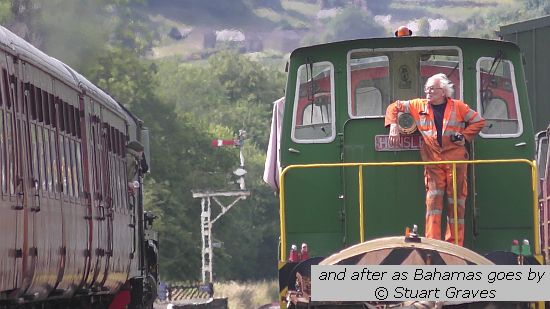
For me, the rest of Saturday was occupied with getting the bracket for the second pump assembly painted, and charging batteries, that from the power pack we'd lifted off the Hatramm needing a boost after being stood for 5 months. I did though fire RS8 up and took it down to the yard neck to capture a shot with Bahamas coming by (although to be honest the light was on the wrong side for Bahamas to look its best).
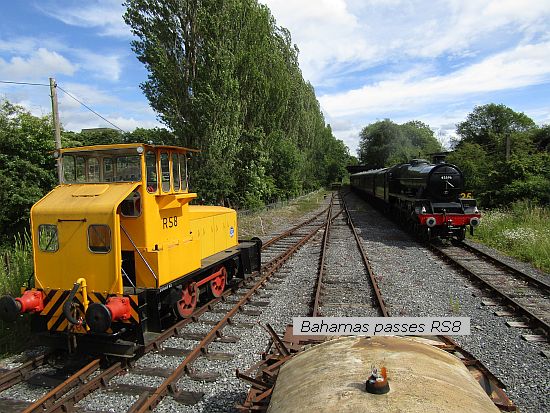
Stuart Graves was hiding behind a couple of bogies (just visible above) for his forthcoming video of Bahamas and proceeded to photo me in my vantage point.
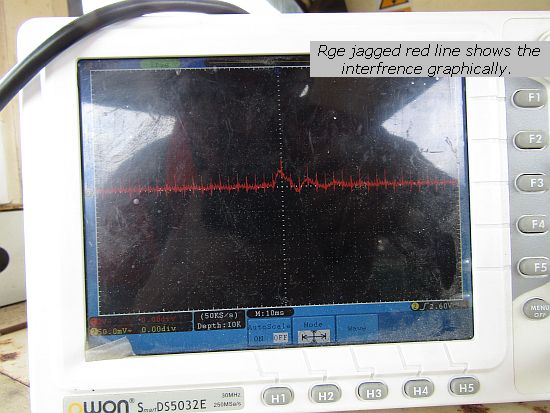
The rest of my time was occupied on Alstom's loco and an oscilloscope. I have had this electronic wizardry for almost a decade but only need it occasionally and as a result, had to find a manual to remember what the hec to do to make it work. I can now see all sorts of patterns on both the power supply in to the speedo module and on the sensor cable itself, despite re-routing it temporarily and cabling in twisted pairs. Indeed, I can even see electrical activity on the wiring when the sensor itself is disconnected from the power supply. What I can make of these patterns is another matter.
The last time we used the particular power pack that Andrew had nominated for T2, there had been some 'electrical activity' visible on one of the starter motor terminals so having left its battery on charge in the shed overnight, I began Sunday by putting RS8's batteries on charge (it had been touch and go whether the loco would start when it came to bring it back down to the safety of the sidings Saturday night) and intended to do a bit of TLC to the cabling on the power pack, which was still largely as I had picked it up from a guy just outside Bristol.
But I just got back in the shed as the heavens opened so while the rain fell I concentrated on assembling the pump bracket to the overhauled motor and pump, and locating the neccessary fittings so that it can, if required be installed to T1 in 30 minutes or so. The rain eased and after taking RS8 back to the end of the yard again, I stripped the cabling to both terminals of the starter- not very impressed at the use of steel shakeproof washers in these applications - cleaned up the terminal lugs, added copper washers and vaseline and put them back together. The plan was to refit the charged battery, plug the delivery and return lines to the winch control valve, and start the thing up to check it over. (You can't run the engine without something connected as there is nowhere for the oil to go.) At this point I realised there was a snag. This power pack was a 3 cylinder Lister and had been utilised with a Highfield Gears winch on the Doll trailer. The pump on the LIster was larger than any other we have and in consequence the lines were 3/4 bore delivery and 1 inch bore return.
But the winch was arranged for 1/2 delivery and 3/4 return, so the quick release couplings wouldn't fit. Moreover, I have 'extension hoses' in my van for those occasions when we cannot get the tractor unit near enough to the winch for the normal hoses to reach. That issue never arose with the Doll as the power unit and winch were on the neck together. The use of quick release couplers was purely a convenience should the need arise to take them off (as indeed we did).
I texted Andrew, who agreed that for now we would revert to the 2-cylinder Lister that had formerly been driving that winch and so had the correct hose bores. So off came the battery for this one, but when we had recovered it from Adam's I had had to snip 3 control wires (because somebody had re-mounted the engine and in doing so, damaged the connector box and crimped 3 of the 4 wires inside together). I had carefully snipped them so that I could easily identify which was which but I had also removed the throttle cable which I had subsequently spent a while refurbishing. The conector box had two large (broken) holes where it had been bolted to the flywheel housing (but was no longer). I figured this wasn't that serious if I could mount it with a cover so set about making a thin joggled plate with holes to bolt to the flywheel housing as before but two new holes in the box which would then secure it and cover the damaged area. This was cut, drilled, quickly painted and bolted on, after which I drilled the connector box by eye and managed to get the pilot hole near enough perfectly central that the new securing bolts lined up. Hopefully this plate will give the box some resilience if it gets hit by something again.
By then it was late afternoon and Tony S, who had been keeping me company by cursing fuel pipework on his railcar which continues to leak air in, started to pack up. To be fair, Tony had had the engine running several times as he progressively restores bits of the original fuel system between the temporary fuel tank and the fuel pump. As each section is found to work correctly, he can move farther away and eradicate whichever fault then appears and he'll soon be able to run from the original fuel tank.
I have got two and a half weeks of significant work ahead of me and a fair few miles to drive. Hopefully I'll remember to use a camera. So come back next week for more thrilling adventures. See ya then.