
Of something of a relief
7th January 2024
A happy New Year - to those of you abroad, from a rather wet UK. We don't have the flooding here that others are suffering (though the Derwent closed Four Lanes again this week) but now they're warning of snow...
This ought to be a short edition as I need to be up early in the morning. New Years Day was, unsurprisingly, spent in part down at the shed in company with Tony S working on his railcar, but a certain amount of bitting and batting together with popping up to Rowsley and doing some work on the trailer. With paperwork and other issues to contend with, it was Wednesday before I returned to the shed, and then primarily because Matt was bringing in a radiator for repair and I needed to get the forklift out.
As there was still a good hour of daylight we headed up to Rowsley, for there was a new rope to wind on to the winch and it was a two man job. After connecting up the extension hoses so that the power pack (on the neck) could reach the winch (at the back) I slid the end of the rope into the drum, secured it, and put a hook on the thimble at the other end. You have to wind the rope on with a certain amount of load - not a great deal, but enough so that it winds in tight and uniformly, without birdcaging and getting itself knotted. This was the mistake I made last year and cost me a rope - the second time I did it with Phil and he hitched my van to the end of the tow and left the handbrake on: so the winch solemnly pulled the van towards the trailer with Phil periodically correcting the steering. The defective rollers caused the loss of that rope, so I was anxious that rope number 3 should benefit from the lessons learned.
In the end I couldn't find the towing hook for my van, and as daylight was limited we used Matt's, whose Ford has a permanent rear hook. With everything set up I pulled the lever on the new valve and the rope started to creep in. The operative word is 'creep': it was so slow that you could barely see it move and it would take an hour to wind in the 50 metres or so. After a couple of turns on the drum I put it into reverse and to my consternation it didn't move at all. I pulled the mechanical disconnect and the drum promptly unwound.
My mind ran down the options: I had had to change the control valve because the previous one sprung a serious leak when we were loading in London - a small crack having appeared. I had planned to change it immediately but the replacement - one of two Andrew had to hand - was 3/8 ported rather than 1/2 and it was several attempts before I got the right hydraulic adaptors to suit. So on the one hand I had the extension hoses - which I know add a load to the system and so causes the winch to run a bit slower - and on the other a reduction in the porting on the valve. I mulled over from where I could get a replacement 1/2 inch ported control valve and would I have the time to fit it? For that matter, could I fit it before the next job or could I cope with the winch running this slow until I had time to do so? Actually, if the winch wouldn't unwind with a modest tension on, would it do so with a loco on the end or would we need to start barriering off? As I fretted over these problems, another solution struck me. There is a relief valve built into the control valve. We never had to adjust one on the other two winch installations, they came with a relief valve set high enough to do what we needed. What if this one wasn't? I grabbed a small adjustable out of my van, wound down the valve a couple of turns and pulled the control handle. Instantly there was a whirring noise from the motor and the rope started winding in at normal speed. I probably need to put a test gauge on the system and see what we're running at, but for now, as the twilight came on, Matt's van advanced towards the trailer at an acceptable pace and the rope wound itself on reasonably neatly. It was a relief - the relief - that it all worked.
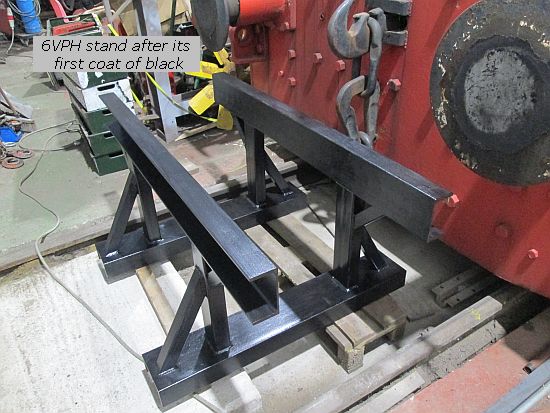
The next day Adam picked up T1 for its 6 weekly inspection and brake test and all was well. Friday was a dash around day. Off to Chesterfield to visit a bus garage, then Rotherham and Sheffield and back. Saturday saw the shed a proverbial hive of activity. For not only were Andrew and I there, but Jagger and Haden, and Andy H. Jagger and Haden were concentrating on painting the engine stand Andrew has welded up to carry Jagger's spare 6VPH. Jagger had primed it all during Friday.
Andy H cleaned down the radiator and brought out an incredible amount of dirt from around the tube fins: the loco was I think an ex-NCB one, but had also had a spell working in a potash environment. The dirt could well have been coal dust, but the flakes of rust were the work of the potash. We had locos working in such environments when I was at RMS Locotec. I commented rather ruefully that if you send a loco to work near potash, you only get half of it back. RMS had done things like put all pneumatic valves and electrics in stainless steel enclosures - that didn't stop the potash, just took longer. Spring pillars seized on their guides, brake rigging pivots ceased to pivot. Unpainted surfaces shed layers of rust like snakes shed their skins.This radiator has come in to me because 'it leaks' (said the customer) - this mght have something to do with the hole, two inches long and one wide, that was revealed in the header tank once the loco casing tops came off. After Andy had finished washing it all down, I saw a bit next to the hole which was obviously wasted away but still 'solid'. I tried a chipping hammer on it and produced a second hole without much effort. It is due to be plated up and then I'll have to pressure test it. After welding up two new tie bars for ramps, Andrew and I got more time in on on DL34. You've seen the base for the compressor, now see the compressor in situ.
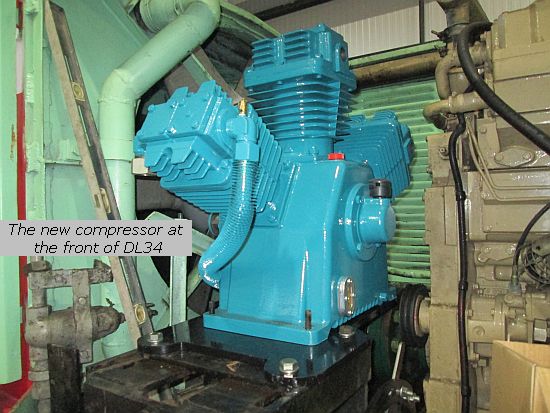
The drawing I have for this compressor was one I did on CAD some twenty years ago and was not meant to be perfect, rather give an 'envelope' for installation purposes. Normally I don't squeeze it in to such a confined space and this has revealed some of the shortcomings of my original drawing. Nonetheless it fits (just) and today I've been able to measure up the alignment to get the machining drawing sorted for the compressor pulley. At the other end of the engine bay the exhauster is in place - you saw it on the floor last week but it is now in situ (for the moment). I hasten to say this is not complete - the motor is one I have in stock being the best bit of the cheap and cheerful winch that first adorned T1, but being a standard motor type it fits the location of the intended one.
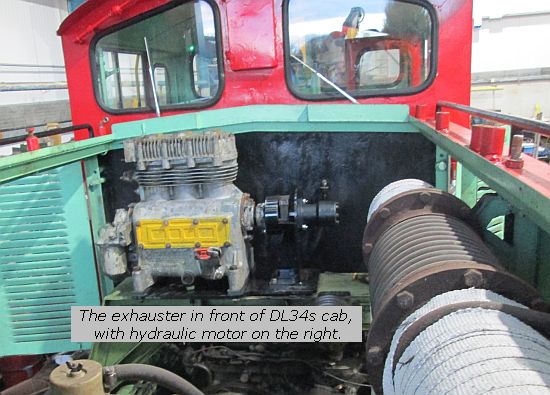
In fact I ordered the correct one earlier in the week, taking advantage of the supplier's 'extra new year discount'. The motor was said by the website to be 'ex stock' though for that I had to accept a drive shaft which wasn't my preferred style. So having placed the order I sent them an email asking could they confirm the keyway, as the order merely specified a 1:10 taper shaft and there were two versions. The reply I got told me that this motor was on a 10-12 week lead time. But it was ex stock per your web-ordering system, I pointed out and they said that they were getting their IT people to look into that. Anyway, we corresponded on this for 3 days, during which I learned that my stock motor (the one in the picture) is 125cc per revolution (useful info, but no good when I only need 40cc so it would slow the exhauster down by two-thirds). Eventually, they miraculously found me a suitable 40cc motor which will arrive this week, and told me what the drive shaft is and on Friday afternoon I was able to talk to another supplier about the torsional coupling whose boss must fit on the motor. And their quote is approximately 2 weeks.
Ah well. Andrew can carry on getting the pipework up to it for me in the meantime. I spent a noisy time on Alstom's loco. Noisy because a 'fault' had set off the bleeper alarm in the cab and no amount of button pressing would silence it. Eventually I found the alarm was triggered by a program line that was written with the air cleaner clogging sensor 'wrong way up' but that didn't stop the bleeper which continued to blast my ears. Further investigation found an input called RESET would cancel it, but this loco doesn't have a RESET button and the input number the PLC looks for doesn't exist. Actually it has become apparent that the program from which I adapted the one for this loco by removing unwanted subroutines and instructing it to delete 'unused variables' has somehow continued to believe in inputs and outputs which are not on this loco and couldn't be on the configuration declared in the program. The loco now has a RESET button but the input it is wired to the PLC knows as something else so I've got a bit of manual deleting to do.
And all this with barely a month to the talk I am preparing for in Derby (early Feb) for which I am scanning slides and old negs to put together the story before I went over to digital photography.
And I need to finish all this and have a few run-throughs to check timing.
And of course this is the moment when I find myself with three solid weeks of transport work to get through.
And yes, the previous 3 sentences all began with 'and', but I'm trying to make a point. A good point or a bad point I don't know, but it certainly feels a sharp one. Come back next week for a progress report. See ya then.