
Of diesel bugs and screenwashers
21st January 2024
Another week of running around.
I said last week was a 1500 mile one and it has been the same this, though a little fewer. We should have moved five locos - one per day - but in the end only got through four: but employing my old rule of 50% it was still a good week.
Monday started with me up early and on the road north to Wolsingham. With my trailer having blown a pressure switch, we had swapped to Adam's 4 axle trailer for the week and Phil had transferred the ramp rails, tie bars and fixings over the weekend. I arrived at Wolsingham a few minutes after Phil, who had just lined the trailer up with the track and was disconnecting the neck. A 'rule' of road goods vehicles is that decks must be sheeted down in order to prevent loose items flying off into other vehicles. From our point of view his is tiresome - nothing 'loose' on the deck is light enough to fly off except, possibly, in a collision but all bets are off then anyway. But of late the police have been actively booking operators for not sheeting the decks so first task is to roll back a long green sheet so that we can get at the wooden packings, etc. In this case, behind the wooden packings is an area of the deck where the chains and binders are stowed. We rolled the sheet away to reveal - an area of deck with no chains or binders anywhere to be seen: in other words, we could load but we couldn't secure.
This I have to admit was a bit of a setback. But to make the best of it we loaded the loco (an 08), I dug out a pair of chains and a binder from the van (no self-respecting person should be without one) and with this minimum of securings (the winch on its brake at the rear and a single chain at the front) Phil took the low loader very slowly out on to the entrance road and parked up. It was now up to me to drive Phil all the way to Heanor's depot at Ilkeston, pick up the chains and binders from my trailer and bring him all the way back again. It did solve one problem - getting the stand-in pressure switch down to where T1 was so that HFS could fit it in place of the temporary tap and top up the hydraulic oil a bit. We reached Ilkeston a little after 3pm and within 30 minutes were heading back north again, reaching Wolsingham about 7pm. Here we dropped off the chains and I left Phil to secure the loco and make an early start, while I returned to Darley Dale. I must therefore concede that while the week has racked up 1500 miles, 600 of them were on Monday.
Tuesday therefore was a slow start as I only had a short distance to travel to where we were to unload and meeting Phil there was straightforward. Unloading was on to a plain track sat on a concrete floor, and when it had rolled as far as gravity would facilitate, it should have been a straightforward matter of starting it up and moving it under its own power - except the cold had got to the batteries and we had to wait while they were given a boost. Once the unloading was complete, I headed home and Phil returned to Wolsingham.
Wednesday, and the temperature had dropped further. I set off just after 6am and reached Wolsingham about 9.15, but a hitch during loading delayed our departure until 12.15 and we arrived to unload at about 4.25. The first loco drew the second away and I returned home, Phil to Wolsingham.
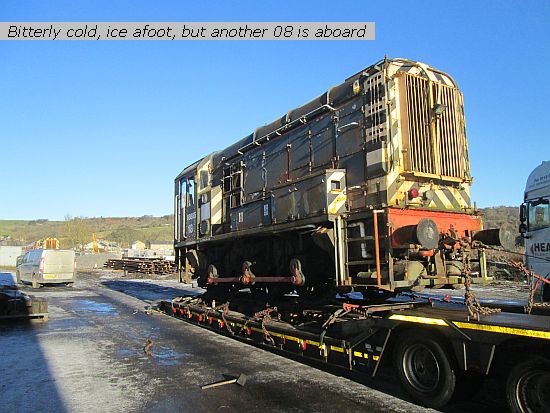
Thursday - the gauge in the van said minus10 deg C as I set off north. The screenwash on the van froze up. Nonetheles the loco was on and we were away by 11.30 and starting to unlooad again at 15.40. This was the third loco on to the same panel of track and that was now full - the next would go on to another panel all on its own, but only the first one of the five is runnable...
Friday - this is beginning to feel like a commute. Hit the road at 06.08 after scraping the windscreen and arrived at Wolsingham at 09.10. The screenwash still won't work but there's no sound from the pump motor. Is it a fuse or have I burnt it out? The loco is on and we're away by 11.00 and Phil has an amazing journey for a Friday, arriving at 15.00. I had formulated a plan for the unload. After the temporary track went down to the customer's panel, I laid out a long sling into the 4ft and as the loco rolled as far as gravity was prepared to co-operate, we took the winch hook off the loco, attached it to one end of the sling and with assistance from the customer, pulled the winch rope through under the loco, around a snatch block attached to the rear of a forklift and back to the front of the loco. For added resistance we had a 'cube' full of coolant on the forklift forks and all 4 wheels had heavy rubber chocks. If I say so myself it looked an efficient plan and it almost worked. My only error was that I had the forklift 3 or 4 feet too close, so as we winched in, and the loco moved away from the trailer, we had to stop when the hook and its attendant loop and swaged end reached the snatch block. It should have been a simple matter to play out a bit of rope, move the forklift forwards and complete the last 3 or 4 feet but the loco was having nothing of it and the forklift was dragged backwards, the rubber chocks crawling like caterpilars over the concrete. Plan B was implemented, another forklift borrowed and the loco pushed and pulled the last few feet into position.
And so to Saturday. I had to be down by 09.00 as I had a visitor due from the W&L to inspect progress. In truth it was not as far on as I had wanted to be and being out most of the day each day on transport isn't helping, but he seemed impressed, took lots of pictures and came back afterwards confirming I can remove a pipe support that is in the way. Even as he was leaving another customer arrived, this time to look over 'his' Fowler 0-6-0DH and some bits he is buying from Andrew. By the time he had left there was a train heading down from Rowsley.
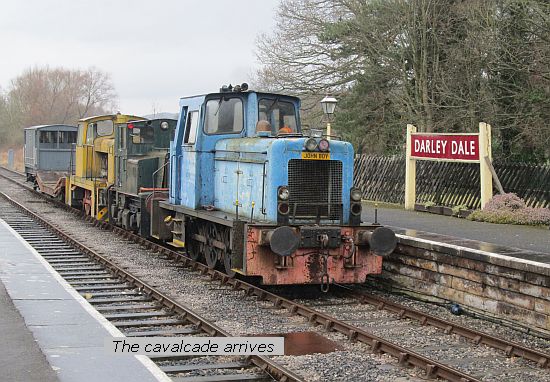
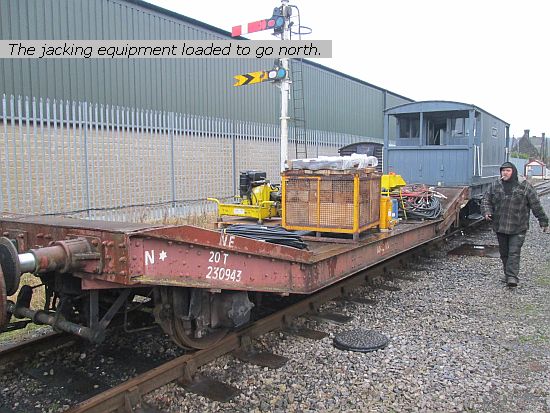
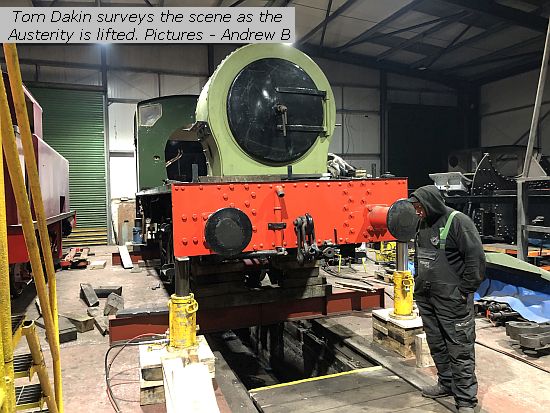
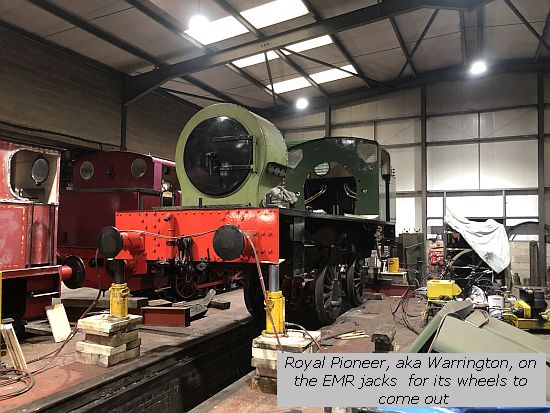
Leading it was Bagnall the Barclay, with Pluto and an EE loco behind, then a lowmac and a brake van. Outside our shed they dropped the wagons and propelled the two locos into the yard. Meanwhile Andrew had fired the forklift up. Occupying a considerable amount of our floor space over the last few weeks has been some re-railing jacks, property of East Midlands Railways, loaned to facilitate the lifting of PR's Austerity 0-6-0ST (currently Royal Pioneer but once Warrington when a resident of Dinting, as was RS8). Andrew had been putting the job off but Tom Dakin was now pressing him, and while we were shunting the locos Andrew had started loading some of the tackle on to the Lowmac.
And then the forklift stopped.
To cut a long story short, we took off a glass bowl filter in the fuel line and found it full of the brown sludge that arises from 'diesel bug'. More specifically it is an algae that lives in diesel fuels if the proportion of condensate present and temperature is right. We've encountered it before and the finger of suspicion is falling on the fuel we've drawn lately off Yorkshire 2895. Whatever, the immediate need was to get the forklift going again and so we borrowed a fuel tank that Tony S had brought down, strapped it to the air cleaner and put a plastic pipe down to the second fuel filter.
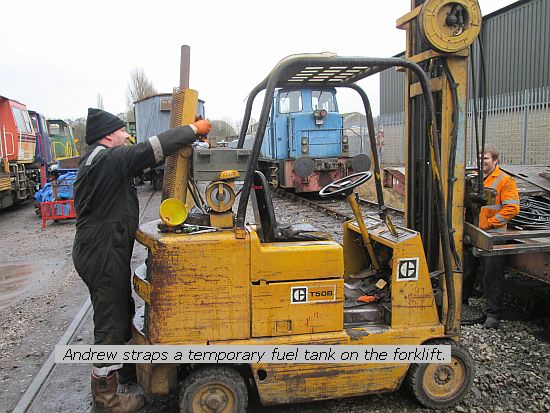
Meanwhile Tom and his train crew had hand-balled some of the lumps on and by the time the forklift was running again only a stillage of packing timbers on the Hatramm still needed to be put aboard. The train left for Rowsley and shortly after, Andrew followed by car.
Sunday and I arrived a few minutes after Andrew to find him and Tom Dakin loading more packing and some oil into Tom's van. Off they went to continue the operation at Rowsley leaving me to oversee Tony S, Jagger and friends. Steph had continued some of the shredding of brushwood (as she had in fact on Saturday) and I swore at my van as the catch holiding the cover over the fusebox refused to open. Eventually with help from Tony I got in and found the fuse controlling the screenwash was blown but I didn't have any spares of this pattern to hand so I still don't know if it was the defect or a protection.
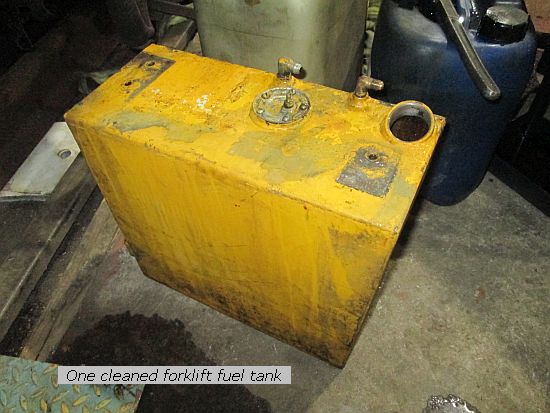
With that out the way I looked at the fuel tank on the forklift with a view to removing it for a good clean inside and out. Two pipes, a sender wire and 3 screws on the top were all I could see, but there turned out to be a fourth screw lower down. But first was the task of emptying it of as much fuel as possible to reduce the weight for handling. Syphoning as an option but was slow and the tank was too low down to be 100%, so in the end I utilised a transfer pump we have, after sorting out an alternative suction line that would fit down the filler pipe. Even then raising the forklift was a slow job, firstly left and right at the front and finally levelling up at the back, before the tank could be swung out underneath.(I suspect that in the build sequence, the tank went in long before the power unit was installed). Outside for a pressure wash, a drain plug appeared out of the muck and made life easier for flushing more of the brown sludge from inside. The tank is still out, drying, but should be OK to refit now.
Up at Rowsley, the Austerity was lifted and the wheels rolled out. These two pictures (from Andrew) show the work in progress with the 4 jacking heads, directed from a central control panel (right of loco) and behind it, the diesel power pack that provides the power.
And that is about it. More locos to move this week, and hopefully by next weekend we can make some of the progress we had intended for this weekend: though I am not entirely confident. You'll just have to come back and find out what's planned and/or what we actually achieve. See ya then.