
Of coarse and fine, unified.
18th February 2024
A shorter edition this week, never mind.
By my standards it has been a quiet week, basically as I had it earmarked for the trailer to get its obligatory '6 weekly' maintenance and inspection and didn't know how long that would take. In the end my new collaborators held on to it so that they could give it a look over, and found a couple of defects I wasn't expecting, and then Heanors asked if I was in a rush for it back as they were a bit busy and in addition to dealing with it they also had to load it with rails, winches, power packs, etc that had been on the two of their trailers to come back home.
The early part of the week enabled me to finish off some drawings and get some materials on order, notably more profiles. Until a few years ago I could reliably place an order on the Monday with the profilers up at Batley, and know that I could pick them up on Friday, even though it was a bit of a trek from Sheffield and even more so from Darley Dale. Transfering to a Sheffield profiler improved the prices but their turnround began to stretch out into weeks. All that is behind them now and it is back to 3 or 4 working days so I was hopeful they'd be available for the weekend. On Monday too a pickup from W H Davis arrived carrying the torque converter and radiator for their Barclay 0-4-0, whose engine was of course already sat in the chassis. These were forklifted off ready for later.
I also had a guy in from Alstom, who has gone off to try his best with the pneumatic valve manifold while I plod on with the outstanding issues on their loco. With an overhauled torque converter to collect, re-pack and despatch to a customer, and the usual incidentals, it may sound like a busy week but really it wasn't.
Andrew identified the capacity of the pump on the Bosch motor and we discussed trialling the set with that on it, but it was around 2/3 of the cc/rev that my figures suggested and I found a firm in Scunthorpe with the correct pump advertised on their website and invested in a new one which arrived mid week. Thursday night an email came in from the profilers to say things were ready and logically I would have been away first thing Friday but I had already agreed to wait for Jagger to arrive and allow him access to the shed. He said he'd be there for about 10 o'clock, but I paced the room and when he hadn't arrived by 11.30 I rang him to ascertain that he was on his way and in the end I set off at 11.50. Now Friday is for many firms 'POETS Day' (which on case you haven't come across the expression is an acronym for 'Pxxx off early, tomorrow's Saturday') and I was worried that I might fall foul. Some of the bits at the profilers were due to go to a firm who specialise in rolling material to radii, but my other two calls were in precisely the opposite direction from the profilers. Added to that my journey up was affected by yet more roadworks - contractors dug up the road outside the Doctors surgery and the resultant traffic queues on the A6 stretched up to half a mile. Anyway, when the forklift put the pallet of profiles into the van, the ones for rolling stuck out, so I unpacked them and put them loose on top, but they made such a clanking as I set off I decided to head to tbe rollers first. I arrived just as the pips announced 1 o'clock and the roller shutters were closing on their Goods In.Luckily I was able to get hold of someone to accept them and the order, and retraced my steps to Sheffield, where I was confident that the other firms didn't stop especially early.
One of the profiles related to the cardboard template you saw last week, so one of the first jobs for Andy H on Saturday morning was to get it fettled up ready for Andrew to weld an additional bit to it and make sure that it all fitted. Meanwhile I took myself down to Matlock and returned with some bolts. The WHD loco engine has a front trunnion mount which needed some UNC bolts 4 inches long, and the rear mount, going from the drawing I have of the same flywheel housing on later engines, needed 5/8 UNC, two each side. These rear ones drive upwards from underneath so the fact that the converter wasn't in the way made getting them in reasonably simple, though try as I might I couldn't get those on the right hand side to go in at all. After lunch the train was pulled back on Track 1 and Andrew brought the crane up into position. The casing structure was lifted off and put to one side, and we prepared to install the converter to the back of the engine. The method we have developed to do this involves using an old drive ring and with the converter sat bell housing up, sliding this over the loose clutch plates and centralising them to within 1mm before pulling the clutch into engagement so as to clamp them both immobile. Then with a bit of grease on the clutch shaft where it must locate into the bearing in the engine flywheel, you present the converter to the back of the engine, get it level and it will slide straight in. Do it with clutch plates loose and you risk life and finger tips trying to get the two toothed plates to mate with the drive ring while at the same time the clutch shaft is penetrating the bearing.
But that assumes you can get the converter into position behind the engine, and it seems Messrs Andrew Barclay did not take that into account when designing their 0-4-0. One of the sales points for Thomas Hill locos, I had it drummed in to me, was that as we operated service fitters on customers locos up and down the UK, we were more familiar than our competitors with the need to design with maintenance in mind, rather than just erection. It was said that you could always remove the sump on a TH loco engine in situ, and if Drawing Office designed a loco where this turned out not to be possible, an irate Service Fitter would make this deficiency apparent. How true this was I don't know, nor how often did we have to inspect the underside of a Rolls engine sans sump, but as I work on 'other loco builders products' I am repeatedly reminded that TH locos are, in general, more easy to work on. After several attempts that almost, but not quite, squeezed it past flywheel housing, cab front and fixed pipework, we admitted defeat and concluded that it only went out or in when attached to the back of the engine.
So I undid the bolts holding the engine again and we lifted that out, reunited it with the converter and put the whole assembly back in the chassis. As the engine lifted off, I looked at the frame mount and it became apparent that the holes on the right hand side are smaller than those on the left. In other words, I need 5/8 UNC on one side but seemingly 9/16 UNC on the other. I also need some new setscrews to hold the converter to the engine - I set about recovering some from a soon-to-be-scrapped loco nearby before remembering that while Cummins use UNC, Rolls - my donor engine - preferred UNF throughout. So the SAE standard flywheel housing has the same PCD and bolt diameter but threaded differently on the two engines. Of course with the converter now in place it is no longer as easy to get underneath to bolt up from the underside: that will require more contortions when the smaller size is ready as well.
Back indoors Andrew welded up the tank base for DL34 and the base for the motor mounting strap I alluded to last week. Andy H finished his day by fitting the tank level gauge and filler cap.
Sunday and with Andrew elsewhere I was expecting Jagger again but started off on my own, painting up the base(s) and cutting timber packers to fit the tank on with, a task made the neater for setting up guides on the bandsaw as I cannot cut a straight line freehanded. There is a customer's radiator sat in the shop awaiting a pressure test. I set this up with blanks and a pressure pump only for the pump not to function. We have two, one I thought worked and one didn't, and this was presumably the duff one, but when I found the other we had used it with diesel last and I rather lost my enthusiasm in that project for the day. But at least it is full with water and not leaking (for now).
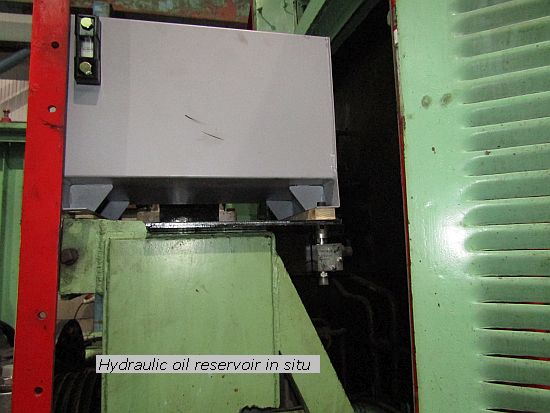
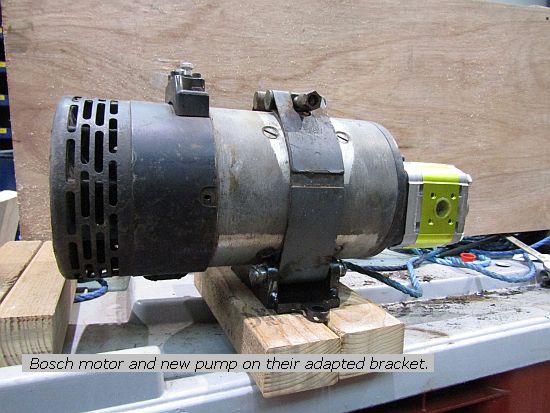
With the paint still a touch tacky I put the reservoir base on to DL34 and followed it with the tank, and one of the control valves which are to mount on a plate behind it. I have yet to drill this to mount the relief valve (because I haven't got it yet) and will probably regret not doing so first when I come to it. The ex RS8 starter motor mounting parts had taken a while to dismantle on Saturday and I found damage to the bolt thread which a die couldn't clear, but the straps themselves are mounted to the new base so here's the completed motor, new pump and mounting arrangement ready for installation on T1, when it returns.
As daylight dwindled I went back out on to that Barclay and with a small pull-lift to save my fingers, hoisted the propshaft up and put a couple of temporary bolts to hold it to the converter output flange. Even that involved reaching down to a propshaft from above the converter as it did not appear that the cab floor came up to allow access from the other side, but I may be being unfair. In better light tomorrow I can measure up to ascertain what sizes I need, but I think it is 7/16 - now shall I employ UNC or UNF?
And with that I'll wrap up this edition. This week commences with another day at the workshop and continues... well, not really that sure actually but I'll be around next week to fill you in. See ya then.