
Of weedkilling and software
9th June 2024
Is it Sunday already? This week seems to have flown by and while most of it is as I forecast last week, I still don't feel I'm much farther on.
On Monday I was off to one of my friendly foundries and returning via the electrical repairers to collect the other two motors. These went in to the workshops but one thought is to put the first motor/pump straight on to Andrew's 4 axle trailer (T2) and build up a second set for mine while relying on the old one it currently has fitted. Tuesday and Wednesday were paperwork days, though included some further reprogramming thoughts on Alstom's software. I took the laptop down to the loco, plugged in the cable so that I can talk to the unit that carries out the Lobat function and read back what it had stored. Consulting the manual I realised that this was a relative value, and relative to about 30V, not only that the manual told me to take a few readings and calculate an 'average' inferring that its trigger might vary depending on minor fluctuations. As it also explained that I need to give it a 'known voltage' so its re-adjustment will have to wait until I can take a power supply down to it.
Thursday, and down to the shed at five to seven in order to open the site for the skip lorry, which normally arrives on the dot of seven o'clock. This time the lorry had been in for service the previous day and wasn't back so I was waiting until quarter to eight for it to arrive. Then it was back home to finish breakfast and I was due at the dentists for 11.00. Out of there Andrew had asked me to 'pop up to Barnsley' and collect some bits from an auctioneers. That done, it was back to Rotherham and pop in to the yard where T1 now lives. At last I got to fit that new cylinder to lift the kingpin, recover the battery from the winch engine to give it a top-up charge before its next job and fit tee pieces into the hydraulic lines ready for that revision of the trailer hydraulics.
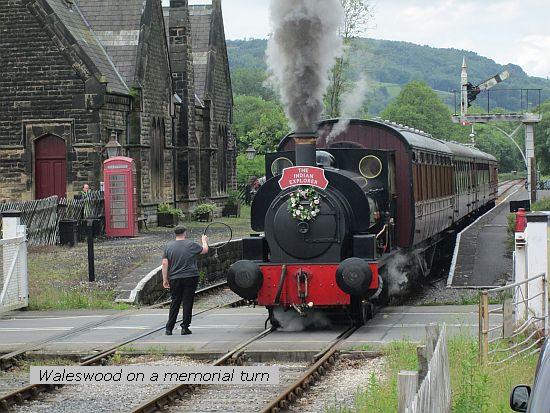
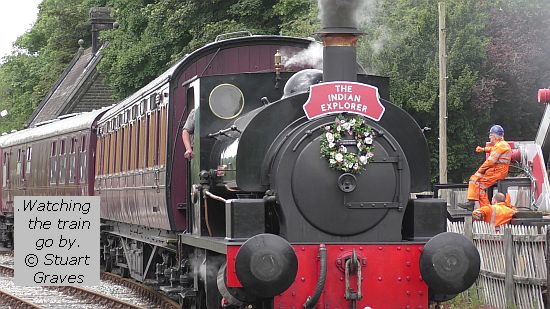
Friday, and Andrew was over as EMR wanted some of their (loaned) re-railing jacks back as temporary supports for a piece of depot track and they needed to be extracted from one of our containers. But first we drew the train back on track 1 and used the forklift to push the exchange empty skip into its proper place. At ten a courier van rolled in to the yard, we put the jacks on a pallet and loaded them in. Later in the day there would be two memorial trains running for a former volunteer, but first we could borrow the token and use the main line as an extra headshunt to extract EE D1197 from its position on track 1. For now it was put over on to track 3 while we sorted out some clutter that was on it and then resumed loading the scrap skip with the last vestiges of Hunslet 7161.
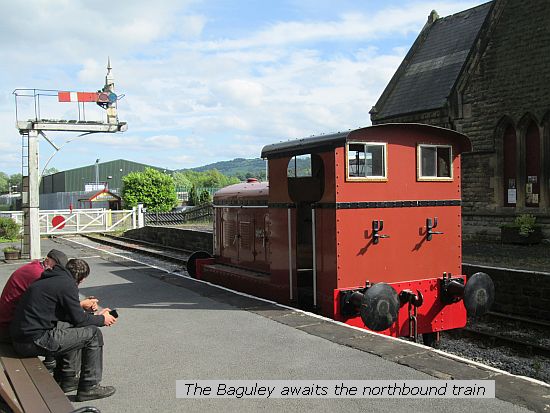
During the late afternoon Mark drove his Baguley 0-4-0DM down. taking advantage of the presence of blockmen to avoid having to do level crossing gates himself. He waited in the station until the final train had returned from Matlock, after which I used Louise to draw D1197 back out of track 3 and handed it over.
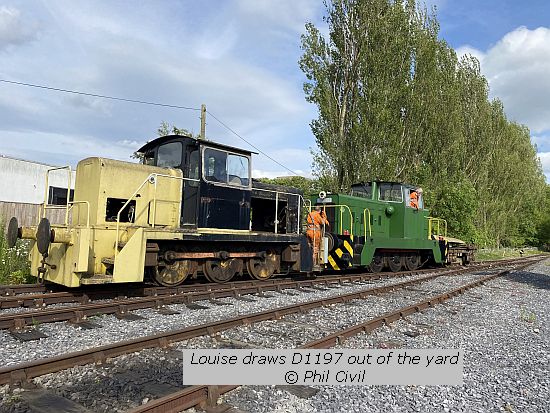
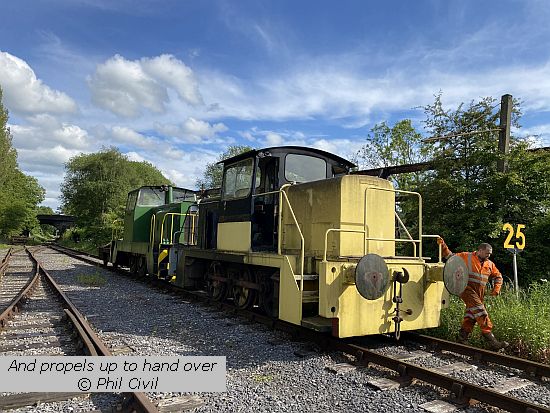
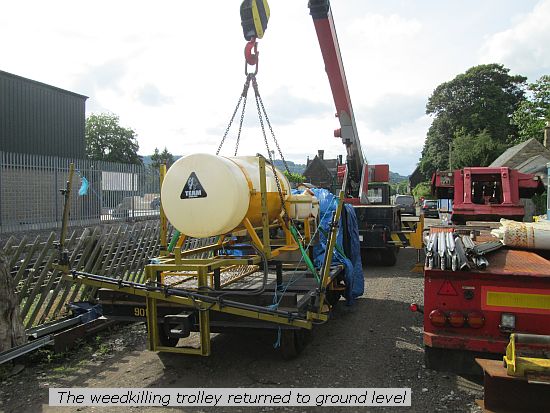
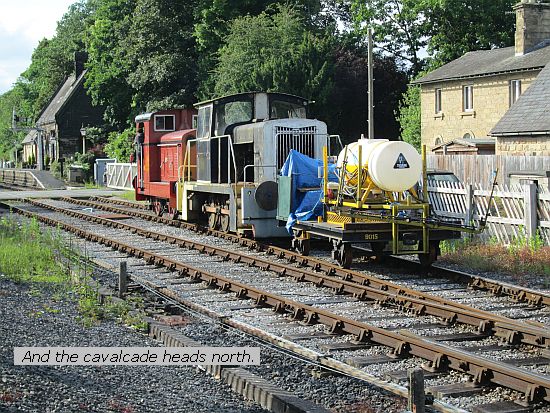
The duo then moved back up to the level crossing, where we had already unloaded the weedkiller trolley from its plinth on Andrew's trailer and now swung it over the fence and down on to the running line, to be coupled to the other end of D1197.
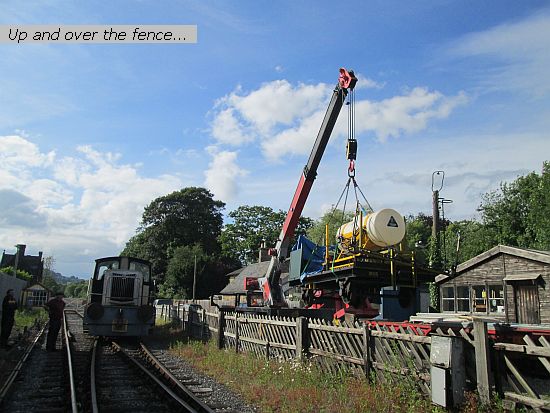
The unusual cavalcade set off at a sedate pace for Rowsley, and for now has passed out of our immediate sphere of knowledge.
Saturday, and I spent the morning doing re-programming at home. Not only had I the main loco program to work on, but addiional messages were needed on the text screen that the driver sees, and all these must be compiled independently so that the PLC merely has to tell the screen a page number to display. In the old Eberle PLC days I programmed the messages into the PLC and thus could leave some lines up while reprinting different messages on the another screen line. That was more flexible but tied up great chunks of PLC memory: this way the memory is kept clearer but every permutation of what I want on screen must be programmed page by page and the PLC program given the right prompts.
When I finally went down to the shed the first job was to re-program the screen: I had done this before but I think I had brought the screen back and set it up in the office. Now I was doing it on the loco (good practice lest I might have to do it again one day) and the manual for it, written before the widespread adoption of USB assumed I had an RS232 output which would turn up under COM Port 1 or 2 on my PC. My USB to RS232 converter cable came up as either Com ports 3, 10 or 11, Eventually I got the screen software to accept com port 3 and uploaded the fresh version. The main program too was then updated. The LOBAT function was now merely a warning message that would come up during the start sequence (though if it trips on with the engine above idle it triggers an 'alternator defect' fault message ).
RS8 was started up and moved to the south end of the yard and parked as a buffer stop should anything go wrong, though as I have yet to get the throttle set up on the Alstom loco it will only run at idle so wasn't likely to charge up to RS8. Thus I had the loco running up and down numerous times and was about to break off for a cuppa when Andrew and his partner (and of course the dachshund) turned up. Later we fired the loco up again and with Andrew watching the input and output module lights, and me watching the track and the screen display, we tried to diagnose one or two of the foibles it was presenting, notably a habit of waiting about 5 seconds before turning on the Clutch In valve. After they had gone I took a look over the direction control program (i.e. that which controls the gearbox, the converter clutch, and the various interlocks and protections it must take account of). On the face of it the program is the same as that I had running for a decade on locos I set up for RMS Locotec and similar to that which is lodged in the '14, but it had 'evolved' and numerous text notes and their alteration dates can be seen as I attempted to 'fix' issues that those locos had developed during testing or early service.
Overnight I concluded that it was time that that particular program module got a complete re-write, but as I had to be down to open up the shed for Jagger and his friend, that task was performed at the shed, covering several sheets of A4 before translating those into a ladder diagram and compiling it into the whole program. Some time after lunch I got to load the new program in to the loco and give it a try. On the plus side, the direction control program is now substantially shorter than it was before (so that saves memory) and is laid out in more logical steps. (The old program, as I said, rather evolved and looking at it now I can't see how bits of it work anyway!) The first run or two weren't too encouraging - an error here or there in my typing and although the loco would automatically de-clutch and reverse the gearbox, bringing the clutch back in wouldn't happen on its own. It was supposed to bring the clutch back in automatically unless you held your finger on the clutch 'out' or the direction buttons.
The program also looks at the gearbox as you start up the loco and if the detection switches were showing the gearbox set one way or the other, it picked this up and ran with it, but if the gearbox had 'relaxed' overnight such that it wasn't detecting forward or reverse, the program asked you to select one or the other - well it does now but on these first tests I hadn't put that bit in and during a software re-load the gearbox managed to lose its detection! One plus point for the new program - the direction control has become pre-selective, that is to say that if you are trundling along forwards you can press the reverse direction button and as the loco comes to rest it should de-clutch, reverse and re-engage (well it did the first two). If you change your mind and press back to forwards before you stop it stays in forwards. But of course this new feature isn't reflected in the screen messages so for the avoidance of doubt, I must create two new 'pages' that confirm that you are in Forwards but that you've pre-selected Reverse (and vice versa) and add the relative page numbers and their triggers into that other module of the program.
I don't like doing major re-programming on the loco: in years gone by it's got me into bigger troubles when you can see so little of the entire program on your laptop screen at the time. Today's changes after creating the original paper version were relatively minor, but I made one last change late in the afternoon which corrected the shortcoming that it wasn't putting the clutch in at the end of the direction change sequence. Now it will de-clutch, reverse the gearbox, and put the clutch back in ready for you to release the brakes and move off.
So a succesful day then? Aah, not quite. One last test from start up and it is now so enthusiastic about putting the clutch 'in' that it does so as soon as the parking brake releases and only lets the clutch 'out' if you hold your finger on the Clutch Out Button. Tomorrow I'll work out how to fix that foible...
And for the rest of this week? There should be a transport job or two, loads of paperwork and further progress on the Alstom loco, beyond that the crystal ball is a bit murky. Come back next week to find out if it's cleared. See ya then.