
Of vac and pro-formas
14th April 2024
My old geography teacher's favourite saying was 'you can't study geography in a vacuum'. Was he being ironic? We pupil's just thought he has daft - you couldn't breathe in a vacuum, let alone study.
With the excitement of last week over, it was back to more mundane things on Monday like sorting out oil pressure switches for a customer with a supplier who takes risk avoidance as an art form. I've seen this sort of thing from time-to-time, indeed back in Thomas Hill days, when we dragged ourselves up to BS5750 Part 2. Some bright spark dreamed up the idea that as a salesman, after I had had a meeting with a potential client and largely agreed what sort of loco they might be thinking of, I was required to draw up the parameters list and get the client to sign that it was correct. Put yourself in the client's shoes. You've approached Thomas Hill because you know they are a locomotive manufacturer and you are thinking about a bigger/better shunting loco, but you, employed as an engineer, have never bought a loco in your life before, (and with the longevity of locomotives, may never do so again) and after a meeting at which you're still trying to get your aspirations into a coherent picture, the 'expert' whom you arranged to see, demands that you sign a list which stipulates all the aspects which you did not, until half an hour ago, know anything about. I didn't like demanding it, the engineer on the opposite side of the table liked signing it even less.
But to return to my dealings with this manufacturer. I started with an email asking for a typical price and lead time for a 'Series X' oil pressure switch, final details to be confirmed later. I gave my address (after all, they need to know that in order to quote a carriage cost) and my website (so that they could confirm that my enquiry was genuine). The response I got was a classic -
'Thanks for getting in touch! To allow me to raise a quote for you, please provide a complete part number so that our team can quote you (please refer the attached datasheet) can you please confirm the end use and application of the requested parts? I will also need to confirm your full invoicing address, VAT and any delivery addresses to quote freight to.'
Does this sound a bit like a pre-written auto-reply? Could the signature at the end be a person or a AI-bot? Since when do you need my VAT number in order to quote a freight charge? I patiently pointed out that they already had my address, and I couldn't specify the exact switch because I hadn't been able to resolve the full details with my customer. It was all to no avail. They insisted that they had to work to both American and EU regulations (I know, we're in neither but it was an American-based company) and I couldn't help thinking this was just a ruse to put people off asking why they wanted such data for a simple commercial transaction. After all, if I order a carton of milk off Tesco's on-line shop do they insist on knowing its end use before telling you how much it will cost?
In the end I succumbed, worked out exactly the specification of the switch in acordance with their ordering info, and they produced me a generic quote, i.e. without a name or address. So I took the bull by the horns and raised a purchase order, 'in accordance with' their quote refrence. That didn't work - I hadn't specified a company name and address, invoicing and delivery (if different). Good aren't they? If they looked back through the email chain it was all there, but they hadn't. And my PO wasn't acceptable because it didn't specify the carriage charge (that they hadn't quoted because they hadn't bothered to look back for my addreess) and didn't specify the end use. So I revamped my order (and went a bit OTT on the end use bit).
Hey presto, I had a pro-forma invoice to pay, home and dry at last! Now, I see a fair few pro-formas, I buy a number of products once in a blue moon and opening a credit account every time isn't worthwhile. Almost invariably each pro-forma comes with the suppliers bank details, after all they want you to pay it don't they? And a BACs payment usually has less cost to it than a credit card charge. It was only after I had logged on to the bank and scoured the pro-forma for the Bank details that I found one line, hidden amid other stipulations, that said for reasons of cyber security, to get their bank details I must phone the Customer Service department! I rang them up, pen and paper poised, worrying that I would get a digit written down wrong and screw it all up. The lady I talked to spoke with an accent. I couldn't resist chiding her employers for not putting the bank details on the pro-forma. 'We thought you might have them already' she responded. Since the email chain also showed someone else in the organisation had 'opened a new account' for me as a 'new customer' this seemed a touch niave.
Resisting the urge to suggest that no-one at this company bothered to look back at the chain of emails I instead asked what they were. Unbelievably, she offered to send me them on an e-mail! For reasons of cyber security they could not include them on a pro-forma invoice that was an attachment to a covering email, but she could send them, as an attachment with a brief covering email. M'lud, I rest my case. Oh and they still haven't told me what the lead time is.
Thursday afternoon I loaded the van with the two compressors and a few last bits from DL34 that needed to return to Llanfair Caereinion, because on Friday I was to attend the commissioning trials starting at 10 o'clock. Given that it had taken over 3 hours last week, and I didn't want to rush with a fair amount of weight in the back, I set off just after half-six and to my chagrin got to Llanfair about 9.20. I bought a cup of tea in the cafe and as I sat pondering how the day would go a low thrubbing in the background made me wonder whether DL34 was nearby. I glanced down the line and it was shuffling over the inspection pit.
With tea drunk I headed over and introduced myself to the two guys with the loco, who were to be joined I gathered by the Engineering Manager once he'd got his starter motor sorted out. I mentioned I had the compressors in the van and they decided that now was a good time to unload me so the tractor was deployed and my van relieved of the pallet. The remaining hour or so before lunch was occupied with loco checks and then shunting a Zillertal 4w carraige out from behind an SLR one and adding it to the 3 carriages in the platform, which had been the service set.
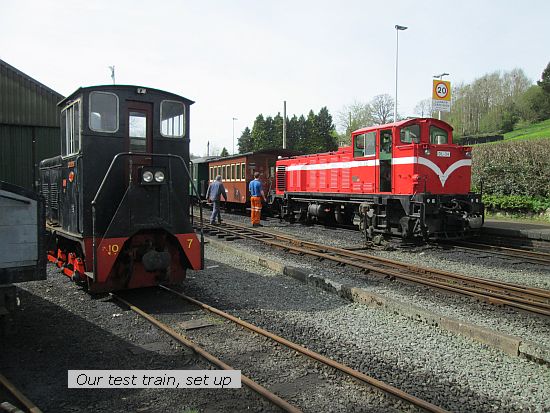
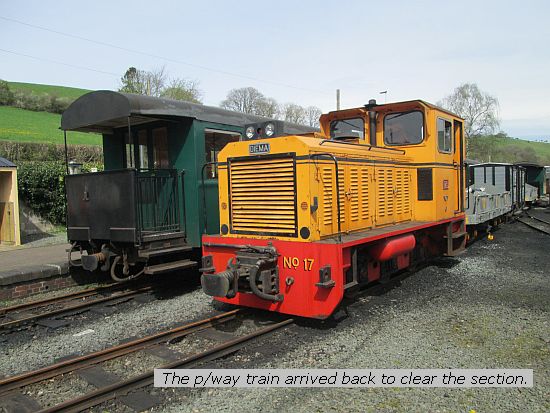
First test, after draining everything down, was to charge the loco air with the engine at idle. DL34 has a significant air tank on the right hand side which I had recommended reducing in volume but W&L decided to retain so as not to alter the loco. After some other trials we moved on to drawing the vac out of the train. Here any confidence I had harboured evapourated as the loco struggled past about 18 inches of the vacuum gauge. Three carriages were fresh out of traffic so should be vac-tight, but I could hear no vac leaks on the fourth. We tried adjusting the balance reg on the AV2 but it seemed to make little difference. For that matter accelerating the engine (and thus the exhauster) didn't seem to either, yet the loco had rapidly got to 21 inches or more at Darley Dale. We had to wait for a permanent way train with the 6w Diema (No.17) to return and clear the section before we departed.
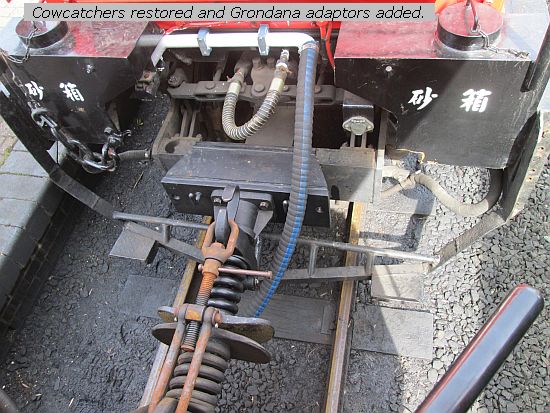
Eventually, with about 20.5 inches we set off, with a plan to turn back at Cyfronydd if it went tits up but otherwise press on to Castle Caereinion. I rode part of the way on the verandah of the leading carriage, as I felt the cab was a bit too small for four.
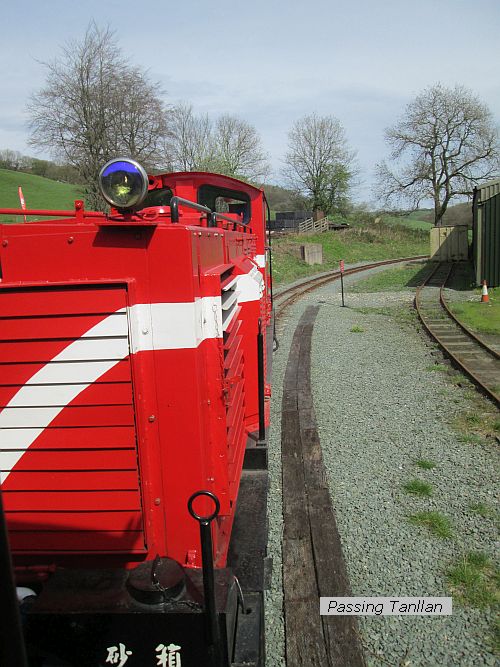
First though we stopped on the straight by the old water tank, and carried out a series of brake tests. Each test involved a higher speed and measuring the stopping distance. DL34 locked up the first couple of times - but the vacuum brakes could be felt on the train and the stopping distances seemed to be highly satisfactory. Again though it was slow to restore vacuum and I had another go at the AV2 control valve but in the end it was agreed it was making no difference so I returned it to the original value. We pressed on and as by now it was becoming a familiarity test run and the driver was beginning to enjoy it, we cruised through Cyfronydd (where the Manager was filming and put a clip up on the W&L Facebook page - I'm the orange lump in the cab doorway) and headed for Castle C.
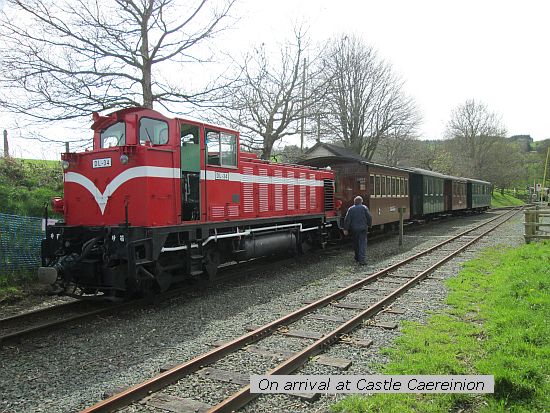
With about 600bhp on a loco of 25tons it has about the same power to weight ratio as a main line loco and its ability to accelerate was impressive, though the smoke it produces is (for now) a bit of a drawback. At Castle we ran round, and again I returned to the leading verandah though as the air horn was b***y loud at that end, moved to the other end of the carriage where the adjacent Zillertal had a vacuum guage.
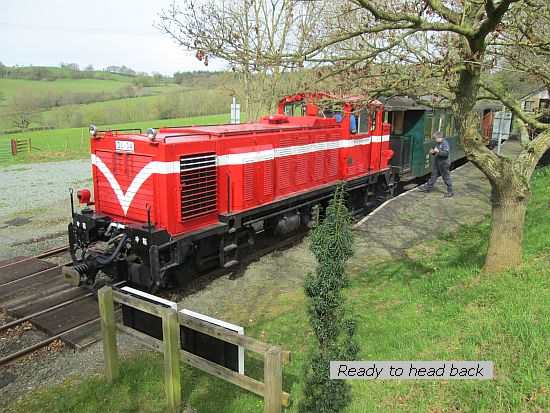
Here I was relieved to see a steady 21 inches or more, recovering quite quickly after brake applications. Had something settled down - a sticky piston ring perhaps?
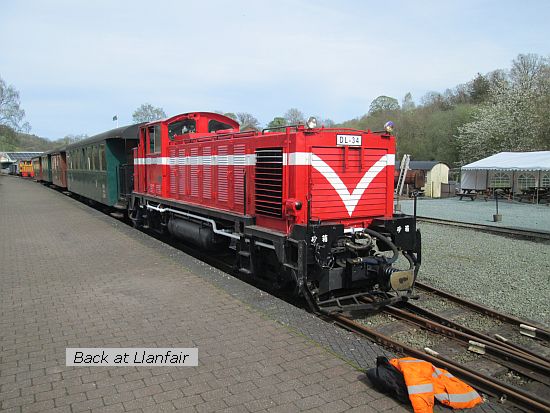
Back at Llanfair the p/way train handed over its SKGLB 4w coach and the SLR was added to make up a test train of 6. The destination this time was Welshpool, but this time they found what had caused trouble all along, the Zillertal that had been next to the loco before was now found to have a defective vac coupling seal and a leaking hose! That explained why, coming back with the leak at the far end, the vac had been visibly better. It also explained, the crew admitted, why another driver had had trouble with vac when the carriage had been in traffic a few days previous.
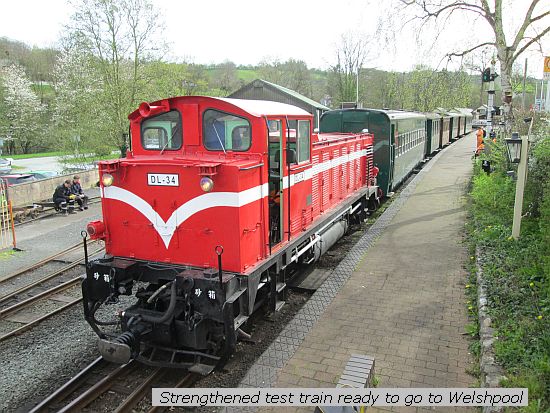
Alas it was by now after 4pm and while I might have enjoyed a run to Welshpool - that lot charging up Golfa with DL34 at full chat should have been impressive - I still had 3 hours drive and opted to leave. For one thing, although I had had a phone call in the morning, by lunchtime my phone declared it was 'Emergency calls only, no network' so presumably EE had died in that area. I got to Welshpool before service came on with any reliability.
Saturday. It had been the second joint annual Twin Peaks gala for Peak Rail and Ecclesbourne, this time from Thursday to Saturday inclusive. Any ideas we had had about partaking had been scotched by lack of time and anyway, we weren't asked to contribute. So I had seen a bit going on Thursday afternoon but had been well away Friday. Saturday however seemed reasonably busy, with trains on an intense schedule.
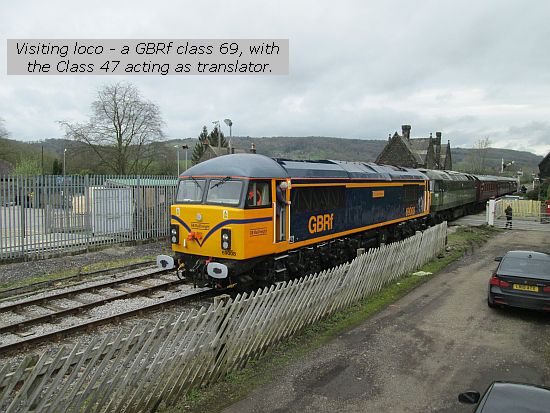
Andy H was present but Andrew wasn't especially well. I wanted to take advantage of the big space at the front of the shed to continue to process of changing the duff LED roof lights, so we brought the Hatramm inside to lift the Terrypicker over from the other side of the shed. Part way through Phil G arrived, having dropped off a passing gala event train, and helped for a few minutes (and had a cuppa) before returning to the station. I had a problem meanwhile. After the lift I had withdrawn the stabilisers, disengaged the hydraulic motor but the hydraulic pump refused to disengage and without that I couldn't engage traction to reposition the Hatramm. Eventually I had to contact Andrew who struggled through a cough and sore throat to suggest that the interlocking is such that both pump and motor buttons must be pressed together: and of course, when I did so, the pump promptly disengaged.
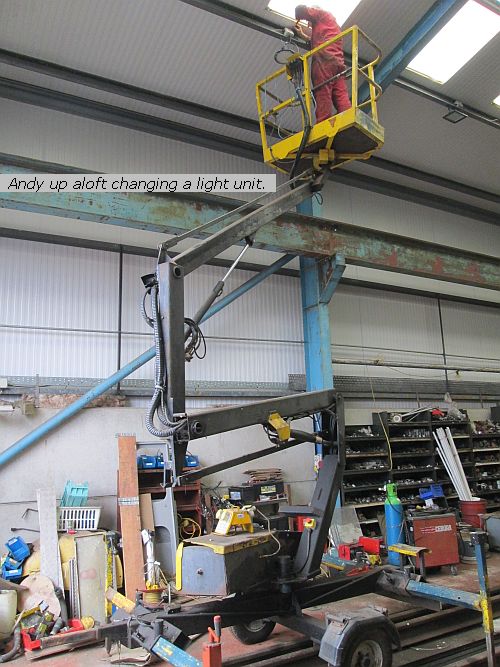
Andy then went up and replaced 4 of the 8 lamps on this last row - 144V and the Baguley railcar must move so that he can access the remainder.. Jagger arrived and continued with preparation work for lifting out the old van body, and Stuart Graves passed by and advised me that a visitor yesterday had harrassed him because he had gone up to our shed wanting to see something and we hadn't been there to show him. Apparently as a diesel gala it was incumbent on us to open our doors and welcome all comers. Oddly enough on Saturday we had no-one either call from train or footpath asking to look around, though a photographer put a picture up on Saturday night which showed a bit of the yard, and moaned at all the derelict locos standing around. Andrew reacted to that and many others joined in.
Sunday. I had, accidentally I suppose I had better admit, dislodged a piece of jack-rusted angle that sits at the top of the buffer beam at the rear of 144V and once had the handrail attached. That handrail is temporarily hanging from the front handrail (having rotted through all 4 posts) and we had lined up a replacement piece of angle but it needed trimming. As I was all alone in the morning I measured it up and marked it for cutting, but realised it would have to be gassed as it was too big to go in the hacksaw. That lead me into fancying making a start on the rear buffer beam on 144V, having yesterday spent some time with a chipping hammer so as to be nearby when Andy wanted to test the new lights. Jagger and a friend arrived and told me the needle gun was in a cupboard I hadn't thought to look in and soon I was merrily sending shards of paint in all directions. Jagger also gassed the angle for me, and later I cleaned it up with an angle grinder so it is nearly ready to be welded back to the loco and a new handrail assembly added to it, using the original as a pattern.
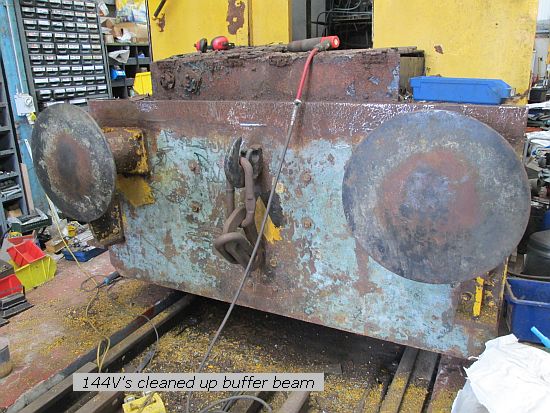
This dos not mark any dramatic switch in priorities, just me humouring myself when I really had some other jobs that I should have been doing!
You'll notice I haven't said much about the trailer this week. Last report was that the brake drums were due mid-week, but HFS hadn't any confidence given the past record of promises and I've heard nothing to suggest anything has changed. I have a wagon to move this week so I've been plotting it on to the 4 axle to see how it will sit and I'll have to get the 4 axle trailer ready once again. Let's hope the weather holds.
But that's for the future, and for now I'll just say how I hope you've enjoyed this week's edition and that you'll be back same time, next week. See ya then.