
Of crates and weak batteries
2nd June 2024
A quiet-ish week - or is that weak?
It was a quiet day on Monday, alone down at the shed. Although I really should be getting on with the Alstom loco, I have no self-discipline on occasions and set about instead firstly re-purposing a wooden crate in the workshop to make a stout tray to keep things together in the van. I had had a plastic tray for this in the old van but the plastic wasn't up to the mass of the things I allocated to it (15ton jack, fire extinguisher, containers for gas oil and screenwash, etc) and had collapsed (it was probably intended for fruit) so a more substantial tray, cut down from a 3 plank crate should last longer.
But that left two planks worth of crate without a bottom, which I cast aside but will return to later. Back outside I returned to work on RS8, installing the relay valve and associated pipeworks. The original pipework wasn't too well supported - some of it indeed relied on the output pipe from the driver's brake valve and when I had disconnected that, it drooped significantly. I hadn't been too keen on this back at Tunstead but now it definitely needed a support, though for the moment it is only temporary, using a girder clamp.
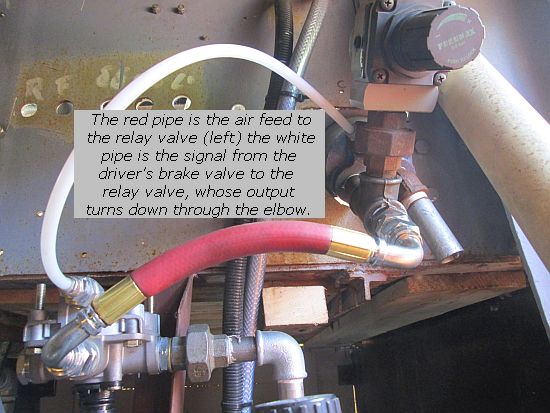
As it was by now late in the afternoon I brought out a battery tester and sure enough, RS8s batteries were 'weak' so I deferred trying to test the new brake pneumatics.
On Tuesday I started transfering my paraphenalia from the old van to the new. The new crate took over from the defunct plastic one and I began to wonder whether I could make something from the two planks worth of sides to superceed the cracked Linbin that contained fishplates, spare Lister engine starter, spare crank handle for Lister in case neither of the starters work or the battery is kaput, etc. Back at the shed the two planks worth was recovered from the rubbish tub, and another piece of transit material, a half wood/half corrugated card box sitting outside was brought in, its ply base recovered, trimmed down and fitted to the two-planks worth of sides, then divisions added to provide enclosures for the important bits instead of them all any-old-how inside. Not content with that I finally added a pair of supports underneath to stiffen the ply and a pair of rope handles on the ends. Thus from an old crate that was taking up space in the shed I arrived at two recycled bespoke crates to keep the back of the new van tidy. Will it last? We'll see.
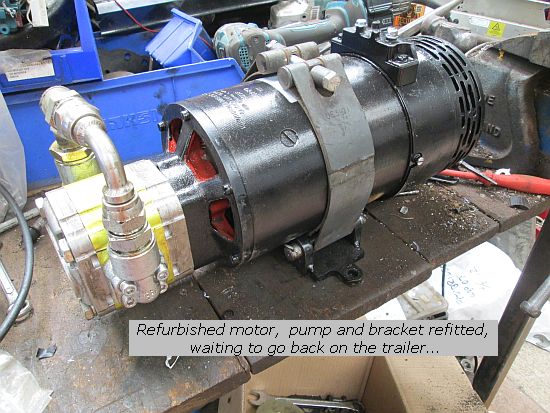
Last week I didn't mention that I dropped in the Bosch pump motor and its two compatriots to a local electric machine company with the request that they overhaul one immediately, one in 3 or 4 weeks and one later on still. In the middle of the week I received a call that the first was ready so after a trip out I swung back by to pick it up. That was Thursday. Barely had I returned home than an email arrived saying that the second was ready and on Friday another that the third was ready. Thus all 3 were finished (and charged for) during May which wasn't quite what I had had in mind. Ah well, here's the first, united with the pump on the bench at the weekend, now do I set about swapping them over again? I suppose I had better if only to confirm that it is now up to the task.
Andrew had been unwell Thursday night so I wasn't expecting him this weekend, which was a shame as EMR had been in and collected the skip on Thursday morning. But owing to a breakdown in communication, they hadn't brought in an empty one so returned Friday morning with a fresh one which they left right in the middle of the entrance lane.. Without Andrew to drive the crane, I had no means of placing it where we wanted it, nor putting in the couple of tons sat on the floor that we'd had to take out. I willed myself to get back on to Alstom's loco, having put in a few hours on the software back at home during the week, finding all sorts of little anomalies. Rather than write a whole new set of sub-routines, I had decided to adapt the software for a loco that I wrote in 2006-7 and edit the differences. I'm beginning to wonder whether that was as sound a policy as I thought it was at the time. For example, this loco, being simpler, has fewer output modules, and the configuration of input and output modules have to be declared in the set-up for the program. Of course, all the inputs and outputs are in different places between the two locos and as I fault-found some deficiencies I discovered two outputs still on their 'old' numbers which didn't exist on the Alstom configuration, yet the 'validation' routine (which supposedly checks what I've written and confirms that it can be converted into machine code) hadn't mentioned this.
Anyway, this occupied most of the morning and into the afternoon, and finally, reasonably happy (and with a long list of further tweaks to make) I decided it was time to fire it up and see what other issues it could throw at me. So, onward through the check sequences, up comes the 'Ready to Start' message and I press the start button and... The starter cranks for about a quarter turn then dies. The batteries are not flat but too weak to start it. At this moment Jagger arrives - not to work but to drop some things off, so we have a cup of tea. After he'd gone I rolled an extension cable out to the loco and set up a battery charger, and on a whim, brought out a second cable which went forward to RS8 and a second battery charger set up there. For now I left the two chargers to do their thing while I went back inside and looked over my print-outs of various program elements to see what else I had missed. For one thing the loco has voltage sensing built in to one of my cards, feeding an input which should have warned me that the battery might not hold up to cranking. This is known in the program as 'LOBAT' though in reality it should warn me if the voltage is outside of its specified range. [Some years ago the 03s alternator regulator failed and pushed the system voltage up to around 40V when running. Surprisingly the batteries took this abuse but most of the bulbs blew.] Scrutinising the program showed me that LOBAT was there allright, but not in the pre-start checks. Had the engine fired up it would have warned me that voltage was low (with a message screen to the effect that the alternator isn't charging) but otherwise it was ineffectual. More notes on tweaks to make.
Later in the afternoon, leaving Alstom's on charge, I disconnected RS8's charger and fired the old girl up. I made some runs to and from the end of the headshunt, testing how the brakes responded. With the original D&M set-up, you pulled the lever and waited and waited and eventually the brake pressure needle moved up. By that time you'd already slowed down on the converter but emergency stops were, shall we say, underwhelming. But now the D&M valve only has to increase the pressure in a small piece of 3/4 pipe stepped down to a foot or so of 6mm bore plastic. (See the earlier picture). If the valve were more responsive I'd probably have to give it a capacity reservoir to avoid it hunting, but it is so slow that it doesn't need it and the relay valve does the work. The brake pressure needle reacts immediately (there may be a case for adding a restrictor or moving the gauge line to a point nearer the brake cylinder, but that's for another day) but more importantly you can feel the brakes apply and being quite short wheelbase, RS8 sometimes performs that little nod as it comes to rest. A better pipe support and a check over for air leaks and I'll be satisfied.
Sunday: I had set up my little laptop in the living room at the Briddon Country Pile and was starting to go through the Alstom programs yet again when a text came through from Andrew that he was on his way over. I wrapped up what I was doing, went down to open up, ran the extension cable back out and put the Alstom loco batteries back on charge. The sky was blue with only a few wisps of cloud, the hills on either side clear and green in the sun. There are days when living here are worth stopping and appreciating what's around. Andrew arrived and we spent the next few hours with the crane, placing lumps in the skip (which we moved back to its preferred position).
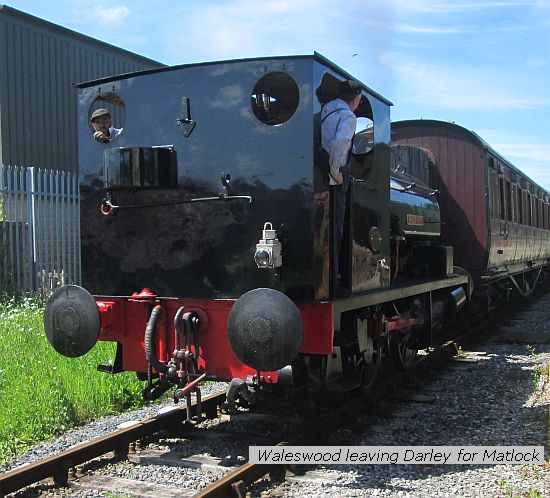
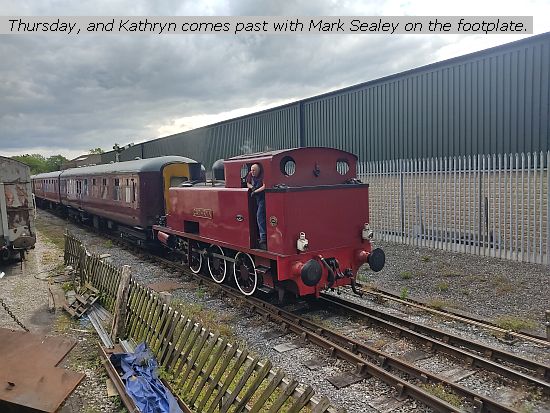
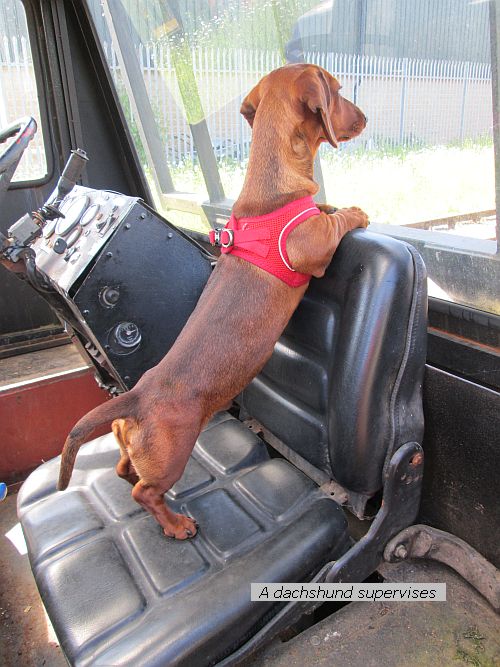
All this took some time, especially as we had to be aware of the trains passing by as some of our actions were close to the running line, so there were breaks around anticipated train times (Peak Rail were running an intensive 2 train service for the Road and Rail gala at Rowsley). I say close - I should hasten to add that we were never fouling but didn't want to alarm train crews by even being near. An additional helper today was the pet Dachshund that Andrew and his partner have, which is unfazed by passing trains but sensibly stayed at a safe distance when the crane was operating.
Andrew departed at half three to catch the last train and I returned to Alstom's loco to upload the latest version of the software and see what else it could throw at me. I had inserted LOBAT into the pre-start checking sequence, and as soon as the system started that routine the alarm screamed at me. Yes, LOBAT was the culprit even though the batteries had had hours of charge. For now I blocked the input so that I could move farther on, get the engine running and check some other alterations. The loco now mostly operated correctly but it seems I must dig out the connector cable and see what settings LOBAT has in its memory and alter them.
No transport work this week as my collaborators are already fully-booked, which is why I haven't been up to fit the replacement king pin cylinder, but must do that in the next day or two, along with collecting those other two overhauled motors. As usual there's a stack of other things to do as a month end passes, Andrew wants to hold a formal meeting with Mark Sealey to discuss various topics and oh yes, I've got to visit the dentist again (but it shouldn't involve sticking any needles in me). I hope you enjoyed this week's instalment and will be back next week. See ya then.