
Of AGMs and mechanical problems
16th June 2024
Sorry, not a good week for photos.
The old crystal ball certainly wasn't revealing any secrets to me at this time last week - my anticipated transport jobs got put back and back until they disappeared out of the week altogether. So it was a mixture of paperwork and software that occupied the earlier part of the week. An additional few lines and a tweak here and there and the gearchange program on the Alstom loco started to work like it should. I modified the screen messages and gave it an additional screen for each direction that announced that that direction was engaged but that the other was pre-selected. I found that the dwell time on the standstill detection (on the seperate module) was adjustable, so set up the laptop and re-set it to 1 second. In other words it would wait one second after it ceased detecting motion and then declare the loco standing still and so permit the reversing sequence to begin. So far so good but when I reset the card from 'set-up' to 'run' it wouldn't and the PLC wasn't impressed. Not only that, when I did come to get it sorted and test it, the dwell time still seems to be at about 3 seconds, which isn't long really but enough that drivers will moan about it.
Then there were the deadmans and vigilance system messages. If your foot comes off the deadmans pedal it (the system) starts bleeping at you and displays the meesage that the deadmans timer is in action - 5 seconds and its clutch-out, brakes on. And as soon as you re-apply your foot to the pedal (or the one at the opposite desk if you're transfering sides) it should revert to the previous screen. I could get the deadmans warning screen but when the deadmans timer cancelled the screen remained unchanged. This, and a number of other little nuisances, continued to bug me. Before I can set up the throttle control electronics I need to know that the control, card is in manual, but the LED wasn't coming on even when the program said it should be. Another adjacent output didn't seem to be working either - I could hear the relay clicking internally yet the light it was connected to didn't flash, but would if I jumped the terminals with a wire. I decided to swap the PLC output module, put one out and kept forgetting to take it down to the workshop with me.
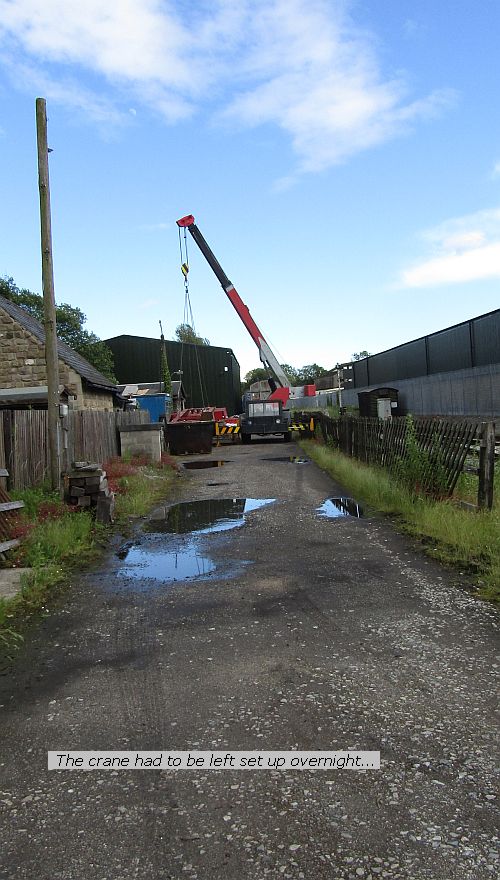
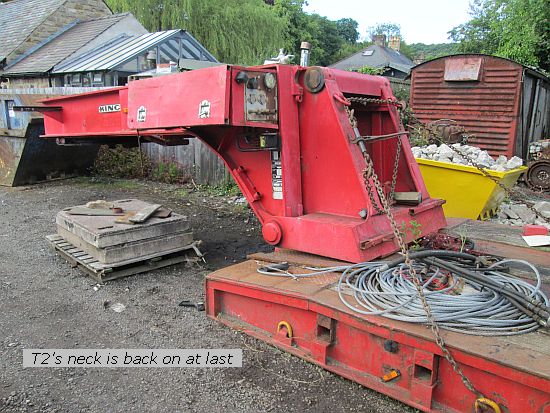
Andrew was across for a while on Friday and we descended on the shed to sort a few things out. The scrap skip had been exchanged Tuesday morning but was left in the middle and needed craning to one side. A gearbox was sat in front of Andrew's trailer (T2) and needed putting out the way so the latter's neck could be reassembled to the deck. We got through these first two operations but Andrew was having increasing difficulties with the crane's engine which was struggling. We found that it was low on fuel (the fuel gauge, like some other bits of instrumenation, needs attention) so topped it up, but nonetheless, with neck half on the trailer, the engine died.
The Perkins 6.354 at the heart of the crane has a glass bowl fuel filter and a paper filter. The former, on examination was clearly clogged with brown sludge which is probably the algae sludge we were aware of earlier. That got thoroughly cleaned out. The paper filter, once taken off was not only far too heavy but what fuel was in it wouldn't flow through the filter element at all on its own. A new one was fitted, Andrew bled the system, while I pumped the lift pump and with a bit of luck it would be ready to go again. It thought otherwise. After several prolonged attempts at cranking we turned the power off and went for a cuppa. Afterwards, I tried to turn the battery switch back on. It is one of those switches where you insert the bolbous end of an L-shaped handle, and as you turn it through 90 degrees, a spiral slot pulls the bolbous end in and makes the contact. There are good quality ones, like on the Hatramm and Pluto, which have spiral slots on opposite sides and two engaging pegs on the handle, or there are, shall we say, less expensive versions which have one slot and one peg and this was one of the latter. Andrew had a go and being younger, fitter, stronger, etc than his old man, succeeded in turning the handle - but only because the peg sheared off. It was game over for the day and we had to leave the crane, jib up, 5 and a bit tons on the hook, stabilisers deployed and fortunately nowhere near foul of the Peak Rail track.
We had a conference. Mr Jones built the crane with two battery boxes, and one 12V battery in each, wired in parallel. We don't like batteries in parallel - you end up with charging issues because the internal cell resistances are seldom the same with any two batteries and as both of them that came with the crane were deceased, we had concentrated on one battery box and isolator and as big a battery as we could squeeze in. As it happens, the battery box at the side we were using also contains the air cleaner and for some reason also gets rainwater in. The one on the other side is bone dry. Therefore, declared Andrew, we should re-arrange things to work from the other battery box, and put in a two-pole isolator. He wasn't going to be at Darley Dale on Saturday, and first thing Sunday he and Dr Ben Riley were off to the Quorn swapmeet so I could do it Sunday morning and leave Saturday free for me Alstom testing.
Friday evening was the PRA AGM at the Church Hall, and although it is quite near, as I was rather tired Steph suggested taking her car down. The AGM was generally as dry as these things usually are, especially when, as a supporting group, the Board can deflect questions by declaring them an operating company matter. A couple of things got my gander up though, one of which was Peak Express (the society magazine, which hasn't appeared for two or more years). I launched in as Roger Hallatt, the Chairman, declared that they had made the decision several years ago not to publish Peak Express any more. I referred him back to the minutes we had just approved of last year's AGM wherein it was declared that the Editor had sufficient articles for another edition and they were, apparently, going to get it published on the near future. Roger back-tracked and Pete Waller, the Membership Secretary and Editor (if he could claim that title when nothing had been editted) got hot under the collar about the amount of work entailed, having to chase people to write up articles, and the time taken to prepare it, etc., etc., plus the cost of printing and posting that the Society could no longer afford. It was awfully tempting to go back to him and say that I knew just how much was involved, having been first Art Editor and then full Editor for the Bala Lake Railway Society's Llanuwchllyn Express, and that in days when 'cut and paste' meant a steel ruler, craft knife and a Pritt stick. But you know how those conversations end, you find yourself volunteering for the job and I don't have the time so stayed silent and let the topic move on.
At the AoB session I had another go. I reminded the Board that at the 2015 AGM certain personalities had pushed through a change to the constitution that imposed restrictions on when someone could be nominated for a Board position, and as the notification period well exceeded the notice period for the meeting it became difficult, if not impossible, to be nominated for the Board at an AGM. Although a Director promised the 2015 meeting that he'd give the membership plenty of notice ahead of the actual AGM date in practice it never happened and new faces on the Board appeared to be by personal invitation, which the Board at the time wanted, no dissenters allowed. Anyway, faces have changed but still we as a meeting had just ratified a new Director who had been co-opted not long after the last year's AGM. I asked the Board whether they had any more plans to co-opt Directors which they weren't bothering to tell the meeting about.
(For new readers, or those with short memories, let us recap. In 2014 Andrew's 14 was in action, we were building the shed at Darley Dale and Roger Hallatt undertook to nominate me for a Board position, but he didn't. As I was operating the 14 that day and couldn't attend the meeting, Steph and Andrew nominated me from the floor and the meeting voted in favour, apart from two Directors, one of whom, I sure you can guess who, was later described to me as looking like she'd been sucking on a lemon. This election probably wasn't in itself entirely constitutional, but a clause does allow for such a circumstance to be valid, even outside the strict terms of the constitution, if enough Directors voted in favour. Aside from those two, others had, thus I and the company secretary regarded my election as valid but the two Directors did not. One came up to me saying 'You only get on this Board by invitation, who invited YOU?' while the other dominated the first hour of my first Board meeting culminating in a resolution to suspend me - which is neither constitutional nor legal. When I questioned its legality he replied 'I don't know and I don't give a...' The Board then spent money on legal advice that ruled my election unconsitutional and therefore I had never been a Director but I am still registered at Companies House as having resigned. The next AGM saw the change to the constitution such that they would never again be embarassed by someone getting on whom they didn't want.)
Once again hackles were raised. It wasn't like that at all, people did approach the Board interested in coming on and they often attended Board meetings to 'see if it was for them'. I pointed out again that the changed constitution was undemocratic and that whether or not it was, it would seem as though the Board said nothing then co-opted someone after the meeting in the eyes of the rank and file members. The changes made in 2015 should be revoked. (I may not have been quite so eloquent but you get the idea). Again, assurances that they would let people know in good time so that anyone interested could arrange a nomination - but I suggested that it was easy to say, but all too simple to overlook. After the meeting Roger Hallatt came over for a chat and we must have gone on for ten minutes or so. It would not be appropriate to go into it in any detail, suffice it to say that things are 'still coming out of the woodwork' and the former manager's way of dealing with things - which had got the company into so much legal hassle and costs, had been applied to other aspects of the railway's affairs that had turned round and bitten them.
I came out of the meeting with a lot to think about and was confused when I got to Steph's car that it wouldn't respond to my key fob. Assuming the fob battery must have gone flat all of a sudden I set off to walk home and get Steph's. Fifty yards later it occurred to me that I had been trying to open Steph's car with my van key - the car key was in my other pocket.
Saturday's weather was forecast to be mixed but I had to be down early as I had another firm coming to inspect T2 at nine o'clock. This is I think the 4th, the others having turned the work down as they're 'too busy' or the trailer is 'too big to get it in the workshop'. This one Andrew had located but couldn't be around so I was delegated. He arrived just after nine and stayed until nearly eleven, not all on the trailer but he did get to see a bit of what we had in the workshops and around the back. Hopefully he was interested and the work didn't faze him, but we still have the commercial details to resolve. I had had trouble sleeping Friday night with the worry of the crane being deployed and weight on the hook - what if the jib slowly came down overnight, might I find it Saturday morning with our neighbours barbecue hut with a jib buried in it? I need not have worried, all was well, though Andrew rang first thing to ask that I check the stabilisers in case they had sunk into the ground!
So once back to myself I decided the crane took priority and set to work on re-jigging things. First task was to dig out a spare 2 pole loco isolator and mount it on the back wall of the battery box. Then on it was to cut 50mm cables to length and crimp lugs on their ends with the hydraulic cable crimper. The pos cable to the starter was threaded through flex conduit to give an additional layer of protection against chaffing getting through the cable insulation as the crane, like cars, is negative earth. A longish job was to create a fresh earthing point for the neg. As I was running low on 50mm cable lugs for 10mm studs, I picked what I thought was a convenient point of thick-ish steel, drilled and tapped it M12. The two cables from isolator to battery were the easiest. There had of course to be an additional thick-ish wire to feed the 12V to the control panel. There was already a wire (taped off) which went from battery box to battery box (though on quite what route I couldn't determine) but with both ends disconnected it gave me continuity and initially I intended to bolt all 3 cables together where they had been in the disused battery box and tape the whole lot over. Then I had second thoughts, pulled the wires back into the engine bay and connected them together there, in the process the crimp came off one, revealing to be a 3 core mains cable of about 0.5mm section with all 3 cores linked together and disappearing up front. For now it is still in use but that is earmarked to be replaced with more appropriate cabling when I get the chance to re-wire it all.
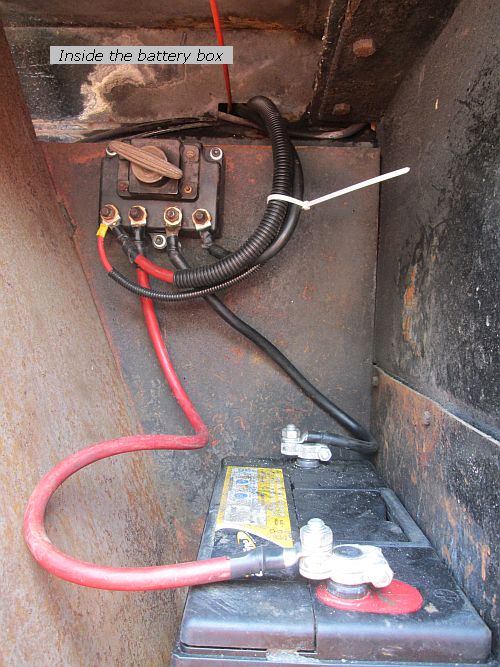
Allowing for an hour of heavy rain at lunch time, this had taken the rest of the day so I came home.
Sunday, Tony S was due over to resume on his railcar so my first job was to put the crane battery on charge ready for when Andrew arrived. I also moved RS8 out the way ready for Alstom testing and a couple of little jobs in and around the shed. Tony proceeded to go through the fuel system on the railcar and when Andrew arrived we had another go at starting the crane. In the end he cracked the injector lines, but the battery had gone down so we swapped batteries back over and gave it a bit of a charge before going again. This time the engine fired up and ran better than we had heard it for a while. The neck was persuaded back on and the crane dismounted and driven back to its usual parking place.
Andrew had to leave but seeing that the battery box had had budget locks once upon a time I checked our stocks and finding one with almost the same centres, opened the holes up and mounted it. But my conscience was telling me that I should get back on to Alstom's loco. The change of output module had the desired results. The desk light flashed and the manual LED came on the throttle card as they should, but somewhere along the way I had screwed up the vigilance timer, and when I fixed that I found that my latest 'fix' to get the deadmans messages to display and revert had merely resulted in the screen not displaying them at all. But I did at last fix the habit of the bleeper to sound the alarm as the battery switch came on - the deadmans timer was brought in by the loco moving - but at power up the card whose job it is to tell the PLC whether the loco is standing still or not takes a few seconds to power up and the deadmans, programmed to act on motion whether the loco is 'operating' or not was doing its thing. That is now sorted but when I turn on either the headlights or the marker lights this, I now find, sets off an alarm even though lights have nothing to do with the PLC. (And as it doesn't display a message it might even be the deadmans!) Maybe it is a wire crossed somewhere but right now your guess is not far removed from mine.
And to this week, well my collaborators are struggling with some mechanical problems of their own that thwarted last weeks' work but fingers crossed I'm out again tomorrow and later in the week which at least means I'll have some pretty pictures for the next edition. Apart from that, the usual issues to be sorted and I'll be back next Sunday to tell you all about it. See ya then.