
Of swapping Yorkshire(s)
6th July 2023
Regular readers may have guessed by now that I am not into gardening. Dibbling out seedlings and learning the latin names for plants has never been 'me'. The closest I get to it is listening to Gardeners Question Time if the radio is on in the van. But first thing Monday morning, even before I might otherwise have been dressed and contemplating brekkie, I was down at the shed, squeezing delicately around the razor wire and snipping away at the undergrowth that may have afforded cover for the b****s that broke into the shed but was now very much in the way for the folks coming to mend it. They arrived just after nine and after taking stock of the situation, decided that scaffolding was out of the question and they'd have to do it with ladders.
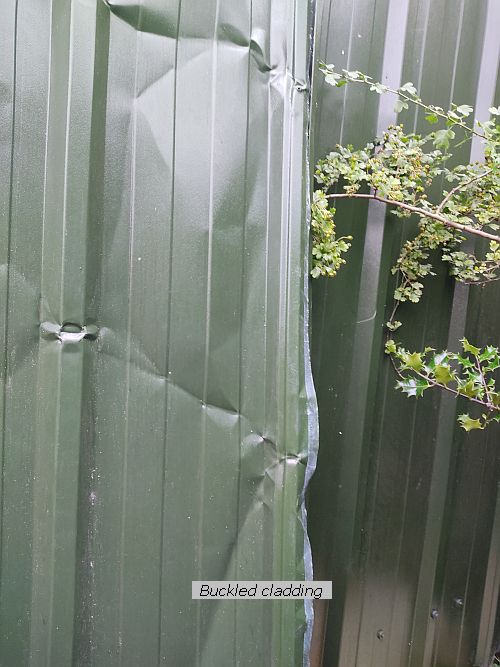
The more we consider the damage done the more we feel sure they expected to be able to peel up a couple of foot of cladding panel at the bottom to form a low entrance way, and it would be hidden by the undergrowth and not be noticed. As it was the concrete panels put them to a great deal of more trouble and as they hadn't broken the panel off from the mid height purlin, had squeezed in between the top of the panels and the purlin, giving them a gap of barely a foot, maybe less.
When I ordered the cladding for the building (years ago) I screwed up. Each sheet must be specified individually, its length, its hand (is it to overlap the one on the left or right?) and how the bottom is finished. Somewhere along the way I miscounted, so had to go back to Tata at Shotton and order more. But they had a minimum order, so I could either order just sufficient to complete and it be far more expensive per metre, or I made up the order to surpass their minimum with a few extra to cover for repairs or other contingencies. They have lain, ever since stacked up at the end of the shed and I hoped they wouldn't be needed, but here we were taking advantage of one to replace the damaged panel and make the building reasonably secure again
It took our contractors most of the day to extricate the damaged panel and slide in the replacement having adjusted it to fit, and secure it. Andrew replaced all the razor wire and patched things up as best as he could. I couldn't help as I was on my way to Cardiff to uplift another 08 and bring it back north. Not much to report there, at exactly 6pm we lined up over the track, I put out my cones and we cracked on through the occasional shower, hitting the road again by about 7.30. A minor aggravation was the winch suddenly seeming reluctant to pull, but it all cleared up on its own.
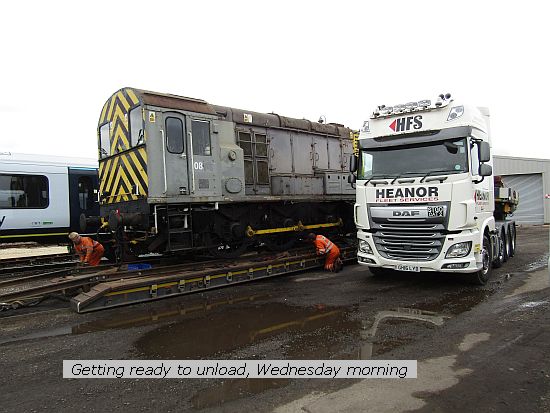
Tuesday and the loco was unloaded at its destination. For the first time I introduced Adam to my bluetooth headset and together we backed the trailer out and round, talking all the time - often Adam telling me to start doing this and me replying that I already was! He agreed it was effective - full communication and both of us working with both hands free. After they'd gone I wandered up to have a look at another loco which I had instructions to move shortly: ironically it was one I had moved before - more on that next week.
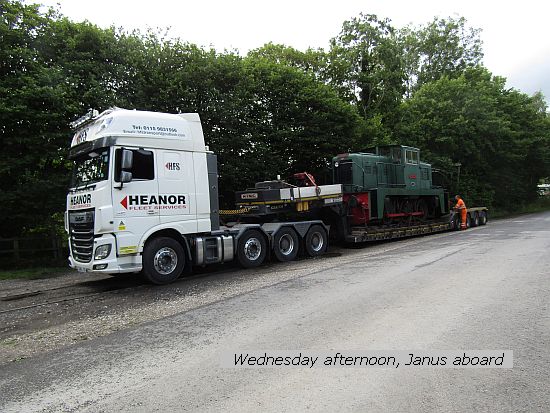
I drove back to Rowsley and met up again with Adam, to load the Janus loco for its return home. The loco was duly loaded, but not before Adam questioned whether it would fit. Normally if there is any doubt I do a quck CAD drawing of the loco and super-impoose it on a CAD drawing of the trailer. I hadn't even thought about this job properly - it came down on my 3 axle (T1) but ramped slightly. It was going back on Adam's 4 axle (T3) which is longer in the deck, so it hadn't registered as an issue. Now I hurriedly got out an old-fashioned surveyor's tape and said it should fit - just. (Otherwise we'd have had to lever up the rails and pack timber under to give a bit of extra length to the slope at the back of the trailer as we had with the 14). It fitted - and just was the operative word - and Adam headed off north, to park up on the A66 somewhere.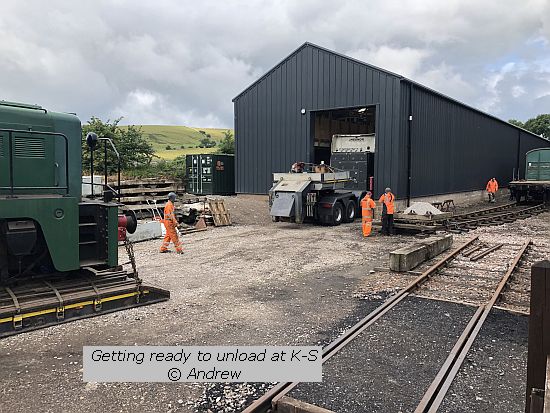
Wednesday - Andrew had taken the day off and was covering Kirkby Stephen so he could see his loco loaded and on its way. My first port of call was Sheffield to swap a repaired ram for a seized one from the crane. Then it was over the hills to south Manchester, to an auction house where I collected a handful of power tools as we start to replace what the b****s took. Well organised, a doorway to a warehouse was cordoned off, you presented your paperwork, they went and picked it, rolled it out to you on a trolley, you checked and signed for it, took the trolley to your vehicle and transferred it, returned the trolley and on your way. The next call was over near Jodrell Bank. Andrew had had stuff from there before and recalled that you parked near the entrance and had to walk over to the other side of the site to find the office and collect a release note to get anything. I duly parked, and set off looking for an office. This had been some sort of nursery-cum-garden-centre. Everywhere was greenhouses with tired signs pointing to a cafe or some other facility, but not an office. Eventually I entered a greenhouse and asked a group of staff, who after mocking my refrence to a 'release note', sent me 4 greenhouses back to a guy in a green tee-shirt who showed me to the 3 lots Andrew had won and invited me to sort myself out.
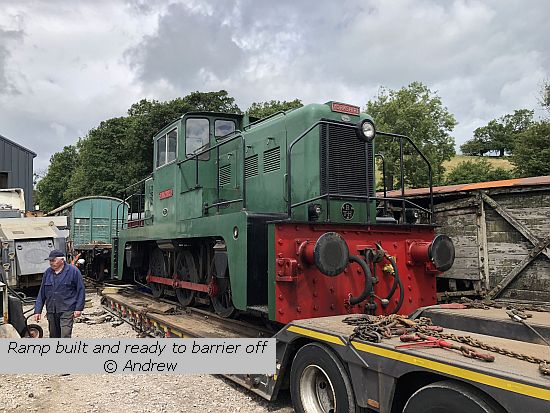
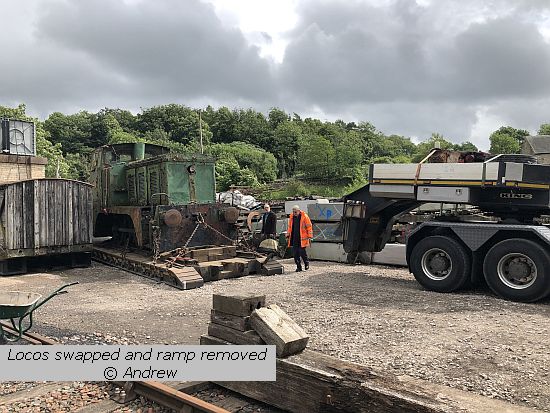
So after a pleasant run round Andrew was muttering he'd had the rough end of the stick. What should have been a straightforward unload and reload, taking maybe a couple of hours had been complicated by the rather awkward access at K-S and that it was on a curve made it worse. In the end it had racked up 6 hours before Adam was on his way leaving Andrew do do some familiarisation and explain to their CME some of the issues we had found but were leaving them to deal with, notably the amount of oil being thrown out by the No.2 end exhauster.
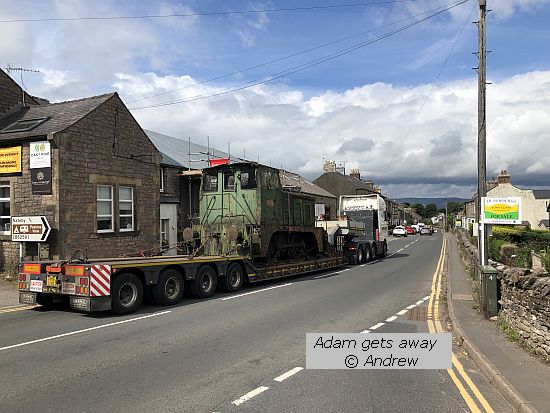
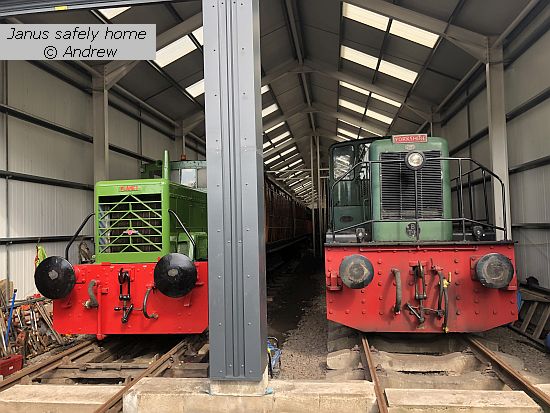
Meanwhile Adam, running low on hours and anxious to get unloaded before dark was pushing on south. I had plenty of time to get to Rowsley, draw the token and bring Bagnall the Barclay around ready to draw it away on arrival. And what is 'it'? One of the last Yorkshire locos built was 2952, a 45 ton 0-4-0 for Workington steel.I may have seen it working on one of my TH -period visits, though I remember most the waves breaking on the side of the steelworks embankment and spraying everywhere with saltwater.
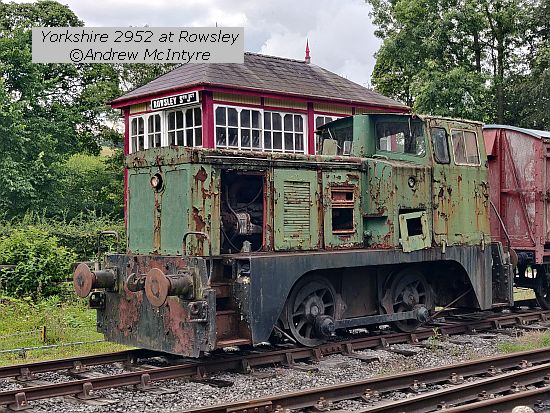
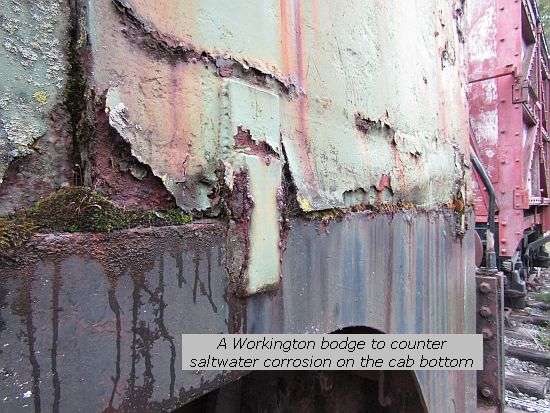
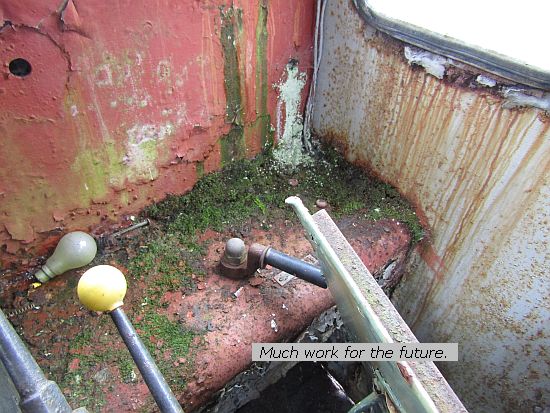
No wonder there is so much corrosion around the cab and casing panels. Anyway, it had been bought from British Steel and brought to K-S, where it was remembered as a powerful loco with a bad rear end oil leak. Andrew had bought it over 3 years ago but it had been agreed that it would stay on site until we returned the Janus. The loco was hurriedly unloaded so Adam could get home, then put on the headshunt for transfer down to Darley later.
First thing Thursday I was back at the shed to meet up with a rep from a local security company to review options for installing alarms, after which it was back to admin work for then and Friday, especially getting things organised for next week. Saturday, and the weather started raining and hardly let up all day. Andy M had joined us and in between showers spent time on the Hatramm trying to get to the bottom of the fault that has plagued the straight air brake control. To recap, because the Hatramm was built as two coupled vehicles, rather than have normal straight air brake valves, it has a brake frame for straight air and another for train air, operated electrically from 3 position joysticks in the cab.
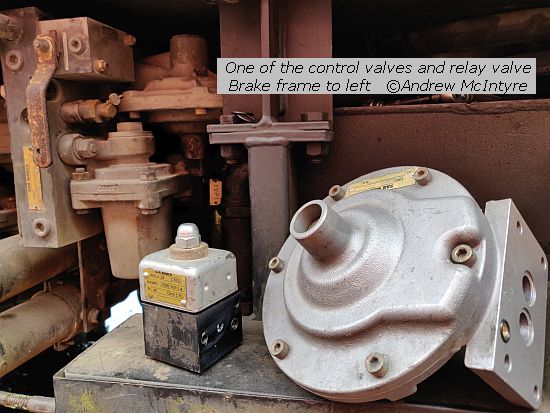
The air supply for the straight air starts with a non-return and a regulator then passes through two valves with restrictors and a capacity reservoir such that both valves must be energised to release the brake, one only puts it into 'lap' and both off gives brake apply. This is the same basic concept I have installed for radio control for years, and like me, these valves then provide air for a relay valve which will then maintain the pressure against any cylinder or other downstream leakage. The train air side also feeds the brake cylinders, through a double check or shuttle valve. We had had both the 'put in' and 'allow out' valves off and Andy had earlier made temporary manifolds to test them on, so we knew they worked, but try as we would the brake went on and stayed on. He even tried exchanging the relay valve to see if that made any difference, and as access to the air brake frame is somewhat cramped, Andrew gassed the corroded bolts that held the floorplate above it down to improve access and light. Meanwhile Andrew and I were doing some testing with the crane. The fact that the rear wheels are also steerable (by a sort of 'tiller') means that it can turn on the proverbial sixpence and crab at an angle to move into a better position. The rail ramp sat on T2 was moved and a part of it transferred up to the other side of the shed. It has begun to reveal some issues that will need attention (a noise from the slewing drive, for example, and a tendency to cut out when idling which may be a blocked fuel filter). It definitely needs wing mirrors! As rain intensified (and indoor work became preferable) Andrew cut a plate to fit on the side of a stillage outside to hang 3 link couplers on. But a last thing test of the Hatramm showed we had not progressed significantly. You could get the straight air to apply and release up to about 2 bar, then the brake went up to 4 bar and stayed there. As part of proving it wasn't anything to do with the train air side (some back feed through the shuttle valve perhaps) we broke into the connecting pipe with the intention of adding a gauge, but heavy rain got the better of us.
Sunday, we had got so far that finishing getting the gauge and doing a test was completed but I had by then decided that it had to be the valve admitting air to the brake pilot that was at fault and was not surprised when the test confirmed that the brake frame performed as before. I argued that it had to be that valve and the fact that the brake pressure rose to 4 bar (probably the regulated supply) was evidence. But we had had that valve off several times and it worked ok on the bench - but, I argued. not with pressure 'downstream'. So we set up a test rig with an air receiver, a gauge and a drain valve and proceeded to power the valve so as to fill the reservoir.
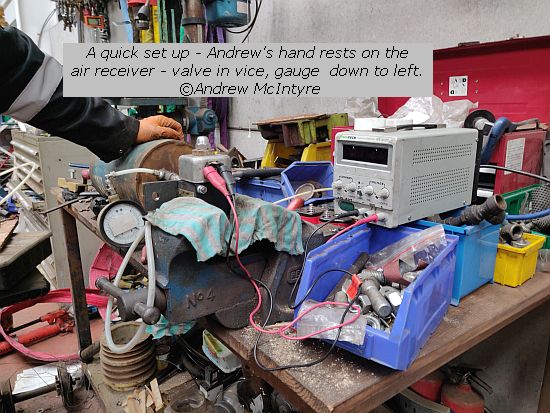
And sure enough, once you got to about 2 bar the valve simply failed to close as it should and air proceeded through the valve to the limit set by the shop supply. Now with proof positive the internals of the valve were scrutinized and eventually a subtle difference between a part we had earlier used to replace a scored one in the valve was detected.It took next to no time to effect an alteration and the valve started behaving properly and Andy M was left to put it all back together again. Sunday's crane familiarisation was by contrast, mundane. On the one hand I tested the charge circuit and found it wasn't so the battery was put on charge for a few hours. We drove the crane up a timber ramp to gain height to get the stabiliser ram back in place, reconnected and tested it. Andrew discovered that at some time the key had broken off in the keyswitch but still worked (most times) so I opened up the control panel and removed the old one ready for replacing it. Like most industrial machines of its age, the wiring inside has lots of crimped cables finishing in mid air and signs of components no longer in use. The forklift is not dissimilar (though simpler) and I fear having to rewire it sometime in the future. Tony S was also with us today, and spent most of the time seemingly under his railcar having found it had only a partial set of brakeblocks and those it had were well worn.
So that's about all there is to say this week. Oh no, sorry, there is the little matter of the Police. They did get back to me - Tuesday I think it was - and explained that the rules set somewhere on high was that if there was no CCTV or blood evidence to collect, then they did not attend. No point in looking for fingerprints as they probably wore gloves, and while she was apologetic, it did seem rather a self-fulfilling prophecy - if we don't look to see if there's any evidence then we won't get any and without any there's nothing we can do therefore assume there's nothing in the first place.
And with that defeatist appraisal I'll leave you to wonder about next week. I'll be here - I think - as usual. See ya then.