
Of what the weighbridge lady said
19th February 2023
Now don't start getting the wrong idea...
It's going to be a bit of a transport extravaganza this week as I don't seem to have taken any pictures around the works, but having clocked up another 1100 miles I hope you'll forgive me.
It's a sad fact of modern day living that you spend far too much of your time in traffic jams. From here to Long Marston is about 95-100 miles depending on your route, and I ought to be able to do that in just over 2 hours, but most mornings it has racked up nearer 3 as I sit cursing in queues at places that didn't seem to be a problem the day before. Well that's not entirely true, there are some regular choke points but they don't seem to be consistent. Monday of course is always bad, as are Friday afternoons, so as I headed down on Monday I tried to console myself that today was the worst day and as Adam had a much shorter journey (but was more constrained by available routes) he seemed to get there first every day, though fortunately, as we had to wait for gates to be unlocked, more than once I was right behind him when he got on to site.
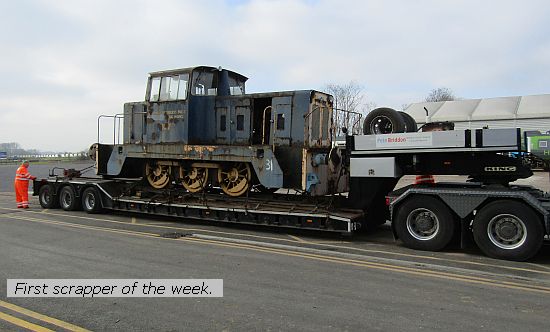
Anyway, first loco on Monday was another Hunslet 0-6-0, a survivor of the Shropshire Loco Collection that was finally to meet its demise. Off we went to the scrapyard, me ringing the weighbridge lady to give her our ETA in the (forlorn?) hope that it might get us some priority when we got there. No such luck, five minutes before Adam, Allelys rolled up with a hopper wagon to scrap (RMC17229 for anyone interested) and we had to wait for them to unload, though fortunately in their case the wagon was light enough to be picked up by the scrapyard's Kalmar and lifted straight in to the 'burning area' for them to make a start.
This didn't help our timetable though, as having unloaded (and been weighed again) we were off to Cardiff to pick up an 08. We were half an hour or so behind schedule getting back on the road but still were entering site in Cardiff at 18.10. The loco was sat ready, and against our usual 90 minute allowance for loading we were up and away, heading out past the security gate at 19.35.
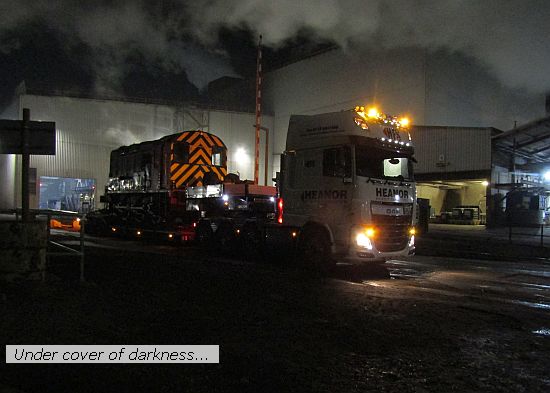
I aimed straight for home, getting in just before midnight. Adam and Ian got as far as MichaelWoods services north of Bristol before running out of hours and parking up.
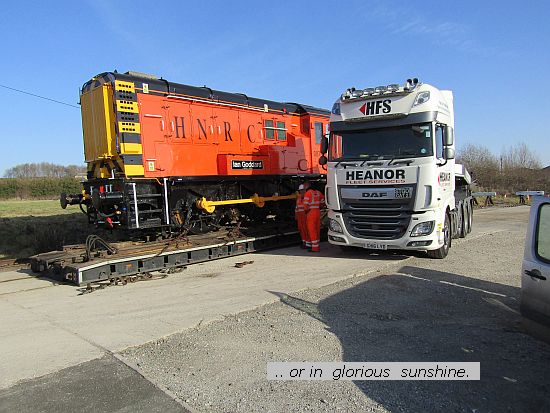
Tuesday, and I had a later start and a bit of time for bits and bobs before heading over to Barrow Hill for the unloading. Off came the defective 08, and on came a freshly painted one to go onward for Worksop. I have a quick and direct route to Worksop, but abnormals must approach from the eastern side and it is a rather circuitous route even to get there, so I knew I had plenty of time in hand. The security gate no longer responded to the numbers I had on my crib sheet so instead I was formally given an induction and issued with my very own top secret access number. Yet another 4 digit PIN to retain. Adam and Ian arrived and as we unloaded we chatted with an employee who turned out to be a Peak Rail volunteer from 25 years ago who had ceased going as Jackie Statham expanded her control (and to think that when I suggested that she had driven volunteers away she suggested quite firmly that such was defammatory). Late afternoon we went our seperate ways and I got an early night for another day dodging the traffic jams down to LM.
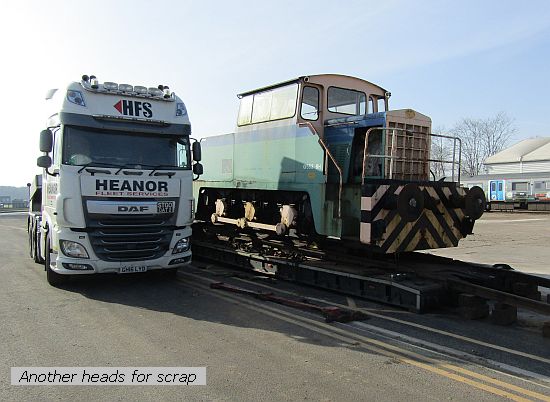
Wednesday it was time for an old fashioned Vanguard. I was worried about this one - several early locos to this basic outline were rebuilt on Sentinel (steam loco) chassis and were about 55tons, and the buffer beams on this one (about 8 inches thick) did make me wonder whether this was the same. But we tried it and the hydraulics coped without undue difficulty. Of course in the early days of Kilnhurst works, Hills' only had a pair of 10 ton overhead cranes with 5ton air hoists. In other words, if you had 10 tons to lift, you could use both cranes on the air. If you had 10-20 tons, you had to do it on the cranes themselves, manually! To build a new frame, you started upside down, i.e. lay out the running plates, then add buffer beams, side frames and stretchers on top. With enough weld in place to stop it falling apart, you had to lift and put it on turnover stands and turn it to the best angle to get all the welds completed. Then you often put all the underframe pipework and valves in (easier access for manufacture but not so good for the poor slob who had to maintain it later) then finally turned it the right way up and wheeled it. This of course meant that the frame could not exceed 20tons and does make me wonder whether the buffer beams on this were added after.
Later TH designs used a twin running plate: the running plate was laid down as usual, but after turning over a second layer was welded down on to the first and this practice continued until after the new shop with its 25ton electric overheads became available. Either way the Sentinel rebuilds had not had to be turned over so 55tons finished gross was no impediment: this 'copy' was only 48 in working order.
There are two weighbridges at the scrapyard - the first day we were directed to the 'exit' weighbridge as it was longer, but even then the tractor and trailer could not get on it together so we have had to detach tractor from trailer, drive it off the 'bridge, and after weighing re-attach, both on arrival and before departure. Seeing that the Entrance weighbridge was actually long enough for the trailer, I asked the nice weighbridge lady if it made any difference and she said no, so on the Wednesday as the Entrance one was free but the Exit occupied, I directed Adam on to the Entrance 'bridge. The weighbridge lady looked at little shamefaced - the trailer had 'maxed out' the weighbridge. She now admitted it was only 40 ton capacity - loco and trailer were way more!. Adam and Ian had to re-attach the tractor, move it across to the Exit weighbridge and go through the rigmerole again which did nothing for tempers!
And on to Thursday. I tried another route permutation and I think this was the worst day of the week but as much of that involved the M42 Adam had copped for it too. It was all the more galling as that was the day we wanted to get through quickly, discharge at the scrapyard and head back to LM to get another loco to avoid suffering Friday traffic. This collection though was an EE 0-6-0, similar in type to 1197 at Darley Dale (or 1120 that recently returned home) and had once been part of the Rutland Railway Museum collection.
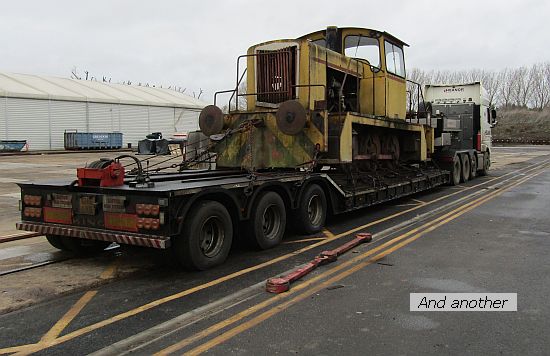
When we got to the scrapyard we were asked to park up as they had another heavy lump to lift first. The RMC hopper had all but disappeared into pieces, but an artic with a big machine on patiently waited. Eventually the big Kalmar ambled down the yard and lifted this off and straight in to the burning area, we got the nod and set up to unload. It seems that at this point someone was flying a drone nearby and as we set up a snap was obtained (see https://www.flickr.com/photos/robmcrorie/52696082365/ ). I was wearing a blue hard that so that might be me but is probably Adam.
As we traverse the yard, Ian and I walk ahead picking up anything that might puncture a tyre and throwing it out of our way, and apart from the first visit (which wasn't a tyre anyway) we have been succesful/lucky. That Thursday our luck ran out as we backed in to somewhere we hadn't been before after the Liebherr's 5 claw grab blew a hydraulic seal and had blocked our exit. We didn't know until later that one tyre picked up a bolt and punctured, but it wasn't the only frustration as we were way later than planned. It didn't matter, a phone call to Long Marston confirmed that the loco we planned to collect next wasn't out on the loading pad and wouldn't be that day, though they did 'guarantee' 10 o'clock Friday. We gave up and headed back.
Friday, due not until 10 o'clock I tried the Leicester/M69/Coventry route again - it had been a bitch on Monday but being later in the morning it was almost clear and exactly 2 hours from leaving Darley Dale I was but 3 miles from Long Marston. I even beat Adam and Ian, who had had an equally easy trip and stopped for 'breakfast' some miles before. We were on site for ten past ten but the pad was still empty: it seems that instructions to get the particular loco out had not been passed down until that morning. We set up the ramp and waited. Adam and Ian poured themselves a coffee. Eventually one of the Vanguards towed it over, handed it to another that propelled it up to us.
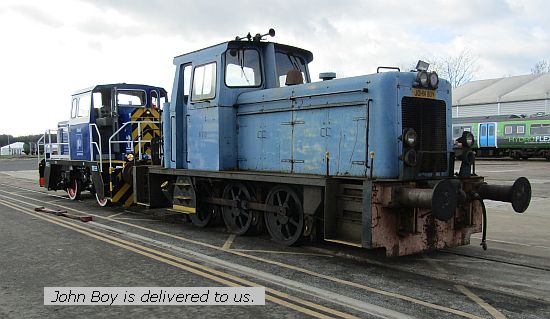
So let me introduce you. Last week we took two Barclay 0-6-0s for scrap, but Andrew had always had his eyes on 873 and a deal was finally struck a couple of weeks ago. It was the last of four ABs built for the BAOR (ARMY 870-873) in 1966, in this case about October, when it was delivered to the Longmoor Military Railway ostensibly for trials. I say ostensibly because it stayed at Longmoor for the next 15 months. In spring 1967 it was on display at the Aldershot Army exhibition, and in June it was in operation at the annual Longmoor Open Day. Finally in February 1968 it departed for Germany, where it was named 'Bagnall' after the Commanding Officer of the 79 Railway Squadron, Roger Bagnall. Yes, a Barclay 0-6-0 named Bagnall, I don't need to make this up. As BAOR ran down and the locos had been superceeded by later Barclay and Hunslet locos, (such as our very own 'Adolf' though hardly recognisable now) 870-873 were demobbed and ended up at Queenborough Rolling Mills. 3 survived there and when moved to Long Marston, 873, having lost 'Bagnall' in favour of 'John Boy' continued in use as shunter until the Vanguards took over, when it was simply parked up. Indeed, we had found on a previous visit turning on the battery master that the cab lights would still shine. I recovered the batteries on Friday and brought them back in the van to see if they'll charge.
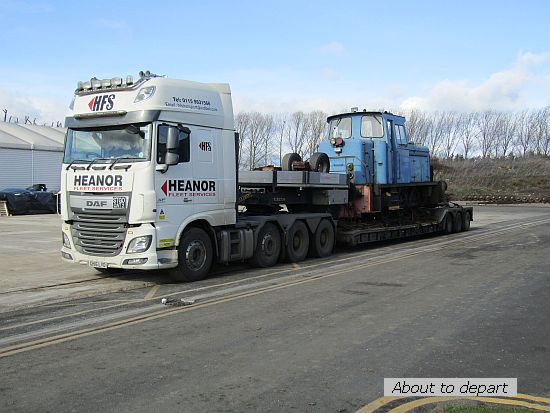
By the time we were loaded, it was apparent that Plan A: get off and unload at Rowsley that day - well no, that was actually Plan B, Plan A had been to load Thursday and unload Friday morning - wasn't going to work and instead it was agreed that Adam would head back to base and bring it up to Rowsley Monday morning. [Yippee, not such an early start!] I saw them away then turned north for Uttoxeter, where two new wheels for the trailer were sat waiting.
Saturday. Andrew had to take grandson home to his mother's and rather than spend the day alone at the shed it was suggested that I could use the peace and quiet and the kitchen table to carry on with software for the Hudswell. It was part done but still a lot to write. Sunday and globe-trotting Andy M, back from a week in Italy had checked he could spend a day with us rather than go home and Tony S was coming over to work on his railcar. Andy made a start on 144V, removing all the plastic bags that had been put on to protect the engine from the atmosphere, and re-routing the rear coolant connection to by-pass the converter heat exchangers that we had raided for their covers. Andrew had me doing some tidying with him first, but then we carried on with the Hudswell, attending to coolant leaks we had traced last week.
By mid afternoon the Hudswell had had its sump filled with oll and we dragged them both outside to be filled with coolant again. !44V seemed to have no leaks, the Hudswell's seemed to have cleared or be very minor. Having set up an extension cable to the Hudswell's cab, I was able at last to download the software: though as I don't get to do this often it took a while to find (a) where in the program I could change the COM port to where the interface had turned up and (b) where it was I could switch it from 'monitor' mode so that I could actually download the program! My early programming was on Eberle PLCs which had a step-counter function, very useful for creating stages during start-up and shutdown where conditions had to be met before moving on. But Eberle got swallowed up by GE and although I have used the latter's 90-30s since then (even 14-901 has one so that's 10 years or more) I have tried several iterations of creating something akin to Step Counters with mixed satisfaction. I thought I had cracked it this time, using a register in to which I added 1 at each stage, starting from zero at start. I thought I had, but the PLC thought otherwise, as having run it back in monitor mode my laptop revealed the counter happily racking on until finally stopping at 32767. It should have stayed between 0 and 5, so all the program lines that anticipated a 'true' condition within that range were left high and dry. I hate re-programming in a rush on the loco, it normally just gets me into deeper troubles. I could see that many parts of the program were indicating correctly, though the lines couldn't complete.
We decided to try cranking using a bit of wire! That revealed a squeak that took a while to pin down and turned out to be the water pump which although fully overhauled was now unable to rotate. An oil drip appeared from the sump. So a bit more time to resolve the software. We had planned to put batteries on and try cranking 144V's enginme, but Andrew is wary of old CAV fuel pumps that have a tendency to stick after standing for as long as 144V's has. In the end we decided not to try that day, and instead removed the last of the broken windows from 144V and drained the water from both locos before pushing them back in.
And that's about it. Tomorrow first thing John Boy is due to arrive at Rowsley and its charged batteries will meet back up with it. I may have to hot foot it off to Long Marston for another scrapper but only if they confirm they'll be ready for us to collect and the week will continue on that commute from Marston to scrapyard. Well it keeps me off the streets I suppose. Come back and find out what happened at your usual time. See ya then.