
Of things that spill
26th February 2023
Getting to know a new arrival.

By the time I got up to Rowsley at about 08.15 Monday morning, 873, aka Bagnall the Barclay had already arrived and Adam and Ian were busying themselves seperating tractor from trailer and assembling the ramp. I got my ovvies on and joined in as usual and soon the loco was off the ramp and sitting on Peak Rail rails. In the back of the van were its batteries, fresh from a long charge at Darley, and I manhandled them over and put them back in, liberally vaselining the terminals as I did so.
Although we had a copy of the driver's instruction manual for the loco I had neither the time nor foresight to read it over, so I stared at the control desk with a 'it's a Barclay, how hard can it be?' conviction. Problem No.1, Andrew thought that it needed a plant key, which for those uninitiated is a simple Lucas keyswitch that turns up on all sorts of things from our forklift upwards. There was a keyswitch in the desk but the slot was thinner than the plant key so that was not it. I looked around for a start button, but although I found a switch that needed to be used as an override for starting (because someone had written it so in white marker!) nothing in the way of a starter presented itself. I had discovered that the keyswitch could be operated with a thin screwdriver and was working my way through toggle switches when one made the starter crank and in a short time the engine was idling and air pressure slowly building.
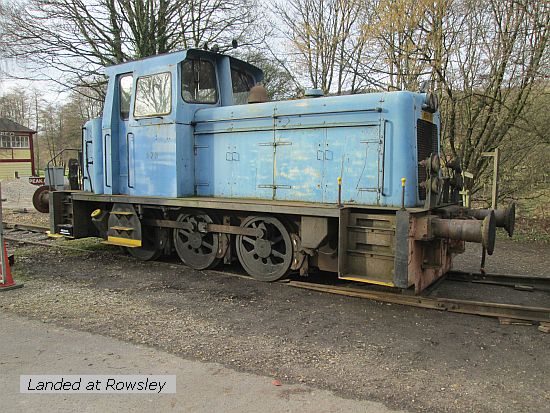
Slowly because despite a moderately large compressor there were one or two air leaks and until you have pressure, you cannot accelerate the engine as it has an air throttle. Eventually air pressure was made, the clutch engaged and the loco moved and enabled Adam and Ian to rejoin tractor and trailer. Another issue were the driver's brake valves, for this loco has no less than 2 Westinghouse type W's (though everything else is Knorr-Bremse design, even if Laycock manufacture, so may be replacements) which come together through a shuttle valve, but one is seized solid so you can only drive from one side. After it moved off Adam pointed out that a small pool of black engine oil had formed under where it had been idling so for that day it was merely parking it up in a location agreed with Mark Sealey and getting back on the road, as Adam and Ian were already on their way back to Long Marston for the next loco.
That was loaded and I returned home. Adam had a non-loco job to do Tuesday morning and Tuesday afternoon was collecting another trailer which he'd bought so the loco only arrived at Rowsley on Wednesday. Once again it was unloaded and this time the Hatramm, which had travelled up the previous afternoon, was on hand to draw it out of the way. Back off to Warwickshire to collect another Hunslet, leaving just a Sentinel which we planned to collect Thursday. So far so good and this was unloaded on schedule Thursday morning but in the meantime I had been advised by the customer that the scrapyard had put a hold on consigning other locos in until they had had time to make more space. This rather screwed our plans so I rang the management and it was agreed that they would accept the last one we had to move on Friday instead.
But I have got ahead of myself, for with both Hunslets off the plan was to haul them down to Darley for component recovery but before that I was asked whether 873 could shunt Mr Waterman's 47 and some other bits and bobs as E1 couldn't touch them and with the Sentinel out of action they were a bit stuffed. Happy to oblige, out came the screwdriver and 873 duly carried out the shunt with ease but leaving a trail of spilled engine oil everywhere it went. The origin was obvious - most Cummins have two oil filter combinations- a normal paper filter (in this case a line of 3) for main flow and a by-pass filter which is fed from the former and simply acts as a continuous catcher of particulates in the oil, returning it to sump. At that age, it is a massive by-pass filter that we refer to as 'the bucket' and like the old song about holes in buckets, it is about as easy to keep liquid tight.
The bucket on 873 was blathered in oil down its side. Later Cummins' after they went over to spin-on filters, used two filters of almost the same size one as main and the other as by-pass (so presumably their internals are different). Our normal practice is to replace the bucket with one of the spin-ons, assuming we have a suitable header to hand, so that was planned for early attention.
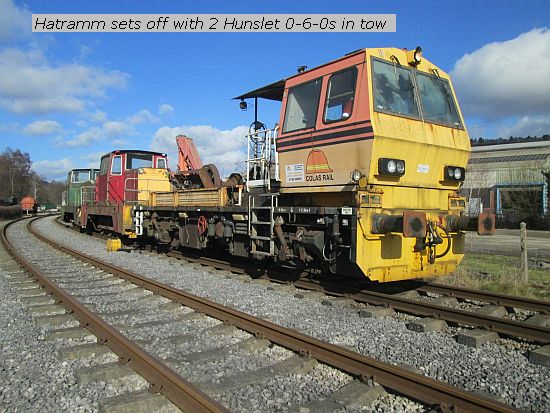
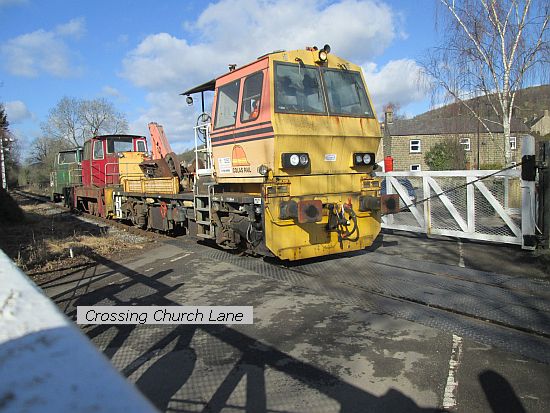
The Hatramm made a strange sight, towing two Hunslet 0-6-0DHs down to Darley. At Church Lane a lady driver rolled down her car window - 'I've never seen the gates shut for a train before!' she called out. I smiled sweetly and called back 'we shut them for every train....'
First thing Friday it was back to Long Marston to collect the last loco for the moment. The scrapyard was even more cluttered than before, though surprisingly quiet, but there had been a tamper dropped off since last we were in, taking up even more of the limited space and we had to unload not on to track but just rough concrete. I had thought, given the slope, that it might roll on this but having winched it to the bottom of our ramp it dug in as an innocent sailor might cling to the end of a pirate's plank in a futile effort to live. Brandishing our cutlasses and bottles of rum, we summoned Tony the Liebherr driver and it was dragged off into the abyss - or the burning area.
Saturday and we had a slightly later start at the shed. I set up my litle laptop in the cab of the Hudswell and started to load the latest version of the software into the PLC. Testing it still didn't seem to be giving me the results I expected. There I was with a loco whose engine wasn't running, yet the warning lights for low oil pressure and low air pressure weren't coming on. The PLC controlled these (the switches themselves were working), so evidently my program lines weren't displaying them because conditions I had inadvertantly invoked were not allowing them to. I started re-programming 'on the loco' which is something I hate doing as you cannot see 'all' the program at the same time, but broke off when Andrew needed me. Together we took off the water pump, finding that somehow the pump was contacting the back of the block and that had prevented it from turning, as it rotated as soon as the screws were eased. Andrew made up a new joint and we put it back but it was sticking before the bolts were tightened so the only conclusion we could draw was that the joint thickness was critical and as we had no thicker gasket paper to hand, a proper Cummins joint might be called for.
A couple of weeks ago I had bought a little radio control unit for the steering on T1 and over the last few days I had decided where and how to install it. A piece of thin plate was therefore cut and rubbed down to receive a coat of Rustoleum and left to dry. During the week I had acquired an old tub of Clare's 'proper' track lubricant which is a black sticky goo not as flow-able as oil but not as gelatinous as Motak. When I had been lifting it into the van the handle of the tub fractured, so I was aware that the plastic of the tub might have- shall we say - become brittle with age and exposure. Thus I set off up the yard Saturday afternoon with the intention of trying it out on one of our turnout's sliding chairs, holding the tub with both hands having eschewed the idea of taking it out on a sack truck. Just past the first turnout there was a report and I realised the tub had cracked down one side, so hurriedly put it down and started scraping the emerging goo back into the tub. It took me a while to realise that far from just a minor crack, it had split all the way down one side and broke a piece out the bottom, so the goo was spilling out faster than I was scooping it back in! Desperate measures were needed and an alternative tub sought from the shed, by which time the goo was spreading over sleeper and ballast though I had had presence of mind to turn and lift the tub so that its split was now resting on a rail head. A recovery operation was then carried out, after which all the turnouts received a generous donation of lubricant on every slide chair worthy of the name.
To finish off my rather unsuccesful day, I put the power back on the Hudswell and the audible alarm screamed at me for no apparent reason. It hadn't before so I must have done something in my last 'improvement' in the software that I hadn't tested when Andrew had called me, but what I couldn't recall. After eating at home I set up the computer and spent the rest of the evening studiously going through and improving a large number of the program lines.
Andrew's car (a VW Golf) failed its MoT early in the week - it's not old, it's not decrepit, but it failed simply (and only) because the rear 'fog' light won't illuminate. It went back in on Thursday and the garage changed the switch, checked the bulb and wiring and could find no defect. But as the MoT basically says if it has got one, it must work, they were unable to pass it. Now, I think these rear high intensity lights are a confounded nuisance. People turn them on in the slightest mist - or worse stiil rain - whereupon they are so bright that those unfortunate enough to be behind will be less able to see their brake lights and if it is me, stuck behind someone for too long, find myself unable to look forward else start a headache culminating in a migraine. So I won't use the things and have yet to experience any fog where their presence would be beneficial. Andrew shares that view hence not realising that it wasn't working.
But if it was not the switch, the wire or the bulb, what could it be? It transpires that the lights are operated by Canbus which makes it a 'software problem' that can only be resolved by a VW dealer. He rang round and found all VW dealerships are booked well into March and in one case, April which is not much good when the MoT is about to expire and without that, he cannot re-tax it (also due imminently). So on the agenda Sunday morning was a go-through of our own and rig up a switch and cable to make it work the 'old fashioned' way. Breaking in to the feed wire ought to have the Canbus screaming that the bulb is defective but at the end of all this it doesn't, which leads me to the conclusion that the Canbus has decided that the vehicle hasn't got a rear fog light therefore it won't operate one and won't flag any error if it can't detect it as there isn't one to detect. Andrew just thinks VW might have written software that deliberately 'fails' after so many miles or months so that you have to take it back to a VW dealership for the proverbial 'switch it off and on again'.
In contrast my software rewrites I had made Saturday night seemed to be working as various lights now appeared on the desk display and monitoring the program revealed it had correctly moved through to the stage that it expected me to start up the engine. But for now that's where I had to leave it as we collected up some bits - including a large plastic builders-type bucket -and headed off up to Rowsley to remove the bucket filter
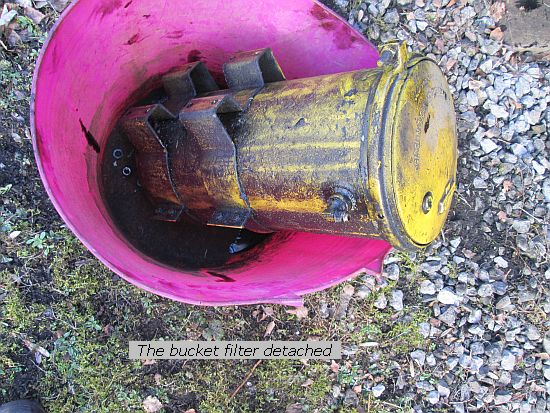
Barclays mounted the engine on 873 rigidly and as their silencer takes up most of the space on the right hand side, the bucket is on the left, attached to the flywheel housing. Hudswells always put theirs on the right, and with hoses long enough that the bucket can go and the spin-on be connected in its place. Not quite so with 873 and as we pondered what to do to keep it operational Andrew decided to mount the filter the 'other way up'. Conventionally you screw the filter up into the header, but the bypass filter drains back to sump and the bucket exit port is on the bottom. Thus when the engine stops, oil that has passed through the element is free to go on draining, and only a (small?) amount of oil is trapped before. A conventional vertically mounted spin-on though could not do so and so would be full of oil when you come to change it. But if the filter is mounted upside down, then once again the oil that has passed through the element is free to go on draining. The oil before the element is bound to come sloshing out as you unscrew, but as you know this and provide for it, and your hand is above the escaping oil rather than the oil flowing down over your digits, that ought to be no detriment. So we drilled the Barclay bracket to accept the three bolts for the spin-on header with the filter thus screwing down rather than up, only to find one hose wouldn't quite reach.
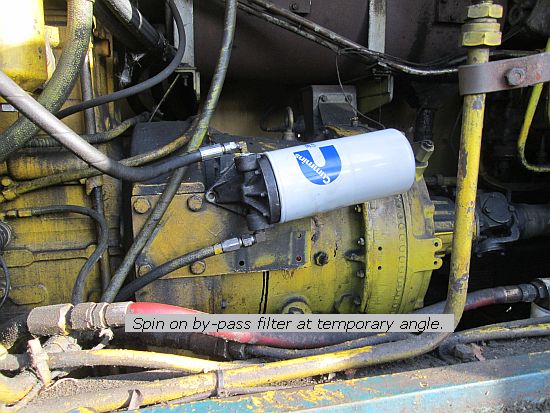
So for now it is held in by one bolt, the filter is at a down angle but not vertical and both hoses will be replaced (they're old and stiff) when we do a service. 873 was started up and ran up and down a few times to check that it was no longer leaving a trail and to convey our tools and the bucket (in its bucket) back to the van. I carried the bucket filter with it resting against my chest - suddenly I felt damp and found the bucket filter had revenged itself by spilling out of the inlet port through two sweaters and my tee-shirt.
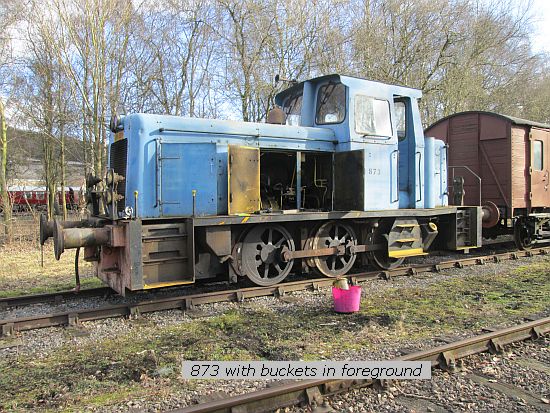
873 visibly leans to one side and the leading axlebox is at the top of the hornguide at the left. The spring hanger nuts are half off their studs on the middle spring that side so clearly it needs adjusting and fortunately we have a 1.5" Whitworth socket (about 62mm AF for those curious) in the workshop so that will be another job to attend to early on, taking the weight off with a jack and screwing the nuts down to level it all up. We can't get the lights to work (well at least it's not Canbus) and so far efforts to change it from low range to high have proved fruitless, but a big air leak appears when we do which might go some way to accounting for it. Back at the shed it was 4 o'clock and after a tea, Andrew did some tidying while I set about mounting the radio control for my trailer on to the bracket I'd made on Saturday with a view to getting it on and working soon. Andrew went out to the van to deal with the bucket and found it had toppled over during the short drive back from Rowsley and engine oil had spilt all over the van floor. We mopped it up with rags and Andrew disposed of the bucket filter casing in an appropriate manner.
No early start tomorrow. Two days to get month-end out the way then more loco moves for Wednesday onwards.Tell you all about it next week. See ya then.