
Of rain and getting wet
15th January 2023
Apologies to any of you reading this while or after being flooded. By comparison, I was just a bit damp.
Before I set off last Monday I set the trip counter on the van for the week ahead and as I came to a stand on the drive tonight it clicked on to exactly 1200. It started off with that early start and much excitement. I was on my way to Lydney to start relocating the class 315 from its temporary Christmas home at the Dean Forest Railway to the Llanelli and Mynydd Mawr at Cynheidre. I had told the class 315 group that we'd be there for 10.00 and did rather hope that they'd be ready then. As it was Adam and Ian rolled up at 09.15 and I didn't reach it until about 10.40 due to Monday morning traffic, roadworks and accidents. Indeed, Strensham, my usual rough 2 hour marker from home, was only achieved after 3 hours on the road.
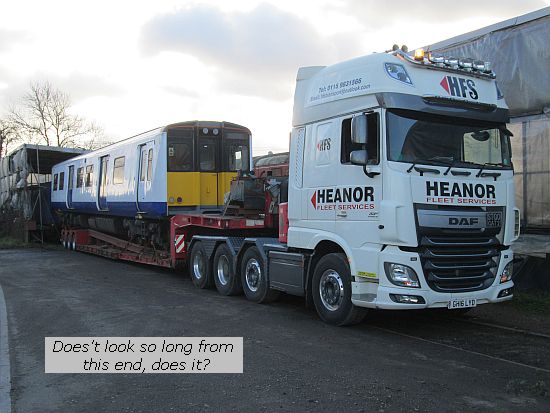
Before the class 315 could be moved it had to be split, which is unfortunately slightly more involved than unscrewing a coupler as there are multiple jumper air and electrical connections and between each vehicle in the set is a fixed bar coupler jointed to its neighbour with four big nuts and bolts - it goes without saying that these are tight. Our original schedule envisaged the first vehicle sat waiting for us at 10.00, loaded by half eleven or noon, and away to Cynheidre to get there maybe 3pm, offloaded and back that day: on that basis I had a hotel booked in Lydney for two nights. But the first vehicle - a driving power car - was only handed over to us well after noon. This was probably the worst vehicle of the four, for not only was it one of the heaviest (38 tonnes) but the outer end automatic coupler and its attendant multiple cable connector made it slightly longer and faced the neck of the trailer.
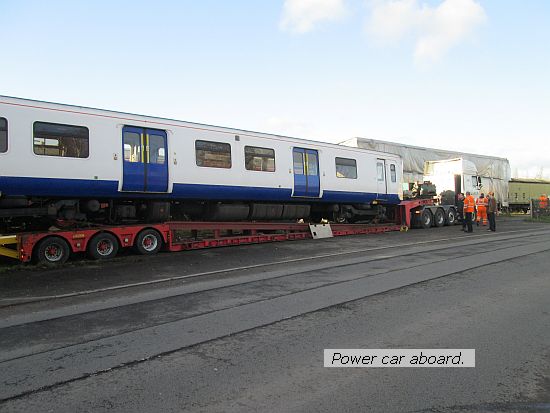
So all in all our planned loading time was a little exceeded getting it spot on in the right position and we hit the road about half two. As usual I went on ahead, but it was getting dark as I arrived at Cynheidre and after meeting up with Mark Thomas of the L&MM group, we walked up a concrete roadway to the envisaged unloading site.
Now, you may have noticed that it has rained quite a lot over the last few days, and even the concrete road - a relic of the colliery days - had rainwater run off over much of its surface. The top of this road ended in what I can tactfully describe as an area of potential mud surfaced in pebbles. I had made the mistake of trudging up in my driving shoes: at one point I lifted my leg and one shoe stayed stuck - and I don't weight 38 tonnes. The pebbles were the L&MM's attempt to make the ground fit for the low loader but while it might have worked with drier weather I had reservations as to what Adam would say when he arrived.
I spent quite some time in and around Llanelli when working for RMS twenty years ago but bits have changed - what used to be a roundabout surrounding a large church now is funnelled into single lanes at one side, and the turn off the A484 for Cynheidre, which used to be an easy 40 degree angle, has been 'squared' off and a pedestrian refuge erected in the middle. That may be traffic calming for most but probably raises the blood pressure of an abnormal load driver who has to negotiate it with a trailer bearing a carriage that is nearly as long as a cricket pitch. It was nearly 6pm when Adam finally arrived at site and we walked up that concrete road together (I put my boots on this time) to view the unloading area by torchlight.
For those of you reading this in built-up areas, light pollution means you never really have it dark - not pitch black all around bar the pool of light cast by your torch. We have unloaded at night (Dereham and Plymouth and multiple times in Cardiff) but not in this blackness. Adam decided that it was best to 'make a decision in the morning'. We detached the trailer and he and Ian set off for the nearest services. I meanwhile had a bed in a hotel 90 miles away, working to a different timetable so charged off east.
Tuesday, and after the earliest breakfast I could arrange I hit the road back to Cynheidre, though I had warned Adam that I probably wouldn't make it until about 10.00. He and Ian got there at nine: it had been raining steadily since about three in the morning, but by the time I reached Cynheidre it had just about finished. In daylight the proposed unloading area looked even less appealing than it did in the dark. I offered to drive the van onto the ground to see how it would behave: if it got stuck then the tractor unit could stay on the concrete road and pull me out. Adam declined the offer, instead we walked over the site looking for somewhere else, but apart from the 'regular' loading pad which was then occupied by a Pacer, there was nowhere fit or firm.
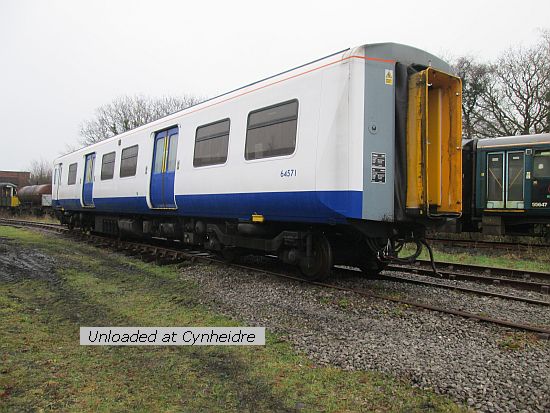
We had a pow-wow with Mark, suggesting that if he could get say 4 bits of bullhead laid out, we could unload it to free up the trailer and pick the power car up again once the ground higher up had dried out or had otherwise been treated. Instead Mark proposed that we take it off on the 'regular' pad, but that they couldn't accept the other three until some trackwork had been completed. We were resigned to the fact that the other three weren't about to move just then anyway so in reasonably short order the Pacer was moved aside, the power car unloaded and the lorry headed back to base.
I of course had to go via Lydney to check out of the hotel: though after 180 miles, damp tired and dispirited it was awfully tempting to say stuff it and have an early night.
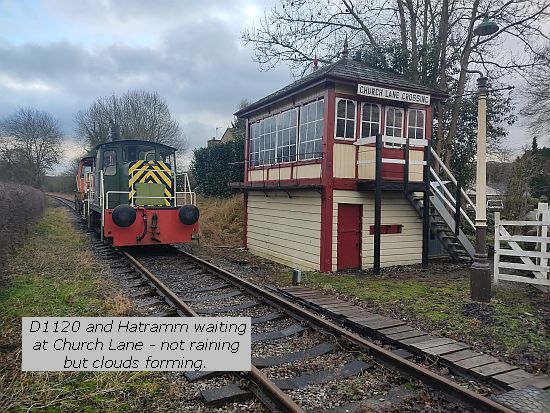
Wednesday. We had arranged that D1120, the English Electric Stephenson 0-6-0DH, be moved up to Rowsley ready for loading Thursday morning, but with Adam and Ian back Tuesday evening that had moved up to Wednesday afternoon. The Hatramm took it up and afterwards berthed in the Engineers Sidings at Rowsley.
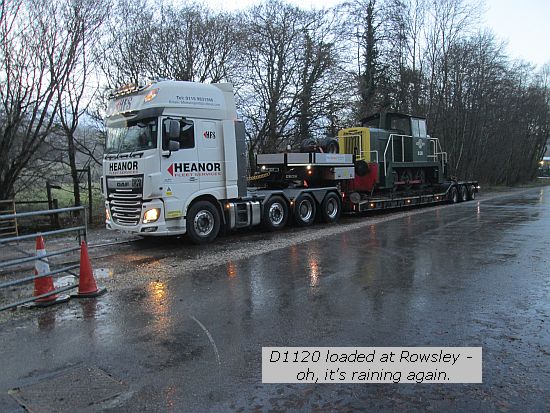
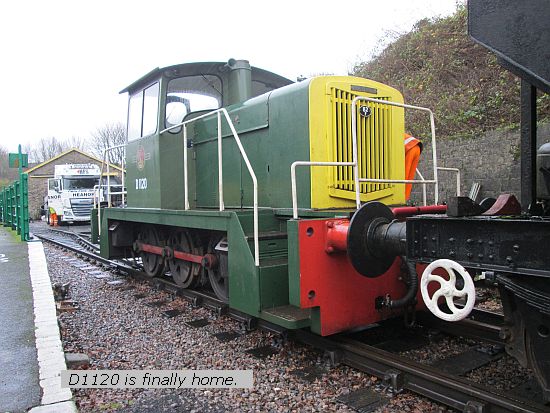
The lorry was back at the yard which meant that Thursday morning they could get on the road to Midsomer Norton nice and early. Given that I am some 40+ mniles further north this means I must either get on the road earlier or drive faster to catch them up. We hoped to be there for 10.00, but again roadworks and accidents intervened (a 5 mile tailback from a 3 car shunt south of Tamworth on the M42 being one) and we both got there about 11.00. The EE finally returned home, and having got the empty unit away I stayed on to go over the new equipments on the loco before chasing after them.
The next rendezvous was at Toddington, where I arrived a minute or so behind them at 3pm. Sat on the loading pad in the car park was a Yorkshire Engine 0-6-0DE. Built new for the Port of London Authority, it was later one of those sold to GKN for the Tremorfa steelworks in Cardiff, nowadays Celsa but once known to us as AS&W. I have spent many hours at AS&W too. With Thomas Hills AS&W were of course a customer for parts and service, but looking to cut costs we saw them as a candidate for 'Locomotive Management' but nothing came of it. After I left Hills I had more prospects - we demonstrated a radio controlled minilok road/rail loco there before it went on up to Sellafield. (Ironically today as Celsa they operate radio control locos and according to rumour, may be buying road/rail locos, but alas minilok is no longer with us). Later I was asked to put together proposals for remanufacturing the YE's - in conjunction with Cummins I submitted tenders to repower them with new superstructures, improved noise levels, and so on. It was deemed too costly and later they rebuilt one themselves using a Perkins 2006 and one of their engineers sneeringly told me how they copied my drawings and done it all so much cheaper. But all I had provided was basic GAs and a generalised description: turning that into metal was another matter.
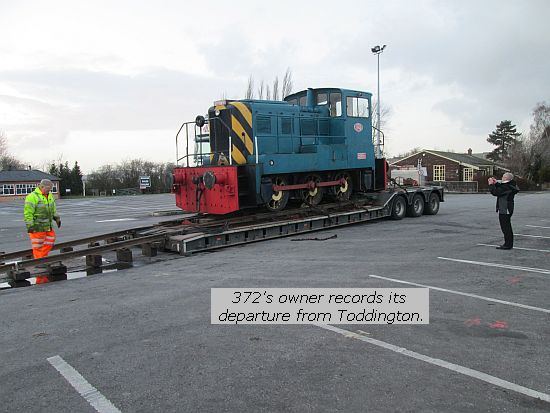
Somewhere along the way 372 once 'Bamborough' escaped to preservation at the G&WSR but we had already supplied a new axlebox and bearings for it and last year paid a visit to investigate a generator fault. It was now coming north to Darley Dale to have that attended to (we have already had the owner's spare genny in for investigation but that too is sadly down to ground). Loading went to schedule in a bitterly cold wind but at least it didn't rain and we were back on the road by twenty to five, Adam and Ian to base and me back home.
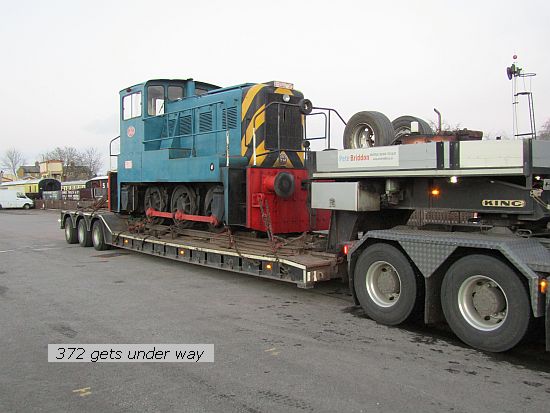
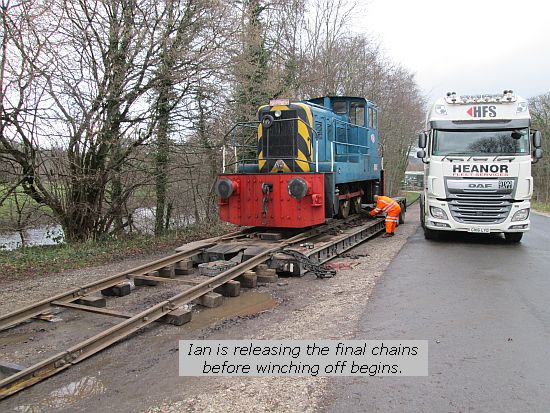
Friday: Adam said he'd be there for 11.00 and dead on time he rolled up, just as I arrived at the other side of the gates with the Hatramm ready to pull it away. Out came the rails, the loco was winched off and the Hatramm drew it clear so that the ramp could be dismantled and the unit re-joined.
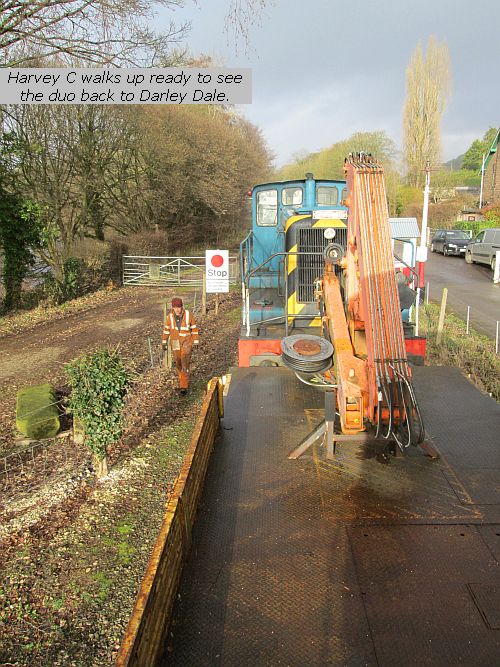
I waved farewell to Adam and Ian for this week and set off for Darley Dale with 372, having both roller bearing axle and side rod bearings, obediently behind.
And finally to the weekend. There is a big space in the workshops where the EE once stood but for now we are enjoying it while we progress other jobs. Most of our time has been spent on the Hudswell, where the cab heater installation has been progrssing. Originally I had planned to put in panel radiators and even got the original Hudswell mountings cleaned and reassembled although the rads themselves were beyond further use. Panel rads are fine but I am aware that with some locos the engine coolant heat isn't sufficient to maintain cab warmth. In part that is of course because drivers will drive with windows and doors wide open, a point I remind people when telling the tale of a loco we built at Hills which had an a/c unit on the cab roof. Customer required it, but there isn't an a/c unit in the world capable of warming or cooling the whole of Somerset or even the quarter mile or so of quarry surrounding the loco. The a/c unit wore itself out while on summer days, the amount of hot air generated by the Cat 3412 running at 750bhp and blown straight on to the cab front bulkhead by the rad fan was sufficient they say that thermoplastics in some of the desk gauges started to go soft.
But I digress. Cheedale had had the standard Thomas Hill panel rads and although (or because) Tunstead Quarry was said to have its own microclimate, ICI had fitted a Webasto or Eberspracher diesel heater to it (although some kind person stole it after Cheedale was sold but before Andrew collected it), the Hatramm has one, and I knew of a number of other locos with similar kit. By chance a few weeks ago I spotted on ebay what is I expect a Chinese copy of a Webasto or Eberspracher unit at a fraction of the price - in fact the price looked comparable with the cost of panel rads, valves, hoses, fittings and sundries, so on the spur of the moment I ordered one and will see how it fares.
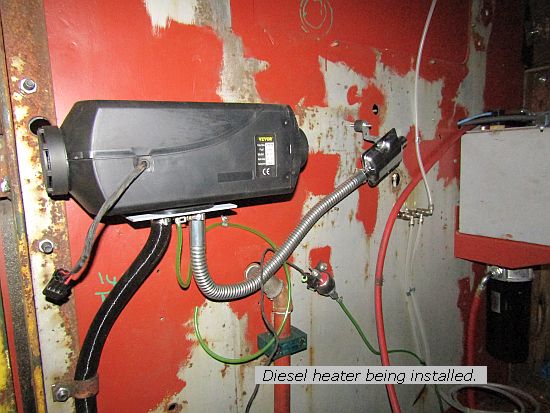
If you're unfamiliar, the 'black box' you see draws combustion air in through the black pipe on the left underneath, burns fuel and discharges it through the steel pipe you see on the right which with a bit of extra pipe I will discharge up into the 'stack to mingle with the main engine exhaust. Clean air is drawn in on the left of the box, warmed inside and delivered (through a duct that is not yet in place) out of the right end. The former torque converter fuel feed is now utilised for the cab heater.
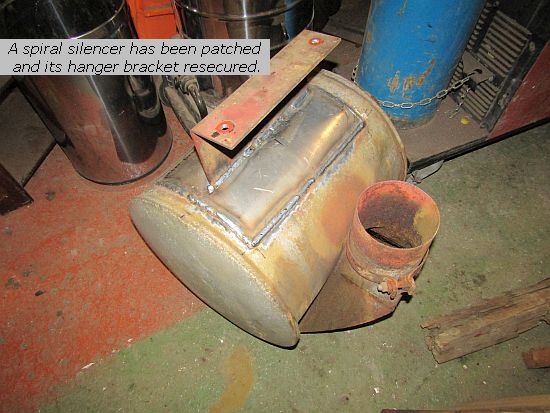
Andrew had also finished welded repairs to one of the spiral silencers fitted to Alstom's loco which involved a large patch where the original hanger bracket had torn itself out. But when he came to put it back he found another hole that wants plating over that we were unaware of, so that's back in.
I had expected to have the new door cut for the cab on the Hudswell but I haven't heard that it was ready and when I dashed down there Friday afternoon I was too late. But the new seals for the door apertures were put on and a start made by removing the old worn out furniture on the remaining door. Andrew had checked over underneath and he and Matt installed the starter motor ready to cable up. I had some amendments to make and a couple of holes to fill in the cooling system, blanking off the planned panel rad connections, installing the tap for the other end of the water filter and extracting a spare fitting from the thermostat housing and plugging off. The cooling system is almost ready as is the lube system. Andrew made up the final steel pipes to connect the air receivers and the compressors.
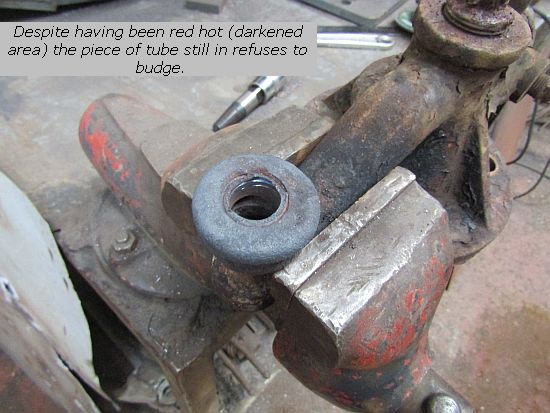
I was having a look at the sand ejectors and realised that the pipes hadn't been removed so much as smashed off, probably in the accident. As such there were bits of pipe still in three ejectors which needed extraction, so off came the ejectors and heat was applied - we even tried big Mak on the stud extractor to no avail. Andrew drilled them out and checked them through - the nozzles were u/s (bodged?) but by chance some I'd had made for a different job were compatable so we fitted those. I made up new joints and the rear pair were re-plumbed back to the sanding valve in nylon.
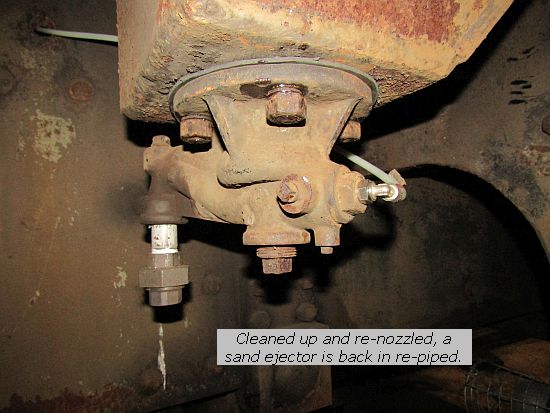
New pipes will be made up next week (when I've bought some more 3/4 pipe). And that about brings us to an end for his week's instalment. A little bit quieter next week maybe but we're hoping that the Hudswell will be very near to testing - first static air and then run the engine if my software is ready. Whether we achieve that you'll have to come back next week and find out. See ya then.