
Of Noddy's 2, 08s 3
5th March 2023
No prizes for spotting that Weekend Rails has at last changed its appearance after a long process of transitioning to the latest version of the software. It should certainly be easier to view this way and we hope you appreciate it.
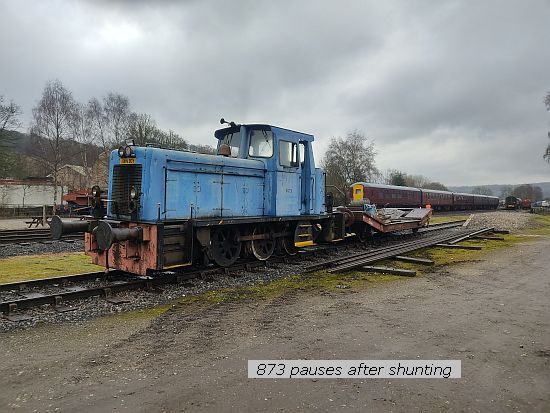
As I said last week, Monday and Tuesday had been left clear for me to catch up on month-end and I would like to say I was up-to-date with it all but I wasn't and still am not. Amongst many excuses was a request to shunt Rowsley yard on Tuesday as volunteer Dave Pendleton had the chassis of an 0-6-0 Peckett, 'Westminster' arriving on a Hiab lorry and there had been a request that it be placed on a spare flat wagon rather than blocks on the ground. The only suitable wagon was an ex MoD 16ft 6 wheelbase 4 wheeler so the word suitable must be taken on the basis that rather than it being entirely appropriate it was rather, available. Trouble was, it was down one of the sidings near to the LMSCA shed, with a lot of other things parked on top of it. With Ben as shunter and Dave running round assisting, the works train and then sundry wagons and coaches were drawn out of the sidings and placed to one side. As 873 has currently no (UIC) drawchain at the south end, and one of the carriages had none at the north end, the Lowmac was promoted to the post of barrier wagon. Here it is on the loop, having placed the empty wagon on the turntable road and put all the other vehicles back where they were before, and over to the left, the rear of the Peckett's frames in red oxide can be spyed on the lorry.
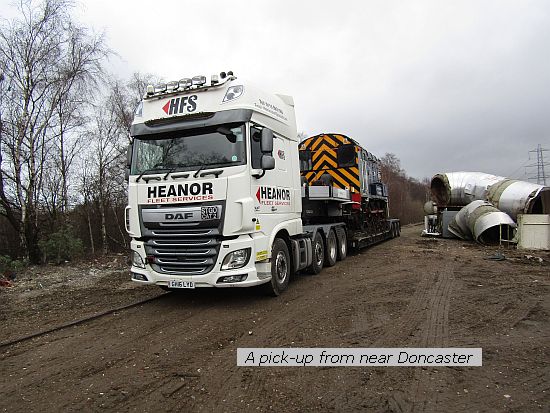
Wednesday and I was due to meet up with Adam and Ian to collect an 08 from near Doncaster. They arrived early which was fortuitous as the photos I'd been sent of the loading area had been taken before somebody at the site dumped a load of scrap in the way. I got there just as they were getting in to position.
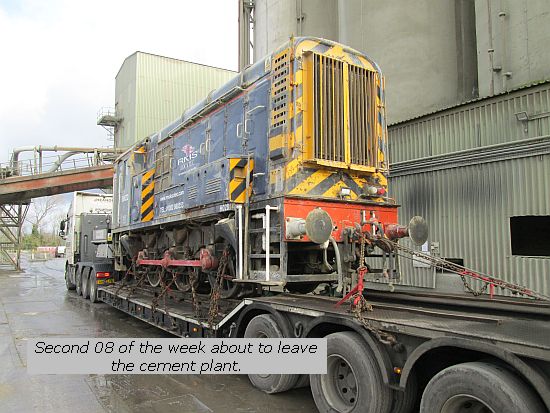
Once aboard we headed south to a cement works, where in a bitingly cold wind we unloaded the loco and waited while it went to fetch another of its ilk that had an engine defect. This involved negotiating some awful curves (08s are rated for minimum 3.5 chains) and propelling the dead one back I was quite amazed that they didn't buffer lock.
Once aboard Adam declared that they were going to see how far they could get before he ran out of driving hours, whereas I'd planned that they went back to yard overnight. Thus I had an early start while they had parked up at Leeming Bar. Not only that, I suffered traffic and roadworks delays so when I turned off the A1 near Darlington I phoned Adam who advised that they had just started to unload and there was no point in my continuing. Instead I headed back into Darlo, had a coffee at my daughter's and went on to Teesport, our next collection, in good time. Here there was a slight crisis. The place where we had been scheduled to load was on a dockside but the siding was accessed through a turnout in the middle of a road. To provide a smooth-ish surface some of the flangeways and such had fabricated steel components and one of these had lately cracked along a weld and been pressed down, resulting in the turnout not going over fully.
Just as Adam and Ian arrived at the security to get their passes, the loco we were to uplift and a second set off to another location which was even better as it had a roof over it. The snag with this building though was that it was frequented by pigeons. The Port authority had rigged up a loudspeaker to play the sounds of what I assume was some sort of kestrel or other bird of prey that regarded pigeons as a delicacy. It seemed to have no effect on the pigeons, but made me jump every time!
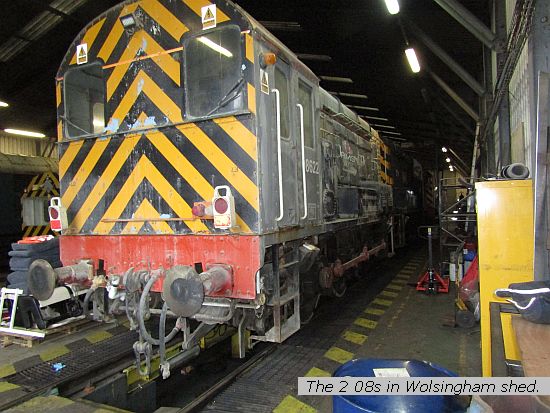
Back westward, I got ahead of the lorry and arrived at the unload point (Wolsingham) with I thought an hour or more in hand. It had been an early start and a lot of travelling and as I listened to a radio programme, I was dozing off when an air horn announced Adam's arrival half an hour earlier than I'd had expected. The loco was unloaded and it was started up to bring itself and our other delivery into the workshop.
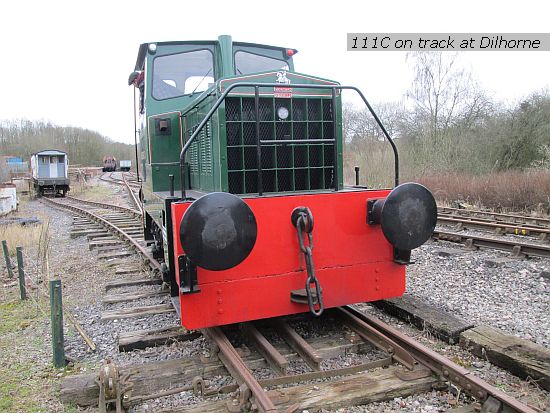
By contrast Friday was a much easier day. I'd said nine o'clock at Chasewater but with Adam always tending to be early, I got there for half eight. At first it seemed deserted. but then a forklift could be seen on the horizon, gates were opened, obstructions removed and I drove in. Phil Civil kindly offered a tea and we wandered around the shed until flashing lights alerted us to Adam's arrival. It transpired Adam had been ringing me but my smart phone had smartly switched itself to silent. We were taking Phil's Thomas Hill 'Noddy type' 4 wheeler to Foxfield, and a 25 tonner is an easy load after 48s. Normally access to Foxfield is at the Blythe Bridge end, but road closures meant that we had to go to the upper terminus at Dilhorne colliery. Adam's movement order envisaged him approaching from the north, but a Google Streetview survey we'd carried out suggested tree branches with low clearance, and memories of our last excursion to Foxfield, when trees had conspired to knock one of the air horns off Adam's tractor, were still raw.
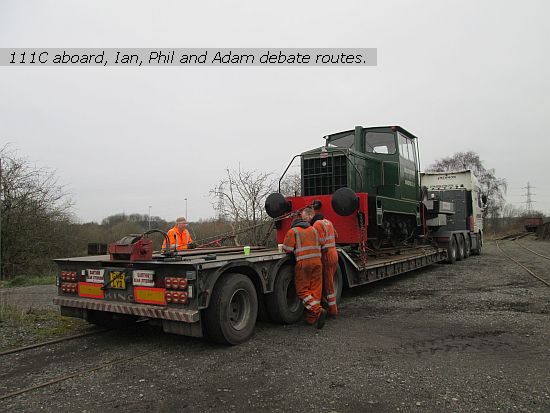
The alternative was to approach as if going to the normal end, then turn right followed by left and come through Dilhorne village, with a sharp-ish bend past the Royal Oak pub. I was sent ahead to scout both routes and determine the better. The official route was clearly superior, though in summer when boughs are heavy with leaves, it might not have been so good. I hung on at the junction to stop traffic while Adam negotiated the turn, then lead them down the lane to the colliery gates.
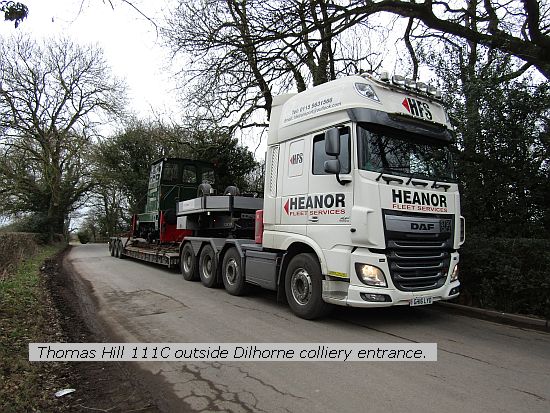
The loading pad at Dilhorne hadn't been used for several years and no-one had mentioned that there was insufficient room to get the tractor to the rear in order to power the winch, but the extension hoses were on board (I used only to bring them when I knew they'd be needed). The Noddy was winched safely down, and parked up to await a formal FTR and ballasting duties the next day.
Saturday and I had a long list of jobs to get through but we benefitted once again from Andy M's availability. A start was made on the 03, removing the old hydraulic oil reservoir and its associated pipework up to and including the two charge pumps, the shell cooler for the powershift and the associated bottom coolant connections for the engine. Off too came the drive ring for the powershift, which is much shallower than the ring needed for the normal twin plate clutch. Back on the Janus, the Bakewell-end nose cone was once again disconnected and lifted clear so that Andrew could line up and assemble a mounting bracket for the new alternator. He meanwhile had taken the van to Matlock to collect a new MIG gas bottle, but Energas have changed the pressures on their bottles and to go with that, you need a different regulator. Twiggs had the bottles but not the regs, so much of our welding had to be postponed.
Having come in from the cold Andy moved on to 144V. It was hoped to get the engine to run but the risk with any engine left unused for a number of years is whether the fuel pump is jammed. If jammed shut, the engine simply won't go but if jammed wide open, or most places in between, there is a risk that it will accelerate and go on speeding up until self-destructing. To protect against the latter Andy cobbled together an isolation cock in the line to the fuel pump as a means of calming it down by starving it of fuel. He then moved on to the Hudswell, drained the sump oil and made a new joint up for the oil suction line which had been dripping, discovering in the process that one stud hole had been helicoiled and that it was standing proud of the surrounding casting, hence the thin paper joint we'd used had no chance of sealing. A thicker rubberised cork joint seems to have done the trick.
We'd had a visitor first thing that morning when someone stuck their head in and asked if we had any Class 14s here. It transpired he was a died-in-the-wool BR-loco-only enthusiast so I showed him the 03 and '901 but he had no interest whatsoever in the industrials. Late in the afternoon another face arrived, this time a former Peak Rail volunteer from the early days at Darley Dale who got more of the official tour. On Saturday I had taken my laptop down to the shed but never needed it. Sunday I opted not to bring it and maybe that was a wrong decision. Andy and me set up and carried out a static air test on the Hudswell, finding a number of air leaks most of which were dealt with. I was able to operate the valve blocks manually - the gearbox juddered to and fro, the clutch came in on the cylinder (and the Vigilance alarm sounded by my ear) the horn functioned, etc. The transmission oil reservoir was topped up and the warning light extinguished, as did the low air pressure warning as the gauge needles moved up. The water pump, refitted yesterday with a new gasket, was also free to turn so things were looking good for a start up.
After lunch the Hudswell was drawn out and the cooling system filled. As the loco had since been drained of its air pressure, I was a bit surprised that the low air pressure warning didn't reappear but more that the 'System OK' indications were not coming on so the loco would not crank on the keyswitch. There were no obvious reasons for this but without the laptop I couldn't view the program to see what exactly was amiss. In the end we settled for cranking it again with a bit of wire (oh the shame) but not to run it.
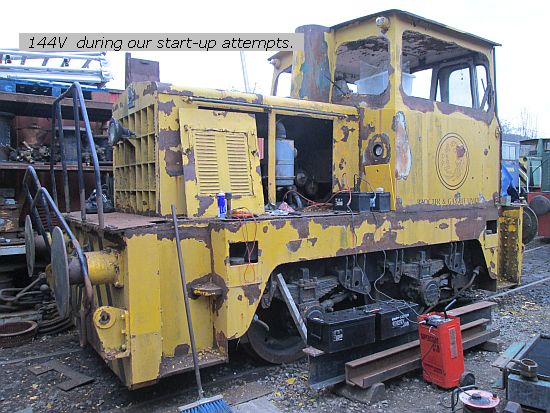
Attention turned to our Noddy, 144V. In addition to shutting off fuel we removed the pre-cleaner mushroom and with a bit of ply to hand, would be ready to cover the air intake and attempt to throttle it if the worst happened. We brought out a couple of batteries onto the running plate, cabled them to the starter and with another piece of wire, went for a 'go'. The starter clunked into engagement but wouldn't turn. A quck debate and a check of the on-load voltage suggested that the starter simply wasn't trying rather than the engine be seized, so another starter motor was sought from the container and swapped. This would spin the engine over and a healthy oil pressure appeared at the desk gauge but no sign of life. Pump linkages were detached, the pump bled (again) and eventually injector lines undone to see if the pump was actually delivering. After more crankings 3 or 4 of the lines became 'damp' and re-tightened up we got smoke out the exhaust pipe but not much else. As the afternoon drew to a close we concluded that the fuel pump, or maybe the lift pump diaphragm are at fault and only a change of pump to a known OK one will achieve action. Both it and the Hudswell were drained of coolant (plain water) in view of the imminent cold snap before being pushed back inside the shed, bringing the weekend and this report to a close.
This week there should be another 4 locos to move, but tomorrow Adam insisted that if I didn't need to go, I should stay home and meet them on Tuesday to help unload, so I'll feel guilty all day. What's in store? You'll have to wait until next week, same time, same new look Weekend Rails. See ya then.