
Of things doing their stuff
28th May 2023
Every time I log in to add the latest edition, I look at the counters for the previous weeks. Since the 'new look' Weekend Rails took over from the earlier incarnation, there has been a gratifying rise in numbers. So maybe I should take a moment to welcome those who now log on for a weekly look at this teeny corner of railway activity as well as thank all you regulars who can't resist their weekly fix. Counselling is available through the NHS, I'm told.
As usual, 'it never rains but it pours'. That's an odd saying when you get down to it. From a grammatical point of view it could mean there is no such thing as plain simple rain, that the term is obsolete and the correct description is that it pours, i.e. heavier than just rain. We of course take it to mean that when all you need is rain, or maybe that even a light drizzle would suffice, instead you have to get it in abundance, like that other proverbial assertion that buses never come on their own - or like Flanders & Swann once sang 'we like to drive in convoy, we're most gregarious...'. There has been a hiatus in transport work - I am not concerned as T1's repairs are incomplete - but I now have a programme that will keep me running around for a week or more and more on the horizon.
The parts for the T1 took up some time during the week: locating and purchasing a new slewing ring (a 3ft wide thrust bearing that forms the pivot between the trailer and tractor) has occupied some time, and not an inconsiderable amount of dosh, plus nuts and bolts that hold it all together, which needed renewal. The damaged air cylinder from the neck turned out to have a home-made clevis arrangement though being an ISO cylinder there are clevis's around that would have done the job, and finally the spherical bearing block needs machining out to accept a standard spherical bearing, and as machining continues to be a problem for me, will be the last major issue to resolve, so T3 will continue to be the primary choice for now. The forthcoming list includes an 02, an 14 and three 08s: more on that later.
The other railway item that has occupied me this week has been the Hudswell and its converter base pressure. Let me digress a little. A Voith transmission may have two or three converters and a fluid coupling - the 14 for example, has 2 plus 1 - and the mechanical output from each is permanently in mesh. The gear is engaged or disengaged by filling or emptying a converter or coupling so as to switch to another. Thus if the 14 is starting off, the first gear converter is filled with oil and doing its stuff, whilst the second converter and the coupling are rotating, but empty inside. Granted, the Voith converters are single stage (hence the need to have different mechanical ratios over the performance range) but Voith seem quite laid back about base pressure and cavitation. In contrast, Twin Disc are - I almost put paranoid but that would be harsh - strict then about the need to avoid cavitation. For that reason, you find on most industrials that the fuel intake for the converter (where the converter is running on fuel) is arranged to be below that of the engine, so that, if you let the fuel run low, the engine stops before the converter runs dry.
On locos where the fuel taps are at the side of the tank, this is usually obvious as one is higher up than the other, but where the outlets are on the tank bottom, it usually involves a riser pipe inside which you can't see. Similarly Twin Disc stipulate a working pressure of 40-60 psi, though in practice provided there is base pressure of some sort, the converter behaves normally. Years ago I went to inspect a loco at Marcroft in Stoke on Trent. It had a Cummins and the converter charge pump was - or should have been - belt-driven. But a lack of converter base pressure was because the pulley on the charge pump had at some time become loose, worn the parallel shaft until it was tapered down into a point, then it and its drive belt sprited themselves away. I returned with a new charge pump, belt and pulley and set the system to rights, but never thought to warn the driver. The next time he got on and released the brakes, the loco started moving which it had never done before and he said he nearly had a heart attack! (Actually, if memory serves, we did a training course there later and my instructor had to give him a thumbs down in his assessment to his management. 'Thank heavens,' they said, 'we were concerned by his driving but needed a third party to tell us to forestall any accusations...) But to return to the topic. Most times the problem with converters is maintaining base pressure, as the old Hoburn Eaton pumps used to wear, or their built-in relief valves opened too soon, and you'd be struggling to get anywhere near 60 psi without revving the engine to full bore. Louise, Andrew tells me, is not showing any base pressure until you rev the engine and we shall look into that further when we get to change its converter.
So for a converter to be hovering at 6.5 bar (a little under 100psi) is not only unheard of but a little alarming. It's not as if I was doing something entirely novel. Cummins installed the charge pumps on the same PTO years ago (though these were the older American Barnes pump, similar to the Hoburn Eaton which Rolls preferred) and the pumps have the same displacement. The fact that increasing the diameter of the relief valve last weekend reduced the pressure to 5.9 bar suggested that the pump was simply exceeding the capacity of the unloader to do its stuff, namely regulate the system to its setting of 4.2 bar. I even put a call in to the pump supplier to confirm that the pump supplied was indeed of the right cc/revolution and after he'd climbed off his defensive posture and I'd explained what we were getting, his only comment was that it was 'bizarre': that if I'd fitted an unloader of 4.2 bar then that should be as far as it got, no higher.
Into this arrived Plan B, namely another relief valve, not intended for hydraulic applications but probably quite suitable, and preset for only 3 bar. So as Saturday came around I concluded this was the next issue to resolve, or at least investigate more fully. But first, at Andrew's suggestion, I rigged up a temporary arrangement whereby the existing relief valve fed the oil back to the tank directly. Up to now, the relief valve dumps back into the incoming feed line. That mimics what happens on the internal relief valve on the Hoburn Eaton - the pressure reaches max, a spring loaded ball moves off its seating and opens a passage that takes the fluid back to the beginning of the pump for another trip around. So on the Hudswell the tee where the unloader delivers to was blanked off, and a couple of bits of clean hose rigged together and back into the tank filler, temporarily left off. The engine was started and no, the pressure was just the same. We broke for lunch, and when I came back found that the joint between the two hoses had weeped oil all over the running plate.
Now it was time for the new valve, but my first lash up using whatever fittings came to hand had so many joints that they leaked and I had to take it all apart again to simplify it. Eventually I had a better set-up, although the smaller valve resulted in a hose which for now is just Jubilee clipped, and this time the pressure came down, but the preset 3 bar relief setting gives us a 4 bar working pressure, though at times the needle hunted slowly as if the relief valve was opening and closing but still unable to hold it down at 3.
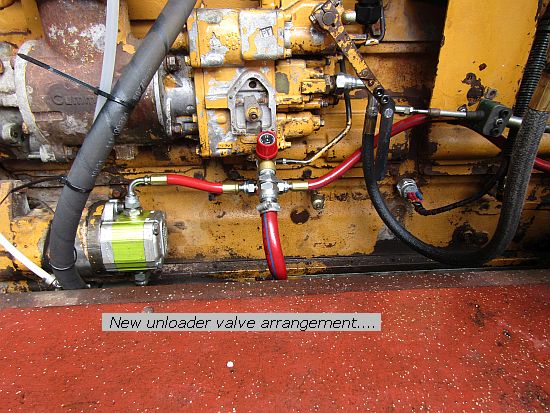
Similarly my novel idea for a dump valve to minimise the converter action during gearchange is only bringing the pressure down to 1 bar, despite that it opens an almost unrestricted route back to tank! At least at 4 bar I am unlikely to blow the converter seals and since it represents the top end of the Twin Disc pressure range, maybe it is time to leave it alone and just make it permanent.
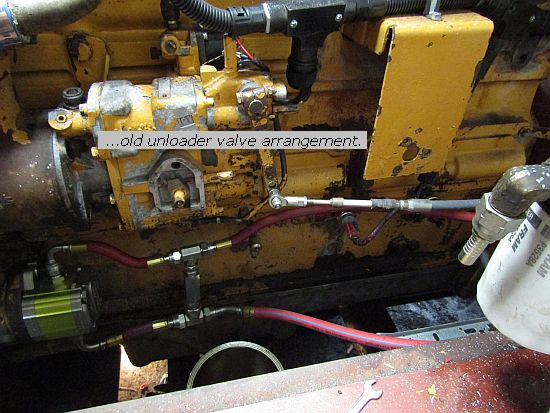
All this re-arrangement of pipework, and trial and error stuff, plus finding all the spare fittings and concocting ways of putting them together took up a large part of Saturday. Andrew meanwhile, after some Father-Son time (grandson is up for the week) came down to continue that 'striptease of death' (I thought that phrase quite poetic when I wrote it last week but no-one said a word) on the Fowler. The cast iron ballast - about 4 tons of it, left in the skip on Friday and next to go in will be the frame plates and other 'heavy steel plate' which needs cutting down into handle-able pieces and non-steel pieces removing, The first major cut was late on Thursday when the frame became two parts. The hot weather on Saturday was taxing and showed little obvious progress though.
First thing Sunday Andrew took grandson go-karting and after getting a bit of admin out the way I headed over to Wirksworth to measure up a loco for transport. I am also contracted to take D9537 off on its summer holiday and it was outside the loco shed being spruced up ready.
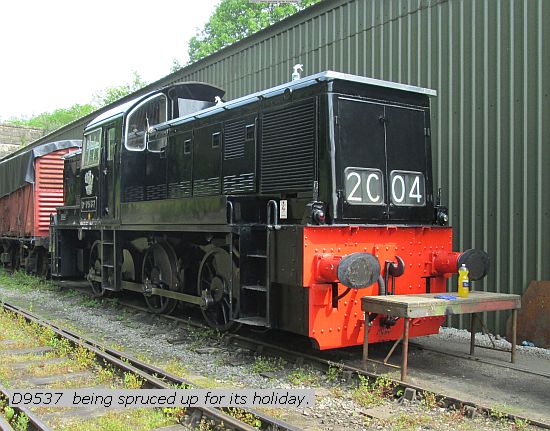
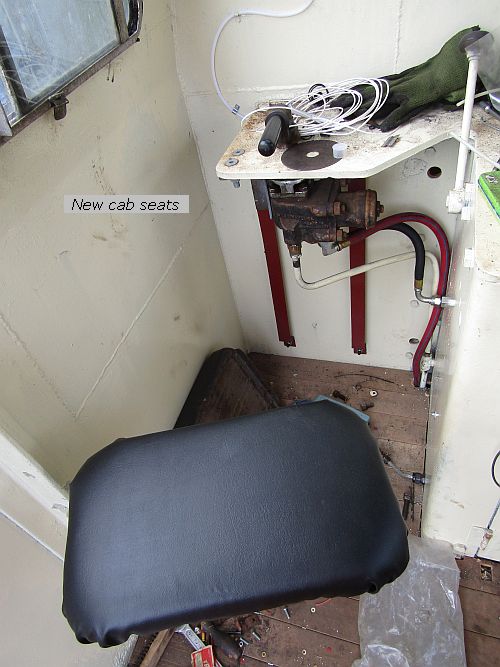
I was just coming away when I got hailed by an (ex?) Peak Rail member who cadged a lift over the hills, followed by a tour of the yard and shed, by which time it was time for lunch. Steph had finished the two cab seats for the Hudswell so they were fixed to the seat brackets and tested with my bum.
The Hudswell was started up and driven outside and I started to look at a minor (I thought) wiring issue that prevented the headlights from working. There are only two visible relays inside the Hudswell's desk. One is Direction changeover, and when the PLC energises its coil, it switches the front and back headlights, and red marker lights appropriately. The other relay is the slave relay for the fuel solenoid. Again the coil is energised by the PLC, but a second set of contacts cuts the connection for the headlights and a third set links the marker lights. Thus if the engine is stopped, the headlights extinguish (to prevent flattening the batteries - the bulbs take about 3 or 4 amps) and if you have the markers switched on, both front and rear display red notwithstanding the gearbox direction set. That was the theory, but although I have had the loco running for several weeks now the headlights didn't seem to work at all and the changeover of the marker lights was lacking. I had had one of the relays out for some reason so somewhere along the way the wiring wasn't put back quite correctly. Probing around with a test meter I couldn't find voltages where they ought to be so resorted to drawing it all out - twice - on blank pieces of paper. Then I noticed that if my neg probe was on the relay return pins I got no volts reading, but if over on a common neg stud I did. Sure enough, lurking almost out of sight beneath two red wires, the common return for both relays was detached from its connection. Getting the swine back in and screwed down tight taxed my patience somewhat (I went off and did something else for 20 minutes) but once back both relays could now do their stuff and the marker lights, which previously both came on together, now only gave a tail indication to the direction of travel. Success then? Well not exactly, the engine wouldn't start. Crank yes, start no. In my drawing out of what was actually wired, I was confused to note that the 'run' relay appeared to be wired through the normally closed connection, which would open when the relay was energised, which couldn't be right else how was I running/stopping it at all? But the relay is run by the PLC so that it can, if it detects a fault, shut the engine down automatically. The keyswitch that the driver uses signals the PLC to start or stop the engine, but also the feed to the relay that powers the stop solenoid comes through that switch, so with the relay incorrectly connected, it has been doing it all.
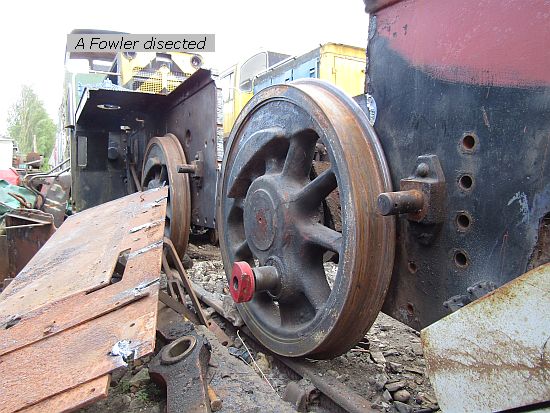
Andrew had taken advantage of the slightly cooler day to press on with cutting with the result that the first frame sections are now in the scrap bin, though this did require some hard graft getting the horncheck brackets off. Incidentally, although many components have been sold on to other Fowler loco owners, there are still some springs/spring hangers available, plus wheelsets, side rods, etc.
Although we move the contents of track 1 aside to prevent setting fire to anything, you might get the impression that it is all in aid of providing some interest for passing trains.....
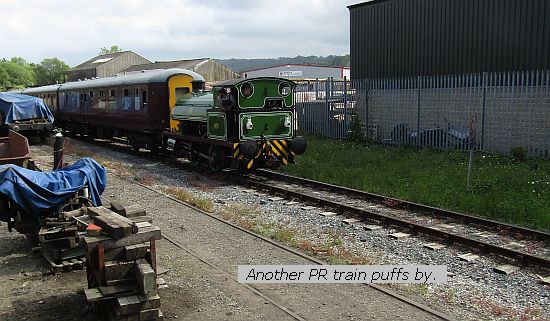
Anyway, that's about me lot. Three days and then it all starts again and we'll be whizzing to-and-fro with locos and such. More about that next week. See ya then.