
Of making things from stock
9th April 2023
You collect clutter - at least we do - and whilst we do fill the scrap bin from time to time, there's a forty-foot container stuffed with bits, many acquired from auctions sites, random deals and or saved from locos 'that might be useful'. Back in YEC days I managed to make up a complete loco using a frame and wheels, a cab from another loco an engine that was standing around and a converter from our 'service exchange' pool. All in all I spent very little to get this up and running by utiliing parts which I'd hung on to on the chance that they would come in handy one day..
By our standards, work on the 03 has been progressing at breakneck speed. On Monday I had a phone conversation with a driveshaft repairer in Nottingham. I used to use one down in Neath which I only discovered thanks to a factor in Bristol using them when Cummins and I were colaborating on repowering a Steelman at Whatley who carelessly sent the overhauled propshaft out still with the Neath firm's details on it. And when I was working for RMS, and we had a contract at Llanelli, it was not unknown for me to be coming back north sharing the car with a propshaft occupying both front and back seats. But we have neither the time nor budget to take it all that far and the last time I had a shaft to alter I took it to this Nottingham firm. That was a few years ago mind, and might even have been this same shaft from when I was putting the 2 speed transmission into the 03!
Their initial response over the phone was optimistic - a couple of days turnround and a pleasantly low price, so Monday evening Andrew and I loaded it into the van and Tuesday morning I set off for Nottingham. Later that day they got back to me. It was the older design propshaft they said, with 6mm tube thickness and would cost a bit more (quite a bit more actually) and they were unlikely to finish it before the Easter Holiday, but they'd try. This was a bit of a disappointment, as we'd rather hoped that it would be back for the weekend and we might get a run out of the loco: after all, if you're promising it to work in a gala event it would be good if it was up, running and tested a week or more in advance. There used to be a sort of convention that the Easter holiday was either Friday and Monday or Monday and Tuesday. It was a bit of a north-south thing when I was younger, and our Nottingham firm was taking Friday and Monday, so they said, it would be ready Tuesday or Wednesday. Not quite the alacrity I was hoping for but I was in no position to argue, only to plead.
We were due to move a loco on Thursday, indeed, I was trying to slot another move in on Wednesday but one end of the job couldn't fit us in. In the end, Phil G had been given the task and opted to travel down and stay overnight on the yard at Midsomer Norton, and it meant that either I must make a really, really early start Thursday morning or stay overnight 'in the area' so as to be at Midsomer on or by 08.30. That meant either sleeping in the van (next to verboten), finding a hotel or locating a floor to crash out on and opted for the last, the floor concerned belonging to a reader of this blog. After an early tea I hit the road at half-six but my journey was delayed by repeated essential detours into the services en route plus an excursion into downtown Worcester to collect a lot from ebay which comprised several boxes of mostly hydraulic fittings which were difficult to gauge from the photos but seemed worth the asking price (though no-one else bid). Thus it was almost midnight when I rolled up outside my friend's door, and seven a.m. when I was taking advantage of his microwave to make up a bowl of porridge.
At 08.15 I was in the yard at Midsomer and a couple of early-bird volunteers broke off from constructing the new volunteer mess room to make Phil and me a tea. The object of our visit was the Avonside 0-6-0 Cranford. You might recall we took it from Scunthorpe to Dereham before Christmas and were hoping to move it thence to Midsomer early in January, but lost out on that one. Although due to remain for the season at Midsomer, it was earlier booked to go back to Scunthorpe but the owners asked us to take it instead to Butterley where I gather it is to receive repairs.
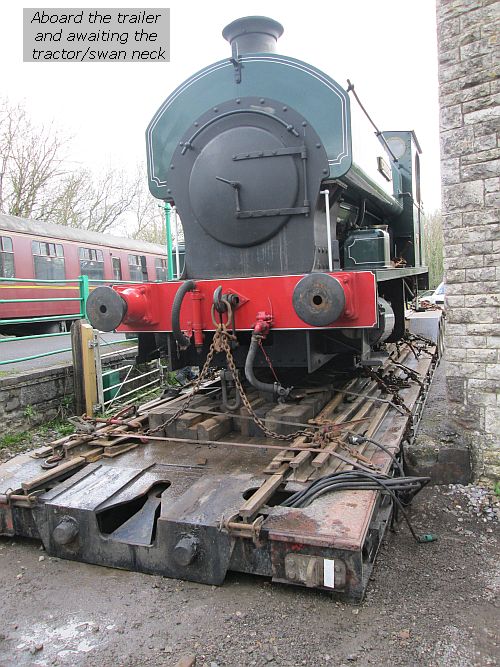
Loading at Midsomer is complicated by the proximity of platform and goods shed: we cannot get the tractor back to the rear of the trailer to power the winch, and although we did have the extension hoses on board it is customary to use a loco and barrier wagon to load and unload there. The loco in this case was our old friend D1120 and the loading went ahead without incident, although the ramp moved slightly in the process and the retreating barrier wagon was about to 'miss' the track but we spotted it in time, pushed it back up the ramp, realigned the tip rails and got it back correctly at the second attempt. I was in charge of steering the trailer and by about 11.00 Phil was on his way north. I got cleaned up, said my goodbyes and set off to follow. For some reason I turned right and then left as I left the station, which is the route Phil had taken but normally I go left down the hill and through the centre of Midsomer as I aim in the general direction of Keynsham. Now I was heading for Radstock and rather than turn back, decided to make the best of it and aim for Bath.
Bath has one of those ULEZ's and so I turned east, and eventually took a steep descending road that brought me out on the A36, but this too had 'ULEZ ahead' warning signs 'Pay on line' (no, ta) but the toll bridge over the Avon was first and I took that. I think though that a lot of other motorists would rather pay the £1 toll than whatever the ULEZ is and getting across the bridge and up the other side was amusing. Being this far east I decided rather than head back to Bristol on the M4 and pass Phil somewhere I had sufficient time in hand to take the A46 and Fosse Way, which I used to do quite often in my days at Hills and after. I recall it as traffic free and enjoyable, but it began to register on me that the Easter holiday was beginning now for some and if I wasn't careful Phil would get to Butterley ahead of me. In reality I needn't have worried - what I was seeing around Tetbury and Cirencester was mild by comparison to what was clogging the M5. Phil reached Strensham at around 2pm for a break and his electronics was predicting a 6pm arrival at Butterley. Indeed, we explored whether we could unload first thing Friday (originally I'd thought arrival would be half-three, maybe 4pm) but Butterley were anxious to receive it that day and trip it back to Swanwick, so we pressed on. To emphasise the holiday spirit I had a long tail back on the M1 near Loughborough after what had been a multi-car pile up which featured a motor caravan with impact damage to both front and rear - some holiday he was having. In the end I drifted in to Butterley towards 5pm and a while later the Barclay 0-4-0DH appeared ready to collect it.
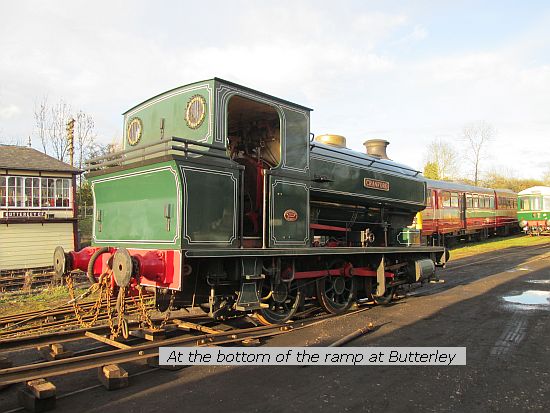
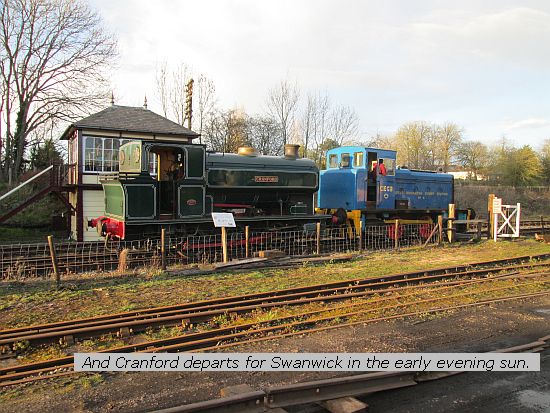
At five-fifty Phil finally reached us, we lined him up and ramped the loco down, the Barclay spirited it away and Phil departed at about half-seven.
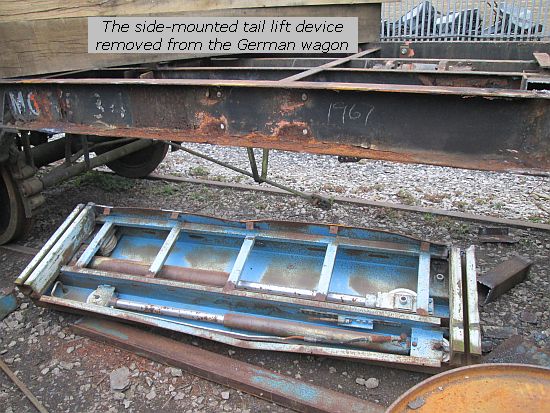
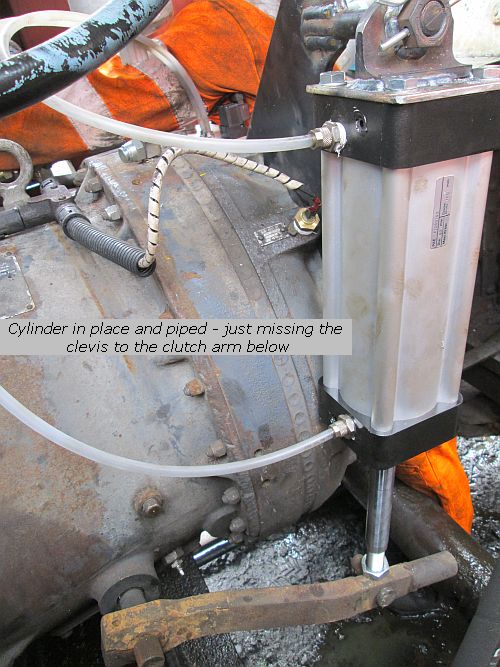
Friday was a slow-ish start though I did get down to the shed later, mostly to sort out the Worcester consignment which turned out to include air valves, electrical switch bits, a number of contact breakers, pressure gauges, quick release air and hydraulic couplings - all in all probably cost ten times what I'd paid. So Saturday and with the imminence of the gala the concentration has been on the 03. Andrew had assured me he had a brand new clutch cylinder ready and I couldn't think what it was but he produced it from its box and sure enough it was a cylinder, but longer than I usually use and lacking the clevis (fork) for the piston rod and the pivot piece for the top. For speed he suggested instead re-using the cylinder and bracket fom 1197 but a few minutes with this proved it was for a right hand side mounting whereas we always stick to left hand side. (I've never understood why anyone mounts the clutch cylinder on right side - it's the side that the big fluid connections and the small bore inlet all connect to so why complicate it with a bracket, cylinder an arm?) Andrew announced he would manufacture himself a top pivot, but instead spent most of his time working with Matt H cutting the tail lift assembly off the side of the second German flat wagon, leaving me and Andy M to proceed with the 03.
I set about mounting the clutch cylinder bracket I had provisioned, conscious that this had been designed for the 10,000 series converter, not the 11500, and that might prove problematic. I hadn't had time to think about adjusting the profile for the slightly wider body of the 11500. I also needed to find somewhere to mount the electrical connection box that had been secured on a plate on the side of the previous transmission and acted as distribution for the engine and converter wiring. Andrew had also dug out a 2 station manifold, bought cheap off ebay some years ago and only now proving useful. Its disadvantage was that it was 1/4BSP in but the two outlets were 1/8, so to prevent undue delay in cylinder operation it would be better if the manifold were located as near to the cylinder as possible. I had a couple of profiles intended to carry a limit switch to detect clutch position, instead I deployed one of these mounted on the right hand side of the converter and Andy mounted both connector box and manifold to it, finishing the task by wiring the manifold to two of the connections previously energising the first and second gears.
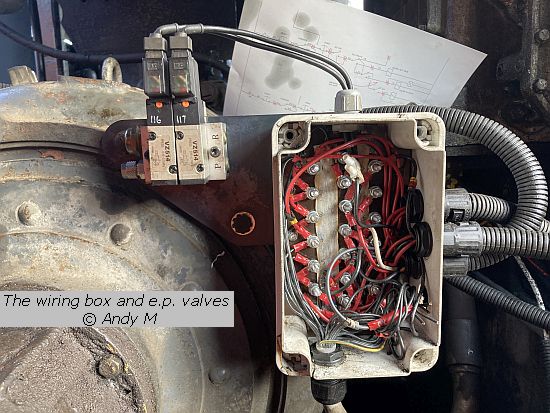
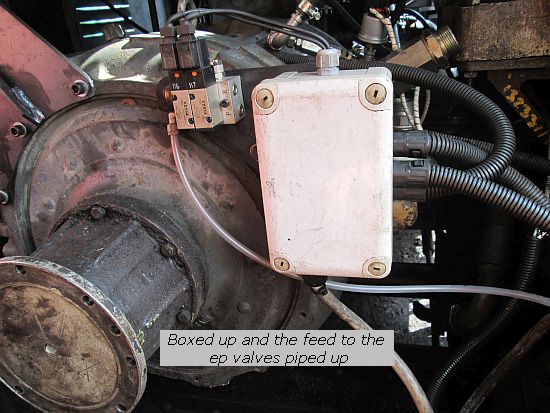
One of the things we are short of are the cast flanges for the converter fluid. I did have a pattern but it got 'lost' some years ago but Andrew managed to find two and with a combination of hydraulic and malleable fittings contrived two assemblies that would enable the original t/c cooler hoses to be re-used. Meanwhile I opened out the holes on the profile that would hold the new charge pump and then countersank the holes. Since the charge pump has the same shaft/key as the traditional version, we dug out a Rolls pulley from the stores and fitted this, but when I came to compare it I realised a problem - the Rolls pulley was a single A groove but the previous drive had been two Z belts. I decided that we'd take the drive pulley off and I'd source a new pulley to suit the taper lock bush, but when it came apart the latter had cracked through and fell in two.
In discussions earlier in the week, we had come to the decision that as the converter is known to leak a bit and would have to come off again shortly after the gala, there was no point in running it on hydraulic oil and it would be more practical to put it on fuel for its gala duties. That shaped my thinking in two directions - one I did not have to worry about mounting the hydraulic oil reservoir, filter, etc and secondly as the plumbing was only going to be temporary, there was no point in going to the trouble of making new hoses, rather I would modify whatever was to hand including jubilee clipping the hose ends instead of swaging. Already the suction filter for the converter circuit had been picked out of 'stock' and we had a new element for the 'head, which Andy meanwhile mounted adjacent to the engine fuel filter. The 'head however had only one nipple and being American in origin, I suspected it would not be a BSP tapping, nor neccessarily even an NPT and it transpired that it was 7/8 UNF, which might be a 'source it next week' job.
That was about where we'd got to on Saturday evening, but first thing Sunday I started rummaging through various boxes and found another adaptor which was indeed 7/8 UNF but to 1/2 BSP rather than the 3/8 I really wanted. I had tee'd into the engine fuel feed with 3/8 BSP so bodged a hose to connect the to filter by cutting down an old one to suit. More adaptors, including some from the Worcester stash, enabled me to complete the relief valve arrangement and left me to find two 3/8 inch bore hoses, each with a right angle at one end and about 96-100 inches long, one to reach the charge pump and the other back again. Such is the clutter we have amassed that I found two matching that description, one I think ex 1197!
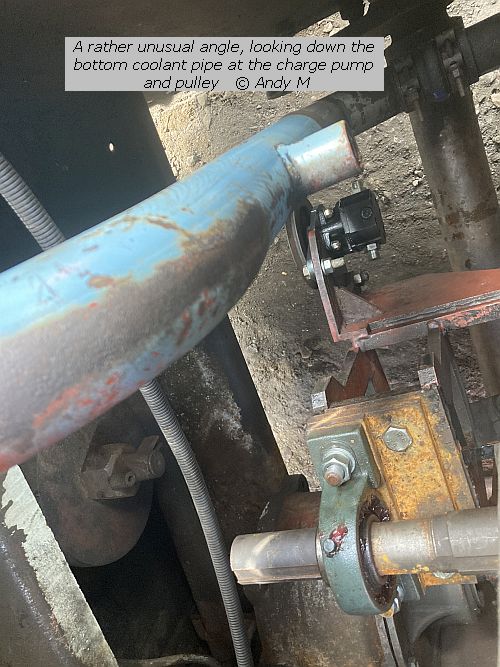
Andy meanwhile having put back together the top coolant connection now reassembled the bottom one. Originally this came out of the engine, turned vertically down, throwing off a 1 inch bypass line, passed through a shell cooler, turned horizontal then up, collecting the by pass line and into the radiator bottom. As the shell cooler is no longer present the entire arrangement must be re-engineered but for now it was reinstated minus the by-pass and with a length of plain tube where once the shell cooler had been. He finished this off by refilling the cooling system with water (plain for now) and to all our relief it didn't leak.
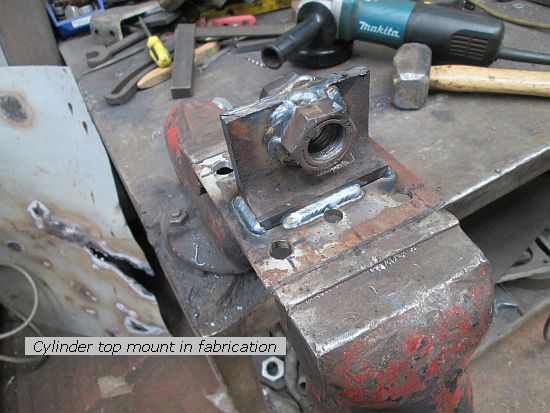
Andrew was on call and had had tele-conference calls both mornings, but now set about manufacturing a top pivot for the clutch cylinder. This revealed the shortcomings of my bracket but we drilled the end for an R clip with sufficient play for the cylinder to cope for the gala weekend after which I connected the cylinder ports to the manifold (the feed to the latter having been put in yesterday) while Andy and Andrew adjusted the big hoses to the cooler and nipped them up.
The 03s batteries had been sat on the side of 144V since our attempt to start it several weeks ago and these were returned to the 03 and connected up. Some 160 litres of fuel were pumped into the tank but the tap admitting fuel to the converter circuit was left turned off. As an aside, Plan A had been to join the return line for the converter to that for the engine, but we had originally used the only return pipe available to the tank and that was for the injector spill return from the Gardner. As such it was only small bore and adding the converter flow was likely to overwhelm it. For the gala we've rigged a temporary return line into one of the fuel fillers.
By now it was late afternoon and we powered up - only a minor issue (converter temp switch wired wrong - swap spade connector) and the engine was cranked. With a dry fuel system it took a while to fill but with a burst of black smoke it came to life and soon settled down to normal running. Andrew felt that this was a suitable moment for him to go (he'd promised grandson a cinema trip) and Andy and I reviewed the neccessary wiring mods. Originally the 03 had been configured to operate the 3 solenoids on the transmission: a primary one that 'made it live', one that selected first gear and another that engaged second (top). These were linked to 3 limit switches that were operated by a cam on the original gear change in the cab and a lot of time it had taken me to make it all happen. Now we had but 2 e.p. valves, one to get clutch 'in' and the other to bring it 'out' again. All the other interlockings etc were already present in the desk, so adapting what was there to suit, in the quickest and simplest way possible, was the order of the day.
In practice, the primary switch would control clutch 'out', and the first gear switch would control clutch 'in', there would be no automatic timing to unload the clutch cylinder, you'd merely wait and then push the lever to the old second gear position which would de-energised the e.p valve. A minimum of extra protection was that feed to the clutch 'in' limit switch would only come on when (a) the clutch 'out' limit switch was toggled away (i.e the lever was being moved to clutch 'in' and clutch 'out' valve was off) and (b) that a relay that was already present and had inhibited all three switches/solenoids unless forward or reverse was properly engaged on the gearbox was repositioned electrically. (To leave it where it was in the circuit would now have prevented operating clutch 'out' had something untoward occurred.) Shuffling these functions around gave us some headaches late in the afternoon with cable numbers that now became duplicated by dint of relocation, but by 6pm, we had power back on and operating the lever gave the appropriate response on the e.p. valves.
So what's left? I need to get a clevis for the clutch cylinder, and a new pulley and bush to drive the charge pump and of course the propshaft needs to return from Nottingham, but whilst it will almost certainly be down to the wire it should be achievable. (I say that with the foreboding that I must return to those bearing suppliers who claim that things are in stock in their other warehouse but in reality are reliant on their suppliers despatching direct from theirs. Andrew is looking at a Bosch 24V fuel transfer pump that Andy M suggested as an alternative!) RS8 is also to take part in the gala (as driver for a fiver at Rowsley) and having lost no coolant during the week Andy drained the plain water and substituted proper anti-freeze mix. Unfortunately we still don't have detail on all this from Peak Rail - I only read about RS8 in the Peak Advertiser! - so quite when we must have it all ready, moved up to Rowsley and who is manning them remains a mystery. I invite you all to come to the Twin Peaks Gala - if you are unaware it is being held jointly with the Ecclesbourne - and see whether we got it all together in time. If you can't, tune in again next week to find me either elated or depressed. See ya then.