
Of converters and resistors
21st May 2023
I usually write this intro at the end - which may seem base over apex but means that by the time I do I know what it is I have written, which is usually as much a mystery to me as I get started as it is to you when you open the screen to read it. Occasionally I have been known to have a title in mind before I start, but most times this starts with just a plain 'OF' and the letters wait patiently for me to couple something up behind them. You'd think, after coming up 13 years of producing this diatribe every week, I'd have said all there was to say. Sometimes I think that too, but there again I sit down, and out it spouts....
Oh hello, is it that time already? It's been an odd sort of a week. No transport jobs to give a chance of getting T1s repairs under way (but a lot of quoting, booking and arranging work in the near future) plus a lot of things in and around Darley Dale. Monday morning I was joined by guys from Alstom who proceeded to replace the repaired silencer in their loco but in the process found that a pipe connecting to it was rusted clean through so in the end that came off and a new one was to be sourced.
A couple of weeks ago I mentioned that the converter pressure sender on the Hudswell was changed: this was because the old one was sending the gauge full scale but the new one was giving a pressure reading of 6.5 bar which is more than a little high. There is a relief valve set to open at 4.2 bar so initially I didn't believe it and took the sender off to substitute a temporary mechanical gauge which appeared to tell me 65psi, so somewhat relieved I changed the gauge in the desk, assuming there was some incompatability. But this too gave the answer of 6.5 bar so another mechanical gauge was installed and this confirmed 6.5 bar so I'm now wondering if the '65psi' I read before was the bar scale not the psi one! Anyway this gave me a problem, was the relief valve not relieving on time or could it be that the pump is overwhelming it? As a first course of action another 4.2 bar valve, but bigger bore, was put on order and a plan evolved to re-plumb the valve so that the charge pump delivered directly to the relief valve, with the feed to the converter off a tee, rather than the other way around as before.
But notwithstanding, we had a shunt planned for Monday evening and I wanted to use the Hudswell to see how it performed. The shunt was to get the Janus out of the shed and leave it on 3A, which meant shunting the 200tons or so of locos on 3B, which has a noticable gradient and a stubborn lump better known as Ludwig Mond. Knowing that the t/c was running rather highly pressured I decided to keep the revs low, but the Hudswell shifted the load without any qualms. However, I am beginning to think it is secretly reading my blog, because after all the compliments I paid it on its rapid and smooth gearchanges last time, it proceeded to 'hang' almost every one! Nonetheless the loco completed the duty and returned to the shed without incident, but I decied not to run it again until the t/c problem had been sorted.
On Tuesday it was the turn of the contractor who has overhauled the motors and gennies on the Janus. He was on site for about 5 hours checking and adjusting the 'neutrality' of the brushgear (so we know it is neither pro-Putin nor Ukraine?) on the gennies, something which requires the commutator to be spun so with a single bearing genny (i.e. one where the inner end is supported by the engine flywheel) can't be done in their works. While he worked outside on it, I was on the Hudswell, starting to run a feed pipe around the cab to provide air to the windscreen wiper motors. I almost dropped a clanger on these. When we were doing RS8, I think it was, I found a website offering arms for Trico wiper motors, which could be adapted to either 3/16 or 1/4 inch shafts and I bought a couple only to discover that our Trico shafts are 5/16 diameter. And I almost did it again, before some vague warning in the back of my mind spoke up and I held off paying the pro-forma. Instead I rang them and changed it, sustituting adaptors and splined arms (though even the adaptors were for 1/4 inch, but I could bore these out) and the gentleman I spoke to, who seemed knowledgable and confident, was surprised when I assured him that the Trico motors we had were 5/16, though his usual clientele are into vintage cars so that may be the difference.
Wednesday and Andrew had asked me to go get some winnings of his from an auctioneers over near Accrington, though first I went in to Sheffield for a couple of suppliers there. His haul included a track gauge (paid about £20 for an item which new is about £2k) a slewing jack, two snatch blocks and a quantity of lifting chain sets. A nice run out with no pressure and back in time for tea.
First thing Thursday Andrew and I popped down very early to shift the train back as the lorry was due in to collect the scrap skip at 08.00. We needn't have rushed though as by 08.30 there was no sign and Andrew left me to get back home for work. Eventually about 09.45 it arrived, having had a puncture that morning on an earlier collection, and swapped the skip for an empty one. I while waiting had pushed on with the wiper motors. The motors themselves use an Enots fitting, so I had ordered tube nuts and olives to suit 6mm OD tube. The olives had arrived in time for me to collect on Wednesday, so to pass the time I drilled out a tube nut to 6mm and tried to connect it. No joy, in fact I realised, the OD of the olive was greater than the ID of the thread, so it was never going to fit. For years my preferred small bore size was 5mm but I was persuaded up to 6mm at RMS though retained left over 5mm fittings and some tube for emergencies. A search of the box revealed I also had some 5mm Enots olives, and tube nuts left over from an abortive spill manifold we created for Beverley years ago, so the plan was changed and the final connections to the motors made in 5mm, but feed from a supply line in 6mm. With the scrap lorry having come and gone, I returned home for some admin work and late in the afternoon Adam rang to say that some of the bits requiring attention were off the trailer and would I like to come and collect? Which took up most of Friday afternoon, for in the morning I was visited by a representative from European Metal Recycling who after our recent visits to their various establishments was interested to see what I was normally up to.
Saturday and it was back to the shed, with Andy M joining us once again. He went on to the Janus and a fresh sequence of settings on the resistor banks brought dividends, though you do seem to have to rev it up more than I remember from when I last drove a Janus. The first 4 locos on 3b (about 140tons) were dragged to and fro without apparent difficulty. Andrew having drawn the train on track 1 back again, carried on with the Fowler 'striptease of death' and sometimes I was able to get back in the shed to fit more pipes and P clips to the wiper feeds.
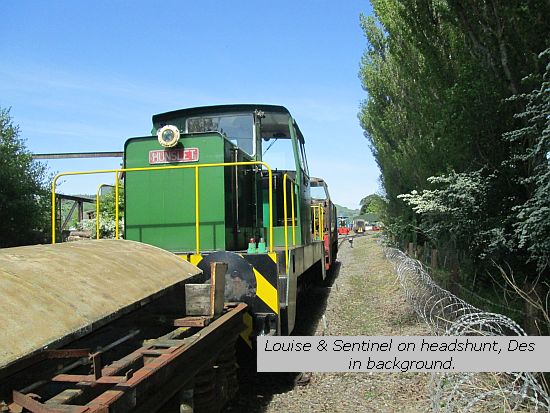
First thing Sunday it was planned for another shunt. Louise drew Des (the Yorkshire 0-6-0DE) forwards then was parked on the headshunt with the Sentinel 0-8-0 behind it.
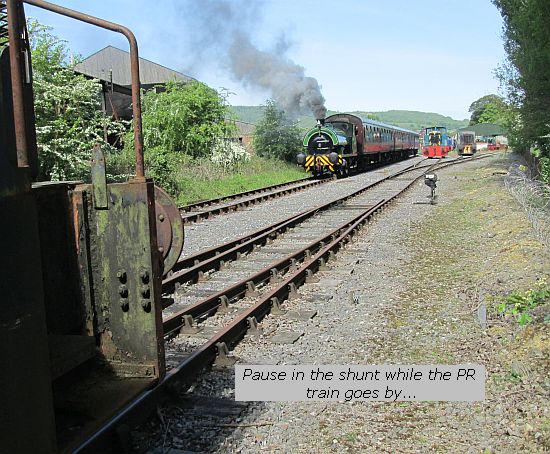
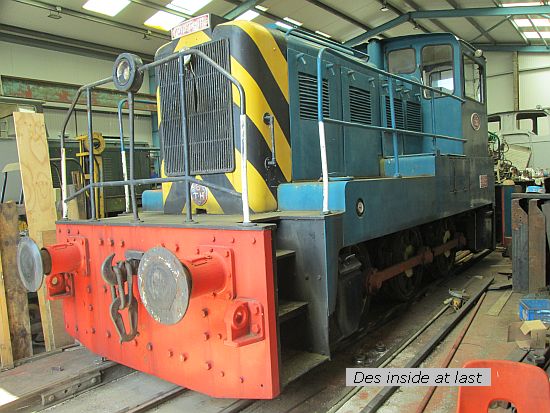
The Janus then collected it and put it on 3a, after which it brought the full rake on 3b up and put Des on the back, before propeling them all back down 3b and leaving Des in the shed for its overhaul to begin. Andy then went to work on some other issues on it, and I seemed to orbit from Hudswell, to Andrew on the Fowler, to making tea. By late afternoon we were reconnecting drive belts to the exhausters and additional compressor on the Janus, and I finally got time to re-arrange the pipework and fit the bigger relief valve on the Hudswell, but a brief start up gave me a base pressure of about 5.8 bar, which clearly is still too high. More investigation required.
Last week I referred to Railway with a Heart of Gold, which has prompted one reader to point out that it is available on the BFI website and my original memory was not at fault, it was in colour, though my DVD plays b&w and a short film behind it is in colour, so my machine wasn't malfunctioning. He also pointed out that one 'crash' was staged, which explains a lasting memory I have of TRPS members expressing concern at the AGM about the image it portrayed of the TR (then over a decade after it was filmed) and a member sat next to me asking whether I had seen it and what were they concerned about. I remember lamely replying that it portrayed the railway as being a bit 'unsafe' - though at the time I couldn't think of any specific instance to cite. Add 50 years of experience and the scene with Dolgoch having apparently rammed a set of wagons, with one at 45 degrees over the next, and the crew acting dazed as they got off the footplate, probably didn't go down well with the rank and file membership. Given the reported frequency of spills in old-time American railroading (not the recent high profile chemical train accidents I hasten to say) such a scene probably doesn't raise as much alarm with the afficionados of American slim gauge as it would here.
So that's about it for this week. What's afoot for this one? The Van is due an MoT, but the calender is still largely clear, not that it will stay that way. And do I spy another bank Holiday Monday on the horizon? What will we think of to fill that? I'm rambling. Time to wrap up. Till next week, see ya then.