
Of (another) four day week (14-5-2023)
14th May 2023
Sorry, one of those quieter write-ups that occur between more interesting oines. Well we can't have Coronations and Euirovision every week, can we?
A bit of dearth of photos this week, mostly because what we've been up to has not been especially photogenic. Monday, well, it was rather more of the same. Andrew was working but Andy M was back for a third day.so numerous little tasks were in progress, including sorting out wiper motors for the Hudswell, spotting and sorting leaks of air or oil on the same loco, etc. Tuesday and it was transport work again, moving the carcase of an 08 from customer's premises to scrapyard - by the time you've removed engine, generator, cooler group, compresor, traction motors, buffers, and numerous lesser parts your 48tons shrinks to about 20 but the springs (still on) will not flex so much for this reduced load and the axleboxes stay at the bottom of the hornguides. For now (until Adam has time to mod it in line with T1) there is a change in angle between deck rails and ramp sufficient that with little spring deflection, as the second axle comes on to the deck the rear axle lifts into the air. This is all too apparent because, as the side rods are also missing, it stops rotating until it finds the deck rails a few feet farther on.
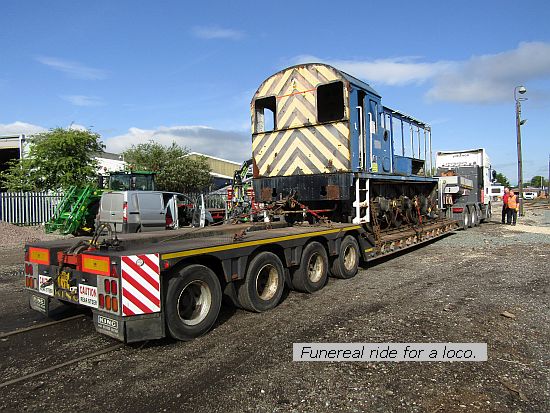
After unloading the first, we headed back and collected a second, but with insufficient time to return that day the trailer was parked up to await Thursday. Wednesday and Thursday were otherwise occupied with various admin tasks from reviewing manuals to quotes and sourcing bits. The issue with the Janus at the moment points to the brush gear not being properly neutralled. The overhaulers couldn't do it as you must be able to rotate the armature and being a single bearing genny this cannot be done until it is attached to its engine. I was pointed to some youtube videos on how to do it but in the end I've arranged with the overhaulers to send someone in this Tuesday instead. Thursday also I had someone in to change the injectors on 1387 to see if that would cure the smoke, and sure enough subsequent running is vastly improved. But as I say, Thursday we finished the job with the second loco in at the scrappers.
With 1387 getting very near to completion my mind has been turning to delivery. Obviously it'll be on either T1 or T3 but the loco has a spring apply/pressure release parking brake and a deadmans system. So we need air on the loco to keep the brake off, but the air to do that needs to go through the ep valve and that won't energise without the engine running, and with the electronics 'live' the system will detect the motion and trip the deadmans. The obvious solution is for someone to ride the loco up on to the trailer with their foot on the deadmans, with the engine idling to maintain air pressure. Another solution would be to have another air supply to the parking brake cylinder with a stop cock hat enables me to trap air in the cylinder, feeding the air through the manual 2-way valve I provide for recovering a dead loco. But then it struck me that if I could see such a simple way of defeating it, so could other people.
Years ago in a rare spurt of innovation at Thomas Hills we had come up with a deadmans system that we thought was ideal. It required no pedals, no push buttons, indeed, the driver wouldn't even know it was there. Basically it put a low power radio signal on to the brake and throttle controls and located an aerial in the roof. Provided the driver held on to one of the handles and was 'in place' the signal was relayed and received by the aerial and all was well. It didn't even matter if he wore gloves. But if he let go of the controls, collapsed or did something else inappropriate the connection was broken and after so many seconds the deadmans would intervene. It was given extended trials at Scunthorpe and that's where it all went wrong. The drivers knew it was there and notwithstnading that it was no inconvenience, they determined to find a way of getting round it. Their answer came in the form of a Kit Kat. The silver paper, wrapped around one of the throttle or brake levers, acted as the relay and the roof aerial received it even though the driver wasn't anywhere near. The moral of the tale, as learned at Kinhurst, was that no matter how good an idea is, somebody somewhere is going to try and prove that they are cleverer.
So back to my parking brake. I have been doing these now for over 25 years, and aside from Ford at Bridgend, no-one has ever raised an issue. Bridgend's problem was that the brake is sized to act as both parking an emergency stop, so the rate of application is normally a compromise between rapid deceleration and wheelskid. Bridgend's sidings were on a not inconsiderable slope, so the brake cylinder was deliberately set up with a restrictor that it came on progressively over several seconds. But a driver applied the parking brake and released the loco brake simultaneously and the latter let go before the former had applied so the loco rolled a few feet. Cue several long phone calls between myself and Bridgend's Engineering staff over why this had happened, followed by a morning of trials on the sidings resetting the restrictor until they had a time lag that they accepted and their drivers understood.
Anyway, back to 1387 and its parking brake. If I could see a way of defeating the brake, I concluded, so could (or should I say would) some driver sometime in the future, so shouldn't the software anticipate the sabotage? The solution for now is to look at the parking brake pressure switch on power up and if it is 'on' - in other words there would seem to be air pressure there but the valve to admit it cannot be turned on until the engine is running - then that's a fault that prevents the loco starting up, and instead flashes the parking brake override light on the fault display. (It will also flag a problem, if the parking brake pressure switch packs in or is otherwise shorted out, which is an additional benefit.)Oh, and the idea I had last week of using a yellow LED to give a green light on the desk button? Didn't work. So today I substituted white LEDs which give a brighter blue light through the button and can be seen in daylight.
Back on Tuesday while waiting for Adam I'd dashed in to a firm who overhauls alternators and starters, etc and dropped off 1387's alternator to see why it wasn't charging. A few hours later they rang to say there was nothing wrong with it, so first thing Thursday I refitted it so that the man with the injectors could run the engine without worrying about loose belts. However that meant that my wiring had to be at fault, so first task Saturday - no second task, first as to investigate a 'fault' on the Hatramm which disappeared on its own - was to bell through the wiring once again. To cut a long story short, the fault turned out to be in the bulb holder in the desk, and after this was changed, the warning light came up and went out like it ought as the engine was revved.
But to get back to Saturday, and the reason that there aren't many pictures, is that the order of the day was 'tidying' outside, partly to make space for a lorry to get to the scrap skip, which is now full to overflowing. So we started by re-arranging some of the engines on the german flat and adding some stuff from the ground to the resultant space. It was all sheeted down and the train drawn forward by Louise before Andrew continued with the forklift moving 45 gallon drums and such after which he resumed gas cutting the Fowler 0-4-0DH in the sunny weather. I returned to the Hudswell and set to work on the throttle linkage to improve and finish it, which took up some time, but later on I brought the loco outside and drove it up and down, virtually smoke free.
The Hudswell gearbox has one characteristic that it is a very poor changer when cold. Having been involved with 5 of them, they are all the same - first few times they fail to reverse and the only answer is to bring the clutch in quickly to get the input shaft to turn a bit. Too long and the teeth will go bang! bang! bang! bang! inside the gearbox and you know it's not doing them any good as there is 100psi or so of air cylinder pressing down. So you learn to flick the lever that puts the clutch 'in' over and back with an alacrity sufficient that only enough rotation is imparted to the input shaft that it goes in to gear almost immediately. How does the software cope with this? Well, ideally I'd write a sub-routine that the computer puts the gearbox back over, and has another go, and if that doesn't work pulses the clutch in valve long enough to jog the input shaft (some locos, Planets come to mind, and also I think class 14s, had a 'nudger' cylinder that pushed the shaft around a bit to get the teeth to line up, but from all accounts they weren't especially reliable) but all this is a lot of complicated programming for a circumstance which, after a few reversals, goes away on its own so I've stuck with the basics. If the gears don't go over, neither forward nor reverse are detected, so the driver can opt to bring it back to the original direction or 'stab' the clutch 'in' button. Normally, pressing clutch 'in' puts air on the cylinder and holds it for several seconds after it has operated before unloading. In this case, where neither direction is engaged it only operates the valve for as long as you hold the button and puts the cylinder back to 'out' as you release. Since the base pressure in the converter is also reduced (that seems to work) this appears to get the gears in with a minimum of bangs! and after a few reversals it all happens without issue anyway and noticably quicker than some other locos I've programmed.
Steph went to a funeral in Sheffield last Wednesday and used the trip to order some foam, etc from an upholstery supplier. It was supposed to be ready Friday so she trekked back specially only to find it wasn't so the seats are not yet finished but the seat brackets are, as I completed slapping paint on them today and while it was out began painting the engine mounting brackets for 2895 to save them getting rusty. So you see, it wasn't a very photogenic week. Next week I need to have got a few more of the final snag list crossed off for 1387 and do some more testing (it's already logged over 3 miles and 6 hours) and put a load on to see how it responds. What else? Well Andrew has acquired some more bits on an auction and I've volunteered to go and get them and I've customers in tomorrow bit otherwise I'm hoping for a few days to catch up on admin, etc., but we'll have to see how/if that transpires.
Oh nearely forgot, arriving in the post this week was a secondhand copy on VHS (you remember that?) of 'Railway with a Heart of Gold'. I remember seeing this at a Talyllyn RPS AGM day screening - must have been about 1969 - but was filmed by an American in 1953, so 2 years after the TRPS took over the line and started railway preservation in the UK. Curiously in my memory the film as in colour, but the VHS cassette showed black and white. Like all such things it has continuity defects for the observant but as a snapshot of a decrepit railway in transformation, complete with a genuine derailment while he was filming, it is an evocative view.
And with that thought, I'll leave you until next week. See ya then.