
Of November blues
27th November 2022
Blue locos or winter depresion, you decide.
I said to Andrew this morning that I hate this time of year. Everything's cold and wet. The days are drawing in to the shortest one and so everything is dark and miserable. Adam had work to catch up on, delayed by the tractor gearbox repairs which gave me a couple of days to do a few things but didn't seem like enough. Steph and I went to the Peak Railway Association local group meeting on Monday night, a planned speaker had had to pull out and instead there were some old Peak Rail footage from around 1990 when the Darley-Dale to Matlock line was being re-instated, when a 2 coach passenger train was worked push pull to a temporary station by an Austerity 0-6-0ST. Snippets of repairs being carried out to the deck of Bridge 35 over the Derwent before the line into the present Matlock (Riverside) station was relayed. And a few of Buxton station when its days as a 'steam centre' were numbered..I hoped to see a little of D2128 at Darley dale in its previous incarnation, freshly returned from Belgium, but that was not to be.
I was contacted by an old friend whose employers were about to scrap a load of nuts and bolts (mostly bolts) and who had agreed to donate them to a worthy cause of loco restoration, so Wednesday I took the van over to Manchester and returned with the floor largely obscured by cardboard boxes and a few plastic bags. Although it was mostly small stuff - M3 and up to M8 - it is stuff that we do use as although I have oft sung the praises of Sir Joseph Whitworth and his wonderful thread, and have hard others decribe BSF as the finest thread form ever, we do employ metric for the most part. Indeed, I have heard it argued that you should use 'modern' threads in restoration work as it enables ferro-archeologists in futuire years to determine what parts are original and which are later alterations. It would be nice to think that some of what I am doing today would still be functional, or in a museum, in a few hundred years time, even if use of the fossil fuels that power them have been outlawed and sea level rises have transformed the outline of Britain into one reminiscent of the Dardanelles. But by Thursday it was back to action and I was off early - not early enough as it turned out - to get down to Crossrail at Plumstead. I had orders to move three 45tonne 0-6-0DHs, which had been bought off an auction. I had been asked about moving another but it was - for now - a bit too heavy. They were parked however, not in a convenient siding in a rail yard but had been craned(?) to a few panels of track down the middle of the car park. As such the rail running surface was about a foot above tarmac level.
Now from our point of view this is about the most awkward way of loading or unloading. If the rail surface is about flush with ground level, we can run the tractor and trailer over, line up, remove the tractor and our ramp goes down to the rails with a short pair of tips to aid the transition. With rails above the ground like this there is insufficient ground clearance (well maybe with 75lb rail and wooden slepers, but here were concrete sleepers supporting 113lb rail) even to get the front of the tractor over the rails, so shuffling away from and back on to the front of the trailer must be carried out in whatever distance you have the rail materials to build your ramp, and the front of the trailer needs to be within a couple of inches to that same dimension.
When I got there, Adam had arrived and lined up, but he admitted he had dropped a clanger. While the trailer was carrying a complement of 4 rails 20ft long, 2 rails 5 foot long and Andrew's fabricated tip sections (about 6ft long). That meant we could only make up 25ft of track whereas we needed 30ft to shuffle our way out and back. He'd left 2 more 10ft'ers behind. But the Crossrail crew were extremely helpful, and after Adam noticed that the first loco was stood just clear of a fishplated joint, they agreed they could lift that panel of track as soon as the loco was aboard. That meant that while we still needed 30ft to get the tractor out, we could drag the trailer forward after detaching the trailer, but to avoid gouging anything out of their posh tarmac we put the trailer on to some sleepers and slid it forward on those, after which their telehandler lifted the trailer so we could get them out again. We probably could have got the trailer to exactly 25ft from the track end but I opted to stop at about 3feet short and use our tips to form a ramp down from theirs onto ours. Our track was duly assembled (their telehandler saving much of our usual physical effort) the winch rope paid out, the handbrake on the loco wound on (I hoped) sufficiently to stop it rolling away down our tip rails and we towed it gently forward. No, I hadn't got the brake on hard enough - it charged down the tips faster than the winch rope but stopped on the next rails although it possibly clipped one of our tie bars in the process. I had of course made quite sure that the loco would fit the trailer (it looked awfully long in reality) by creating a CAD drawing of it but my dimensional information didn't have any ground clearances and in particular I had no knowledge of a cross stretcher that lay behind and below the buffer beams, and carried the end of the brake rigging. So when this came up to the back of the trailer it limited how far up we could go and was about 4 inches short of clearing the neck at the front. By now the Crossrail guys, true to their word, were already dismantling the fishplates on their track panel so we warned them that we were going to winch it part way back so we could pack up our rails a touch more.
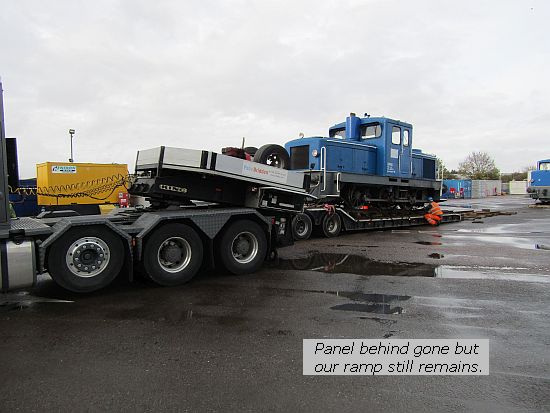
Second time the brake rigging cleared and when we height-sticked it later it was comfortably within bridge clearances. The track panel was moved aside, we packed away, the tractor was re-attached and we were ready for the off. Now, Plumstead is on the eastern side of London and not far from the Dartford tunnel, but Adam had already informed me that the official abnormal load route required him to go all the way clockwise round the M25, past Reigate and Heathrow, and turn north not on the M1 but the A1. The M25 circuit was not a surprise, we had had that before with loads from East Kent or Spa Valley, but the A1 rather than M1 was, and meant that I would go anti-clock round the M25 and if I saw them it would be going the other way between the M1 and the A1.
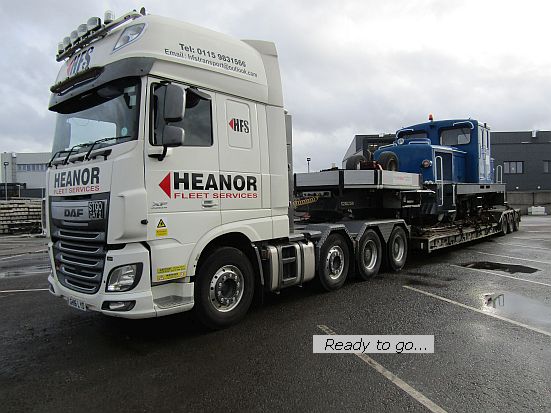
And of course you're thinking that the chances would be slim as I had a much shorter way to go, but I had also arranged to drop some parts off at a customer's which was going to add some time in a detour. But you're right of course, even with that I guess they were probably somewhere over near Heathrow as I joined the M1 and got home at five-thirty, almost 11 hours after setting off. The next morning it was out early to unload. I got there fifteen minutes ahead of Adam and unloading went straightforwardly for the most part. The loco rolled serenely down the ramp until the second axle hit the permanent rails and it stopped (the track sloped slightly upwards which didn't help).
'I'll drive it off' said the customer's rep and we spent five minutes trying to find the battery isolation switch. We were nearly convinced it was inside a locked compartment in the cab, protected by a numeric padlock for which we had no combination. I rang my contact at Crossrail 'Where's the BIS?' 'There isn't one,' he replied, 'we just disconnected the batteries' and he guided me to the battery compartment. With them reconnected the engine started and we built air, but we still couldn't engage drive and even went so far as to locate a pinch bar before the Customer's man hit the right sequence and the loco crept away.
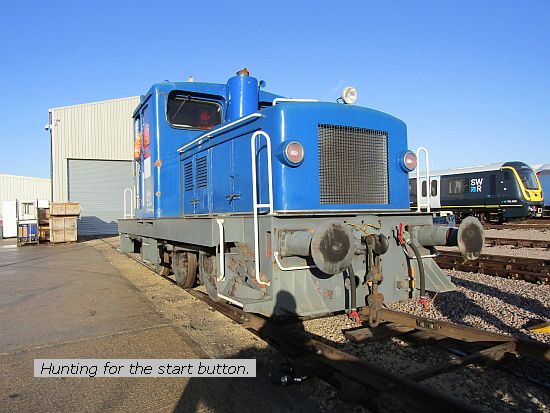
Adam headed back to base, I headed home to get some work done, having agreed 'same time Monday' at Crossrail for the second loco.
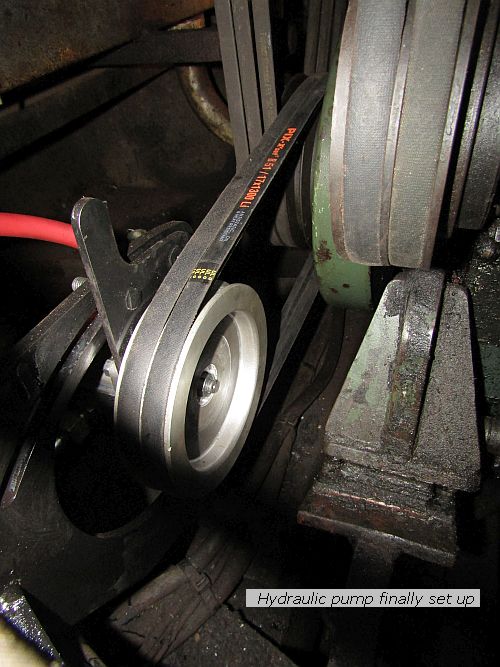
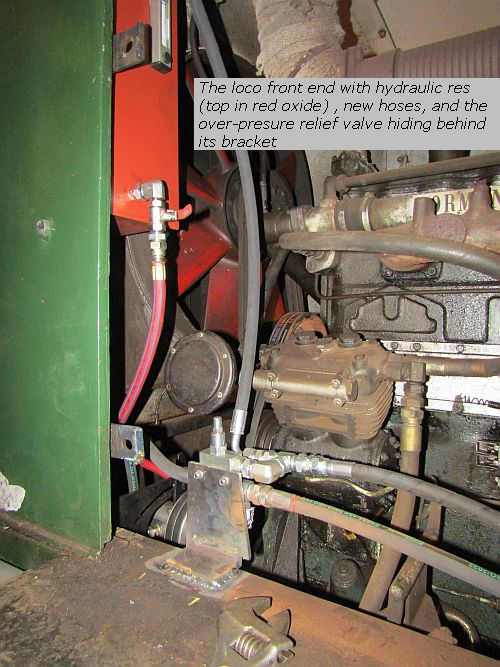
Saturday, and an ambitious programme of work was scheduled primarily on the EE Stephenson to get the vac fit finished. At last the final pulley to drive the pump arrived, machined by Matt but just needing a clean up of the keyway with the keyway-cutting kit Andrew had acquired during the week. That fitted, on went the pump, its driving belts and the belts for the fan, I could complete the hose that delivered oil to the pump from the res tank and the other hoses could be set up and made secure.
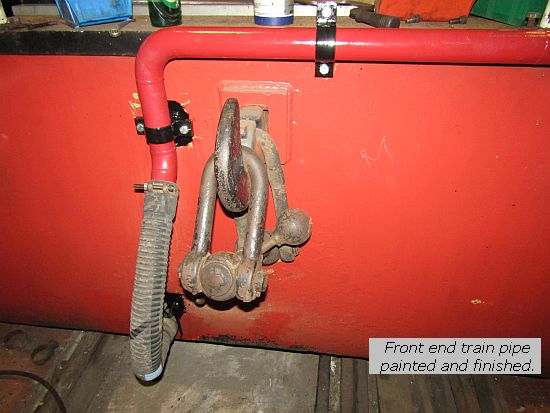
Andrew put together the bracket that holds the over-pressure valve and then refitted the front vac pipe section which had been primed and painted during the week.
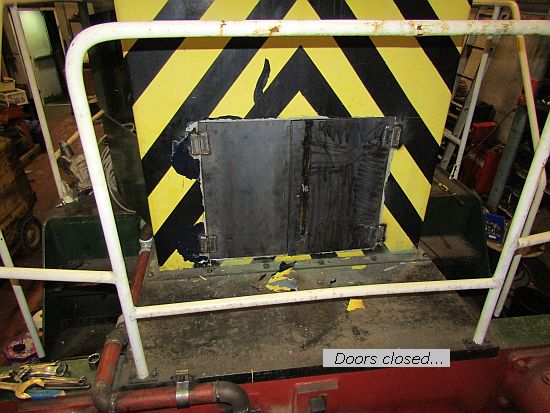
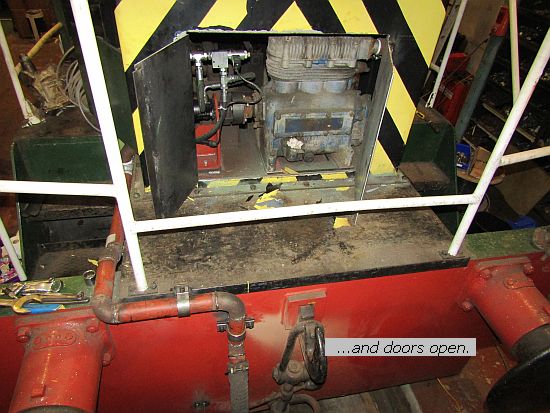
He then resumed work on the rear doors which were basically functional by the end of the day.
As for me, I spent a fair amount of time trying to find homes for the new stocks of nuts and bolts, but I tackled less than half before concluding that some of our stock locations require a serious overhaul. I was also distracted by two visitors, who arrived to collect 2 compressors that Jordan had sold them but before Jordan himself. After loading them into the back of their vehicle, I performed the usual guided tour.
Sunday: we opened up for Tony S to work on the railcar but Andrew and I set off for Adam's. T2 has waited patiently for us to convert it to become a loco carrier, and for some weeks now it has had a quantity of rails on it. With the prospect of havng T1 and the Doll possibly out on separate jobs at the same time we needed to take stock of these. We de-bundled them and measured each, noting also their combination of fishplate holes and whether any additional holes matched for the purposes of tie bars. Considering that these were built up and used as a loco loading ramp they were in pairs that were almost, but not quite, matching lengths. The two shortest were over a foot different and these were brought back in the van, together with the tie bars, fishplates and the tip rails which are cruder, but much lighter, than Andrew's fabricated ones. On our way back we popped into Wirksworth, where Charlie has been stopped having lost its transmission oil. After topping up the res, we ran the engine and found a failed joint on the heat exchanger, but nipping up the bolts made no difference so it was slated for a return visit with a fresh joint. A cup of tea back at the shed and it was really too late in the day to start much serious work. I cleaned up a couple of fishplate pairs and put them back in the van as a reserve set for this week, Andrew organised a bonfire and then set about priming the new casing doors on the EE. With that complete we decided to call it a day in the cool, damp darkness of a November evening. Tomorrow it is another early start and off to London for the second Crossrail loco, with a third loco and then a carriage to move later in the week. And so it goes on. If I survive another thousand miles or so on the road I'll be back next Sunday to tell you all about it, See ya then.