
Of misuse and the art of control
23rd October 2022
Got you guessing?
What a week it has been, hasn't it? I didn't think Ms Truss would make it to Christmas but I certainly didn't expect her downfall so soon. But I should steer clear of politics as if there is one thing that is certain, it's that we'll all have different views which can easily come between us.... .
By my standards it has been a reasonably quiet week when I've managed even to make a start on software for two of the locos. But I'll not get ahead of things. On Monday Andrew was watching several items on an auctioneers site and was successful with 4 lots. As he was busy with work I was volunteered to go and get them (from Barnsley) which I slotted in on Tuesday afternoon. In fact I had intended to go somewhere else as well, but interruptions in the morning made me later and later leaving and in the end I only found the auctioneers at about 4pm. (It would have been sooner but I managed to take a second right in the sprawling industrial estate thinking it was the first and I must have been driving round for ten minutes before I returned to my starting point and found the turn I should have taken). Anyway, I came away trying to balance a Makita power drill, two die grinders and a reciprocating saw (the last like new) without dropping them or tripping over their cables.
'What's a die grinder?' asked the man locating the lots from my release note. Had I been in a facetious mood I might have come up with a witty retort linking it to a certain dating website but I instead I explained that these were power tools used to remove metal freehand. We have diegrinding bits that can go in power drills, but the load is imposed more sideways and the drills are not designed for that, as their intended loads are end-on. Proper die grinders are designed for side loads, and are cylindrical rather than pistol grip, better to be controlled in the direction you want to remove metal.
In the course of Wednesday I got down to the shed to unload the winnings and out of curiousity flipped on the 110V and tried them out. One of the die grinders has a big masking tape strip around it endorsed 'NO GO' in blue marker pen but it functioned as soon as I hit the switch. The second die grinder and the reciprocating saw similarly worked straightaway but the Makita drill did nothing at all, and I put it on one side with the intention of having a better look later. For what Andrew paid, he had more than his money's worth without it.
The loco for Alstom is not far from finished but was still awaiting my full software on its PLC. I had originally intended to use the programs that I wrote for the loco RMS did for Croft, merely deleting some sub-routines that weren't applicable and amending some elements such as, for example, inputs or outputs in different places on the modules. I tried that some weeks ago - well months really - and got myself into frustrating knots with the 'validations' declaring all sorts of errors as I tried to amend something over here unaware that the software also used it over there and changing its properties at this spot screwed things up somewhere else. I told myself that as I had a paper printed version of the Croft program, all I needed to do was start from scratch, type it all line by line, making tbe alterations as I went along. The trouble with that approach was that I wrote the Croft program in 2006 and according to the notes was making amendments up to about August 2007. Some of these were minor improvements or alterations the customer asked for: like I had written a sequence that if the loco was standing idling for 15 minutes, it automatically shutdown to save fuel as the customer had requested, but then they asked could I insert an additional warning message at about 14 minutes in case the driver had good reason not to want it to shutdown.
On the other hand, we had a rep spending time at Croft overseeing its introduction and he also knew a bit of programming (he wrote me some stuff in 'C' which I wasn't familiar with on another job) and who kept asking me to tweak a bit here or there. So when I came to look over this program, now 15 years later, it was very much a 'what the hec was that for?' and the realisation that line 'X' might in fact have repercussions much later in the program if I omitted it or clutter precious memory if it was actually superfluous. There was nothing for it but to go back to first principles and compose it all again, hopefully not making the mistakes that I probably did in 2006. This however is time consuming and really requires concentration. I had lined up an evening one Saturday a fortnight back only for plans to be changed. In addition there's space. My little office desk is cluttered with keyboard, mouse mat, monitor, printer and piles of papers. There isn't room for the laptop, second keyboard and mouse, the 'book' with the Croft program print out, the 'book' with the Alstom loco's documentation, plus loose sheets of paper with scribbled software doodles, and the vitally important notes of which markers and Registers I've allocated where so that I don't duplicate and overlap them. Then there's the Hudswell. That too has the same PLC but without the text screen, and whereas on the Alstom loco you press the start button and the PLC cranks the engine, gets it started, idles it for 10 seconds then ramps the throttle up to about 1200rpm and stays there until the air pressure reaches working, on the Hudswell it is a key start, manual throttle and a set of warning lights that inform you of whatever it is unhappy about.
The subroutine for operating the clutch and gearbox may be almost the same but not much else. And back in 2006 I had not long switched from Eberle PLCs to GE and although using 'Ladder' in both, the actual commands were very different and I was still tending to 'think Eberle but write in GE format' rather than write using the best means within GE. Now, I can quite understand if some of you are saying to yourselves that all this is totally unneccessary and a what's wrong with pneumatic control systems and rods and linkages. To an extent I agree, and I don't favour the modern Canbus systems with a little TV screen that creates images of instruments and displays needles across them, or where electronic transponders are fed into special analog input modules or analog outputs drive proportional valves.Some of this seems to be electronics for electronics sake by people who understand electronics but don't have a clue about locos. The Hudswell continues to have a bowden cable throttle and a Westinghouse Type W brake valve and tbe driver's hand operates each without any electronic interference.
But consider for a moment the original Hudswell control system. The clutch cylinder had main air permanently on one side of the piston, when the same pressure was applied to the other side, the greater piston area overcame the 'out' side and pushed the clutch 'in' - at least as far as a stop bolt that was to take the load off the clutch linkage during normal running, and one should periodically adjust that stop as the clutch wore but did anyone? Up in the desk a simple on-off valve labelled 'Clutch Out' isolated the clutch in supply. Nearby the forward and reverse control lever operated the gearbox and the clutch 'in' valves thanks to 3 cams acting on their rollers. There was no real mid position - the detents were one direction or the other, and as you moved the lever the middle cam turned off the clutch 'in' air supply and restored it once you got to the opposite direction valve. Thus the 'timing' relied on the speed of the driver's arm and the stiffness of the gearbox and clutch linkages. First time or two, with the oil cold and thick, it was usual to have the gearbox 'ratchet' that is, go 'bang-bang-bang-bang' as each tooth hammered its neighbour for the clutch had re-engaged (or never fully disengaged) before the gears had sunk into their opposite direction engagement.
And was there anything to stop the driver trying to change direction while still moving? No.
Was there a means of stopping the driver engaging the clutch with the engine running anywhere above idle? No.
You could take the clutch out with the loco moving (better than Sentinel and Thomas Hill practice, I grant you) but for the rest it relied on the skill of the driver not to do anything stupid. Can you take the same view today? In many places the loco is just one piece of kit the operator operates - it's called 'multi-skilling' but just how much of real skill the operator retains across this and other machines is open to question. Today - and it's not just 'Elf and Safety' but common sense - you have to build in the interlocks and protections for both the machine and the crew from it being misused or even deliberately abused. And whilst you can probably do much of it pneumatically, electrically is much more practical for many purposes and trying to add all the interlocks results in massive relay banks like the HaTRAAM. We once wired a loco at Hills with 45 plug-in relays and it wasn't even radio controlled. Electronic logic in the PLC enables all the safeties to be built-in without massive wiring and visual fault-finding if you simply follow the displays. I'll get off me soapbox now.
This weekend we were joined by AndyM but Andrew had our grandson up so his time was slightly less free. I asked Andy if he fancied taking a look at the 'duff' Makita and an earlier acquired Matabo drill that was also non-functional. His immediate question was had I checked the plugs, as his experience was that workers (and see 'skills' above) pulled the plugs out of sockets by their cables and often managed to pull the wires out of the connectors in the process. I confessed I hadn't and he proceeded to open up the Makita plug and reveal not only a wire detached but that someone had assembled the plug without any strain relief which made the result almost inevitable.
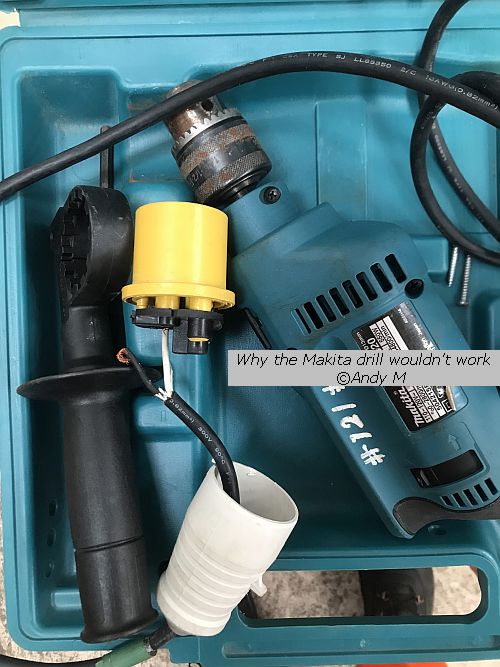
Strange that an almost new-looking drill should have had its plug swapped. The Makita was restored to work, but he had less luck with the Metabo, finding the trigger module rusty inside as though it had been immersed in water and the electronic regulator probably duff. We moved out to the Alstom loco and after assembling the rear drawhook between us, we investigated the charge circuit which wasn't functioning. Together we were able to prove that the cable to the regulator, part of a 25 way multi-core, was somehow broken, but finding continuity one one of the spare cores, we swapped them over, up came the regulator and the batteries received charge. In between time I had got around to making up the new fuel hose between the filters and the fuel pump on the Hudswell and was preparing to make the end off at the fuel tank now that I had the ferrules from the supplier.
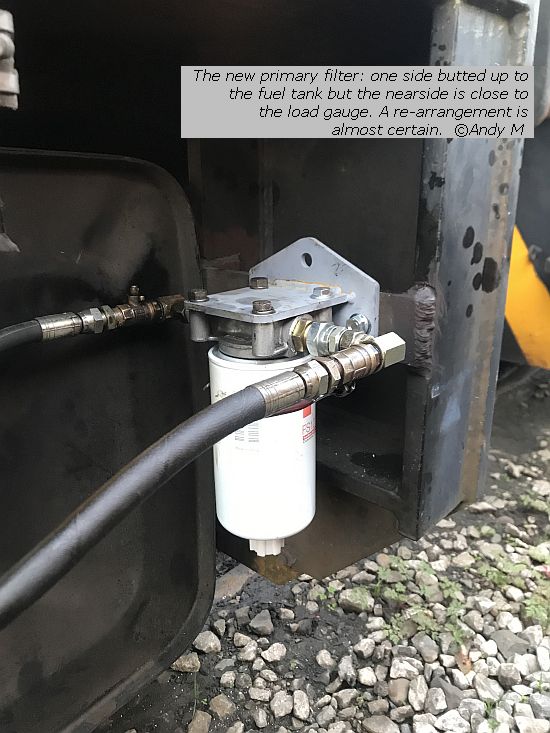
Andrew was down making a start on the Hudswell's pneumatic pipework to get air into the receivers and up to the cab. Andy took himself to the Hatramm where the new primary filter was hanging on by one bolt and not yet connected. He marked and drilled the second bolt hole, and connected the filter, primed the bowl and got the Hatramm runnng. The pipe connection though is uncomfortably close to the edge of the vehicle (the original was but this is slightlly worse) and I had better sort out another combination of fittings to bring the hose in a bit.
Outside on the railway the trains were passing well-filled with happy faces and a preponderance of children - it was a Peppa Pig weekend at Rowsley so Darley Dale station was closed with trains non-stop (except one on Sunday but we'll not go into that) and I found myself wandering around with a fresh ditty to the tune of 'Oh Danny Boy'.
'Oh Peppa Pig
You'll make a super sandwich...'
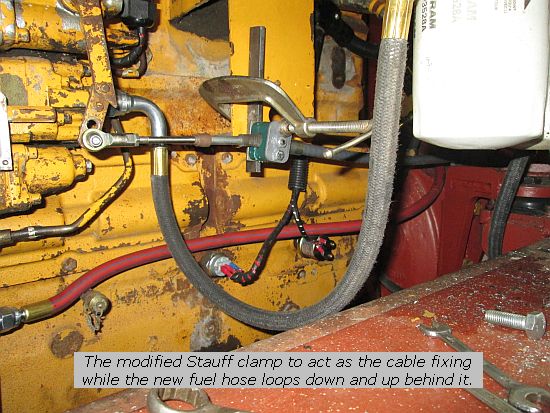
Sunday and it was raining heavily. I brought down some electronics jobs for Andy to keep him dry. I had a 'bare bones' program ready to install on the Alstom loco but didn't fancy running a mains cable out to it so left it for another day. Andrew had produced a small Stauff clamp Saturday evening and suggested it might serve to anchor the end of the throttle cable. It was a little too big in the bore and there was a recess in the cable end to suit such as a u-bolt to hold the cable in line and stop it moving to and fro with the inner. I could cut a bit of the Stauff moulded plastic away to obtain a grip, I thought, and with a tapping in the top plate, put a grubscrew through to lodge in the recess. So that I did and it needs but a 20mm or so spacer to position everything in line. For now a g-clamp is holding it all in place for test and you can also see the new hose that loops well clear.
Having made the pipe connection back at the fuel tank, I realised that my one-piece flooring here made access to the fuel stop cock rather difficult, so amended the boards into two pieces and added a ring-pull to lift the access panel speedily. I still needed to rebate the edge of the boards around the desk where the steel treadplate over the gearbox would be better flush with the board tops. To save tiresome chiselling or Stanley knifing, I tried trimming the wooden boards with a slitting disc on the battery grinder: very effective but the smoke it created was a trifle overpowering. Like sitting over a bonfire without the flames.
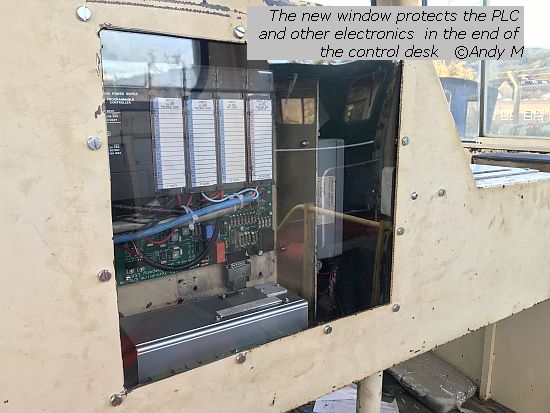
After lunch Andy returned to Alstom's loco to trace a fault whereby operating the Master Door Control switch didn't register on the PLC. I suspected a broken wire but it turned out to be a duff switch so that got changed and he managed to re-arrange the air pipes as, presumably throughout its life, the door switches for the left hand side have been crossed over. He then took the section of clear plastic cut, drilled and fitted the resultant window over the PLC in the desk.
Back on the Hudswell, I removed the last vestiges of the original pneumatic pipework, save for the pipe to the brake cylinder from the brake valve, and finding a suitable Enots adaptor for this, reconnected the cylinder to the output port. A tee part way down provides a branch for the gauge line, but this too was an Enots fitting and had little metal in reserve. However another recovered fitting was much more of a reducer and accepted being drilled out to 29/64ths and tapped 1/4BSP to enable ordinary plastic pipework up to the gauges. Andrew was installing the 1 inch air main from the receivers back to the cab, (still in progress) and late on we removed the old Westinghouse safety valve and replaced it with a tee carrying a new Seetru safety valve and the pressure switch which will tell the PLC that the air is sufficient to operate.
One of the blockmen at Darley Dale had asked me earlier whether 'we had ever got that little yellow loco restored'. He remembered RS8 arrive in its woebegone state and I suggested he pop around after he'd closed up the 'box. We'd just sat down for a cuppa when he and his assistant appeared, so a quick tour of what's afoot in the shed and out to RS8, which was fired up and run up and down for them.
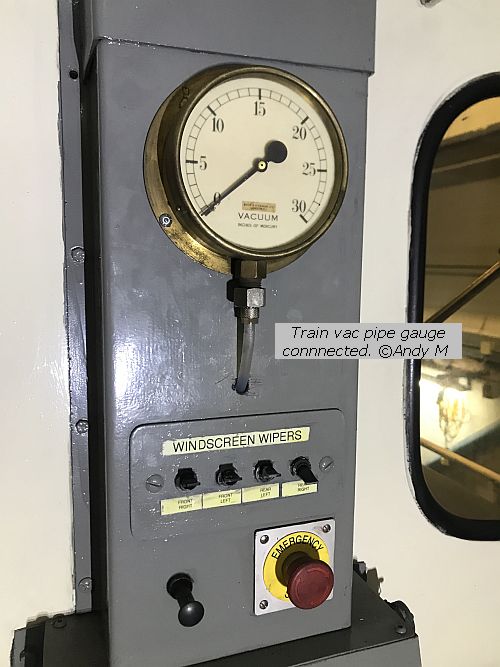
Andy had come back in and did a bit on the EE - the vac gauge had been mounted by Matt last week but Andy has connected the gauge line and routed it towards the tapping that Andrew had put in the train pipe.
We had hoped to have the transmission coupling for the Janus remanufactured this weekend and to this end both the rivets and the new outer re-inforcement rings were to hand, but the laser cut spring steel discs are taking a little longer so hopefully that will be on the agenda next week. And if you're thinking that a lot of jobs appear to have been tackled this week, you'd be right, all in all a very satisfying couple of days with much progress. This next week is due to see an 03 and two 08s moved, so I'll be out and about again with software in the back of my mind. And at last I've managed to allocate a day to get my hair cut - seems to have been easier getting a flu jab booked. Anyway, I'll be here again next week, I hope. Will you be too? See ya then.