
Of 'It ain't 'alf cold, mum'
18th December 2022
As I get older it seems as though my fingers won't stay warm like they used to.
Once again it has been a quietish week here at the Briddon Country Pile. Definitely one to curl up in front of a non-fossil fuelled fire if you have one. Monday had me over to Manchester but I got engrossed in some e-mails etc first thing so it ended up occupying most of the day. Tuesday and I was putting off tackling the on-line form filling for the customs declarations neccessary to get something over to Northern Ireland. When I finally bit the bullet it took me fifteen minutes just to find the right page on the gov.uk website, then find the paperwork I did last time (months ago) print it off and fill out a fresh set changing the date, etc where required. It occupied 90 minutes overall, and I was gratified, nay astounded, when it was accepted and generated the required declaration and movement numbers. Before it could change its mind I printed it off and dashed over to Sheffield to get the consignment into the Palletline depot. Steph had been scraping the ice off her car when the front wipers stopped working. She thought maybe a fuse had blown so Wednesday morning first thing I took her off to a friend's in the van: the temp gauge showing minus 6 deg C. and returned to take a look at it But it wasn't a fuse I could hear the motor but the wipers stayed still, , and Andrew did some research and found that the linkage arms tend to fall off with wear. 'Genuine' replacements were costly, but 'aftermarket' versions were cheap though the first one I tried had a website problem that wouldn't allow the order to complete. Ringing them merely got an apologetic message saying that there was no-one to answer and please place your order on line! I moved on to another supplier and the order was dispatched that day. Thus Thursday I had again to run Steph somewhere first thing and this time the temp gauge was saying minus 8. This was getting a trifle concerning. I had put some antifreeze into RS8 last weekend but wasn't sure of its strength: if it was minus 8 then with the sun at least shining, how far had it dipped in the earlier hours of the morning? RS8 was at the head of the line on track 3A and was a little exposed.
The kit of parts for Steph's Micra, ordered for next day delivery, was, as per their website, to come by Royal Mail but I was relieved when instead I was notified it was couriered by DPD and would be here between one and two pm. I hung around the house, as you do when determined not to miss the delivery, after all, DPD had been here loads of times, what could go wrong? At 2pm the tracking data changed to: 'driver was here at one-thirty but could not find your house'. Andrew who was working from home, found me a phone number for DPD's Stoke depot where it had last been. A DPD-lady there rang the driver, but he 'couldn't remember which package it was' and she admitted his command of English wasn't great but I suspected it was more a case of 'I've too many deliveries to do to turn back'. She suggested I ring again after 3pm as she finished shortly - but after 3pm no-one would answer the phone. Eventually it arrived Friday: actually that day was like Piccadily Circus with two seperate calls by DHL, one from UPS, Evri and late on from Amazon. Saturday morning and Andrew and I were off in the van. It was a relatively short haul over to Leek to collect a Cummins short motor which made the van settle a bit but certainly was within its capacity. Some of the roads over showed signs of surface ice and as I had taken the 'high route' after Warslow (via Lum Edge and Merryton Low) it was disconcerting that it started snowing. With the engine loaded and secured we set off back, taking the lower route initially along the Ashbourne road, getting back to the shed at about ten to noon, with the idea of firing up RS8 and drawing the train back so that we could get the forklift out. A careful look over RS8 showed nothing visibly wrong, save that even the engine block was white with a layer of frost - but no big cracks, no holes in the rad matrix, though the coolant level had disappeared out of the gauze filler in the rad neck again. But the batteries weren't having anything of it - the external battery box on RS8 leaves them rather exposed to temperature changes.
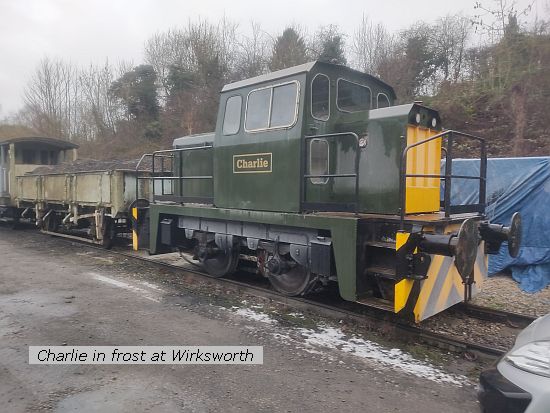
So we packed things back up and headed home for lunch, after loading up a few things needed for Charlie. Thus with the van still loaded with the engine block, we set off after for Wirksworth. Charlie had 'sprung a leak' on one of the flanges that convey the transmission oil in or out of the heat exchanger. I had cut some new ones last week - for once out of 5mm nitrile rubber rather than my more usual diet of rubberised cork. We released the two bolts, catching as much oil as possible, pulled out the old joint and inserted the new, Andrew refitting the old bolts with additional washers as he suspected one might possibly have bottomed. The old joint revealed easily why it had failed: the central hole is oval in shape, but the material at one side had bodily moved outward under pressure until the 'land' on which the flange applied pressure was next to nothing. The oval hole was no longer oval but more triangular. We topped up the reservoir and then fired up the engine. With not having been used for a week or two and with the cold, even a Rolls, which always had a reputation for good starting in cold weather even if some of its other characteristics were not so popular, took 3 attempts before finally coming to life. Converter base pressure came up on the gauge and the repaired joint remained oil tight. We left the loco running for several minutes with the air drain open to blow out any moisture, during which time Director Tim Oaks walked over for a chat. Even after that, this one photo I took this week still shows the frost whitening of the buffer beams, fuel tank and underframe sides although I think at this point the temp gauge on the van reported it as being 1 or 2 deg C.
The car park at Wirksworth was largely full with Santa trains fully occupied and significantly up on 2021. As we st off back it was several minutes of queuing to get out onto Cauldwell Street. We debated stopping back at the shed but being rather cold and tired, we opted for an early finish.
Sunday: Matt was waiting for me when I got down at 10. First job was to get the batteries off RS8 and in and on charge, but although the temperature was only minus 1 I was surprised to find that the sink in the shed wasn't draining so presumably (as the temp inside the shed was still over 2 degrees) it had frozen in the ground outside. While the batteries received the benefit of a charger I checked over RS8 more thoroughly than we had the day before, carefully as the running plates were treacherous with ice and being an ex-steam loco, those running plates are smooth, not in any way treadplated. I brought out some anti-freeze and topped it up neat to get the level into the gauze filter but noticing some of the accumulated water on the frame stretchers under the front of the rad was ice but some was blue with anti-freeze. We had trouble with the bottom rad connection not sealing at Tunstead and it seems likely it is leaking again, though there was no sign of any damp patch under the loco, nor any visible drips when it is running.
Matt made up the oil suction connection on the Hudswell while we waited for the batteries, but after an hour the charge rate had tailed off dramatically so we took them back out and reconnected them, and fired the loco up. Matt came into the cab and asked after the low air pressure protection system, which I duly explained and demonstrated. When the loco was ready I put it into forwards and it refused to move. It wasn't coupled, it wasn't chocked, the clutch was in and there was base pressure, but it wouldn't budge. In the end I reversed it, and although the Hatramm was buffered up behind it did finally budge but gave me the impression that maybe it had been frozen to the rails. We moved the loco round to Track 1 to draw the accumulated rake back - now much easier without 70-odd tons of 2HAP. Having shown Matt the control valve on the low air protection system was it now a coincidence that it started leaking? No matter, we coupled up and Matt went off to release the brake on the Ferry van at the far end.
By the time he had, I had another problem. The governor valve had stopped leaking, but instead had now tripped the brakes on even though we had 7 bar in the tanks. No gentle tapping with a spanner would dislodge it, and I concluded that to get the shunt done, I had best disconnect the valve's output line and connect it instead to a spare cock on the adjacent air feed manifold. But the two were different threads, so leaving RS8 idling I headed back to the shed for some alternate fittings. Some ten minutes or so later as I tried with chilled fingers to encourage a 1/4BSP male to screw into the 1/4 BSP female of the cock - humm some disturbing metaphors there - I noticed a wisp of air coming from the now open port of the control valve so hurriedly put the pipe back on whereupon the system reset and I could move the train.
With sufficient space for the forklift to get to the van, we broke for a tea and lunch. Andrew duly arrived with our sandwiches and in Steph's Micra. With the engine out of the van the rake was repositioned and another bit of shunting completed. While Matt set about adjusting the brake rigging on the Janus we attacked the wipers on her car. According to the You-tube video, getting the arms off the driving spindles merely took a sharp clump with a soft-faced hammer, but You-tube isn't always right. After an earlier light snow shower it now turned to rain and dis-spirited we gave it up for the day.
The brake rigging on a Janus is unique, like much of the rest of the loco. Just as the loco is symmetrical from the side over the centre line of the cab, so it is also symmetrical longitudinally, ending up with 4 brake cylinders each one acting on a combination of 3 brake hangers and blocks, with two turnbuckled pull rods. If Yorkshire ever wrote up instructions on how to set it up, I've never seen any, and there seems to be as many 'methods' as fitters who have worked on Janus. In theory it is compensated, in that the first brake block acts as a pivot to transfer force to the second brake block, which in turn acts as a pivot to transfer force to the third, and thus all three should - apart from any mechanical losses - experience equal braking force upon them. We have the assembly drawing for new rigging showing the correct lengths for the turnbuckled sections and the pin holes for the last stage between second and third hangers, but apart from this Janus having rather more holes as choices for pins than the drawing, the drawing also illustrated brand new wheels (3ft 8) and blocks, whereas we had turned down wheels (nearer 3ft 6) and worn blocks.
What should you adjust where to compensate? Andrew and Matt spent a happy(?) hour adjusting to and fro on the opposing sides of one end (there are two cross connections which mean that the opposing sides are not wholly independent) while I waited patiently in the cab ready to make a brake application and then release to see if all the blocks swung free of the treads. It became apparent that there must be a 'sweet spot' where it all works perfectly but it is hard to find with the stiction brought about by all the pivot points and the sheer weight of all the parts. As one for whom compensated brake rigging has always meant a horizontal pull rod pulling on a triangular junction where one side acts on the adjacent crossbeam and the other takes the pull forwards to the next crossbeam or another triangular junction Janus has always seemed an un-neccessarily complex brake rigging that achieves little of benefit and still requires 12 blocks rather than 6 for an 0-6-0 and takes twice as long to adjust - when you know what it is you need to adjust...
Sentinel stuck with a brake rigging design for years that they knew was poor because having built a few that way it was henceforward 'the standard'. Yorkshire so far as I recall never built any more 0-6-0 or 0-4-0 locos with a Janus-esque rigging - did the Drawing Office know it had defects but couldn't deviate from 'standard' on repeat orders?
I had part-filled the hydraulic reservoir on the EE last week and we finished topping that up before carrying a final check around of all the hydraulic hose connections. Plan A had had us taking the loco outside to start it, but the sound of the weather gave second thoughts and instead we decided to prime the system by cranking the engine on its own. I had undone the two bolts that hold the motor to its bracket and pulled it back so that, with no load, we could easily see which way the motor turned and whether we had to reverse the hydraulic hoses to make it suit the exhauster. But the engine cranked so slowly that it was never going to start anyway and so Andrew detached the belts and turned the pump by hand to charge the system. Suddenly he found it far harder to turn and at my end the motor shaft rotated - of course it had to be the wrong way so out came some containers, we detached the motor hoses and swapped them over spilling as little as possible and catching it. The motor was reconnected to the exhauster but this time Andrew could not turn the pump by hand though when I helped it a little the exhauster ran on a gnat's as the pressure dissipated. The batteries meanwhile were back on charge so after a cuppa we cranked it again and got some rotation on the exhauster though the batteries were far too tired.. The rain continued outside, but even this was consoling as the water standing in the sink had quietly drained away. The Met office forecasts 13 deg C tomorrow - is summer just around the corner?
At this moment it is customary to wish you all the Seasonal Greetings from Andrew, Steph and myself and hope you all have a good Xmas and similar new year. 2022 marked ten years here at the Briddon Country Pile - how the time has flown. And you out there are still tuning in each week or so to read about it. Amazing. Whether I'll be writing the next edition on Christmas Day remains to be seen but it wouldn't be in any way unlikely. Hope Santa brings you what you want and until next time, See ya then.