
Of a palletful of pads
20th November 2022
What did we do before pallets?
It has been a quiet week by usual standards: just two customers visiting to ascertain progress on their locos and one demanding that I finish it by the end of the month but as they're one of those firms who only pay on 60 days they are not likely to see that happen. I've got customers who pay faster! The client who is buying the Hudswell on the other hand is quite laid back and having seen how much new material has gone into 'his' loco went away impressed.
On Wednesday Andrew 'won' something on an auction site: not ebay and his bid was seemingly the only one received although the auctioneers took it at his maximum. That meant that on Thursday I was delegated to head north west to Bolton (Andrew initially said Blackburn but Bolton is at least 30 minutes nearer) to a transport firm on a rough Industrial estate. The rain had been falling steadily most of the way over and as I pulled up outside their offices, it was to park almost in a large pond. The auctioneers had said they would advise them of my arrival time but either they hadn't, or the message hadn't got through because the two men who assisted me were not expecting me and had to move half-a dozen pallets to get at Lot 170.
And what was Lot 170? It was a rather decrepit pallet of Strail pads. Ah, but most of you are none the wiser. In the old days level crossings all had check rails and the surface over which the vehicles transected was filled in with tarmac or sometimes just old sleepers or such. Nowadays most crossings have big, thick rubber pads with drainage channels moulded in to their top surfaces and flange grooves at their sides. Strail ('Where Street meets Rail') is one such brand (other brands are no doubt available). And what did the transport firm want with these pads? Did they have their own, private level crossing? From what I could gather, they used to lay them down on plain ground (read muddy field) and drive lorries over them, and given by the quantity of mud and dead plant life clinging to them I can believe it. Was that all I wanted? they asked, we have another palletful around the back. We went to look, sure enough they had, but after checking with Andrew we both felt that we had sufficient for our immediate needs.
And what are they? Well, when we first planned out the Geoffrey Briddon Building we anticipated having a door at the north end through which we could unload items arriving by road. Then in order to overcome objections raised by the council we moved the buiiding a touch east and deleted the Bakewell-facing door, which means that all vehicles bringing bits in and out must travel past the shed and be unloaded at the Matlock end. In practice this has meant bringing the forklift out of the shed to lift whatever it is on or off and bringing it back in, but the trusty old forklift is not at all happy on rough ground. We did create concrete pads at either side of track 3A, but the middle has been kitted with strips of chequer plate to provide a tolerable surface to drive over. It is far from ideal and every now and again the forklift grips one and launches it out the way or another bends up and snags on the underside of the 'lift. We could fill the middle in with concrete but it would take up much time in preparing, reinforcing and probably lifting and levelling the track etc before entombing it. Whereas Strail pads...
So back to Thursday and there I am with with a palletful of Strail pads and a largely empty van. I said the pallet was decrepit and perhaps because of its rotted condition the load above it was sloping to one side, like that leaning tower thingy. I backed the van around to where their forklift had now cleared the way to Lot 170 and wondered whether to tip the van to one side to match it. Certainly if the load had been true and vertical it would - just - have fitted through the doorway but two or three attempts leaning on the stack while propelling forward just wasn't going to work. Getting colder and wetter I suggested handballing the top two off, laying them on the van floor and putting the pallet on top which they agreed to try. Boy, those Strail pads are heavy - it took the 3 of us (OK 2 and a half as they are younger and fitter) to lift and drag two in and surprise. surprise they wouldn't sit flat together between the van's boxed-in wheel arches so we put some timbers on to try and form a base for the decrepit pallet to while away its final journey upon. With those two off the slanting pile just made it through the door and I put a strap over the top of them before slamming the back doors. Somewhere about here I was wondering just how much load I had - one of my faithful assistants had remarked that 'I'd feel that all the way home' but judging from the tyres and clearances I was still well within the van's capacity. So I set off back, and while I kept my speed down to around 55mph and was aware of the weight (if only by the creakings and groanings in the back) I returned home without incident.
Late that day we moved the train back at the shed and extracted them all with the forklift, and put 2 torque converters back in their place to take away Friday. The two converters were definitely lighter than Lot 170.
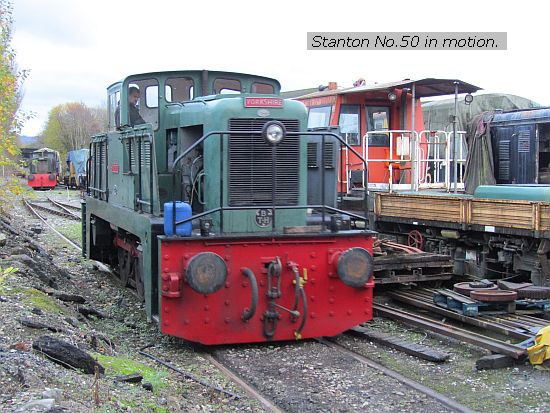
Saturday was Steph's birthday, and to celebrate she had a day away from me by taking an early train (early it should have been but was actually running 45 minutes late) to Darlington and our daughter's. Thus roused to take her to Chesterfield, I was down at the shed in reasonable time including, in the back of the van, 4 new batteries for the Janus. (I walked in to my supplier 'I want four 655s.' 'Oh good' he replied, 'I've 71 of them in stock'). We fitted them as first job, with both Matt and Andy M to take the load off me. Duly installed we attempted to start the Matlock end of the loco and got zilch, but the Bakewell end cranked and after a lot of bleeding until fuel flowed from the pump, it fired up. A wiring error was identified and the Matlock end ran with less bleeding, which my thumb much appreciated. To achieve this RS8 had pulled everything out of the way, and I hoped to get some dramatic pictures of the Janus trundling up and down, but only the Bakewell end actually took power so here's about my only photo of the week, as it crept rather limply along.
Closer investigation revealed that on the Matlock end the AVR (which controls a 7inch Simms dynamo which provides the initial generator field excitation) was completely dead so the dynamo was producing nothing. With daylight failing we pushed the loco back inside. Over on the Hudswell, Matt had brought in the new jockey pulley so that received its bearings and the assembly was put on the loco and the fan belts adjusted. Earlier in the week I had come back with some of the hoses for the hydraulic pump and motor drive on the Stephenson and assembled them to provide the feed through the filter, the by-pass valve which will enable the driver to turn off the exhauster when not required, and the return line back. Since I could not measure them to the pump, these will stop part way up the engine bay where a new over-pressure valve will form an emergency dump-to-tank route if anything untoward happens further along. Once this is in place, and the new pump fitted (I have had to order another as by changing the attitude of the pump the rotation was wrong) I can measure up the remaining hoses and get it completed. Andy M reassembled the remaining coolant connections to the radiator. Andrew has not been very well of late and arrived later on in the day, making a start on the material I had brought to manufacture the new doors to fill the hole we had made in the rear of the fuel tank structure. That is well-progressed though a minor c***-up in my converting the dimensions from aperture to plate sizes means that awaits another piece.
On Sunday Andy M continued going over the Janus wiring against a diagram,. identifying a minor error but more especially that when the generators were overhauled, the resistors had had all the clamps and wires renewed but probably not as they had come off, so values were a bit wide of the mark.
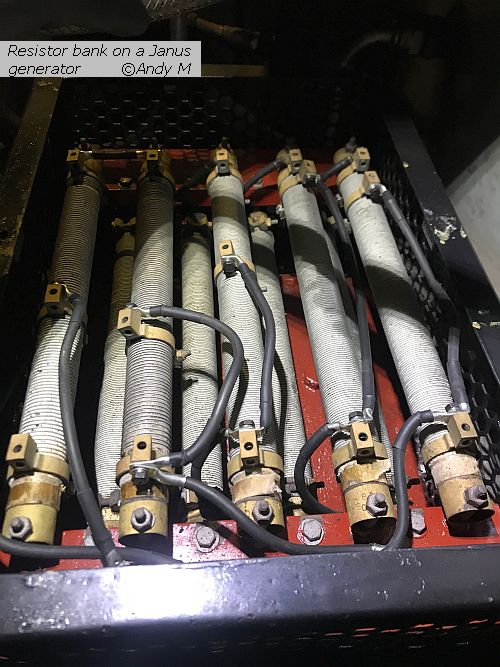
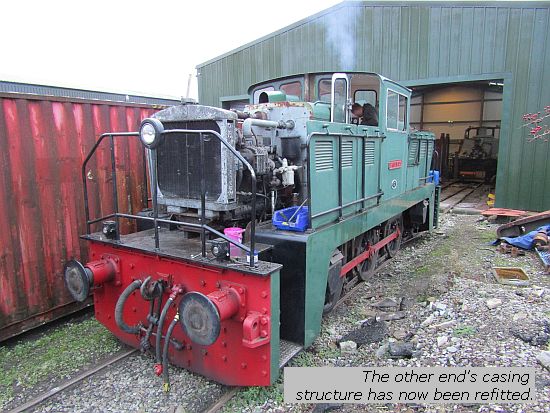
This also accounted for some of Saturday's lack-lustre performance but has now been corrected to the book's 'start off values', for with a Janus to get the best performance you must match the engine rpms (which are both mechanical connections from the power handles) and then the generator outputs which may mean tweaking the resistance bank values. For now that is stalled, but we did take time to refit the casings on the Matlock end, so the loco is now externally almost complete.
Andrew took some of the vac pipe off the EE and sanded it down followed by priming both the pipe and the clamps. He intends doing the rear section also. I hid away in the Hudswell's cab, assembling the air feed pipe which splits off to the duplex gauge, the electro-pneumatic valve manifold, the sanding valve and the driver's brake valve, together with a filter to protect the valves. The feed to the duplex and driver's valve are straight through, but the ep valve block and sanding valve feeds are through stop cocks should the need arise to isolate them.
Which brings me pretty well up to date.Oh, but I haven't told you the outcome of the silent ebay seller. We lodged a formal complaint with ebay, and after a few days the payment was refunded.. Keep watching; it will probably get relisted, perhaps by somebody 'for a friend' and at a higher price. Never list something on ebay at a starting price that you aren't prepared to sell it at.. Andrew has some plans for me tomorrow afternoon, and I have some plans for myself from Thursday onwards (a job I was expecting to start tomorrow or Tuesday but haven't had the ok on the Risk Assessment/Method Statement yet) so we'll see how the week goes. I should be back next Sunday to write it all up. See ya then...