
Of the sound of silence(r)
4th September 2022

Is it Sunday again already? I'm losing track of my days at the mo. Let me see now, what has been happening this week? Part of the time has been taken up with admin as it always seems to be. The exhaust system is one of the last major parts of the Hudswell rebuild and by Wednesday I had finally sorted out a specification for the silencer.
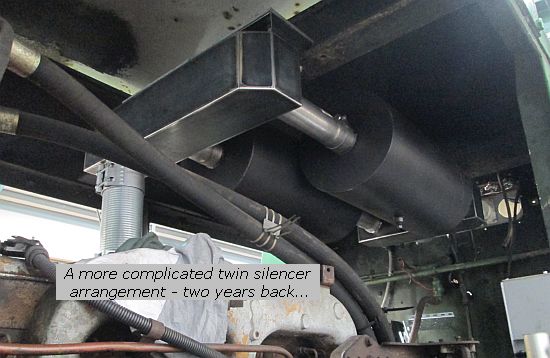
Although last time I ended up with quite a sophisticated twin silencer layout that fitted within the cramped space of an existing casing structure and engine position, this time I had decided on a simpler option as the twin arrangement though resulting in smaller silencers, required fabricated boxes before and after firstly to split the exhaust into two hopefully equal flows and then rejoion them after. By setting the two silencers at slightly different pipe lengths from the source I had hoped that I might end up un-synching the two pulse trains and maybe get one to assist in cancelling the other out, but the rigidly-mounted engine meant that any improvement I had achieved in the exhaust noise could not be discerned above the overall power unit din, and the fabrication charges increased the cost and delay in completion.
Yet out of 3 companies approached, only one responded and that was for a large silencer that I could have just fitted under the casings but would have been a right pain for maintenance with the volume it took up. I asked about the next size down - a foot shorter and several inches less in diameter - especially given that this loco will spend a proportion of its time waiting for wagons to be made ready to set off and only a brief time with significant power on to get them moving. They had reservations about its performance but I took a judgement and have ordered the smaller one and we'll see how it goes.
At the other side of the turbocharger the air induction hose arrived from a firm in Scotland, as the local supplier having provided me a 'bargain basement' length of 125 mm bore when I needed 140 has never come back with the stuff I asked for having promised they would. That is now on the loco and this weekend I have been progressing more of the torque converter pipework, possible as the torque converter charge pump arrived on Friday. This neatly slots in to where in other applications the engine might have a steering pump or similar, and saves a belt drive off the front of the engine. It does not of course, have a built-in relief valve as the Hoburn Eaton or Barnes ones do, so that needs to be added externally.
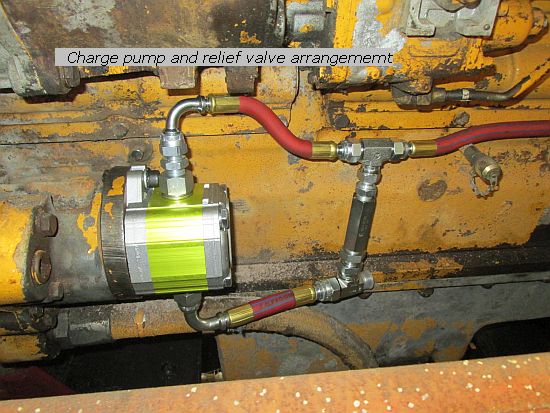
So here's how it is looking by the end of the weekend. The pump is of course that on the left. The oil comes in through the bottom connection (the actual feed will be to the bottom of the tee but is not made up yet) and emerges under pressure from the top, turning back to the tee and hence along to the converter. The cylindrical component between the two tees is the relief valve. If pressure exceeds 4.5 bar this opens, allowing the excess to go back to the input line and so go around again. The rather nasty twist to the upper (red) hose is because to get the pipes roughly right I had to use an adaptor bush and nipple rather than a proper reducing nipple because I couldn't find any. That'll be changed before the system fills.
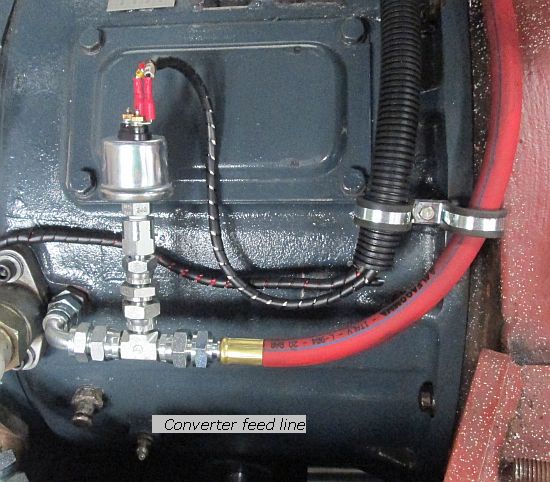
At the torque converter end that delivery hose is made up and the device on the tee is the pressure sender for the cab gauge. I've tried to keep things away from the inspection cover for the clutch but the sender overlaps it a bit and I might try to re-arrange it later on.
Back on Thursday, Andrew (who was on holiday this week) had us go over to Wirksworth to carry out a service on Charlie, which included changing two brake carriers for the later version and checking the brake rigging was 'true' all the way through. On a chain drive loco, because you alter the loco's wheelbase as you adjust the chain tension, the brake rigging has to be fully adjustable. (On a loco with its wheelsets in hornguides you ONLY adjust the rigging between the weighshaft and the first axle: thereafter the crosshaft centres must be that of the hornguide centres.) But there is a danger that unless you measure diligently, you accidentally end up with the loco's axles out of square to the loco frame, and setting up the brake rigging true to the frame then has it unevenly applying to the wheels. I also changed the pressure sender for Charlie's torque converter gauge: this is the third on this loco (I've never had others fail so fast) and I will be interested to see whether this survives or succumbs to something unique about Charlie.
Late Thursday afternoon we were doing a quick shunt back at Darley Dale as we were to allow someone from RMS to extract a component from a loco and were bringing it nearer to the shed. RS8 had already carried out a chunk of it and the plan was to pick it up with the Hatramm and shunt it back next to the shed doors. The Hatramm was running a little irregularly last weekend. Every now and again its rpm would dip and sometimes the electronic throttle would react and send it higher. More annoying than serious. Anyway, I was listening to the engine as Andrew was about to move off, and climbed aboard. 'I think it's about to die on you' I said. 'We'd better get this shunt done quickly then, ' quoth he. Five seconds later the engine had died away. That rather put the kaibosh on it, and the man from RMS had to walk a bit further up the yard.
Thus Friday morning was occupied with sorting out the Hatramm. Andy Mac and Andrew had already discovered last weekend that a big moisture seperator in the fuel system had no filter element in it, so our first suspicion was that it might be dirt in the fuel system and I had ordered up a set of replacement paper filters though 2 ut of 3 won't arrive until next week. When the Hatramm first appeared, it was obvious that the fuel system had been 'Christmas tree'd' as the lift pump was missing and I bought one from a German supplier on e-bay. The moisture seperator filter element must have gone that way too, but instead of taking the whole filter they'd merely removed the guts and sealed it all back up. First discovery as I tried operating the lift pump was a bubbling sound nearby. Andrew traced it to the bleed screw on this seperator, and then found that it had fractured. The immediate plan was to dispense with this unit and put instead another paper filter with a moisture drain on the bottom. We had several but they all had adaptors to 1/2 inch BSP whereas the hoses were all 3/8, so for now the hoses are joined together. The joints either side of the lift pump too were found to have vibrated slack-with them tightend and the two fuel filters opened up and examined (a bit of sludge in the primary but nothing excessive) the engine condescended to start, but its operation was if anything even more erratic than before.
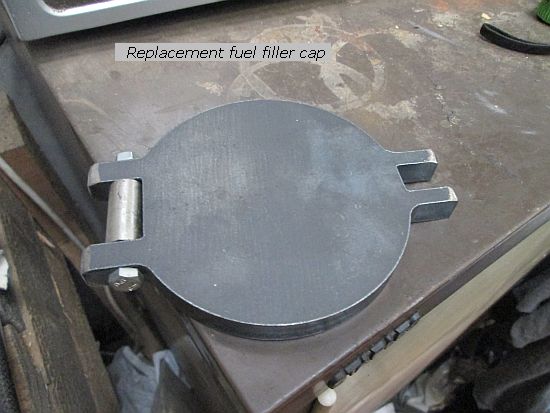
Andy Mac dropped in later that Friday, pausing on his way south east to avoid the traffic, and for a job to while away a little time I passed him a profile I had in stock and invited hm to manufacture a fuel filler cap for Yorkshire 2895. the profile was made to the original Yorkshire drawing, but needed drilling through and a tube cutting to create a hinge that could then be welded to the tank neck. The original has been bagged over since we collected the loco from Elsecar, where presumably it had been broken off. Here's that of the opposite side, and the new one awaiting installation.
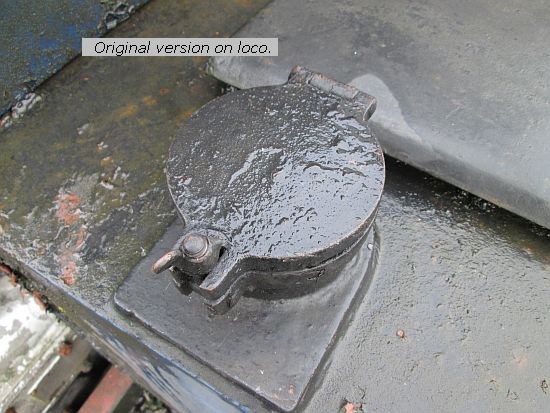
We had the Hatramm in action again on Saturday, but the engine was behaving even more erratically and it was becoming unusable. This time though it was clearly related to the throttle system not fuel, and in a lull I opened up the desk to check whether a mod I had done some weeks ago (the most recent change in wiring that in any way touched the throttle system) was to blame. I tightened up various conections to no avail, so had a tinker with the settings on the electronic governor box. When Andrew re-started the engine it raced up to 2000rpm and refused to come back below 1400. Clearly my little tinkering had affected something crucial on the settings. Together we reversed what I had done and tried a few other few tweaks and it began to settle down, and didn't put a foot wrong for the rest of the day. A bonus was that whereas previously on start up it tended to charge up to full rpm and then return to idle as the governor 'woke up' now it would race up to about 1400 and then subside. If we can figure out what we did to achieve that we might do it some more! We do not like revving cold engines straight up to high rpms, it's asking for trouble.
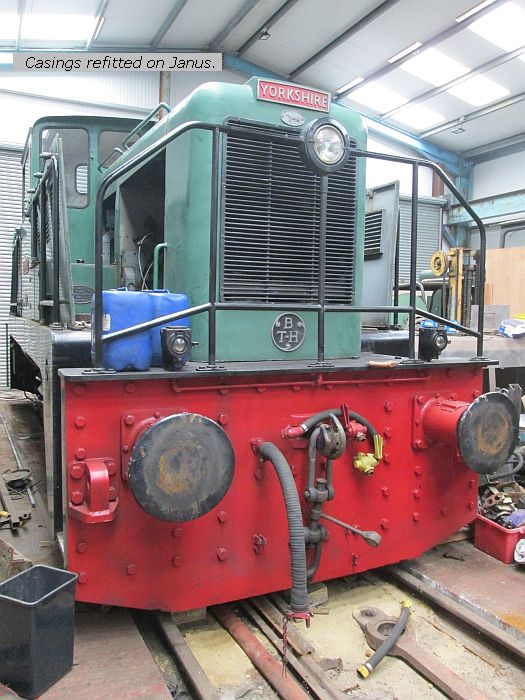
Part of Saturday was occupied with replacing the casings on one end of a Janus, plus recovering the two prefab ramp sections for a quick re-engineering to suit loading over the back of the Doll trailer. Andrew was at Quorn this morning for the swapmeet - selling for a change not buying - and this afternoon we laid out the two halves of the prefab ramp to check it was going together like it should.
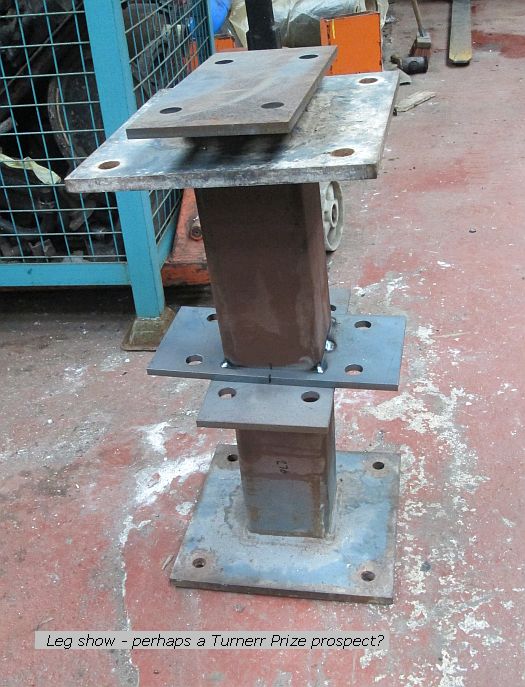
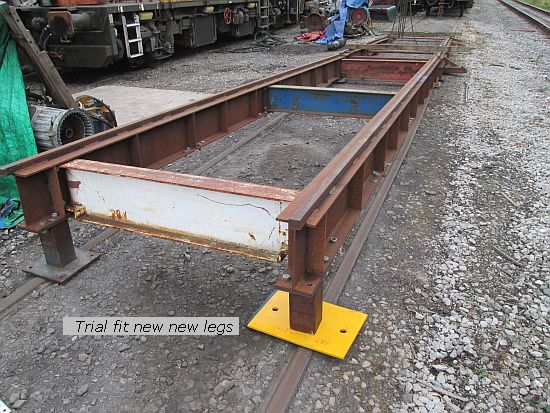
The feet were mostly just tacked together so after this it was taken apart again and the feet taken back inside just as a shower started. Today was also different for two seperate visitors - one, an ex copper - who arrived with his dog and ended up staying for a cuppa and bought a copy of 'The Railway to Merhead' - and the other who wanted only to see three locos he had 'not seen before' (apparently I took him round 3 or 4 years ago so presumably nothing else has changed since) but then toured everywhere just to check if anything had. The first had arrived just as I sat down for lunch - the dog was eyeing up my bacon sandwich but didn't get any. It did though enjoy a drink of water before dog and master departed. We try to look after our visitors.
I forgot to add a sad addendum to last week's blog. I nearly added it on Tuesday but as so many catch up here on Monday it would have been missed by most, so instead I held it over.
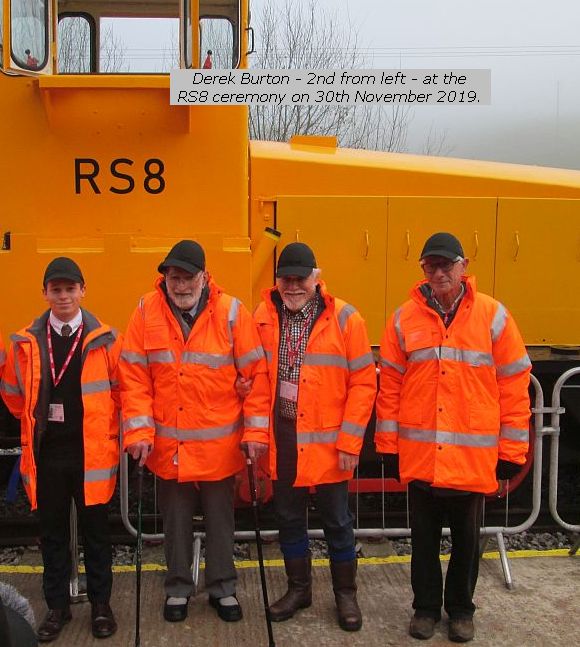
One of the engineers most attributed to the 'birth' of RS8 in its present form was Derek Burton. He returned to Tunstead for the formal handing back ceremony just before the pandemic and although walking on sticks, was up in the cab with me and asking questions about the change to the control pneumatics we had made. He was pleased that RS8 was in such good hands. Sadly he passed away on the 4th August and will be interred at Elland on Monday 5th September. I had hoped, with the pandemic out of the way, to make contact and learn more of RS8's history but that will not now be. RIP Derek.
And with that, I'll bid you adieu for another week. A big transport job is in the offing, plus a couple of other run-of-the-mills, but you'll have to wait and see. I'll be back, touch wood, next Sunday as usual. See ya then.