
Of Pacing yourself
7th August 2022
Sometimes, you just get those days.......
As weeks go, this has not been one of my finest. Both Monday and Tuesday evenings had Andrew and I at the workshops, getting the second winch fitted to its baseplate and hosed up: together with a brand new control valve this added £600 or more to the investment. On Tuesday morning though I was out with Adam and Ian and 'T1' collecting a loco for scrap from Barrow Hill. It was the same one we had brought in a couple of weeks before, but if it was minus its power unit then, now its drive axle and side rods were missing, its middle axle was in the rear position and numerous other bits had been removed. We loaded it up in almost record time and headed up to Sheffield.
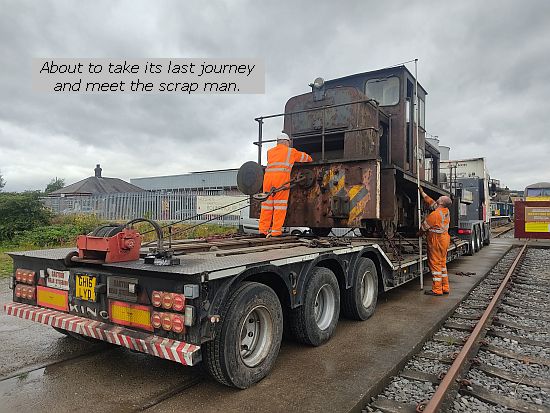
At one point we were going to move it last week but the yard was in the process of scrapping wagons and there was no track clear for us. When we arrived two wagons remained to be cut but had been moved aside - the fact that they had apparently arrived for scrapping while still loaded with stone might have made it a trifle awkward. Before we could discharge our cargo there were wheels and axles littering the scene. And I don't mean wheelsets, the axles had been cut through just behind each wheel reducing each wheelset into 3 distinct pieces. A grab came over armed with an electromagnet. It would pick up a wheel and a piece of axle, or maybe two wheels, and 'throw' them out the way, each lump hitting the ground with a thump that you could feel 50 yards away through the soles of your boots. And once it was clear, for good measure the operator swept over the ground like it was a giant metal-detector, making sure that any sharp bits that might terminate our tyres had been dragged out of the surface.
We unloaded and as usual ran out of gravity and had to wait for another operator to bring an even bigger machine over. This one had a four jaw grab: it reached over and gripped the loco by the casing structure, dragging it away from us as far as his mechanical arm would reach. We asked the operator for a bit more to give us space to bring Adam's tractor unit back in front of the trailer: he repositioned and obliged, but the casing structure had given its all and crumpled like a torn out page of paper. He tried the fuel tank but got no purchase, so returned to the front handrails and the loco surrendered itself to its fate.
After taking the unit and trailer back to base, Adam and Ian came up to Darley Dale in the 'big van' and we loaded the power unit into the back. This is the unit which I had brought from near Bristol a year ago in the back of my van (just) having had its old hoses and control valve discarded and new delivery and return lines fitted with quick release connectors so as to keep it independent of the winch. They headed off and we finished the work welding the winch down to its base and connecting the new hoses, loading it up in my van about 21.45 that night.
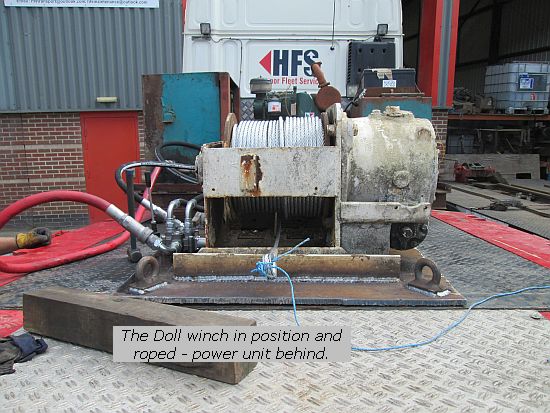
The following morning I expected to be off to Adam's first thing, but a few emails etc intervened and it was lunch time before I departed.. Adam and Ian were out but Nick was expecting me, the welder was all set up and the power unit was already sat on the Doll. Nick was seemingly impressed by the welding of winch to base, and I got the feeling was hoping that I'd done it and he could get out of it. I had to explain tactfully that Andrew had welded it and having only been taught to stick weld by a Welsh farmer (not a strong recommendation!) I was not the one to be tasked with it. Adam arrived back anyway and it was soon on, the lugs back marked and welded. The hoses were connected up and we were ready. Or were we? We had yet to see the winch function, and for that matter although we knew the Lister TS3 ran, we had done so with the pump detached rather than run it 'dry'. So we turned on the two isolating taps (which we had closed so that we could remove the old hoses and attach the new) and fired things up.
Nothing.
Adam suggested that there was insufficient oil in the reservoir, banging the side of the tank to indicate how empty it sounded. (There's a sight gauge near the top, but the tube has gone opaque with age so was no use.) As the feed pipe to the pump had a big loop in it, he suggested that the tank level was at least lower than this so the pump couldn't draw. We disconnected the hose and turned it round so that it was nearer level, and as I had brought a 25 litre drum of hydraulic oil with me, we added most of that. But still nothing happened, and we began to wonder whether the isolating tap, having been operated for the first time in years perhaps, had closed and stayed there. As with so many tasks in life, it's the smallest item that trips you up.
I set off for nearby Loughborough - Lufbra or Luger-baruga as Andrew and Jennifer used to call it in their student days there - where I knew of a hydraulics supplier, returning with two spanking new 1inch ball valves. Adam meanwhile had drained the hydraulic reservoir, removed the old taps and nipples, and cleaned the latter so they looked like new. The new taps were installed, oil refilled, the TS3 re-started, I pulled the control lever and the winch drum started to rotate. All it needed was a rope, so we unloaded the drum from the van, only to realise that the end we needed to start on the winch was at the inner end of the supplier's drum, so it all had to be pulled off - all 73 metres of it. Adam set off trailling it behind him from the yard over the rough ground, then the entrance road, then he turned left and was almost out of sight by the time the last few coils were reached. I fed the end into the winch, locked it off, and started re-winding the rope on to the drum ready. A final check round and back off home.
First thing Thursday morning and it was off to St Philips Marsh, Bristol. Adam had said to meet him at noon and I was keeping my speed up expecting to catch him when he rang to say they were just leaving and it would be 1pm. I eased off and still got there for five past noon, but had some difficulty getting on to site. I did though have sufficient time for a tea before the convoy arrived, the convoy being Adam with the Doll, Phil with T1 and Ian following behind with the escort van. They unfortunately arrived at ten to one, just as I was thinking of ringing them to see where they were, and headed straight to gate 2, whereas I was behind Gate 3. Turning two large artics around wasn't simple. Meanwhile I was waiting for the Pacer to be brought up to us. It was sat in some sidings with another unit in front, and having been out of traffic for 18 months or so, drivers still signed for such vehicles are becoming scarce, at least in Bristol. When it did come up, it was with another attached and some time was spent getting it separated and in to position.
And as they explained their arrangement, we realised that not only had we first gone to the wrong gate but now we were the wrong way round, so Adam, Phil and Ian backed out, went round the nearby roundabout, drove back in but turned towards Gate 2 so that they could back in through Gate 3. We lined up the Doll, set up the ramp and started to winch the first half after the fitters had separated it from its pair. Andrew and I had had a discussion earlier in the week about attaching to these vehicles. Obviously I did not want to repeat the mistakes of another haulier that resulted in that incident at Dereham, but Andrew was well aware from his days at Porterbrook that the electrical connector under the BSI coupler was prone to damage if misused. so a twin strop was devised. Either was strong enough, two gave ample safety plus a straight line pull.
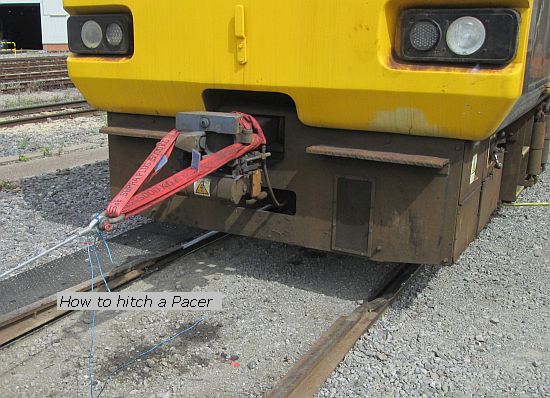
The winch however was a bit of a disappointment: though with two snatch blocks we got the vehicle in to position and secured,
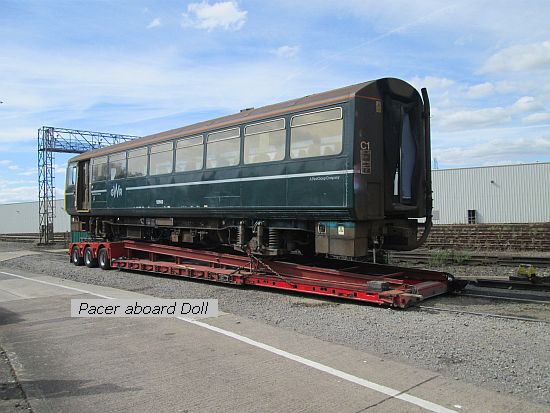
Adam moved the Doll to one side and we brought T1 into its place. Two years or so ago I created a 'master' CAD drawing of T1 and ever since have superimposed drawings of loads on it to check for any foul conditions and running heights. According to my drawing, the Pacer would just fit but it was very tight. In reality it did not fit at all and after a conference we concluded there was nothing for it but to leave it behind for that day. We unloaded it and dragged it clear for Phil to re-unite T1 with its neck.
This was the lowest point of the week for me as running Phil with T1 empty was not a profitable operation. Some St Philips staff were a little perturbed too, we assured them we'd be back, though without the drama of Mr Scharzenegger. We were booked into Strensham that night: as we left Bristol the overheads warned of an hour delay between Junctions 14 and 12 of the M5. The convoy had no choice on route: but I did, I turned right on to the M4, went to the next junction and meandered up through Stroud.
Strensham is a nice enough services and I have had meals there in the past, but it has gone the way of the world and franchised its catering out to McDonalds. I won't bore you with the why but about 35 years ago I promised myself I would never eat at McDonalds ever again which rather restricted my choice for evening meal and Friday's breakfast. We were rolling north up the M5 by 06.45 but the thought of the M6 and Birmingham did not appeal so I turned off, skirted Kidderminster, through Bridgnorth and rejoined the route at the Shrewsbury by-pass, reaching the Tanat Valley at Nantmawr just after 9 o'clock. A phone call to Adam, revealed he was on the far end of the M54, though Phil was much nearer, having parked T1 in a layby he arrived with his tractor to help the incomer by blocking the road to any oncoming traffic at strategic places.
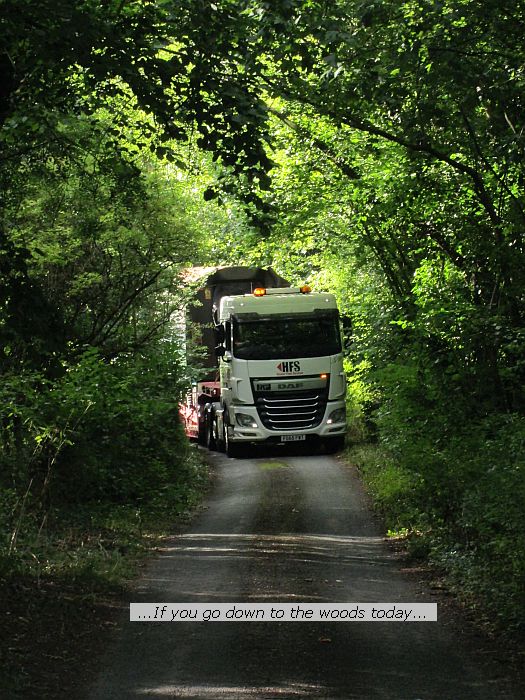
Access to Nantmawr is tight: we had been in with T1 before but the Doll is much longer in its carriage-carrying format. The tight turn right off Cefn Lane had been a worry but ironically Adam brought the Doll round without the forecast 'shuffle', though collecting leaves, branches and a bit of soil/turf as he did so. I walked ahead, having little to do, and got this shot of it creeping slowly up the lane while the TVLR track swings right in the foreground.
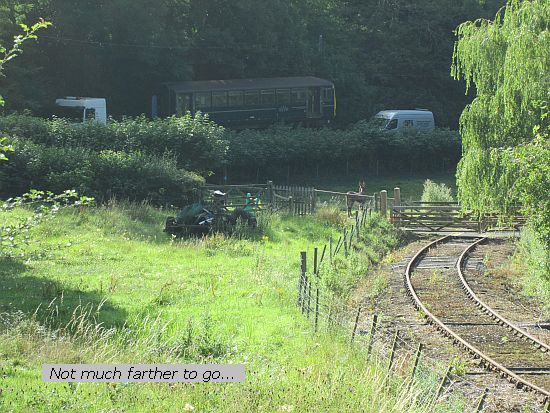
Unloading was straightforward though time consuming as we had to line up to a track that is on the curve, so you're guessing where to stop to achieve a tangential ramp while the tractor unit obscures your view of the curve itself. Also not only do you run out of gravity but the track is then uphill, so the Pacer had to be pushed out of the way, as we did wth the Dace last year. (And it's uphill with a long wheelbase vehicle on a sharp curve: pity we didn't have anyone there to drive it.)
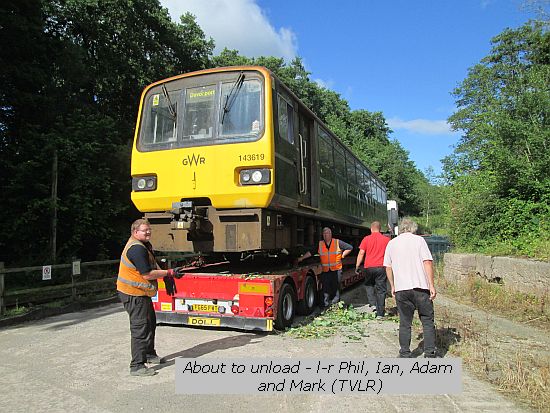
After all this I headed home, and for those readers who are interested, the overall mileage for 2 days was 428 at 52.3mpg.
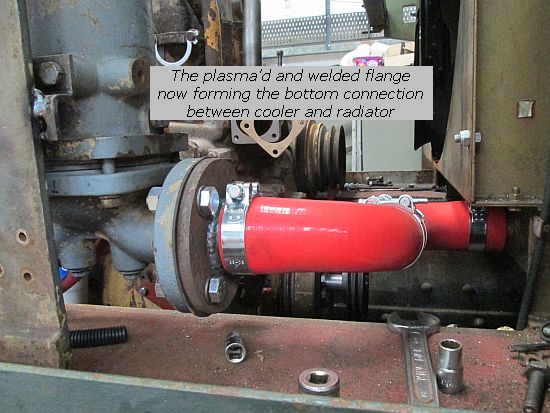
Saturday, and we got to work back at the shed, mostly on 1387. The speedo sensor bracket got amended and received some paint. I dismantled and cleaned up the old cab radiator brackets which Matt also painted. Some 70mm o.d. tube had arrived so I cut a short piece off with the hacksaw and marked two flanges with it for plasma cutting to suit the transmission cooler. The driver's brake valve got fitted and late on Andrew found me a handle to use. Matt removed the remains of a steel pipe from the inside of a brass torque converter outlet casting and tapped the result out to 1 inch BSP. I already had a 90 degree casting but found it would obstruct a grease nipple so concluded that a swept 45 degree connector to a straight casting and nipple would be neccessary even if it meant cutting a bit of cable tray away to clear it.
On the converter hydraulics, I'm going to experiment on this loco whereby the PLC will open a valve on top of the converter so that when the clutch is dis-engaged the converter dumps its base pressure to tank. As the clutch re-engages the vave will close and the base pressure will restore: if it works the thump that you get when the clutch comes in will be avoided. That valve is now in place and its pipe conections worked out. With the recently overhauled water pump refitted and a few other tasks, it did feel like a day of worthwhile progress.
Today Andrew was taking his son go-karting and I got down to the shed to receive a text from Matt that his car wouldn't start. So left to my own devices I cut two 60mm lengths of the tube for the new flanges and drilled holes in the flanges for the plasma cut to start: refitted the speedo sensor bracket and went on to fit the sensor and its cable in conduit up towards the desk, though it is not long enough and must be jointed to reach the electronics box.
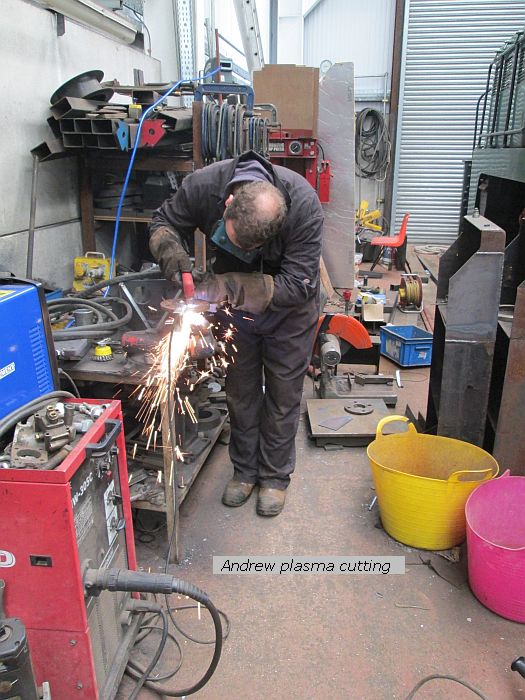
With various bits of wiring tidied up I was relieved when Andrew arrived (he brought lunch) and proceded to cut the flanges plus a plate from which to mount the limit switch that will detect when the clutch is 'out'. By the end of the day the two flanges had been welded up and cooled sufficiently for me to fit them and the hoses into the bottom of the radiator.
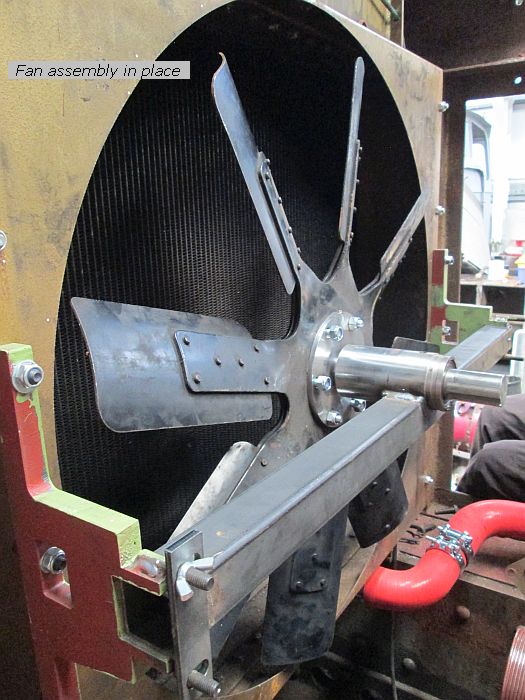
We also trialled the fan bearing assembly on its mounting bar, determined where it must go and then welded it to the support bar. Andrew did not like the washer on the retaining bolt so produced a larger one by broaching out a disc from some plate and drilling out its centre. The whole lot was then assembled with bearings and bolt loctited. Which brings us back around to Sunday night and going home time.
Next week has us back to St Philips and Nantmawr but as for what else, I have no idea what's in store. So you know where I'll be found on your internet this time next week. See ya then.