
Of brakes and punctures
11th September 2022
Normal service is being maintained.
I am not anti-royalist, but there is more than sufficient regarding the death of Queen Elizabeth on (all) other channels, and as I never met her so cannot brag about incidents we shared, here I will endeavour to retain a 'funeral free zone'.
Last week you got a glimpse of the pre-fab ramp being re-jigged and loosely tested but I gave no clue as to why. Rather than tempt providence I shan't say much this week either other than to show you a bit more of it. Monday evening we were welding up the remaining legs for the upper section (they had mostly been tacked, and a base plate or so not ready, when I pictured it last week).
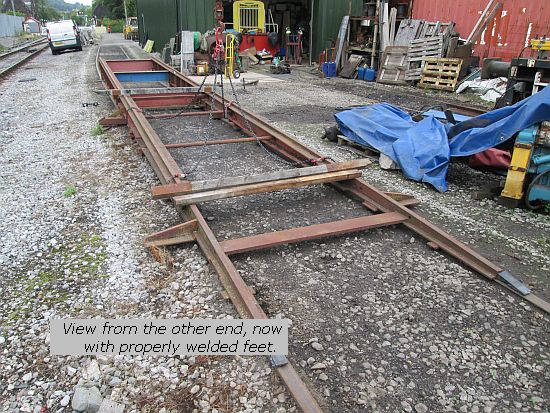
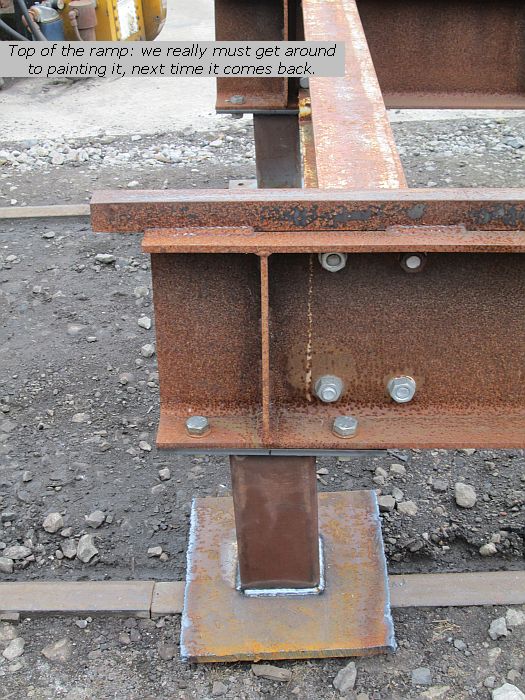
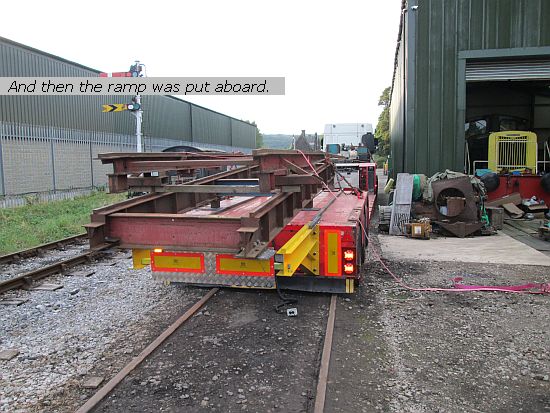
We also made some extra bits and just had time to lay it all out again before Adam arrived with the Doll trailer to collect it. Now you can see the rearward extension added to the Doll which means it can handle coaches up to 64 feet in length.
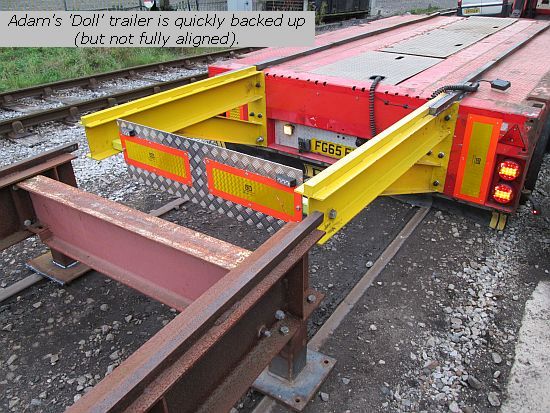
The frantic rush was to get it ready to commence a contract that we had just been awarded and that Adam planned to begin on Tuesday, only for me to get a message that it could not begin until Monday 12th for various reasons. Now of course the demise of that royal personage and a certain funeral will almost certainly mean a lot of extra work for Adam shifting concrete barriers for crowd control and anti-terrorist measures (he has regular work from a local supplier) - it never rains but it pours.
Talking of which, heavy rains early in the week continued as showers and the odd roll of thunder later. I got a call from Mark Sealey to advise that Tom had died - they had put more fuel in and presumably stirred some sludge up in the bottom of the tank resulting in clogged filter(s). We popped up one evening to check only to have to shelter in the cab as the heavens opened. On most Rolls' locos you find in addition to the 2 or 3 filters on the engine (which are paper and you replace them) a primary filter with a handle on the top which exorts you to turn it. This laudable invitation - rather akin to Alice with a bottle labelled 'Drink me' - is because although it contains a paper filter element the outside of this element is tightly bound in brass wire and operating the handle turns two scrapers around the brass exterior, hopefully dislodging all the crud that has stuck on the outside of the element. You are supposed having done so to undo a drain plug on the bottom of the bowl and eject said crud along with any contaminated fuel and condensate. Trouble is, nobody ever does, and we're as bad as anyone else in that regard.
We cracked the line on Tom's primary filter and of course nothing flowed, which is in a sense good news as it ought to mean that the contaminate got no further and has not affected either the fuel pump or the secondary filters. Andrew had dug out a spare element, so we extracted the filter assembly complete from the loco and opened it up, only to find that there are two versions of this filter with different sized elements and our stock was the other. We took the assembly back to Darley Dale and I put the element into a bath of mild solvent in the hope of de-sludging it.
Thursday, and I headed north to Sheffield to visit a couple of suppliers with half an ear on the phone in case I had a message from a haulier. In this case Andrew had spotted a haulier down south who had kitted himself out to move one loco and having no plans to move others, offered the rails for sale. It looked to be 75lb/yard as we use, and included tie bars, fishplates and tips, sufficient we hope to equip 'T2' the 4 axle King. A purchase had been sorted, and he was to deliver it direct to Adam's yard and as Andrew was at work, I was delegated to be there to see it off and check its suitability. To achieve this without me camping out it had been agreed that the driver would give us an hour's warning of his arrival, sufficient time for me to get to Adam's either from Darley Dale or Sheffield.
My first call in Sheffield was at a hydraulics repair company. Last year I was despatched to South Wales by Andrew to collect an auction lot he had bought comprising about eleven or twelve 35ton Tangye jacks. I had dropped one in to the repairers earlier to ascertain how much it would cost to render it servicable: in fact as I recall I delivered two as the first turned out to be beyond repair, having suffered corrosion of the bore by the presence of water in the oil. And there things rested as Andrew's enthusiasm for the project had been overwhelmed by other priorities. But about 3 weeks ago they reminded me it was still there, and I took the remainder of the consignment in with a request to get us 4 functional ones out of the batch. And that they managed (just) the remainder of the others coming back in kit form. Why does he want 4? Well, it's to do with loco weighing. If we lift the 4 corners of a loco with 4 identical jacks, driven by one power pack with a suitable pressure gauge, as the loco leaves the ground the pressure reading is taken, all 4 jacks must be sharing equal load, and a simple calculation from the hydraulic pressure at rest can deduce the gross weight of the loco. It might even prove possible to axle weigh too, but the danger there is that lifting an individual axle transfers weight to others that you aren't trying to lift. For now we'll settle for determining the gross.
Anyway, from there it was over to my regular pnematics and hydraulics suppliers to collect the two main hoses for the transmission cooler on 1387 plus more general purpose hose to finish off the small bore lines. By now I felt sure that the driver had neglected to phone and would be calling in at Adam's so I hightailed it down to Nottingham. There I fitted a proper hook to the winch on the Doll and a couple of other things, then backed my van over out the way to await the arrival of these rails. Standing alongside the van the front tyre looked low and I wondered if I had parked in a hole. I backed up a couple of feet and could almost see the tyre deflating in front of me. 'Oh deary me' I spoke cheerily 'I must have a puncture.' Years ago I was out with a hire van and Terry Day was passenger. We had had a puncture on the M1 and had a tough job getting the nuts undone and the wheel off the hub (It was a Renault, and the hub was on some slight taper and we had to hammer the wheel off from the inside, a very safe course of action when it is up on a jack).
Ever since I had bought Big Mak I had consoled myself that if I ever needed to change a wheel it would be there at least to undo the wheel nuts (and do them up again - my brother-in-law had a wheel come off his Peugeot - my old 406 - after he and his boss changed a tyre and neither thought to tighten the nuts up sufficiently) but Big Mak was back in the shed. I put gloves on and set about changing the wheel. Getting the spare out from under the back, the valance of the van managed to move my glove to one side and chomp through my skin in two places at my wrist, and I do hate the sight of blood, especially when it's mine. With the spare on I concluded it was time to depart - if I set off immediately I might make it back in time for the friendly garage in Matlock to mend it ready for me to go out again tomorrow.
So alternative arrangements were made and I set off for Matlock, where I told Nicola that I was so depressed at having a puncture that I'd tried to cut my wrists. Then added that I was only half-depressed so settled for slashing one. Andrew was able to head direct to Adam's from work so was later to check off that all had arrived.
Friday: after a quick load-up at the shed I was off to March. DB had told me that although it 'wasn't their call' I would be unable to collect the OAA wagon as the track used for loading was occupied with contractors scrapping wagons, but a call to the Operations manager had revealed that the work would be all but finished on Thursday and we were clear to come in. I made it for 10.30 as agreed with Adam, but he was about 20 minutes behind. The scrap contractors were still filling a final couple of large, high-sided lorries with tons of steel by dint of lifting it with a telehandler and dropping it in - with a loud report that never failed to take you by surprise.
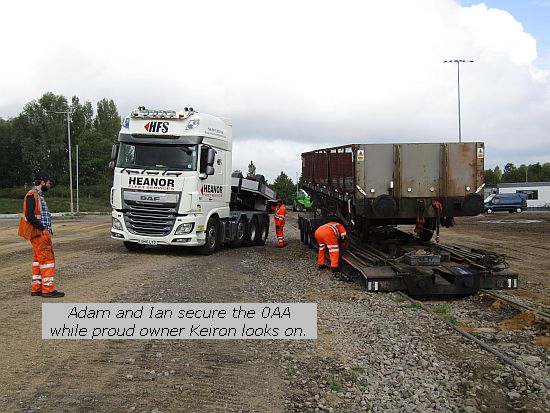
The OAA's new owner was present so as the track sloped slightly down to the ramp I had him just ride the brake gently as we pulled the wagon up to us, then it came up the slope, we stopped and rehitched farther up and brought it aboard (long wagons get too close to the winch if you haul all the way on the drawchain). We set off north, I bringing the owner with me, heading for Quorn & Woodhouse on the GCR. They had accepted it despite having a Beer festival on that day, which at least meant a backdrop of passing trains (including Ivatt Mogul 46521 which I'm pretty sure I saw on the Cambrian back in '63 or '64 - yes I'm getting old) and an audience in front. Whilst we waited for Adam and Ian to arrive, I asked a traction engine owner if he'd have enough steam to pull the wagon away from us once we got it off in about an hour - I thought it would make a good picture. The lorry was only about 20 minutes behind and the lining up and ramp assembly was straightforward. But the unload wasn't. Normally gravity does its thing and your loco or wagon duly rolls down under the constraint of the winch. This one didn't. I could pull it further up without difficulty, but downhill it refused to go. Adam tried pinch-barring, but it still wouldn't. Being close to one axle I realised that the disc pads were rubbing, and the owner, having apparently asked Whitemoor if they would carry out a brake test on it, pulled the string on the dizzy but it had no effect. The traction engine didn't have enough steam up, but the owner of a vintage tractor came to the rescue and with a long strop I keep in the van for such issues, pulled the wagon down while we let out the winch cable lest it suddenly changed its mind.
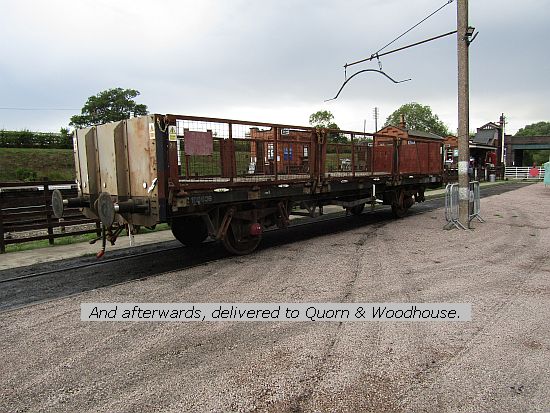
The wagon was safely unloaded, the low loader reassembled, and we all headed our seperate ways home.
Footnote one - before I left, the owner revealed that yes, there was air in the brakes, pulling the string on the other side had triggered the dizzy to vent...
Footnote two - Adam reported that the trailer had a puncture. Do things happen in threes? (Punctures, not footnotes).
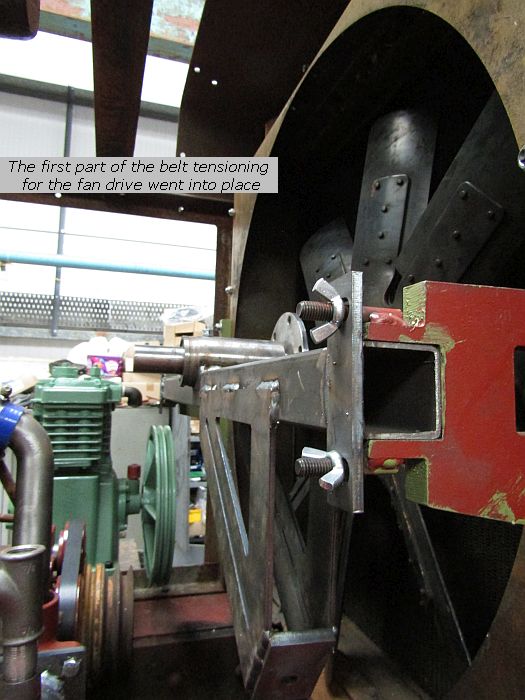
Saturday and normality returned to Darley Dale. With Matt on the Janus, Andrew welding up fabrications, I got back on to 1387 and Jagger was preparing his JCB for departure. I had been a bit alarmed last week when I turned on the new batteries and none of the lights I expected to see on the PLC came on. I swapped a module over and this time it all lit up - well mostly - so I did a preliminary check through finding one wire I had missed and a couple of queries to look into further. The fan drive was produced by Andrew and trialled in place: my 'standard' jockey pulley arrangement (aka what I did on the 03) won't work on this loco as the belts are rather closer so that requires a rethink.
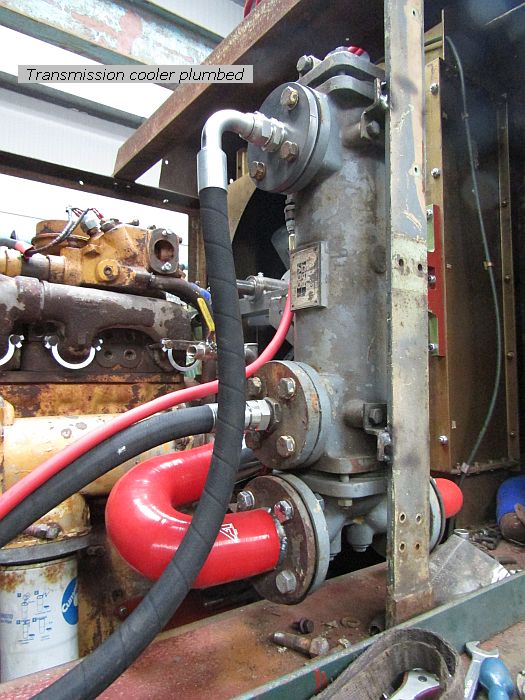
The hoses though went on and the last feed and return lines to the transmission system finished. Andrew also welded up the little coolant manifold enabling that to progress with temporary layouts for the cab heater connections and such. Although the solvent had turned dark brown with material from Tom's filter element, it still wasn't in any way de-clogged so at Andrew's suggestion, I recovered another complete filter from the Hunslet 0-6-0 up the yard, checked it passed fuel (it did) then opened it up and cleaned out the usual sludge ready to go onto Tom.
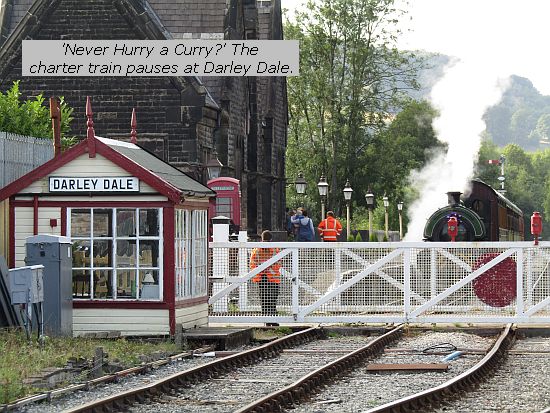
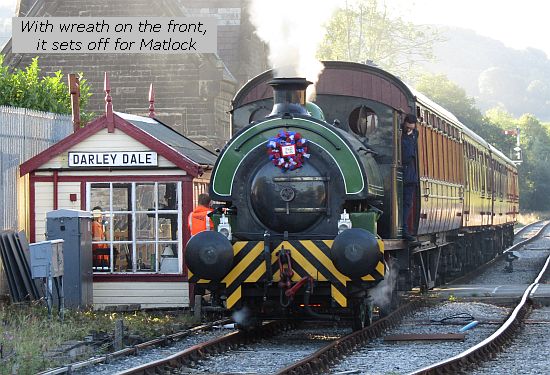
As we regularly work on later than the railway normally finishes, we were still around to see the first charter from Fox & Edwards that night - a curry train which ran wrong line at Darley and waited some time before proceeding to Matlock.
Sunday. Had I known that Matt was not turning up I would have gone straight to Rowsley and returned Tom to life, but as it was I pottered around tidying and putting the repaired wheel back on the van in place of the spare until first Jagger and then Andrew arrived. Adam brought another trailer at 1 o'clock and we bid a farewell (I won't say fond) to Jagger's JCB. After welding up a couple of bits for Alstom's loco, Andrew turned his attention to progressing the vac piping on the EE which has been patiently awaiting its turn. In between measuring up bits on 1387 I acted as labourer - the threading machine was at last given a permanent(?) home on a workbench so has a sensible working height and Andrew plans to add a pipe vice to the bench shortly.
And that about wraps things up for this week. See how I've teased you with pictures of the Doll and not told you what it is all in aid of? You'll have to come back this time next week and find out - maybe. See ya then.