
Of recovered relays
6th February 2022
Carry on like this and the HATRAMM will provide me enough relays and timers for 2 or 3 'ordinary' locos.
Monday saw me occupied all day with the 'month end' and VAT paperworks, and some of that toppled over into Tuesday. But Tuesday night I was off to our daughters, to give myself a flying start to get to a loco inspection on Wednesday, which took up all day. The latter half of the week was largely concerned with sorting out materials for on-going jobs, with belts, brake blocks, engine mounts and many other miscellaneous bits either being received or collected, plus writing up my report from Wednesday.
My profilers were due to have last weeks profiles ready, so I phoned to enquire on Thursday and was promised a call back. I rang again on Friday morning as I set off for Sheffield, taking Charlie's old heat exchanger in for attention and passing within 2 minutes of the profilers - but still got no answer. Don't it just infuriate you when that happens? Chances are when they do get them ready (they're already late) I'll end up having to do a special trip. So anyway around to Saturday, and a weather forecast that could be described as 'mixed'. Andy M was joining us once again, and progress on the OBA was intended so a reluctant Tom was started and both OBA and HATRAMM were brought up as close to the shed as we could. Then the rest of track 1 had to be drawn back so that the forklift could get around and lift the Matlock end of the OBA back off so that its new plywood sheath could be marked, cut and drilled.
At regular intervals the HATRAMM burst into life, with Andy M running it to check whether the latest relay/timer/wire he'd just disconnected/re-connected did in fact screw up something else in the system.. We had had a philosophical discussion over e-mail as to what way to simplify the HATRAMM wiring: I would love to substitute a PLC but we simply don't have the time, so a proportion of the wiring must stay, but as we have no plans to re-unite the HATRAMM with its sibling all the relays whose job it is to switch between 'this' panel and the other cab can depart, together with all the wiring down the chassis. Actually that would also enable the removal of a large number of diodes whose function is to block a signal heading from one cab to say a relay coil or warning light from also finding its way up the wire to the other cab, but for the moment at least that is not so important. Of course No.1 task was to establish an engine stop function, and after some experimentation Andy agreed with me that we put it in the feed to the relay that shuts the engine down should it go over maximum revs. The alternative was to break the connection from the throttle potentiometer but I still have memories of the trouble I had at Sheerness in the '90s with another brand of throttle controller where such an action caused the throttle to run at max rather than idle or shutdown.
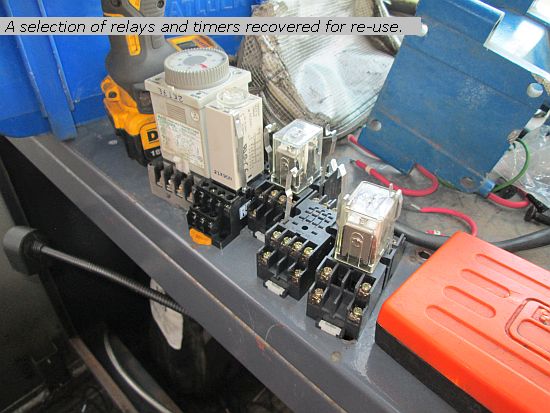
I recovered two brake block carriers from 14 901 which will be leant for now to Charlie. In the end Andrew had to leave early to deliver a washing machine, so things wrapped up with both HATRAMM and OBA left overnight ready for Sunday. I was able though to bring back into the shed 3 more relays (not the ones above, but more) recovered from the HATRAMM as 'redundant' including a big 3 pole changever which may yet serve other applications. Sunday brought more of the same but with a cold wind that went straight through you and even a hail shower during the afternoon.
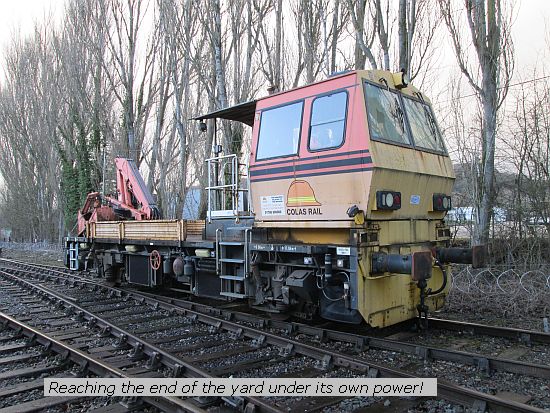
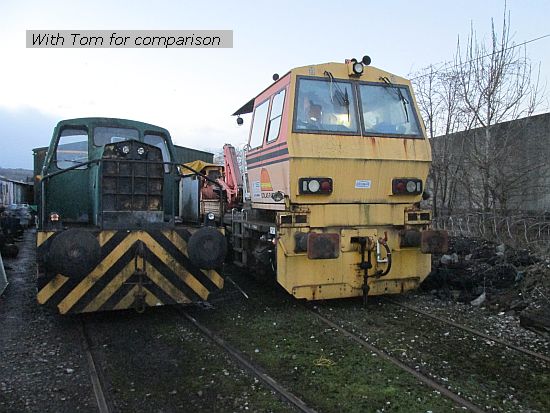
Again track 1 was drawn back so that the OBA's Matlock end and its primed plywood could be reinstated, then a bit later the Ferry van was opened up and some bits extracted before the remaining vehicles of Road 1 were put back in their usual places. Tony S was also with us, working on a railcar, so there was plenty of activity. We promised ourselves a 'play' on the HATRAMM before the end of the day, so towards 3pm Tom took RS8, 14 901 and the Stephenson back across to Track 1, leaving the way clear for the HATRAMM to run through the yard and up to the headshunt.
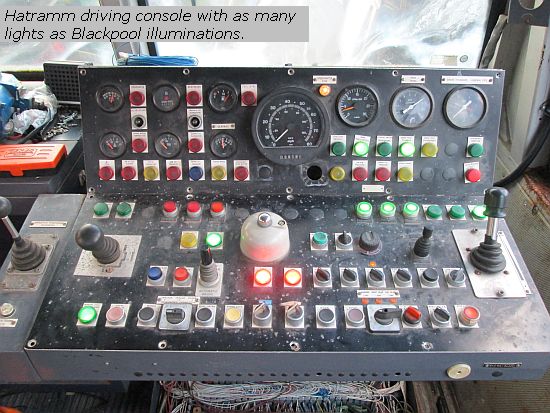
Our first attempt wasn't quite the triumphant moment: we got drive all right, but the throttle was inhibited at idle. So it was a sort of a crawl rather than breasting a ribbon. Andy deduced this was due to a pressure switch in the train air side, which for one reason or another isn't yet functional. (The straight air brake - or 'Direct brake' in control panel parlance, is fully functional and operates from an inauspicious joystick.) We would like the train air side to operate but see no immediate use for it, and certainly don't need 3 bar minimum in the train pipe which at present is required in order to get throttle. So another jumper or two got added under the desk and this time it behaved like it should, though within our yard we probably only need first gear and certainly not 3rd or 4th.
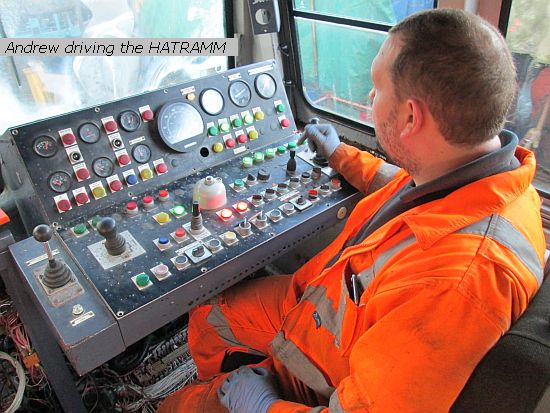
The HATRAMM, with its coil spring primaries and flexibly mounted cab, rocks about a bit on the track at Darley Dale, which to be fair is not of the quality to which it is probably accustomed. Both Andrew and I had goes, and then it was Andy M's turn. Now, because we don't wish to annoy the neighbours, we seldom sound horns when moving off as it is usually just Andrew and me and we know what each other is doing. However Andy M, having been brought up like all good railwaymen to sound the horn before moving off, pressed a horn button - and the valve stuck. As the pneumatic diagram was back in the shed, Andrew stopped the engine and opened the air drains to try and silence it, and after a short time (but seemingly a long one) the horn stopped. We breathed a sigh of relief, restarted the engine and it promptly came on again. This time Andrew did consult the manual, and confirmed that isolating cock 'R4' would stop the horns which was one of two just behind the cab.
When we first started running the HATRAMM a few weeks ago we had another air valve start to bleed air through which would have caused the hydraulic pump to engage (which as the hydraulic system is basically empty, would not have been good for it) so it may be that some of these electro-pneumatic valves have not appreciated being left idle for the last 5 or so years and will need replacing. We will have to address these issues as the wiring corrections progress. In the meantime another 3 or 4 relays and timers have been removed. The mysterious relay 'D7' which we could not find earlier was identified by its wire numbers at its base, but the relay occupying its location had the number K10 in faded felt pen, and the relay next to it, which sbould have been K10, bore K17. It doesn't help fault-finding when all these alterations have been made but only recorded in someone's head or notebook.
Up to today every time we turned the electrics on the gearbox oil pressure gauge needle shot across to the top stop. I had meant to look up (because I have a note of it somewhere) what this meant as these electronic temperature and pressure gauges react differently to wiring issues. Andy M was able to bottom it with a fault around a relay whose function was to isolate gauges in the un-occupied cab but in the end he did so by permanently wiring the sender to the gauge. We also have a slack alternator drive belt. The engine has two alternators, but one is wired to the tacho (not unusual, there's a 'W' terminal on most alternators for the purpose) and while they are both generating (in that the warning lights go out) one is only turning at about 400rpm as that is what the tacho says. On Saturday, after a some belt screach, the alternator caught up and showed 800rpm idling and rose up with the engine. but today is stayed down. It'll go on the snag list for rectification as we move on to the next phase of HATRAMM progress.
And that's about it for this installment. Various things are in prospect for this week, starting with another call to the profilers tomorrow and wrapping up things on Charlie now that everything we should need is to hand. How it will all pan out I'm not sure, so come back next time and find out - see ya then.