
Of lost pens.
13th March 2022
Half way through March.
It will be a bit of a short edition this week, partly because I haven't really done anything worth photographing, and mostly because what I have been up to - on the locos at Daley Dale at least - doesn't merit much text.
Monday for example was 100% paperwork and I didn't really leave the house until Tuesday when at Andrew's request I made the long trek up to Eggborough to look at a number of lots at a forthcoming auction. I knew that this was a 'big' auction site - Adam has used it to sell several of his old tractor units - but I didn't realise just how big. I signed in, donned a hivi and toddled out the back of the office block armed with notebook, pen, tape measure and camera. He had neglected to give me any lot numbers to look for, but that didn't concern me unduly as a quick look revealed that lots of a similar type were grouped together. So I could by-pass all the earthmoving machinery and vans and forklifts and such and just go after what Andrew had told me about. High on that list were several low load trailers, so seeing a large number of articulated tractor units parked together, I surmised that trailers would be nearby and turned that way.
I wandered lonely as a clot twixt DAF and Volvo, every lot, but trailers present there were not.
Never mind: turning north there was an expanse of concrete dotted with engines. That is to say diesel ones, many simply chopped out complete with their frame members from whatever vehicle they had powered and left there, some bleeding black oil onto the crisp concrete, to await their fate. I kept walking amongst them, as up each side access ways forklifts were steadily adding more candidates.. Andrew had told me of a large Cummins with a gearbox still attached, but that was about the only thing I couldn't find. Cats yes, Ivecos and Mercedes, Volvos and others, plenty of 6B Cummins' but not the one he was interested in. Coming to the end of this expanse of engines I gingerly crossed the access way patrolled by those fast-moving forklifts and entered the land of gensets. Here I had more luck. Andrew had shown me 4 Cummins gensets with 'shunter sized' engines and although the auctioneers website had plenty of photos and info, engine numbers were absent.
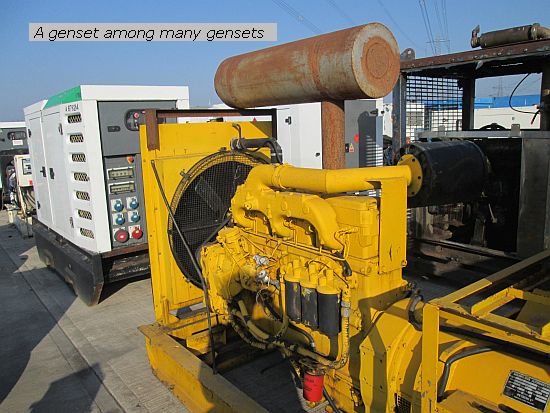
At last my camera and notebook came into use as I identified an old 12 litre with a 7W serial number - so probably coming up 50 years old - a newer N743 PG220 (but still 12 litre or 743 cu in) a NT855 G4 (14 litre or 855 cu in) which was new enough to be have BIG CAM cast on its block. By now I must have walked close on a mile and still hadn't toured half the site. I swung to the left, working my way round to where a veritable forest of cherrypickers and scissor lifts obscured the skyline.
'I know you' said a voice. I looked at the speaker, an old man, white-haired, and fewer teeth up front than I've got. I have never been very good at remembering faces: voices funnily enough stick with me but neither of those features in his case rang any bells. He seemed convinced that our paths had crossed before. It wasn't quite a 'Dr Livingstone, I presume?' moment in the middle of the auction lot jungle though as we gave each other snippets of information it became apparent that he must be mistaken. We shared a whinge about the government's plans to block gas oil (non-taxed red diesel) use from construction sites and such (rail is exempt but it will be interesting to see what happens when I next try to buy some) and went our seperate ways without bidding farewell.
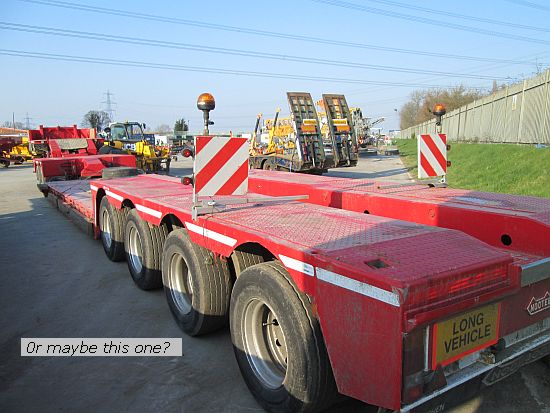
At last I saw in the distance the markings of one of the low load trailers that Andrew had showed me on the website, and here they were, just about as far away from the tractor units as it was possible to get in this massive yard.
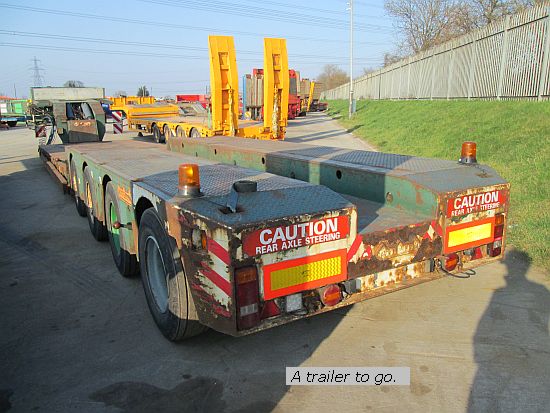
Out came the camera and notebook, and this time the tape measure too, getting rough dimensions to see whether they had potential as rail carriers. The afternoon was wearing on. It was well over an hour's drive back and I felt I had done all I could. I set off in the direction which I thought was the office block as a lone mini-digger tracked by, looking for others of its flock.
Passing several large silent 360s I amended my course and eventually located the office, returned my hivi, signed out and escaped to the security of the van. Having forgotten to pick up my mobile I was relieved that I hadn't missed any important calls, but as I replaced my notebook, camera and tape measure in their normal positions, it became apparent that I no longer had my pen.
I have had two afternoons at a certain heritage railway this week, working to restore the function of a two axle diesel hydraulic. It has at its heart what we referred to in my days at Hills as 'the Westinghouse 5 way valve' with a mixture of awe and disdain. For it was a valve totally unique to Westinghouse and designed specifically for use on locos with Twin Disc torque converter drives. Thus from a mid position on its control lever it had two positions in either direction, the first to give you an air feed to the gearbox in that direction, and the second to provide a feed to the clutch cylinder; but before you could get from that gearbox to clutch position, built in midget cylinders kept a sprung peg to block your way. You arranged your gearbox so that once it had completed its travel and was firmly home in the direction you wanted, it sent a pneumatic pressure back to the 5 way valve and this retracted the peg into the midget cylinder, allowing the lever to move to that 'clutch in' position. Now that sounds simple enough, but as the valve moved from the 'gearbox' position into the final 'clutch in' position it closed off the port down which it had just sent the air to put the gearbox over. On a Hunslet gearbox (which has mechanical latches) this was not a problem, but in SCG or Wiseman gearboxes which retain the air pressure in the cylinder to keep the gears in the direction you want, you had to provide an alternative route for the air to stay in the gearbox cylinder, so a shuttle valve (or double check valve in rail speak) was neccessary for each direction to feed the box from the 'gearbox' port or 'clutch in' port.
And then of course there was only one cylinder to operate the clutch, so again shuttle valves had to be utilised so that 'clutch in' from either forward or reverse gave the pneumatic feed to get the clutch system to operate. When it all worked it worked quite well but by the time I joined Hills in '78 Westinghouse had discontinued it as the ageing valves revealed a marked propensity to leak like the proverbial (I was told it was because of the long flat sliding faces - one feed moving across 5 exit ports). Trouble was, there was nothing like it anywhere else. It wasn't a matter of 'the Westinghouse 5 way leaking badly? Fit a Bloggins one instead.' No, it had meant a major re-think of control systems and although Hills issued a Service Bulletin listing the alternative arrangement and a willingness to quote and install it in replacement on site, it was not something to undertake on a whim.
I come across them comparatively rarely nowadays - 144V has one and my present activity will put me in good stead for when we come to reactivate it - but in the end this week I removed the desk covers for the loco I was working on and set about plotting it all out with paper and pen, the better to follow what was, or wasn't happening as it should. It was a blustery day and without the desk covers there was a relatively unrestricted route for the wind to flow through from cab door to engine compartment. Several times the pages blew over, and once I glanced back and saw that my pen was no longer there. Of course, the loco is parked over a pit, but currently this pit is about 4 inches deep in water. I climbed gingerly down the steps and there was my biro, floating on the water like a twig at attention. I may have invented a variation on that old game - I will call it Pooh Pens. For although biros have a hole in the tube and a hole in the cap they appear more seaworthy than the Titanic. As there is little current in a pit I opted to fish it out with the aid of a passing broom rather than wait for it to sail serenely to the other end. At least it wasn't lost, well it was but briefly.
This weekend Steph has been up at our daughters and although that ought to give Andrew and me carte blanche to put in what hours we wanted, in practice the extra responsibilities of washing up and food production devolves to the next parent. We got down on Saturday and put in time on a bit of sorting - Andrew has sold a quantity of spares to a team on the Wensleydale and needed to get them together in a stillage ready for collection. I cleared the electrical panels and expensive bits from the cab of D1387 ready for him to spray the cab internals (he said he'd do this one evening weeks ago 'come hell or high water' - we'd had the high water since then) and fitted some other bits to the front of the engine. The painting was done last of all so that the fumes could dissipate overnight, but before we had got that far a lone Peak Rail volunteer was spotted and accepted the offer of a cuppa, followed by an inspection of the HATRAMM and 144V.
Andrew still isn't back to 100% and so things were not very productive today. Jagger was across with girlfriend Rochelle: he got himself into a bit of a hole with a JCB so we have let him bring it to Darley for a few weeks and he has found a load more things to attend to than he was aware of - as it always is with machinery. He arrived with a large box of bits from JCB and left this evening with a large list of bits still to buy. With the cab almost dry I was able to refit the desk parts and manufacture some supports for the cables inside the desk. Encouraged by Big Mak, I invested in a Makita battery drill a couple of weeks ago and today used it for the first time - maybe not quite as powerful as the 110V drills but certainly as quick when you don't have to first set up the extension cables! The first wires from the loco's battery master switch up to the control desk area, via a little sub-connection board with the alternator feed fuse on it, were put in last thing. No pens were lost over the weekend.
Hmm? The auction? No, Andrew didn't win anything.
Anyway, that's it. Transport work features prominently again this week, but first thing tomorrow it's back to Sheffield to collect my new glasses followed by a few other suppliers. What else will happen, who can say - other than me, next week. See ya then.