
Of circuit breakers that can't
30th January 2022
- but what other role in life have they?
Mornin', afternoon or whatever is appropriate to the time you've chosen to delve into this week's edition of Weekend Rails. A relatively quiet week by my standards, certain days earmarked to do things which somehow didn't happen, you know how it is. But all in all, more work on the horizon and more than enough to get on with at the shed, added to which Steph hasn't been well this week (no not Covid) which added a few other colours to the paint. So let's draw a veil over the weekdays and move on to the weekend, which originally was what this was all supposed to be about.
I woke up in the early hours of Saturday morning to the banging of the bathroom door, a sure indication of windy weather, for Storm Malik was passing us by. I dimly thought 'oh bother, that sheet I put over 144V will have blown off' (it was not in the best of condition, a good work out would likely rip it more) but tried to go back to sleep.
Andrew wasn't sure what his plans were so I headed down to the shed on my own. Almost first job was to go out and see just how bad 144V's sheet actually was, and to my surprise, it was still pretty much how I'd left it last week, but as a precaution I lobbed a lorry strap over the top and with a lot of huffing and puffing (up and over the cab walkway to get to the other side, contending with a blustery wind that rippled the sheet and kept dislodging one side of the strap while I'm attending to the other) I eventually got it secured down. I headed back inside for now, and though it wasn't really on my 'to do' list got it into my head to start stripping down some of the bits that came off the HATRAMM last week. One such was a large enclosure that once contained the guts of the Network Rail GSM-R system, and still containing two large 4 pole relays, two high current resistors, stand offs, other bits of hardware and a 10amp circuit breaker which bizarrely, had a pop rivetted plastic sign saying 'Do not turn off'shaped and positioned to prevent the circuit breaker being operated - or operating on its own for its intended purpose.
Andrew's plans hadn't come to fruition so he joined me a bit later, starting to get parts and tools ready to go deal with some issues on Charlie. After a lunch I decided to go up to the HATRAMM and try out this new mag pick up that had arrived during the week. So firstly I looked for a suitable bolt from our stores and finding that the brass reinforced tab at the side of the pick up would accept an 8mm bolt wandered up with bolt, sensor and a spanner and slid myself along the sleepers from one end until I spied the engine. The pick up would only slide in so far - there was an o-ring in a groove and it would go no further. Was that right? I didn't want to hammer it in (it's only plastic) so tried screwing my bolt through the tab. It wouldn't reach. I decided I needed a longer bolt, and not too keen on the crawl back up the end, figured I could climb out over - what I thought was- an air pipe but which I later learned was the TCA (Track Circuit Assistance) duct. (Well I thought it was a stupid place to put an air pipe, but it is French.)
Back with a longer bolt, I again tried to get it to start but it wouldn't co-operate, so out the pick up came and - I couldn't start the bolt on its own either. In fact it dawned on me, it was only a 6mm tapped hole. Back to the workshops to exchange bolts. This time I got it secured, turned on the batteries and tried to start the HATRAMM but it was just like before. I concluded that that o-ring was holding it too far back from the starter ring gear so I walked all the way back to the shed to find a thin screwdriver to prise it off with. By now Andrew's interest was piqued and stopping what he was doing, joined me and insisted on taking over. Without the o ring the sensor went all the way in, back on went the electrics and I tried the start button. The engine cranked and immediately fired, revving up smartly, probably (I deduced later) because as the controller first saw a signal stream coming back from the mag pick-up, it would drive the throttle open as cranking rpm is barely half idling speed, and as the engine picked up there would be sufficient fuel delivered to bring it quickly above idle until the controller corrected.
We do have a history to record here though. It certainly started with 14 901, the first time we got the DV8 running at Elsecar and before I started re-wiring it. Having recorded the event Andrew called to me to shut it down, and I pulled what I thought to be the 'run' relay out of its socket only for the engine to accelerate and stay there. The revs weren't unduly high - such that I waved the relay out of the window at him with a 'hey look at this' type expression, but he was rather alarmed and we had to take steps - rather hurried ones in his case - to bring it back to rest. There's been a couple of other occasions with RR C6 engines which have been started up for the first time after long periods of idleness when the fuel racks have stuck open sending the engine well over the maximum speed its makers had in mind. We had learned to be cautious when starting engines up for the first timne, and that before the famous incident when D9523's engine ran away in front of us on the East Lancs.
Last week I made an tongue in cheek comment that knowing the brakes worked was advantageous. I should perhaps admit that having a known method of shutting the engine down (even if, as with 14 901, it turned out not to be correct) is a sensible practice on these occasions. Andrew however seemed quite excited, even though to my ears the engine appeared to be settling down, and was yelling at me to stop it at once. On the desk is a button marked 'Engine Stop Delay' which I thought fulfilled that function after a short time, so pressed it. Andrew informed me, even more loudly than he had been doing up to now, that this did the opposite - maintaining the engine running while the operator switched to the other cab. For the method Geismar envisaged that we shut the engine off was to turn the main keyswitch back to 'off' but as the key for this disappeared at the hands of youths several years ago, I had instructed Andy M to wire it out in order to get as far as we had. The simplest way to shut it off might have been to kill the circuit breaker powering the throttle controller (provided it didn't have one of those 'Do not Turn off' notices blocking it) but that assumed that I knew which it was, so I settled for unplugging the throttle controller on its MIL-type plug and socket which had the same effect. Andrew took an executive decision that we know it works, but we don't go any farther on it until there's a 'proper' engine stop button, which in this case will probably mean re-purposing and rewiring the Engine Stop Delay into an Engine stop without delay. Yes, it is advantageous, and for every action there should be an opposing counter-action, so to speak, like getting drive yet having brakes.
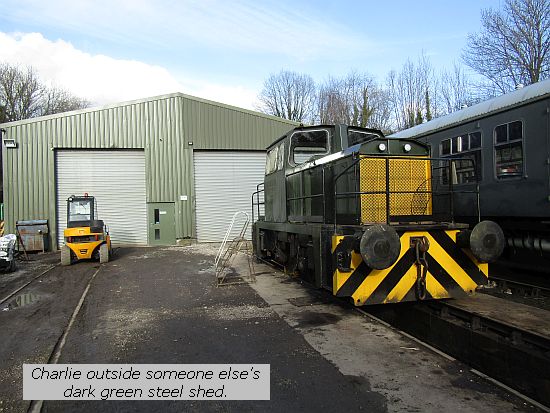
By the end of the afternoon everything (we thought) we needed for Charlie was in the van. Charlie had several issues to attend to. The transmission cooler was leaking but so was the charge pump. The latter is arranged in the later Rolls-Royce style, whereby they re-purposed the supercharger drive provision on the timing case to provide gear drives for the compressor and the charge pump. This meant that neither the compressor nor charge pump had belt drives, but the compressor had an aluminium body that proved prone to fracture so was discontinued and the charge pump (which had to be opposite rotation to the belt-driven ones) if the shaft seal failed, tried to pump fuel into the timing gears and thence to the sump. So Andrew's plan, while we were draining the coolant down for the transmission cooler, was also to extract the compressor and charge pump, remove the latter and blank it off, and mount a replacement belt-driven charge pump which he had Christmas tree'd off James Saturday afternoon. My task would be to make up new hoses as the charge pump moved thus from the loco's left side to its right. We also had new belts as when last inspected, Charlie only had 3 of its 4 'Z' belts driving water pump, fan and alternator, but I had a set of 4 on the shelf which I thought fitted the bill.
First thing Sunday morning we set off for Wirksworth, stopping at the shed long enough to pick up the things we'd remembered overnight. Charlie was sat over the pit and I went underneath to start draining transmission oil. Andrew was aghast to find that only 2 of the 3 of the 4 drive belts remained up front and these looked like they'd been living on starvation rations. But you couldn't really fit the new belts with the fan shaft attached, so off it had to come and yes, to get that detached you really needed to remove the fan guard first.
[It was practice with Rolls' C6 and C8 to put a tubular extension shaft on to the water pump and mount the fan on its extremity. It depended how much had been put between that dictated how far the radiator was ahead of the engine, but we never exceeded a shaft length that Rolls' itself hadn't pioneered with Sentinels. One day a Rolls engineer was looking over an MoD loco in its original incarnation with a C6T - 'Who approved that??' he said, pointing accusingly at the fan extension shaft. 'Shrewsbury did,' an indignant Thomas Hill engineer retorted. 'We wouldn't now,' said the man from Shrewsbury. Rolls had realised that the long shafts shortened the life of the water pump.]
I came out from underneath to find a crisis. My set of belts were too short - maybe that's why I had them on the shelf - mine were SPZ1600 and those that had all but come off on their own could just be discerned to be 1612's - only half an inch but a crucial one. Moreover Andrew had been viewing the top of the water pump and where the charge pump drive was due to migrate, and decided that it was a bit more involved than he'd appreciated (the tacho drive is resident there) and maybe we should substitute a refurbished pump in its present location, after all, it has been OK for about 15 years. Thus between us we changed the cooler and apart from a broken pipe clip, that is complete, but we finished rather earlier than intended with plans for an early return. Charlie's old cooler is bound for professional refurbishment in due course.
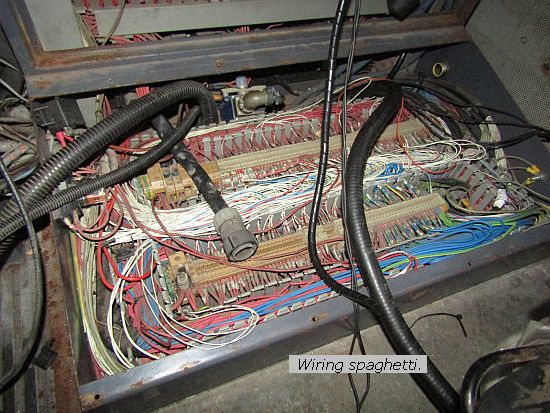
He was off out this afternoon, so I returned alone to the shed and after unloading the van (I'm due to be at my daughter's Tuesday night and don't want the weight) wandered up to the HATRAMM with half a mind (some say that's all the brain cells left that function) to wire in an engine stop. Some idea of just how complex this thing is can be seen from the two photos. You will also probably be able to see that some of the relays have been identified, but most have not, and those that have have been by spotting wire numbers that are known to be connected there. The actual engine stop will (should?) be quite simple. A relay, K9, no woof jokes please, is already present in the feed to the throttle controller. Its coil is energised by a speed switch - if the engine goes over its governed rpm significantly, the coil is turned off and the supply to the governor breaks. Add a normally closed push button in series with K9's coil and all should be an Uncle called Robert.
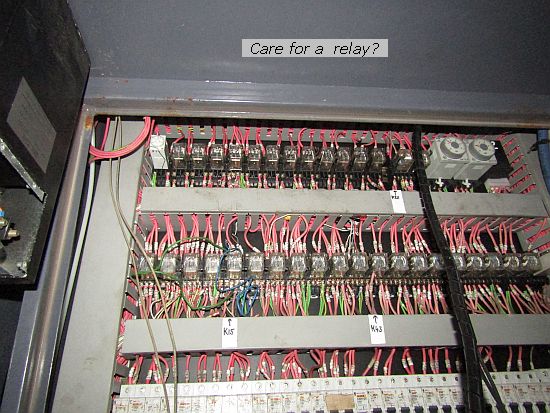
Now, which is K9, and can I prove that it is still being energised from the speed switch? One wire number is 22, but I've found that in the connectors at the bottom - it arrives in one side and there's nothing seemingly connected at the other. OK, so maybe I'll just do a bit of tidying up until Andy M next appears... Every new bit of equipment that has been added to this vehicle has been supported by its own independent stabilised power supply. There's still 2 more taking up space in cabinets. I start pulling out cables and trunking that Andy has already snipped. There's miles of wires we think are solely linking up the OTMR module, and probably quite a few relays (some of which have numbers, but are they 'our' numbers?) but the only way to prove it is to follow the blighters through to their destination and see if they actually are still connected to anything. I'd liberated few more yards when it was becoming too dark to see properly. Maybe it's time to get home.
And with that, I'll leave you. Have a good week - if Storm Corrie allows - and I'll be back - see ya then.