
Of being a Christmas tree
23rd January 2022
And you didn't think it that time of year?
I find that a list concentrates the mind and helps me not to forget things I need to do. Regular readers might also recall that I (used to) apply a 50% rule: that if you achieve 50% or more of what you set out to do in a given time, regard it as a 'win'. In front of me is a list that I created for last Monday morning. There are 13 items on it, and I ticked off only 6: and one of those was a 'get ready for Tuesday'. For it was time to be back on the road again: the transport job I had booked for Monday had unfortunately been postponed but I was due to meet Adam on Tuesday first thing to pick up an 08 bound for South Wales. The job had been arranged 10 days ago after being in abeyance since last summer, but as I neared the collection point the news came through that the staff on site 'knew nothing about it' and 'needed 2-3 days notice'. I appraised my customer who was a little perturbed and shortly after I arrived we were informed that the locomotive concerned would be shunted out as quickly as possible. Nevertheless this delay rather screwed up the plan and after a flurry of further phone calls Plan B was arrived at which had the loco loaded and taken back to Adam's yard for an early start the next day.
Thus on first thing Wednesday morning I was up and driving towards South Wales, overtaking Adam on the way. Incidentally, regular readers will also recall that in colder weather I have observed that my van fails to provide the same fuel economy that it achieves in summer, and Wednesday was no exception, with overall fuel consumption falling as low as 42mpg en route but gradually recovering to about 47, yet had I been doing the same run in a summer month I would have expected 49/50.

My arrival at the present home of the Burry Port & Gwendraeth Valley group was at about 1 o'clock, well ahead of the loco, giving me plenty of time to look around and then be acting as sentry at the entrance gate when the low loader arrived from the Kidwelly direction. Adam followed me over a rather rough track down to their present unloading point, which involved laying the ramp across a section of rather muddy ground by a farm crossing which probably accounted for much of the sticky mud. Conversation with BP&GV members revealed a lot of common ground, one having been involved in both the Bute Town and Pontypool & Blaenavon groups, (so think Ashdown and North British 27932) and recent news of Ford Bridgend, where I spent many hours in the past.
With the loco off and winched out the way, the now empty trailer was rejoined to the tractor and Adam set off lickety-spit for Cardiff. I was a little while behind him, relying on my superior speed to catch up but a Personal Needs Break and a delay getting through security saw me about 20 minutes behind them in the end.. No matter, they were lined up and had started assembling the ramp, and we were finished and waiting when the first candidate loco hove into sight. The name of the game was to load the loco, turn it round and unload it again, and then repeat the exercise with a second loco, (why? to even out flange wear) before loading a third to bring back north for repair. All this needs a lot of ramp building and dismantling and I had estimated that with a prompt 6pm start it might take until 11pm. In fact we had already started later but it went quite smoothly and I left site at 10.30 with the third loco loaded and ready to roll. Common sense would have dictated that I had a nice warm hotel bed to go to, but that had not been on the radar and I drove home to Derbyshire, though I did have a sleeping bag with me in case I was too tired to proceed! Adam and Ian were almost out of hours anyway, so I had a chance for a lie in on Thursday morning before driving over to Barrow Hill to assist in the unloading. You may notice that none of these loads have been supported by any pictures - partly because after one 08 the next looks much the same but mostly because I was too busy to take pictures!
The job scheduled for Monday had been re-arranged to Friday and once again I was off at silly o'clock this time bound for London. For a change this was to collect the tender from Mayflower and take it to Tyseley, and although I made the effort to photograph it at Southall I have yet to take any pictures of stuff at Tyseley!

And so on to Saturday. I was aware that Andy M was coming this weekend and and as I felt bad banishing him up the yard to the HATRAMM, our first task was to shunt road 1 so as to release the HATRAMM and bring it down nearer the shed. That is not as simple as it sounds, because the number of locos etc on road 1 considerably exceed the length of the headshunt, so a rather convoluted shunt ensued in order to get the HATRAMM down on top of RS8, itself 3rd loco from the shed.
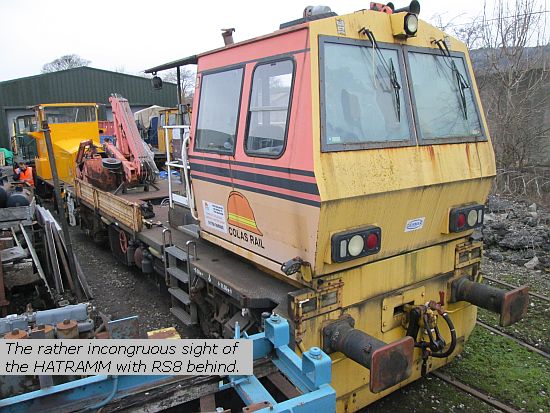
He cracked on with resolving wiring issues on the HATRAMM and I went back inside to get some parts primed. When Andrew arrived he suggested that I recover the heat exchanger end caps from 144V's cooler pack in order to get the second cooler finished. I feel bad iusing this loco as a Christmas tree but hopefully we'll make some progress later this year on getting it back into operation. Over lunch we discussed the HATRAMM problems. We knew, from past experience, that with air pressure we had working brakes (advantageous) and that there were signs of the powershift engaging. But on the minus side we also knew that we could not get any throttle control (and by the nature of the fuel pump, this meant that the engine would not inject any fuel without manually holding the throttle open) and for some obscure reason it would only crank for about a second at a time.
Andy had located a copy of the manuals for the throttle control system (Barber Colman) on line and so went through the diagnostics - proving at one point that the actuator was working and that we had power to the control governor. But he hadn't found the elusive D7 I mentioned a couple of weeks ago (we still haven't) and indeed, not only are very few of the relays actually marked, but as we've dug deeper it transpires that many of the modifications made to the vehicle in the course of its working life have not been added to the manuals we have for it.
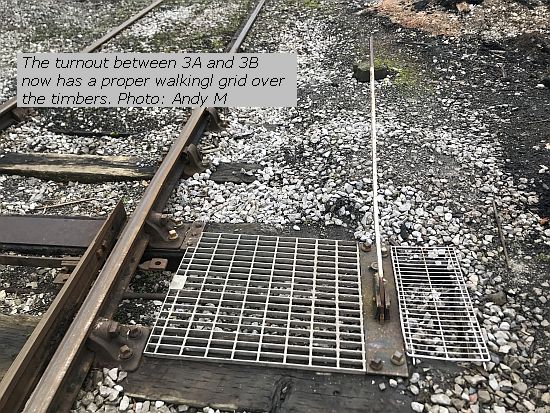
Meanwhile Andrew and I set about clearing the floor around the Hudswell in order to reassemble the casing side on the 'far' side of the loco but eventually came to the conclusion that there was no way the forklift could reach that far and an alternative method would be required. The new cab back plate was however dressed down with a grinder and more 2 inch vac pipe cut and threaded for the EE.
It was just Andy M and me on Sunday morning and so I found myself acting as 'second head' (two being better than one) on the HATRAMM. Andy had by now positively identified K1, a relay which activates the starter motor and was a big rectangular black plastic automotive one. But there was a second one, with no identity deduced, that appeared to be in series with it and likely a later addition by its mounting position. I removed one of its bigger connections and dabbed it on the other and nothing happened, so as I held them together Andy pushed the start button and the engine cranked until I pulled the wires apart. Thus we concluded what whatever powered this second starter relay went off after a second. There may well be a timer somewhere that accounts for this - we haven't found one yet - but for now it is wired out so we can crank the engine without its interference.
We had got this far when Andrew arrived with sandwiches and as he had arranged to go out with his girlfriend that afternoon, we started further discussions over lunch with him in 'consultant mode'. The throttle control unit drives an actuator (essentially a coil that creates a magnetic force acting against a static magnet and with a spring return). The actuator incorporates a potentiometer which is moved as the actuator advances thus giving the controller a feedback as to its relative position. The demand for all this comes from another potentiometer in the desk connected to the driver's throttle handle and lastly a mag pick up on the engine flywheel tells the controller what speed the engine is running at. As the engine has a single lever fuel rack control, the de-energised position on the actuator is at engine stop, and this was where the actuator stayed, meaning that we could not run the engine. So far we had checked all the inputs apart from that mag pick up, because with only a 1 second crank burst before that second relay had cut the starter out, it wasn't practical. I had thought about bringing my oscilloscope down today but (a) I'd forgotten and (b) it would have required several extension cables to get mains powr up to the HATRAMM. But the manual said you should be able to read something like 2.5V on the AC scale of a test meter, and although alternative courses of action were discussed, with past experience of these systems I pushed for testing this first.
With lunch finished, we returned to the HATRAMM, fired the engine up and Andy M put his meter on the input terminals of the controller to see what sort of signal was coming in. There wasn't any. So now it was a game of hunt the sensor: off came the covers at the back of the engine bay but revealed little new. The sensor reads the flywheel ring gear teeth, and normally is to be found somewhere in the 10 o'clock to 2 pm arc of the flywheel housing - at least in my experience on Cummins, Cat, etc. We had to go underneath on the HATRAMM as it was nowhere to be found from above and when we got there, we found...
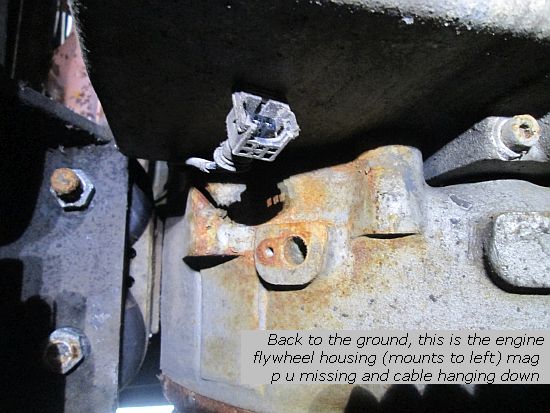
There's the hole for the mag pu, it has a tab on it which bolts to the tapped hole alongside so saves the hassle of trying to set up its clearance to the ring gear teeth. There is the cable that goes back to the controller, but somebody at some time has raided our sensor, and all the time this will have prevented our progressing it. When first acquired, we found a priming pump in the fuel system was missing, and various other bits of equipment gone from the cab - clearly it was 'christmas tree'd' before it came to Derbyshire. There were still some other problems to deal with. A fault somewhere resulted in the hydrostatic pump drive engaging as soon as air pressure began to build. As there is no hydraulic oil in the system and we don't want the pump running dry (and anyway, with that engaged the normal drive gearbox is locked out) that had to be sorted and isolated, and similarly the clutch the engages the hydraulic motor for 'creep control' had come in and these were indicating on the control desk.
We manually disengaged and isolated them and built the air pressure up with a temporary 'calibrated screwdriver' holding the throttle open. At this point the HATRAMM was buffered up between RS8 and Tom so although when Andrew engaged first gear the input propshaft to the transmission stopped turning (i.e came on load), not so much as a twitch on the output propshafts could be seen. Tom was started up and moved aside. With Andrew in the driver's seat and in command of gearchange and brakes, Andy M in co-pilot's chair watching proceedings, it was down to me to squat by the engine, with my hand in the vee and manually increase or reduce the engine speed on command from the cab, but in practice I couldn't hear a word being said. Watching down through the engine I could see the propshafts and the ground, and as the engine speed increased the HATRAMM started moving southwards and in due course, back to where we had started. It was a very satisfying occasion.
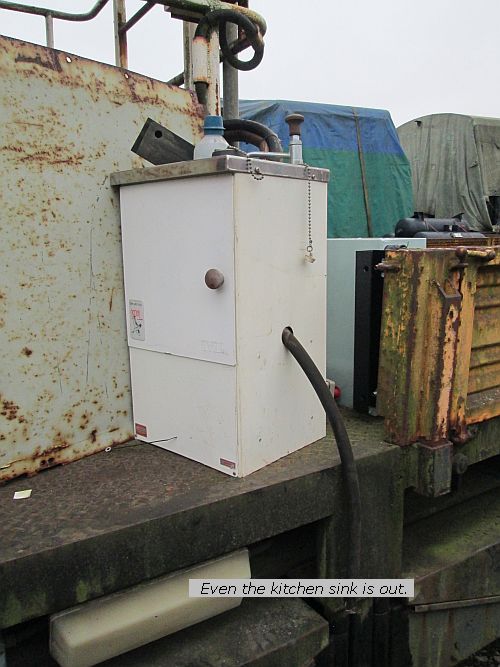
Andy has cut out much of the interlocking relays that switch control to the trailer car (which we don't have) for reliability and whilst there is much sill to do, to get motion from it does start to open other avenues. A new mag pick up should solve our control issues and we can move on to getting the hydraulics working and with it the HIAB crane at the other end. For now, parked up again, Andrew departed and Andy continued removing redundant equipment, bits of TPSW, OTMR and GSM-R even - at Andrew's behest - the sink.
Leaving him to it I returned to 144V and got a temporary sheet over the cab to reduce the rain ingress through missing windows, but anything now was rather an anticlimax and as I knew Steph wasn't feeling well, we wrapped up rather earlier than usual, with Tom putting the HATRAMM back onto Road 1. This week is rather up in the air, several jobs planned but no sure how it will pan out. Come back again and find out - see ya then.