
Of things in the back of the van
29th May 2022
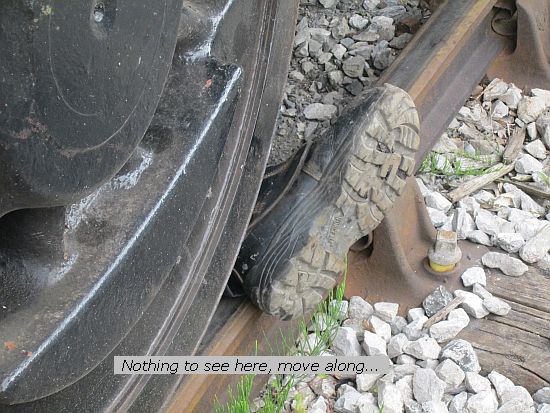
Now, stop me if I've told you this one before, but years ago I despatched one of my fitters to collect a load of bits from Marcroft at Stoke and take them down to what was then my workshops at Long Marston. I had mentally assessed that what he had to carry was within the weight limit for the van and thought no more about it. Until that is, he reported that he had been stopped by the boys in blue, weighed at a weighbridge which showed he was about 100kg over-weight, and was then taken to another weighbridge and there issued with a prohibition notice. He had to take some bits out, go on to Long Marston, unload and return for the remainder. As Company Secretary I was to be prosecuted (as the Co Sec is responsible for a company's actions) and if found guilty, would receive points on my licence. What had happened was that I had not considered just how much weight he was normally carrying in tools, which turned out to be about 125kg, but with the assistance of a gentleman who is today a stalwart reader of this blog, we were able to point out to the West Midlands Motorway Unit that they would be ill-advised to prosecute me based on a weighing that was in itself illegal. The first weighing was on a dynamic weighbridge, the second on a static. The dynamic weighbridge is not as accurate - they could tell he was overweight but within the proscribed limits they could take no action. The Police however had blown it - they did not have the right to keep going from weighbridge to weighbridge until they got the answer they wanted - the first was their only opportunity, but they intended to prosecute based on the second.
All this came back to me as I drove back home after collecting the proceeds of a bid Andrew had made (but I funded) on an auction. I had been there before, so much so that as I rolled up, Kate - she even gave me a free pen last time - pointed at a number of pallets stacked with crates and said 'That's yours over there' as I got out the van. I was a bit taken aback - each crate was marked with a weight - 86kg - and there were 10 crates. No prizes for realising that 10 x 86 is 860, nor for me not appreciating that the items (which for the catalogue had been pictured out of the crates) might be crated, given their source. At first sight I wasn't sure they'd all fit. Then I realised that as my tools were still in (plus some of the bits like bottle jack, etc that I regularly carry in case of need during transport moves) history might repeat itself as the van's carrying capacity was about 900kg.
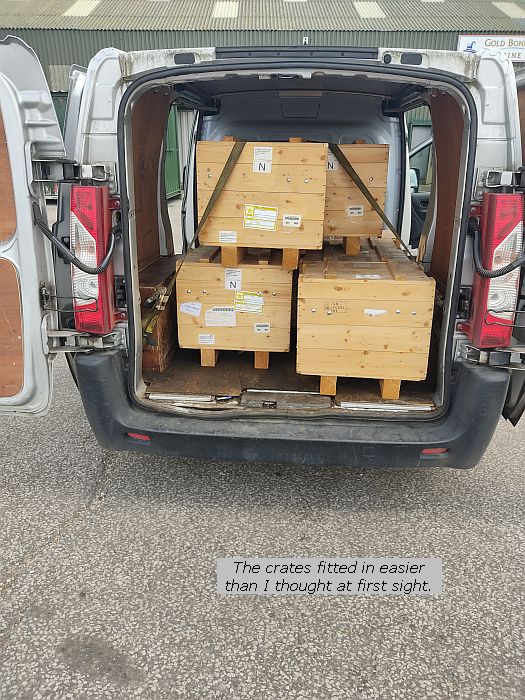
I got them all in, and was relieved to see that the van didn't look overloaded and set off for Debrbyshire, which was reached wthout incident. And here's a curious thing. I had set off first for Sheffield with a consignment to drop off at Palletline for a customer, yet arrived at the loading point after about 100 miles with fuel consumption at 50.4. The return run, only 90 miles direct and 'uphill' as previously theorised, brought the overall consumption down to 47.8, suggesting that even loaded to its maximum, the van came back on about 45mpg, and this on a vehicle with 101800 on the clock. Andrew and I unloaded them by hand on Monday night and for now they reside taking up floor space.
On Monday night I attended the meeting of the Derwent Valley Branch of the Peak Railway Association and found myself in conversation wth DaveL, Stationmaster at Darley Dale, who was putting together a working party to tidy up the northbound platform at Matlock station which is looking unkempt as trains are currently not using it. He had been discussing it with the railway's General Manager to find a means of getting a train in that complied with certain conditions. I immediately offered use of the HaTRAMM and thought little more about it as the meeting was about to get under way. Talking of the HaTRAMM, the transducer saga has continued with, amongst other things, the crane manufacturer telling us that they 'don't have documentation from that period so cannot assist' and washing their hands of it. Further research suggests that the cheap unit we picked up probably won't work in our application so either we plump for a new transducer to what we think is the correct spec to suit the existing pcb, or we source/build/concoct a new kit, which with the advances in electronics may actually be not all that difficult today. The decider may be to try a 1.5V battery on the signal wires to the pcb and see if the unit accepts them as a valid signal.
On Wednesday I was out again collecting parts - we were supposed to have the gardeners back in to weedkill but again the weather kaiboshed it. On Thursday the van was in for a service and MoT, which it passed without problem bar a duff number plate light bulb which I had known about just never got around to changing. On Friday I had a morning run to collect a torque converter but was back at the shed in time to give a tour to a booked enthusiast: on Peak Rail the 0-4-0ST was out on driver experience, this time coming south of Darley Dale level crossing.
So on Saturday morning I saw DaveL on the platform as I arrived, so popped over and suggested when he had a few minutes to spare, he might like to walk across and I'd show him round our HaTRAMM. As it happened one of my first jobs of the day was to continue the change to LED panel lights, as we had 4 more green ones arrive and I'd found a white bulb-replacement in stock so was going to change the red one I swapped last week back to its original module but with the LED in as it had a bult-in flasher which I hadn't appreciated. I've got ten more reds and ten yellows on order so this work will resume shortly though I'll need more greens and a few LED-replacements for those illuminated buttons to see the job through. Anyway I had the panel up and was changing assemblies when I heard voices and found DaveL and two others had come over to see what this HaTRAMM was. I was happy to take them over it and sing its praises- we'll see what transpires. Back at work I completed removing the surplus limit switches. Strange to relate, all the 'downwards pointing' switches seemed to be wired normally closed (so remove and substitute a temporary wire bond) but the vertically 'up' ones were wired normally open, so removing them should have no effect. Quite why I don't know - a normally-closed switch has the fail-safe benefit of stopping the job if for some reason there's a wire-break or similar defect: the normally opens merely mean that if a wire breaks, they don't have any effect, and you won't 'know' if they're functional until they do (or don't).
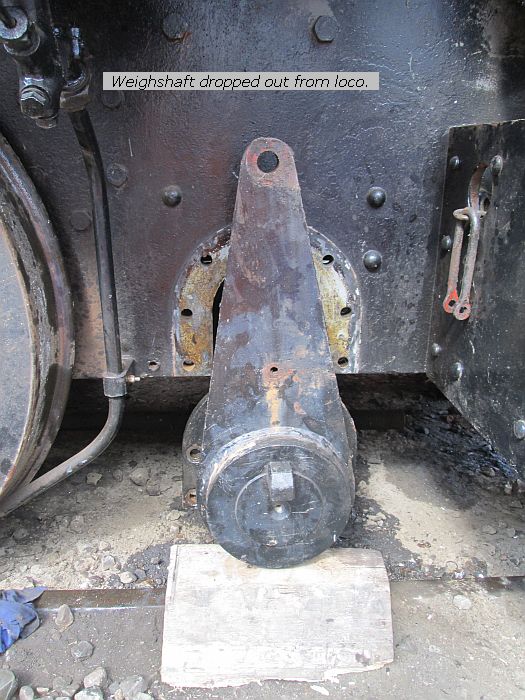
I must confess to having judged Fowler a little unfairly last week. By chance on Monday night we realised that there was in fact a grease connection to the middle bearing on that brake weighshaft, but while I am altering wires and lights on the HaTRAMM, MattH was struggling with the seized bearings and making little progress.
I broke off to get lunch and then returned to the Church Hall where the PRA was holding its AGM. This of course was the first AGM since Mrs Statham unexpectedly passed away and I was relieved that there was no suggestion of a minute's silence as I'm not sure how I would have reacted. Otherwise it was a rather mundane meeting, bemoaning a fall in membership (some deaths, more simply not renewing) whilst failing to observe that it might be the consequence of a failure to produce a single magazine in twelve months. Members are promised 3 issues a year and for many it is the only contact they receive from the railway, without anythng they may feel that they are not getting any value for their sub. The Board were keen to promote the 'new' PRA website where news was published (but only by the very few with access to the website's 'back-end') yet this website's existence remains largely unknown to most of the membership who would need banner headlines in a magazine for it to sink in. The magazine itself was brought in to question - with paper and postage today it is something of a luxury. A 'magazine' can be created digitally and circulated electronically, and only printed - on more modest paper - for those who opt only to receive it that way.
Despite two PRA Directors also being plc Directors (and the PRA being the supporters group for Peak Rail as a whole), questions about the future of extensions to Buxton and the Quarry consortium were rejected as 'plc matters, not PRA' - some things in Peak Rail, it seems, never change. One questioner referred to the problems with Dove Holes tunnel, used by stone trains going north out of the Buxton quarries, suggesting that this justified re-instating the line through Millers Dale to Matlock. I may not be a civil engineer but I cannot see that a permanent solution to the presence of an underground water course that has found its way in to Dove Holes Tunnel and causes flooding after heavy rain, is going to be any more expensive than re-instating miles of railway, repairing bridges and tunnels, upgrading the Matlock-Ambergate section and re-routing the Monsal Trail on a new alignment to satisfy the national park authority, the ramblers and horse-riders and the thousands of people who have signed the petition opposed to reinstating the railway. The questioner seemed unaware that when Dove Holes tunnel is shut by flooding, the trains can go along Ashwood Dale, through Buxton and pick up the LNWR route instead.
[At the last plc shareholders meeting that we were able to attend (pre Covid) Mr Tomlinson, the Director fronting the extension plans, spoke at great length finishing with the statement that if the Quarry Consortium failed, Peak Rail would never get back to Buxton. The subsequent annual reports make no mention of the Quarry consortium and Mr Tomlinson resigned from the plc Board on the 16th May].
I was the only one of the Briddon clan at this meeting: Andrew was on call (so was ready to field calls or dash off if required) and Steph was having a weekend in Newcastle with our daughter. By the time I returned to the shed, Andrew was aiding Jagger on the JCB, extracting stub axles from the front assembly with a large drift and a sledgehammer.
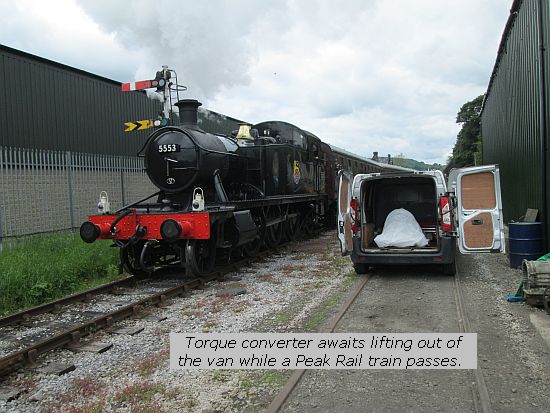
On Sunday I pulled the train back with Tom so that we could extract the converter which was still in the van from Friday. Andrew aided Matt and eventually it was agreed to drop the complete brake weighshaft which took some time and involved lifting the front of the loco. It proved that the right hand side outer bearing was stuck too, but that has been knocked apart, cleaned, lubricated and should be OK, but the middle one is still solid and awaits more time.
An early interruption was a contact of Andrew's, a former Elsecar volunteer who called to collect a surplus Earl of Strafford nameplate and insisted on posing by the loco before he left. The engine that was once in RS8 was brought nearer to the shed - we have agreed that it is probably past redemption but its sump arrangement, which is what makes it suitable for the installation angles that Yorkshire favoured in its locos, should be recovered and used to convert the C6T that will be going into 2895 once those laser cuts arrive from the profilers. I had more wiring to do on another loco, then filled its transmission reservoir only to realise the float switch for it isn't indicating which goes on the snag list. I have a temporary program ready to install in the loco's PLC for testing purposes which should be sufficient to get it operational without any interlocking or safety protections, but it has been static for a decade so re-starting it after this time will require considerable caution. That may be my way of celebrating this 4 day extravaganza next week. I'll just have to make notes though else I'll come to write the next edition and not recall what I did which day as they blur into one. See ya then.