
Of plants and plant
19th June 2022

It's sometimes hard to comprehend that almost every Sunday for coming up twelve years I have sat at this (or a predecessor) computer and proceeded to write out something that has proven of interest to people both in this country and abroad. I've touched on this before: sometimes it can be a strain coming up with slants on what we've been up to that might be educational or simply entertaining. And that's without the photos needed to flesh out the words and stop them getting tedious or undecipherable. I am not seeking praise to be lavished upon me (though it would be nice...) , just observing that some weeks I sit and play Patience, putting off the moment when I have to put finger to keyboard and don't know how to start or what to say when I have managed to. This week isn't one of those
First thing Monday Andrew had a call from the weedkiling contractors. It had been dry overnight, the forecast was dry and could they get in and spray? Of course, I zipped down to the shed, set up a water supply for Liam to refill his sprayer and showed him the area on the station platform that had been agreed with the Stationmaster Dave L. Three quarters of Darley Dale platforms are tarmac, but one quarter, the down platform from ramp to beyond the station building is ash - a lot of it ash from loco fireboxes. (I have scoured that bit of platform many times in the last decade. Peak Rail used to light the loco fires on old pallets, oblivious to the nails and staples used in their making. So the 'ash' used to contain rusty metal that you really didn't want passengers injuring themselves on.) Anyway, the plant life was making the ash look green, and not in the metaphoric sense, so Liam set about spraying that first before returning to dose our yard. On the basis that I didn't want to be accidentally identified as a weed, I left him to it.
Later that day, Andrew having time free, we went up to Rowsley to sort out the brake pipework on Tom.
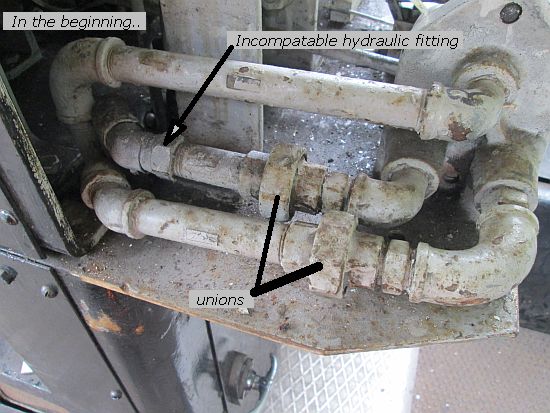
And here's the starting point. On the right is the Laycock Knorr driver's brake valve, the pipe in the foreground is the main air going in to it, the middle pipe is that going to the brake cylinder, and the top one the exhaust to atmosphere, piped away inside the desk. The middle pipe is the culprit, since it has a hydraulic-type fitting where an older cast 45 degree elbow ought to be and as the hydraulic is a parallel thread and screwed into a malleable iron ebow with a taper thread, getting them to seal is a tall order, they aren't meant to. Trouble is, as you can see, the three pipes are very close together, and getting a spanner in on the two unions and being able to turn them to release after 40 years of paint and idleness was going to be next to impossible. And so it proved, to gain access to the middle pipe in the end we cut through the exhaust with a battery grinder and removed it in two bits, but even then it was a hassle and makes you admire the pipe fitter who put it together but also ask who in their right mind in the Sentinel Drawing Office thought this was a good arrangement? Ironically, when we got to the hydraulic fitting (which had even been sawn off so barely two threads were able to engage in the elbow behind) we found that actually that elbow was even worse, just that we hadn't been able to get the leak detection spray on it. Here's the finished result with two pieces of fabric re-inforced hose (more flexible than wire) the exhaust just pressed on the barbed 'insert' (it could do with a clip but it's under no pressure) and the cylinder line with a brass ferule swaged on.
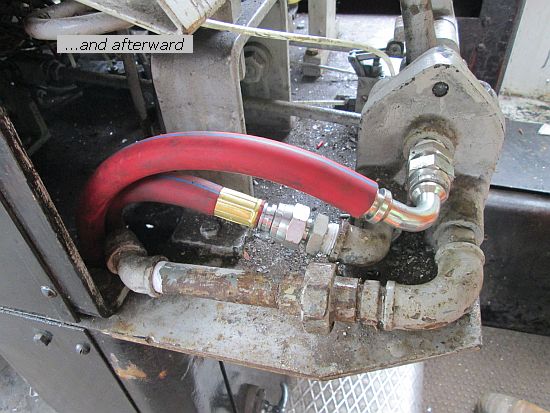
That makes Tom ready for use around Rowsley and awaits Peak Rail's pleasure. Rowsley meanwhile was full of Clayton vans, and it may only have been a coincidence that the shed doors were lowered almost as soon as my van arrived, but Clayton are carrying out modifications to one of their battery electric BoBos there, this one belonging to Sellafield.
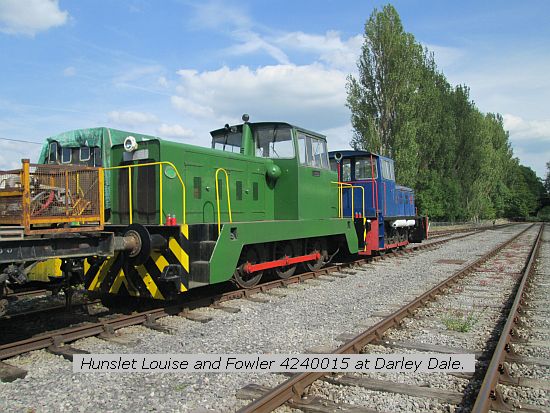
I had arranged with Adam to meet at Elsecar at 08.00 on Tuesday, so of course I knew he'd be there before that and aimed to arrive about half-seven. In fact, his route brought him south from J36 of the M1, whereas I came off at J35 and up through Ecclesfield, and met him face to face as we turned off the main road. By twenty-to-eight we were on site and lining up to load the last loco (for now) to leave, Hunslet 0-6-0DH 'Louise'. This loco was presented to Elsecar by BP and like the Yorkshire, we have many memories of it from our time there. One particular one was the day (1st of April, (yes) 2007) they asked us to come and look as a hornguide was loose. We thought it was a practical joke., but no, they were serious, and sure enough one hornguide casting, normally held on with about 5 substantial fitted bolts were all sheared and only the horncheck piece across the bottom was keeping it there.
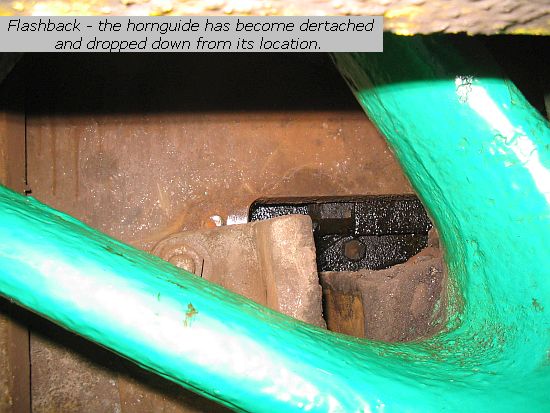
You can see the gap and fresh metal exposed in the picture above where it has dropped an inch or two. Locotec came to the rescue: we took the loco in, dropped the axle out, machined new bolts, refitted the hornguide and returned it in full running order.
We were early at Elsecar for 3 reasons. One was because Elsecar management wanted us in and out early as they had an 'event' on. (Staff indicated the event was a public consultation meeting over the future of the railway so politically seeing a loco departing might have prejudised some people!) Secondly Peak Rail had asked us to be in as early as possible as Allelys were due in later to collect a carriage, and thirdly the outgoing loco had a long way to go and Adam wanted to get as far as possible Tuesday night. I should perhaps say at this point that although coming in to us at Darley Dale, this is not another for Andrew's collection, rather a loco being brought in for attention on behalf of its new owner.
Normally with any loco I haven't moved before, I get dimensions, draw up an outline in CAD and superimpose it on a drawing of the trailer in order to know how easily it fits. But I hadn't done that this time because I had it in my mind that the Hunslet loco was no longer than an 08 or a Sentinel and we'd carried them before. All went well, the loco was drawn up until the buffer beam touched the top section of the deck, it didn't look wrong at the other end so we disconnected the winch hydraulics, moved the tractor back up to the front and backed up to it. But as Adam came up close it became apparent that we weren't going to couple up as the loco's buffers were repulsing the neck of the trailer. We needed another 3 or 4 inches. So the tractor went back to the rear, re-connected the hydraulics, we let the loco back down a bit, inserted some ramps and pulled it back up, so lifting the buffer beam that it cleared the back section of the trailer and thus the loco went further on. This is a problem that will not happen in the future as you'll understand later.
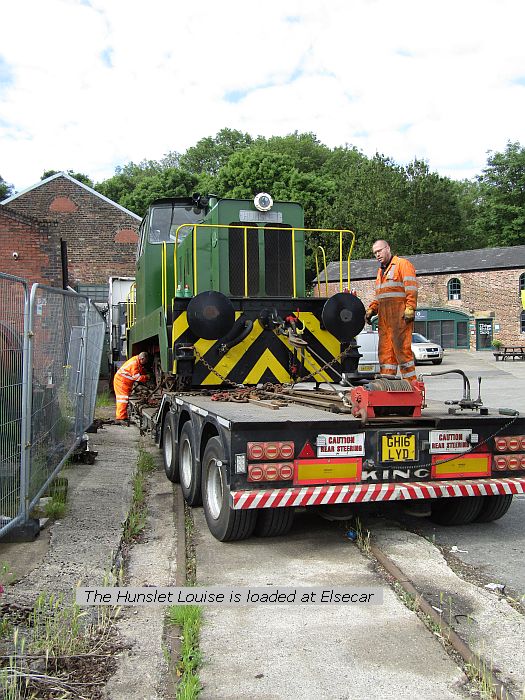
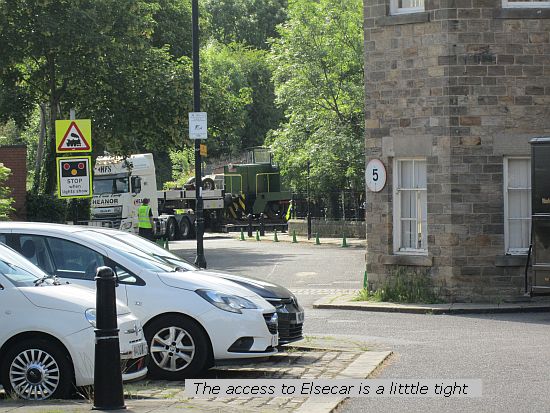
Anyway, despite this delay we were rolling by just about half nine starting with a sweeping 180 degree turn in beautiful sunshine of the Elsecar yard, followed by a supervised departure through the short but twisty and narrow road that acesses the site.
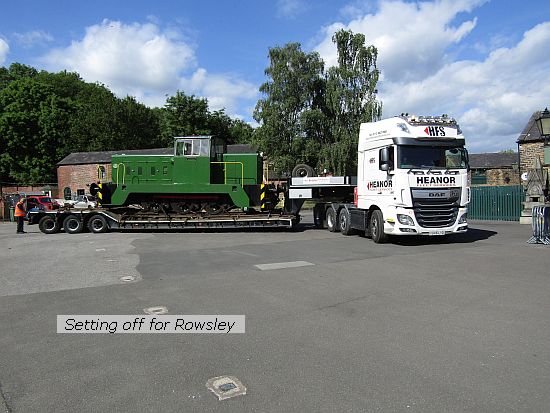
Back in Derbyshire, the departing loco made its way up to Rowsley with the Hatramm, and we were waiting when Adam arrived at about quarter to twelve. The Hunslet was rolled off the ramp rails (which were needed at the other end of the ramp) and down onto the Peak Rail track, after which a bit of a more complicated shunt was required as the departing carriage was occupying the adjacent headshunt. So it was a full run down the loop and back again before the Yorkshire 0-4-0DE could be aimed up the ramp and the winch take over.
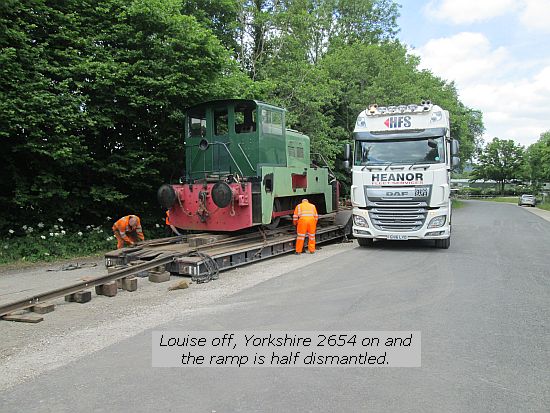
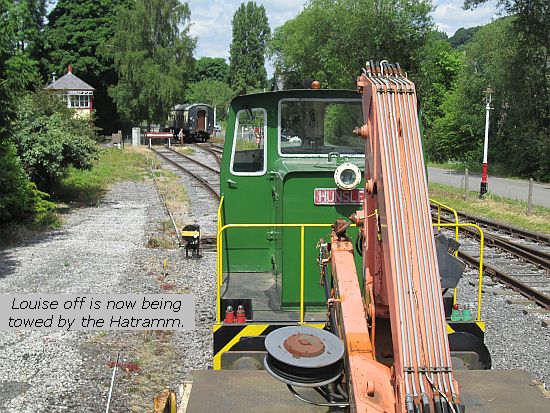
With the loco aboard the usual procedure of dismantling ramp and rejoining the tractor unit to trailer was completed before I set off with the Hunslet and Hatramm back to Darley Dale, but first I put the Hunslet gearbox into neutral with a spanner and we shunted the carriage into place ready for loading later. (I suggested this to be helpful and it was taken up by Harvey C, but having learned since that two tenders came in, it might not have been of benefit!)
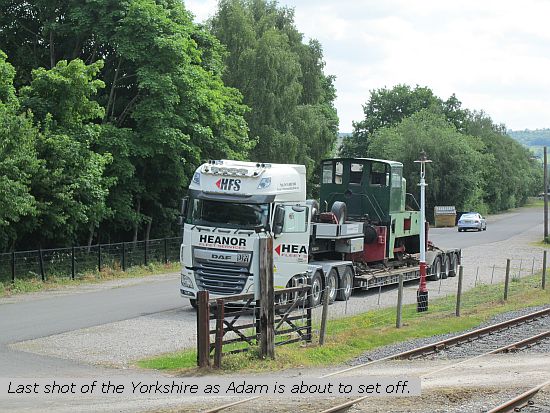
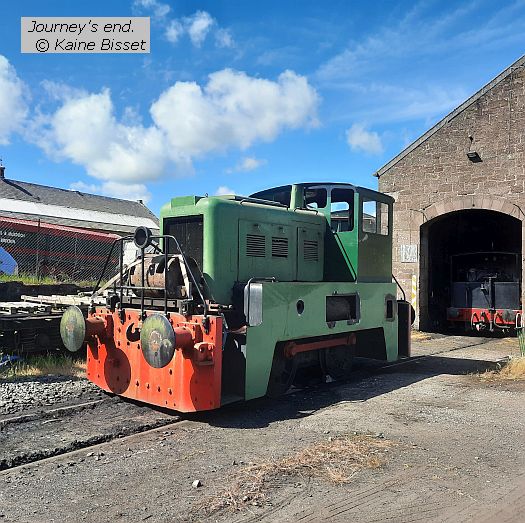
I didn't follow Adam northwards- had there been a follow-on move I might have, but as it was a straightforward unload I left them to it, they were up near Berwick that night and the following morning unloaded at Brechin. I am indebted to Kaine B for the following pictures taken there.
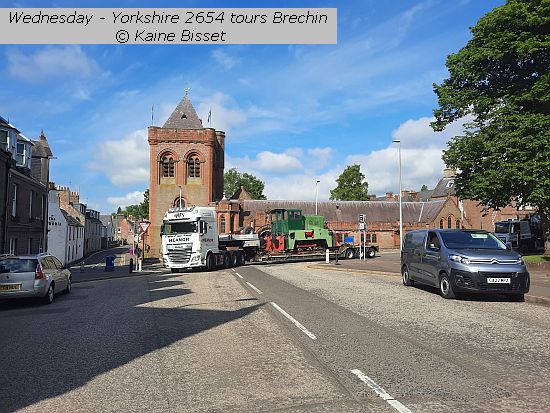

On his return leg, Adam diverted to collect a second trailer. As I said above, the present King has been extremely useful and moved many locos over the last couple of years, but with only 3 axles it is limited on weight and its deck restricts the loco length. Andrew has been on the look out for a bigger trailer, and this week completed purchase of what I am starting to call T2, as it is another King trailer but with a longer, heavier capacity deck and 4 axles to carry it. So much longer in fact that Adam was able to push T1 onto T2 and give it a ride back to base on Wednesday afternoon.
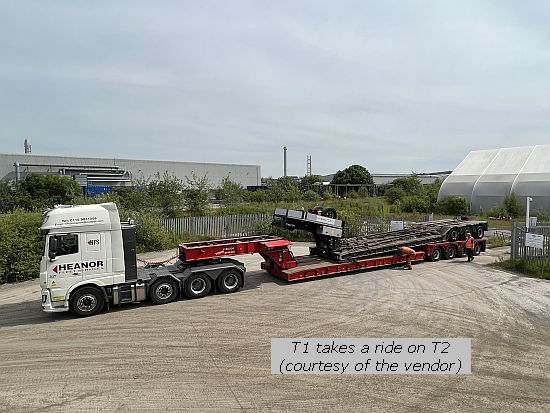
T2 is though, too big to get into Darley Dale (at least through the gate) so up-fitting it with rails and winch will have to be done at Adam's, but first it must be thoroughly inspected and any defects attended to. In the meantime Adam has invested in modifying another of his trailers with removable bits so that it can carry longer vehicles (like carriages) when required. Thus over the next few weeks I'll be going from a choice of 1 trailer to three - I can see I might be even busier on that side 'ere long.
One evening this week we decided on a make or break with the Hatramm SLI (Safe load Indication) system. As you'll recall, our tests with the crane have thrown up that even with no load on, the system is displaying overload lights and Andy M reported that the pressure transducer apeared to be showing readings that were out of range. A cheap transducer that we picked up from ebay made no difference, but then we hadn't researched things properly and it is likely that it was an unsuitable unit. The crunch question was, were the overload lights on because the transducer was giving an invalid reading to the electronics card or was it because the electronics card itself was also defunct and was wired to 'fail safe'. We had concluded the only way to prove it was to provide a signal to the card that was within operating range and try the RESET button. If the card was OK, the overload lights would clear, at least while the signal was maintained. The Signal was simply to wire a 3Volt battery across the transducer signal wires, but this had no effect whatsoever and we were forced to the conclusion that maybe whatever took out the transducer had had a similar catastrophic effect on the electronics. Andrew had had a budget figure of £1500 to install a replacement system which did not appeal to the bank balance.
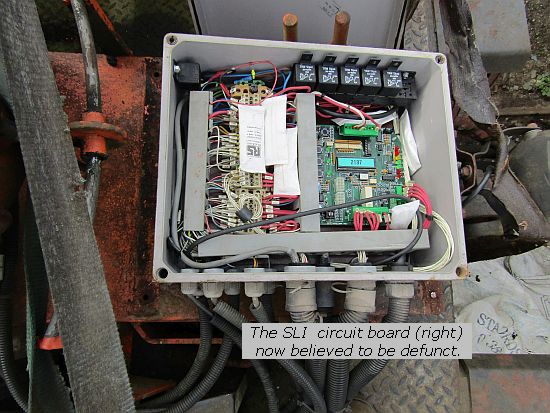
A good quality transducer is little more than £100 new, and its analogue signal could be resolved in a 'smart relay', the sort of which I have used on stand-alone deadmans or other systems in the past and therefore possessed the software to program. It only remained to determine what adaptor was needed to get from the hydraulic tee on the Hatramm where the existing transducer is installed to the thread on the bottom of the new transducer - a simple task if the thread on the former is exposed, but as we don't want to remove the old unit (and risk spilling oil) until ready, a detective task to determine what fitting range the manufacturer used. In the end, the adaptor which we hope is correct, and the smart relay both arrived on Saturday, the transducer is due from Germany on Monday; so you might find me re-wiring and programming in next week's instalment.
As at last week I was looking forward to running the Hatramm to Matlock on Thursday with a working party to clear the platform of weeds, but for technical reasons and illness amongst some of the party, it was postponed for a later date. Late on Friday Andrew and I went back to the shed and did an hour or so tidying up - not that you'd really notice - as on Saturday we had 30 members of the Industrial Railway Society booked for a visit. Andrew said that we'd be up early and down for 07.30 to get ready, but he wasn't and it was 09.00. The format was much as we had done for the IntercIty group in April - split the Track 1 string in front of the 2HAP, draw it forward until it was roughly level with the end of those on road 2 so all could be inspected without obstruction. This time I used some stakes and stretched a tape barrier rather farther along before tieing it off on a loco on Track 2, to give a larger peepers gallery of the adjacent running line plus the ability to see some of track 2 occupants from the other side. Off came all the sheets from our locos (bar one which is now so ripped it barely covers it anyway) and we still had time to put the kettle on.
By 10.00 there were 2 or 3 hi-vi-clad enthusiasts milling around the gateway, by quarter past it had swelled to over 20 and at about 10.25 I meandered down, handed out sheets showing disposition of the locos and did the usual summary reminder before allowing them on. After 45 minutes they seemed to have pictured all they wanted, we checked they were all about the shed while Andrew and Matt shunted the locos from Track 1 back down to free up the headshunt while I fired up RS8 for promised cab rides. Taking only 4 at a time I had a queue to work through, but after I was finished, Andrew fired up the HaTramm and all that wanted to got a ride in one go! Most of the party began to drift off, some to go see HST at Rowsley, some for a Peak Rail train ride, while two stayed on for a cuppa and a chat. Andrew met up with one of the party whom he had known at Porterbrook but apparently had kept quiet about his penchant for industrials. Steph had brought our lunches down so after consuming bacon sandwiches we set about replacing the sheets. 144V received the one from departed Yorkshire 2654, but Coronation's sheet proceeded to rip along the middle so is not really doing much any more. It started to rain during the afternoon but at least we had got them all back on by then.
Andrew popped over to Wirksworth to replace the batteries on Charlie - it has become prone to the stop solenoid not pulling in, but it made no difference and a quick phone diagnosis with him suggested that the pull-in part of the coil (the unit being two concentric electro-magnets) was on its way out. On his return we went through our stock, but they're all old ones and it looks like they're all in pretty much the same state. Today has been a quieter day with work progressing on a commercial job. We've had two visitors, one whom e-mailed yesterday to ask if he could visit and another who was peeering over the fence at RS8. It seems he knew it from its days at Dinting so I gave him the guided tour and showed him around the cab. Other work over the weekend has been re-arranging things in the grey container (a lot of which is now related to the road haulage side, like spare timber packings and such). Matt had recently acquired an endoscope and Andrew found its camera end was smaller than his, so we put it to the test by peering in to the cylinders on Ludwig Mond through the injector holes. Of the two cylinders which we had previously identified had to be (one or other) the cause of the knocking that took the loco out of action, one has some damage to the edge of the piston, but the other has something far more significant embedded, either a somewhat deformed bolt or some other foreign object such as a broken up valve insert. Either way we now know which to tackle, the only question is how and when (plus for how much). Late on we carried out a pressure/leakage test on a Laycock-Knorr brake cylinder, the reconditioning of which has been an interesting exercise, but I'm pleased to say it passed and my customer will no doubt be equally pleased to see it return.
And that about brings you up to date. We're planning to do a trial move on Wednesday with Adams trailer (T3?) and a coach chassis and I may have other moves on T1 for Thursday and/or Friday. As for anything else, you'll have to come back next week and find out. See ya then.