
Of old Lang sign
3rd April 2022
Who says I can't use puns like that in April?
Forty four years ago tomorrow (today if you are reading this over your Monday morning Weetabix/coffee as I gather so many do) a naive young man started a new job as 'Marketing Assistant' in the locomotive builders Thomas Hill (Rotherham) Ltd. I was responsible to the Sales & Service Director, John Capes. Yes, that I was Marketing Assistant to a boss who didn't have marketing in his title did seem strange but then after two and something years in Sales Admin at Stanley Tools, where the Marketing Department was staffed by failed teachers or retired Army officers, just getting into a Marketing role - at more money - was to be savoured. And I wasn't so naive that when Margaret came into my (shared) office on my first day and asked if I'd like to join the Sports & Social club and be secretary it didn't ring enough alarms bells that I tactfully declined.
At that time Hills had two full time salesmen on the road for complete locomotives, three for parts and service sales (after market) and about ten mobile fitters doing repairs to customers locomotives throughout the UK. With office staff, workshop staff, a drawing office full of draughtsmen with ink pens and drawing boards, two or three ladies in a makeshift canteen (where I first learnt the term 'crozzled' for bacon done to a crisp) and a small number of people working in the parts wharehouse over the road, it was a busy, and seemingly, profit-making enterprise poised for expansion as it trebled its workshop space.
Now, I wouldn't want you to think I've been the kiss of death to British enterprise. I don't often pass the old Stanley Tools offices but last time I did they had moved out - the hammer factory at Ecclesfield is now a supermarket and the screwdriver factory at Hackenthorpe became, I think an old persons home. Between Stanleys and Hills I had a 3 month spell at Firth Cleveland Ropes, and was relieved when the Hills' job came up as I didn't think that FCR was all that secure - within 12 months of my departure they had been sold to a competitor and closed. Incidentally there was a railway connection, they also made the Ram pinch bar, but their primary product was wire rope, using machines assembled in the 1930s. They could turn out as much 6x19 configuration rope as you could ever want, but the market had moved to favour 6x36 or 6x37 and they didn't have the profits to invest in a new machine to make more of that.
So anyway, I said goodbye to FCR and moved to TH, and learned all about shunting locos (I had been stolidly narrow gauge up until then) and the practices of capital goods sales. It is difficult looking back to those years to put over how much it has changed. The majority of our locos (we regarded both Sentinel and Yorkshire as 'ours' because we had acquired them through Rolls-Royce) were in colliery yards and steelworks service. Once every gasworks had had locos but they were now a dying breed. Quarrying, cement and the petro-chem industry provided us with steady demand and the Ministry of Defence Army Railway Organisation were satisfied customers. And look at it now. The collieries have gone, as coal is the bete noire, with a few exceptions much petro-chem traffic has gone over to pipelines: many smaller steelworks (and some larger ones) were sold to the Chinese and in some cases taken away and reassembled there. When Hills had started, Baker Bessemer had a steelworks which did wheel and axle work barely a mile away. Then BB closed and the business transfered to Steel Peech & Tozer in Rotherham, then that closed and the business moved to somewhere in Manchester, and a while later (and some time after I had departed) Hills closed its doors too.
All this introspection has been triggered by the present day, when coal is being tolerated for heritage rail use (but for how long and to be bought from where?) and diesel is being pilloried not just for its harmful pollutants but for simply being a fossil fuel. The way forward is being touted as fuel cells, hydrogen or batteries. Yet sadly those proponents of hydrogen don't seem to take into account that hydrogen, even at high pressure, cannot store the same energy that a tank of diesel can, and being a very thin gas, can sneak through cracks in pipe connections that could make refuelling a delicate operation, and let's face it, we have too many past experiences of what happens to pressurised gas cylinders on train underframes in a crash - think Quintinshill.
Battery technology has come a long way but is it really there yet? Reports coming my way suggest that the new Clayton locos - 90ton Bobos of which a significant proportion is battery - put into work shunting the equivalent train that a humble 08 (48tons) could handle, needs recharging after an hour or so.
So we're coming out of a pandemic - two years ago we were heading in and I prophesied that we could write 2020 off: and while many heritage lines had a good 2021 (Bala Lake I hear had a record year while the Talyllyn reportedly did better in '21 than in '19) we are coming into the '22 season with uncertainty of coal supply, significant inflation and a squeeze on disposable incomes. Whilst many had reverted to holidaying at home as foreign travel became almost impractical, airport queues have suddenly increased, and the price of fuel at home may curtail day tripping. And into all this you have new variants of the virus that are more adept at getting from person to person now that we are all tired of taking precautions and the government has lifted its foot off the brake.
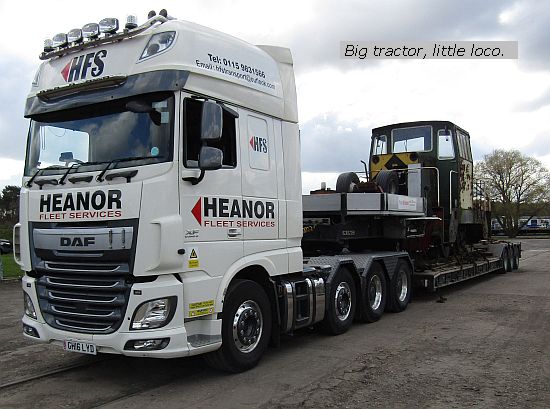
To take an example, on Tuesday morning I had a panic call from Adam asking me not to make any more bookings for the low loader as he had two drivers call in sick with Covid and a third under suspicion. I had only firmed up on one job and we agreed that could stay but I back-pedalled on others I had anticipated. After an aditional day down at the shed, I spent more time on site and created a new clutch pneumatic system rather than muck about trying to resuscitate the old Lang brass valves. Then on Friday I was out with the trailer, with Phil G rather than Adam who was covering elsewhere, moving a loco from Long Marston up to Rowsley.
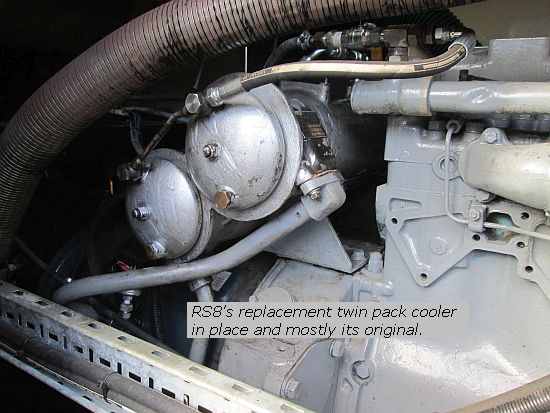
RS8 has at long last been receiving attention this weekend. Sidelined for some time with a leaking transmission cooler, that it might be useful to have working again finally reached the top of our priority list and first thing Saturday I set about draining the engine coolant and whatever oil was still in the cooler. Its replacement - the cores and body ironically being its original cooler but with end caps bequeathed by 144V - was fitted and not long after lunch with its batteries reconnected and coolant topped up, it came back to life and the transmission reservoir topped up until base pressure appeared and the level stayed steady in the sight glass.
We didn't move it far that day, other tasks were in progress and the day was winding down, though Sunday was planned for a 'bit of a shunt'. But before I left it I did try the (Lang) horn valve: it had been isolated at the distribution manifold and I vaguely recalled it was leaking. Sure enough, air wooshed out of the exhaust port so I isolated it again and on a whim, thought that if I plugged the exhaust port then it might be OK. To get at the exhaust port I eventually found it necessary to remove the air line from the valve going to the horn, and having plugged the former, turning the air supply back on to the valve, instead of wooshing out the exhaust port, it now wooshed out of the horn's port. People seem to think that a loco should have a working horn - just shouting 'get out the b****y way!' isn't acceptable under ROGS it seems. I put it on the list for Sunday.
In fact it took up quite some time on Sunday. Having got it off the loco (it is bolted through the cab roof) Matt H took over and stripped it, eventually finding its sliding faces needed lapping, a spring was missing, its operating shaft bent and shaft and body seals needed renewing. It stubbornly refused to seal up properly for ages, eventually settling down to a slight whisper which would have to be acceptable short of indentifying a new replacement.
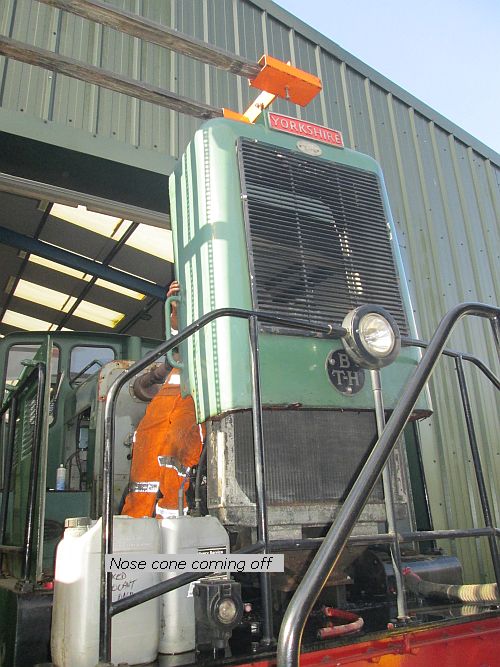
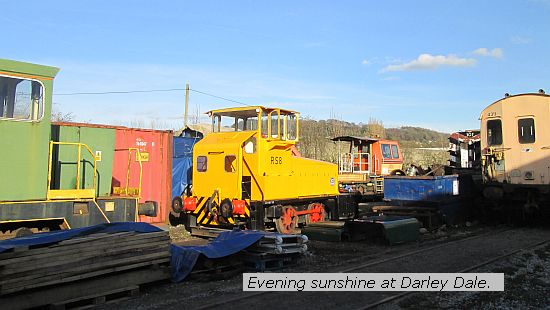
So we moved on to the shunt, the purpose of which, apart from re-positioning various locos, was to start lifting the casings off another that has been inside the shed being got ready. RS8 still has an issue with its power - initially today it would 'stall' at only 900 rpm and not rev over 1500. With a tweak to the fuel rack stop and the throttle cable at the fuel pump end, we got the full load rpm up to about 1300 and at that it even managed to shift Ludwig Mond - a notoriously stiff old thing for its first move of any day even when not sat on track 3B, which slopes up and is ballasted so high as to intefere with the flanges. Andrew and I agree that there is still some work to do on the throttle - we don't seem to be getting full travel at the fuel pump and I have the feeling that the cab end may have slipped on the shaft - but driving it again I was reminded what an excellent view the driver gets and the ability to grab the controls at any corner of the cab is really rather good, even if a day shift on the brake lever does represent a weight-lifting work out at a gym.
So that's it for now. Next weekend we have a visit booked for the Inter City Railway Society - originally due for 2019 but cancelled by Covid - which will require a detraction from normal acitivity. Or there again I could be flat out 'living with' Covid. How will it all pan out? I'm going to suggest you come back next week, like I always do - see ya then.