
Of multi-jobs
8th May 2022
Here we go again.
Well, it's either feast or famine. Last week I had photos in plenty: this week, well let's just say that what I have been doing hasn't been particularly photogenic, but here we go anyway. Back at the beginning was a Bank holiday, and Andrew and I were off to inspect a friend's 0-6-0DE with what we feared was a generator problem. There is a tendency in many industrial works to operate on the principle 'if it ain't broke, don't fix it' and while that may be sage advice in some applications, it does not apply to many older machines built in days when the term 'multi-skilling' hadn't been coined and employees took pride in their work. A classic example was an 0-6-0 flameproof loco Hills supplied to the then Mobil oil refinery east of London. On its arrival there was but one regular driver, and he took a shine to this loco. He drove it carefully, and even came in on his day off to wash and polish it. Then Mobil went over to 'multi skilling' where any number of employees were deemed 'competent' at a range of tasks and would be allocated as plant management saw fit. As it was now a common user loco, it became just a tool to do a job. One of our Service Reps was there once as the loco was at work. The driver slammed the brakes hard on, the wheels locked up and almost before it had slid to a stop he was descending the steps to the ground. Before long it had so many flats that the wheels were like the traditional thruppenny bits (for post-decimilisation readers, think 20p/50p coins) and the vibration, even with a flex-mounted cab, must have been unpleasant for the crew. But we started to get complaints about things 'coming loose' and realised it was the percussion that was doing the harm.
Not that the practices were unique to Mobil. We had a number of locos next door at Shell. Whilst still under a new loco warranty Shell claimed for a broken spring. That was unheard of, so we investigated. It transpired that the loco had traveled through an open catch point: it couldn't pull up as it had a train on the hook. Why were the catch points open? Because the second man/shunter simply hadn't got to it in time to pull the lever (the loco was thought to have gone througn still at 10mph or so). The crew worked in pairs. Who was driver and who shunter for the day? That was determined by who got to the loco first in the morning - allegedly it was a race to get the 'cushy' job. Shell on reflection conceded that maybe this wasn't a warranty matter after all.
But then management often doesn't get much of the story, or doesn't want to hear. I once had a hire loco over in the Manchester area and got a call saying they had an air leak. I despatched a fitter to attend to it. The fitter rang me. 'Did they tell you how it happened?' 'No' I admitted.'They've derailed it. The air leak is because they've ripped the drain tap off the bottom of the main air receiver.'
But I digress. Diesel electric locos were generally preferable to diesel mechanicals, but it should be no surprise that the Twin-Disc hydraulic drives largely usurped them - at least away from British Railways and to be honest, the development of shunters continued in the industrial market when BR froze in time with all the shunters it could ever need..Hydraulics were cheaper, didn't have lethal voltages close at hand and a defect usually only resulted in a protective shutdown. But ignore inspections and maintenance on a DC:DC diesel electric and you can end up with an expensive repair. The loco manufacturer generally tries to protect those big expensive electrical machines by putting bulkheads between the engine and the generator, and probably adding filter panels to the casing doors of the generator bay. The traction motors, sat underneath, are usually given a protective bed plate that catches any oils, coolants, etc that leak out of the engine (or due to a careless fitter during servicing) and stop them dripping on to that delicate electrical machine. Yorkshire, who built many DE's, had a strange habit (to my eyes) of taking the exhaust system through the generator compartment. That's OK when new, but what happens when joints blow or the silencer gets old and develops a hole? And what about that fitter who, desperate to get the loco back into traffic so he can get a manager off his back or return to a task he prefers, decides to take a new pipe through a bulkhead by simply chopping a hole through, or concludes those filter panels are just a nuisance and tosses them away? A diesel hydraulic is not affected significantly, but a DE?
We did our checks of this loco but it didn't take much to confirm our suspicions. Even a 9V digital volt meter showed a fairly low resistance to ground; a Megger meter showed much less and a loco in action, hot and with constant higher voltages, would be lower still. There was a big open slot cut in the bulkhead meant to exclude the fumes and dirt of the engine bay from the clean generator bay, and the casing doors of tbe latter had no filter panels. (This I should add here is not the present owner's doing, but dates back to its steelworks service.) Wipe your fingers over the end of the armature windings and they came came back blackened with oily dirt. We checked over a number of segments on the windings, they all returned pretty much the same resistances. Whenever this generator had last seen the inside of an oven (to bake on the inslation materials) it was past its 'best before' date, sped up by the short-cuts of steelworks fitters.
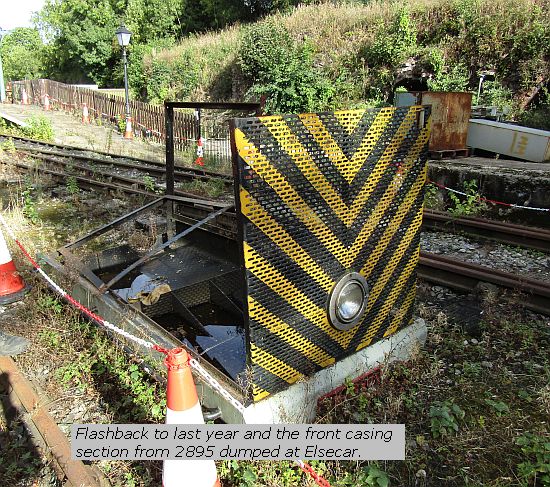
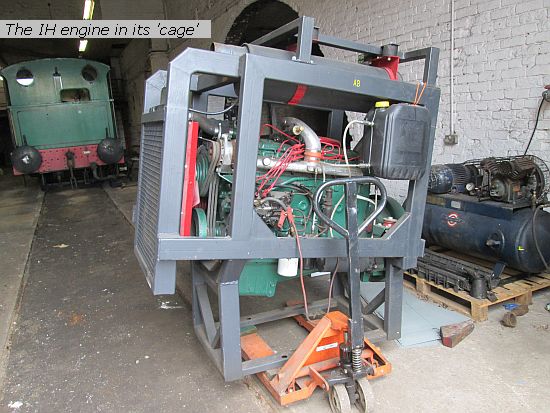
I was up at Elsecar again on Wednesday, collecting the loose bits from YE 2895 that couldn't go with the loco at the time. Andrew had arranged a HIAB fitted lorry from our local hauliers and by the time that arrived the bigger lumps were sat waiting and the smaller, inconsequential bits were in the van. The 'haul' included the International Harvester (American) engine that someone had attempted to 'fit' in 2895 after fabricating a massive cage in rectangular hollow sections, the idea being apparently to bolt this straight on to the cross-members of the frame - but whoever planned it had overlooked the 2 inch vacuum pipe going straight through so this had been chopped roughly out the way.
The remaining casing parts too had to be recovered from around the station site, and a trolley was available to get these parts to the loading area after 'flat packing' the various parts with a battery grinder.
Andrew also listed the casing doors, but some or all of these are not the originals and he envisages restoring the casings to their original appearance using the drawings in our possession. While having a bite to eat and waiting for the lorry, a group of EHR members came over and started questioning me in a rather aggressive manner. I had become quite used to members of the public asking 'what's going on with the railway?' to which I would tactfully reply that I had no idea as my presence was purely that of a contractor. But some of these people knew me (and I them from when Andrew had had locos here) and their questioning went rather deeper. I was glad when someone else took over the conversation from me, but I gathered later that Elsecar's site security arrived shortly after and defused the situation.
Still on 2895 incidentally, having known about the prospect of the sale for some time, I had already drawn up a new scheme for the rear engine mounts, and spent a while on CAD this week looking at the front engine mount scheme I had produced for the 0-6-0 Fowler to see if I could adapt any of the parts for the Yorkshire, given that the Fowler is to have the engine taken out again. One thing that hadn't struck me before was that Yorkshire arranged the front sandwich mounts transversely rather than longitudinally, the way we always did at Sentinel and Hills. But even without that, try as I might the angles just didn't bear any relationship and soon I was drawing the Yorkshire front mount from the (imperial) drawings and superimposing a new design in (metric) profiles to go in its place. (I was rather hoping that the Yorkshire front mount might have turned up somewhere in the 'loose bits' as I think it was adapted to hold the Cummins, but as none of the Cummins survived I presume it went the same way.) The pads on to which the front sandwich mounts bolt - still with the bottom plates of the sandwiches attached as the rubber had de-bonded - are still there and so will be re-used, hence using the geometry of the original Yorkshire front engine mount rather than starting from scratch.
The transport work anticipated for later in the week was postponed and hence I had the time to finish off the drawings and issue them to the profilers, as well as finishing the month end accounting and that quarterly highlight, my VAT return, for which this time I had to authenticate myself again to HMRC. Apparently I am really me. For the weekend I had an A4 page list of things to get done and a fair few of them were progressively crossed off, which by applying my 50% rule (roughly if you get 50% of what you planned to get done done then congratulate yourself on a productive time) was a good one.
Tom has seen further attention - Andrew has addressed the oil leak and appears to have reduced it considerably but not entirely. I had the side of the desk off and adjusted the position of the roller operated valve that initiates direction change: we had disturbed it a couple of weeks ago and it had become a lttle unreliable in operation, indeed last week I had unscrewed the knob on the throttle handle in order to get the lever to move that little bit further as the knob contacted the desk side! Also disturbed were the gauges for the torque converter and the tacho had stopped reading. The former had been intermittent - sometimes converter base pressure read zero and the temperature went nearly full scale. Then at other times both would read normally. On Saturday they both read normally but on Sunday they played up and I found a loose connecting wire between the gauges. The tacho meanwhile was a 2-wire device and Andrew suggested the drive cable to the genny may have failed. On Sunday I suddenly realised that the tacho display head had only one wire attached but it took several minutes before I located a wire which I thought might be the missing one: actually I'd seen it on Saturday but thought it was something else, some of Tom's wiring is in need of improvement.
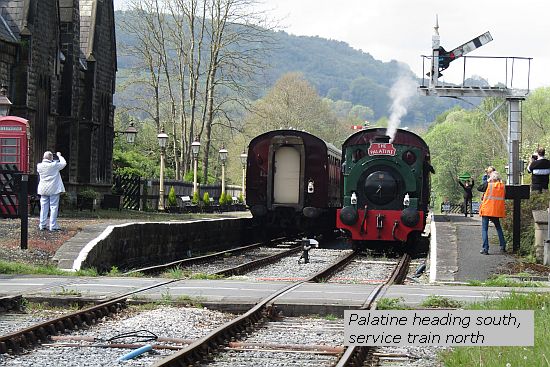
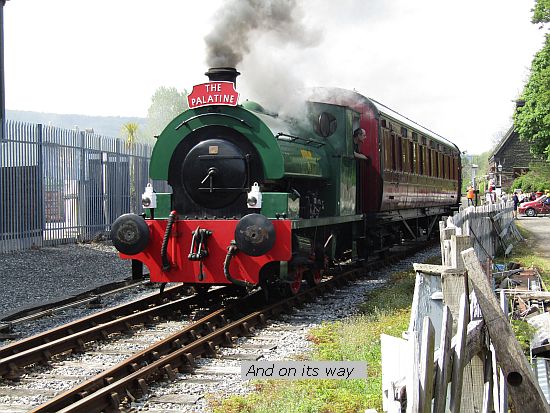
On Peak Rail the change in management is at least showing enterprise and if rumours are true, is bearing some fruit. While the class 25 was working the ordinary passenger service on Saturday, a recently arrived interloper was in charge of the new, independent 'Palatine' service (in earlier times that was two coaches on the daily service train, which were locked off when not used but remained in the rake) which gave the sight of 2 trains crossing at Darley Dale, only seen of late on the occasional gala event. The Bagnall was out again today in charge of the 4 coach service train.
My brother-in-law, his french wife and her daughter (from an earlier marriage) arrived in the UK on Saturday and are staying nearby for the week. They turned up this morning for a grand tour (or should that be La Tour Grande?) of the workshops. I had had enough time to do a bit of shunting first - the second German flat wagon was back over on track 1 and the Fowler 0-6-0 brought back to 3A in the hope of making a start on removing the Rolls-Royce C6T engine which is now re-allocated to 2895. Later on with Andrew about I did further shunting with RS8, which certainly has first class visibility - no wonder Dinting loved it - repositioning things in anticipation of forthcoming tasks, keeping 2895 near to the shed.
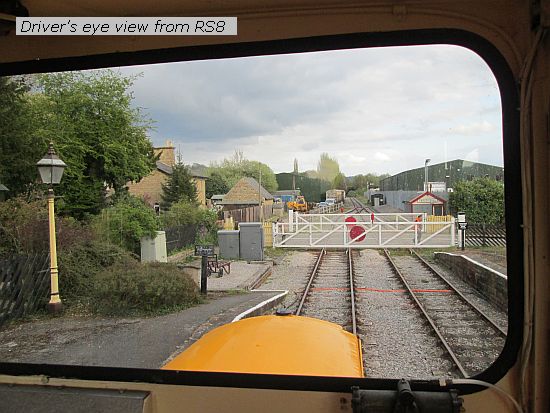
We didn't get to progress that loco in the end though it is imminent as it would be good to have the engine out, and its sump swapped for that needed to accomodate that 11.5 degree angle of installation on or about the time all my profiles arrive and enable it to go straight in to 2895. But first job though is to get all the pigeon dung off the chassis and as this can harbour some unpleasant organisms, Andrew has coated it with diesel to soften it and its grip on the steel and will later scrape it off but with appropriate PPE before any attempt at pressure-washing. With a number of minor tasks completed on other projects, like assembling a fluid rervoir tank ready to convert the Bluebell's Sentinel, from fuel to hydraulic oil in its converter, assembling control linkages, casings sides and ends, etc on other locos have all been crossed off the list but not really worth photographing.
So what's on this week? Well that rescheduled transport work I hope, though next Saturday I am hoping to head back over to Llanuwchllyn for the company AGM. At least one day should be in the workshop during the week to make up for that, but how it will pan out, you'll have to find out. See ya then.