
Of complication by design
22nd May 2022
'If it works, it hasn't got enough safety features' - attributed to certain engineers...
Once again it has been a week that while very busy, hasn't yielded anything of photographic value, so I have trawled through some old ones to break the monotony.
On Monday we were due to have the weedkilling contractors in to perform their annual attack on the unwanted plant-life but as they need to see rain free for several hours before and after, the forecast didn't suit and it was re-scheduled for one day this next week. On Tuesday I was in the shed all day with a lot of work proceeding on the 0-6-0 Fowler to identify where the brake rigging was sticking. In addition, the brake hanger nearest the front on one side had managed to destroy the head of the split pin that retains it to the cross beam, so we opted to take this off, re-lubricate it and fit a new pin. That sounds simple doesn't it? First we moved the loco so that the side rod was at the highest point on that side, only to find that said side rod effectively obscured the top pin of the hanger. It would be a lot lighter and easier if at this point we could have removed the brake block from the middle of the hanger, but the block was retained by a special bolt, whose thread (at the back) contained a castellated nut with split pin through. Would this split pin come out? No. Could you get in and cut the pin off or drill it out? No to that too. Nothing for it but to take brake hanger and block off together, for which the brake rigging had to be adjusted back far enough so as to clear the flange 'clip' - that part of the block (on some designs) that goes around the back of the flange to keep the block aligned with the tread.
At this point, as the brake hanger was slid outward on its top and bottom pins we realised that there was insufficient clearance between the hanger and the back of the side rod, (which, as I said above, already overlapped the top of the hanger) to get the blasted thing off. Nothing for it, we had to drop the side rod (fortunately the section from the front axle to the knuckle pin) to get the space to take the brake hanger off in order to drill out and replace a damaged split pin. Having dropped the rigging pull rod from the weighshaft it became apparent somewhere around then that the problem we were investigating - that the brakes were dragging all the time - was after all, related to the operation of the weighshaft. In short, the two air brake cylinders will push the weighshaft arms (as they should, 2 cylinders a 50 psi apply over 2 tons each) but the return springs underneath are unable to pull it back again.
And this issue has taken up much of our time this weekend. We had a similar problem with Beverley when we first acquired it fom the 'Shropshire Collection' back nearly twenty years ago. Allelys had difficulty loading it because the brakes had been applied with air, the handbrake wound up behind it and the weighshaft had seized - actually the engine had too but that's another story. The weighshaft on the Hudswells (we had 3 at the time) had a steel block bearing bolted to the underside pf the frame members that carried the weighshaft across, but whereas the other too had grease or oil holes for lubrication, Beverley did not and hence it had seized while left standing. Obviously the only solution was to drop the weighshaft, knock off the bearings, clean the bearing inside and weighshaft outside and drill the former for grease and a nipple before re-fitting.
In Hill's days we used a polypenco bearing sleeve in a steel housing that bolted to two gussets that were welded between the underside of the frame and the buffer beams. But polypenco absorbs lubricant and swells slightly as it does so. We had a number of locos where weighshafts started sticking in the warranty periods and concluded that it was a combination of the swelling polypenco and the gussets not being perfectly vertical on the loco, causing the bearing to be angled very slightly to the axis of the weighshaft. Either issue on their own would not have caused the weighshaft to stick, but together they did. We increased the clearance between the dry polypenco and the weighshaft and the problem never recurred.
So back to this Fowler. I have never been much of a Fowler fan at least not of their diesels. I nominate as justification firstly the very poor step access to the rear walkway (Hills weren't much better on the older locos but at least we had a shunters' recess at the rear as well as the front), the equally poor step access from the front recesses (which the shunter has to share with the brake cylinder and its return spring) and the rear sandboxes which require you to climb up those stairs with your bag of sand to get into the cab and fill the sandbox through the cab floor.
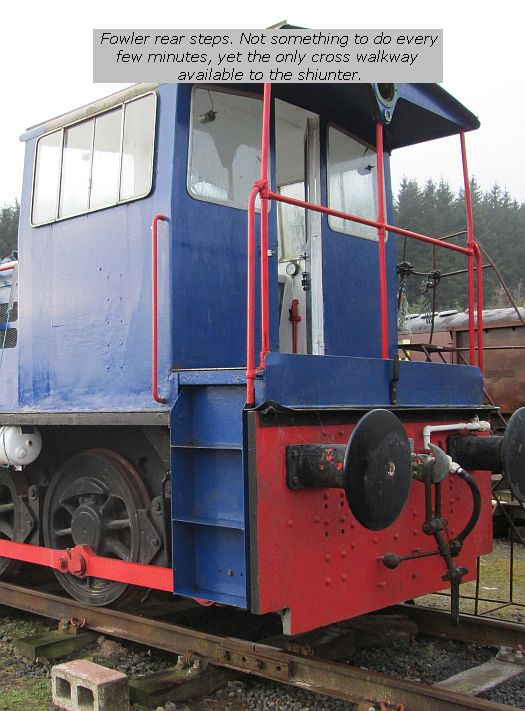
Mechanically they were much of a muchness - with various transmissions and mostly Leyland engines - but it seems as though they used the engine manufacturers standard radiator without regard for the additional heat load imposed by their transmission and completely without any awareness of recirculation - where the air passes through the rad core, gets hotter so rises as it emerges and gets dragged over the top of the rad and back round through the radiator again. When Andrew and I repowered the 03 we at first ran it with no duct from the front casing grille to the rad face and it was noticeable now quickly the engine seemed to warm through - too quickly given the little work we were doing - so I created a duct to stop recirculation and the improvement was quite apparent. I can't claim credit for this - it was something that Hills had become aware of latterly, we called it 'air management' - and I've seen it applied to competitors locos.
And then we come to the brake rigging, which looks conventional from the outside, but has a near central pull rod with equalising links at each crossbeam. Now, full marks for fitting two brake cylinders - it should guarantee that the weighshaft turns evenly at each side. (As an aside, Hills, Sentinel et al did it that way too no matter what the weight of loco, but Hudswell and Hunslet locos had only one cylinder for their 0-4-0s and only 45ton or upwards 0-6-0s meritted two.) The weighshaft bearings between weighshaft and side frames also have grease provision, but, presumably because their rigging pulls in the centre, lurking just off-centre is a third weighshaft bearing with apparently no lubrication provision whatsoever. There seems to be an access hole through ballast block under the engine - did the designers anticipate continuous automatic lubrication from the leaky engine above? - but no reliable means of forcing lubricant in, and this, we have now concluded, is where the problem has arisen.
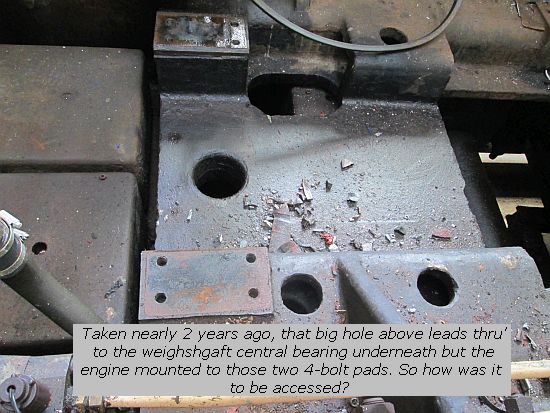
Quite what solution we will use to resolve this - heat may be the next weapon to try - remains to be seen.
The HaTRAMM has come in for more TLC over the last few days. Although the machine itself is working quite well, before its crane can be LOLER'd we need to have a working load sensing system and the existing one is showing overload the whole time. We proved to our own satisfaction - while Andy M was around - that the transducer was defective and the pcb that interprets the transducer output was consequently not co-operating. Andrew spotted a suitable transducer on ebay at a seller only over in Ashbourne, so we picked that up for a song. Its manufacturer however, has told Andrew that the transducer we've bought is manufactured exclusively for JCB and refuse to give him any information, not even a pin-out as to which pin is which in its plug. And although the previous transducer was wired with a 4 pin miniature DIN plug, this one has a Deutch plug. A week or more ago I managed to get hold of a socket that matches (they seem to be out of stock with regular suppliers) and had cabled up the socket to a suitable new cable but really wanted the pin out to be sure of connecting it correctly to the card - you never know whether the device or pcb are protected against wrong polarities and such. Yes, the crane does of course have a UK agent, but they're based up in Scotland and so far seem reluctant or unable to answer e-mails. The crane itself was made in Italy so maybe we'll ascertain if the Italians will talk to us instead.
Meanwhile we have had conversations with our H&S advisor regarding the multitude of additional limit switches added for Network Rail use. For example, to prevent you accidentally swinging the crane the wrong way when operating on a line adjacent to a running line, there's a left-side/right-side selector which introduces limit switches to impede you, but with such running as we are likely to do that is not an issue. Similarly there was an additional system that prevented you raising the crane high enough to risk contact with a 25kV overhead. That alone has 3 limit switches none of which now do anything as the device which was used to activate them was missing before the HaTRAMM arrived in Derbyshire. Given that 25kV overhead hasn't arrived in this part of Derbyshire either only goes to show that these protective sytems, which would otherwise need to be 'proven' to a LOLER inspector, are not relevant and with the appropriate Risk Assessment drawn up and filed, can be removed.
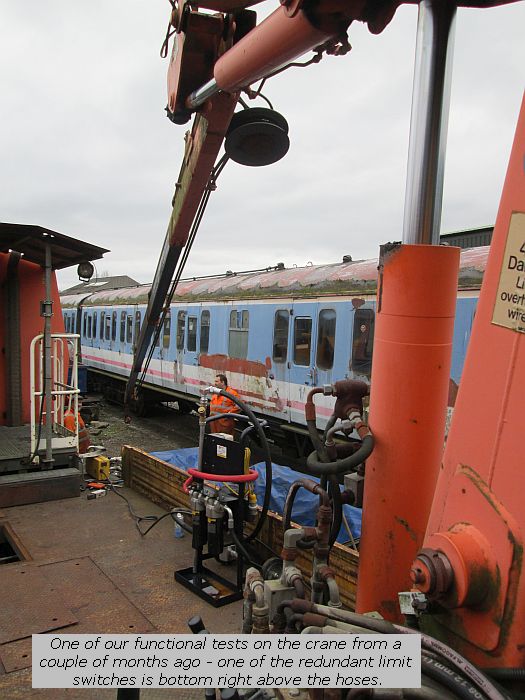
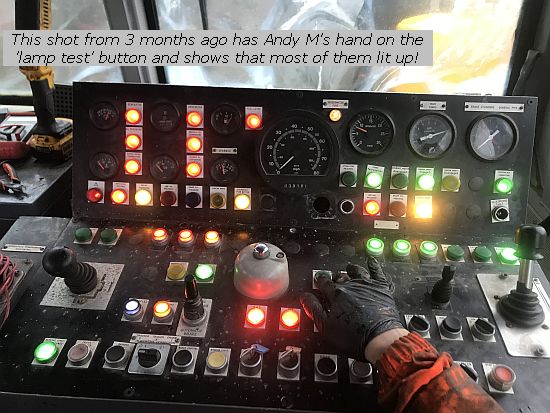
This afternoon, given the sunny weather, and benefitting from AndyM having previously marked the switches as to their out and return cable numbers, I removed three (there's still 6 to go) and as all are wired solely to break an otherwise continuous loop, jumpered them out at the Junction box which also happened to be the point to which the transducer could be usefully recabled. I also started on the task of replacing ordinary bulb warning lights in the desk with LED ones, partially for reliability, and mostly to minimise electrical loads given that we are only running on one alternator now, not two. This task will still take a while to complete as I only managed three.Sadly on power up late this afternoon our newly cabled transducer had no effect on the load limit outputs from the pcb but later it did occur to us that the latter may need a reset as it is supposed to latch after detecting a fault.
Amongst other snippets from the weekend, two members of Heritage Shunters appeared out of the blue to ask if they could look at 'our' 165s as they are missng parts for their PWM and wanted to see what they need to source. Andrew finally sorted the engine oil leak on Tom, Tony S was over working on his Baguley railcar, Andrew finally got the last axle in position under the B5 bogies that are still resident from the departed PCV and a certain JCB which is a temporary resident has had its front axle replaced at last. In between work on freeing its brake rigging, the Fowler 0-6-0 also had the battery tray and the massive 25 gallon oil tank lifted out of it (neither to be required at its new home) and the contents of the tank drained. Late Saturday night we officially 'de-named' Yorkshire 2895 - the 'Earl of Strafford' nameplates being removed. The fact that the plates were aluminium and in contact with steel gives rise to a galvanic reaction was apparent on removal. I am probably guilty of this myself in the past with 'Yorkshire Engine' badges.
So all in all a fairly productive weekend but despite having made a list, there's still things we should have got done but never quite got time for. Isn't it always? If the weather holds this week we've got the re-scheduled weedkilling visit, I've got a run out tomorrow to collect some cylinder heads, the van's booked in for an MoT and who knows what else. Hopefully I might even have found something worthy of a photo. Come back and find out. See ya then.