
Of belts, books and ballast hoppers
1st May 2022
Lots o'words. lots o' pictures so jump in.
So at five to nine on Monday Andrew and I (he had taken a day off work) came over the road bridge at Butterley to see the sight of the Heanor tractor and my trailer with HAA wagon aboard sat at the gates that guard the MR-B's site. Having gained entrance, we found the yard had been cleared ready and proceeded to unload the HAA.
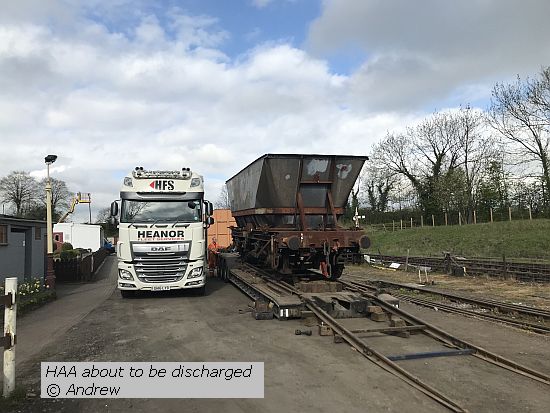
Whilst it had been comparatively free runing going on to the trailer at Barry, whether the brakes only rubbed in one direction it seemed definitely reluctant to roll off. With the rails onto which we were unloading being filled in almost to rail head level, although I made an effort to gouge out a flangeway, as soon as the first axle made terra firma the wagon stopped and to use our standard phrase on such occasions, we had run out of gravity. It was suggested I could drag it onward with the van - I was less sure, having failed to budge a lighter Dace wagon at Tanat last year, and sure enough all I did was heat up my clutch.
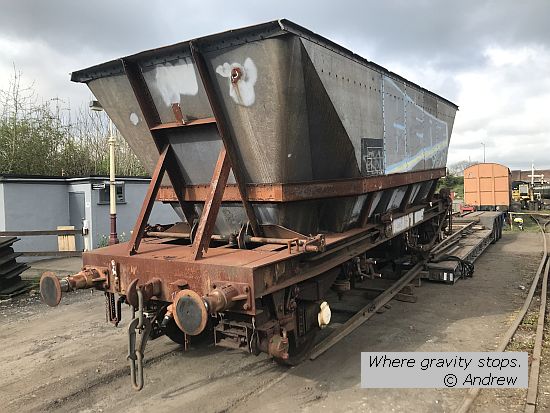
We detached the winch rope, Adam moved the tractor around and pulled it forward until there was space suffcient to rejoin tractor and trailer. (I heard later that MR-B deployed a pair of 20s to haul it east to Swanwick!) We backed out of the site and headed north. Although we started several minutes behind, we overtook Adam somewhere en route and arrived in good time at Elsecar. This is the fourth item we've taken out of Elsecar. At the sale that they organised of surplus equipment, the two 0-6-0 diesels, the Hunslet 'Louise' and Yorkshire 'Earl of Strafford' (no that's not a typo, it's neither Stratford nor Stafford) had been sold, but a problem had arisen with the latter, which, having been the subject of a rather mis-guided engineering re-hash, was in pieces and covered in pigeon crap thanks to months spent in an open-ended shed where the feathered vermin were wont to roost.
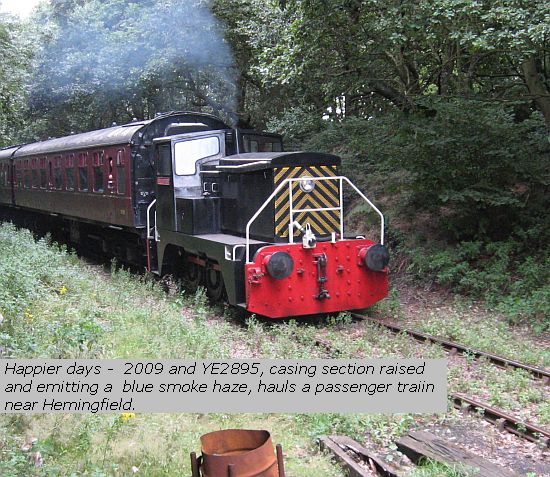
It got close to the loco being sent for scrap, which would have been a shame for such a modern design which cosmetically would have rivalled Sentinel. Designed in the latter half of 1962, it was one of the final locos YE finished before United Steels shut it down and after some demos it went to a quarry near Burton-on-Trent for most of its working life. I remember frequent refrences to it during my days at Hills, as Service Department looked after it. When rail traffic ceased it went to Ruddington in 1992, being sold to the Elsecar project in 1997. Here I came across it when we had locos there. The design utilised a Rolls-Royce C6 with a 'dry' sump and the engine tipped at 11.5 degrees to line up with the Yorkshire final drive gearbox. But by then it had lost the Rolls and gained a secondhhand Cummins 855 out of a lorry, fitted by a well-meaning Elsecar member. Now, for reasons too long to explore today, I knew that Cummins would never accept that installation angle as a permanent one, and worse still it had a front pan sump, in other words the majority of the sump acted as a drip tray to return the oil to a lowered section at the front where the oil pump sucked from - but this was now at the highest end of the engine!
More still, lorry engines have relatively small fans (26 inch in this case) as they normally travel fast in one direction and the air is therefore rammed in. Shunting locos tend to move both directions (alternately) at equal (slow) speeds so need bigger fans (typically 39 inches) to induce sufficient air flow, especially when the loco is moving in the opposite direction to the flow the fan is trying to induce. The efficiency of the fan is in turn related to the clearance between blade tip and fan cowl - the less clearance, the more efficiently the fan pushes air through rather than it simply swirl around the blade ends. So there was this engine, whose oil supply was potentially compromised, with an under-sized fan dwarfed by the cowl aperture it ran in (they'd even routed pipes through the gap). I was aghast by the poor pipework, especially relating to converter fluid, so Andrew and I went in one evening and re-plumbed the smaller bore stuff. Some time later the radiator started leaking. The 'expert' who put the engine in had the Board's ear, declaring that it was only that big because it had been a Rolls-Royce engine, it didn't need to be for a Cummins. He returned to the scrapyard and brought back a 'suitable' lorry radiator.
This was substantially smaller in both area and depth, not only because of the ram air effect on the lorry application but also because it was not expected to deal with the heat load coming from a torque converter, which can be greater than the engine itself. Moreover, as you don't go bashing lorries deliberately into things (aka buffering up in locos) it was of much flimsier construction. We told anyone who would listen that it would overheat. It did. Not to admit his error, the expert went back and bought 2 electric fans(!). We said it'll still overheat, but now it will flatten the batteries, and sure enough it did. We went on to arrange with RMS (where I then worked) to take the leaking Rolls rad into stock in exchange for a used but non-leaking Cummins loco one, but as the latter was a little taller and squarer, Elsecar raised the casing section, spoiling the aesthetics of the design.
Anyway, now incomplete and the sale for it having fallen though, I was asked for a price to take it to scrap and Andrew asked me to negotiate. In the end a price was agreed for the loco and associated bits and the bank transfer having been made we were to pick up the majority of it. Getting there first I was able to get the crash barriers that protect the Elsecar station site moved and ready so Adam could pull straight in and line up. The loco was pulled forward and attached to the winch, and slowly made its way up and on to the lorry.
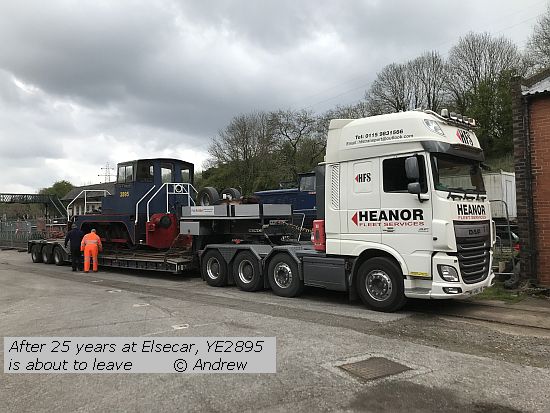
Once loaded and away we set of back to Derbyshire, the van passing the 100,000 mile mark as we dropped into Ecclesfield. We were sufficiently ahead of Adam (who was photographed coming through Chesterfield) to have a cup of tea at home and still arrive at Harrison Way just as Adam did from the opposite direction. The loco was duly unloaded and Adam set off home while we assessed the loco in better light and made it secure just inside the Peak Rail gates.
Tuesday. Originally I had Tuesday earmarked together with Wednesday to move three ballast wagons to the Epping & Ongar railway, but Adam had a meeting with his accountants in the morning so would be setting off at an indeterminate time. So he said to leave Tuesday to him and just join in on Wednesday. That left me free to do some admin and then zip up to Rotherham and drop off some non-ferrous scrap at Booths, getting back just in time to meet up with Harvey to bring YE2895 down the line. Plan A had been to take Tom on a test run, but Andrew disagreed as he hadn't attended to a minor oil leak, and as the HaTRAMM was minus alternator belts he proposed I take RS8.
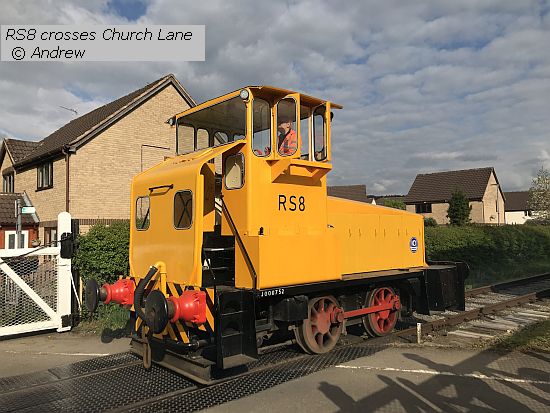
All went well until half way between Church Lane and Rowsley, when the engine shutdown. It re-started immediately and kept running, but the temp gauge was up as it had been when the ICRS visited, so I took it forward gently. Waiting for us at Rowsley, Andrew pointed out that it had developed a coolant leak, so we hooked on to YE2895 and started to return. Bang! Bang! Bang! and then Andrew yelled STOP! which is not easy on RS8 as the D&M driver's brake valve is very slow to respond. Although we knew the propshaft was engaged through the gearbox (it had been going slowly round as we winched it on and off, and I could almost wind the loco along by turning it) with RS8's additional speed it was flailing around and hitting things. Andrew set the gearbox in neutral and dropped a bolt in to keep it there. At the south end of Rowsley yard we stopped by a hose pipe and gradually trickled water in to the radiator (not too quickly to prevent any thermal shocks) until it was full and on the way back it didn't exceed 60 degrees.
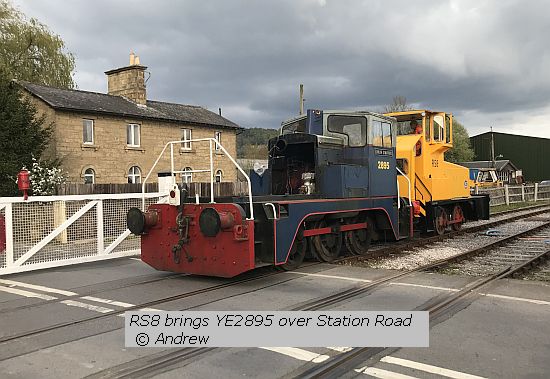
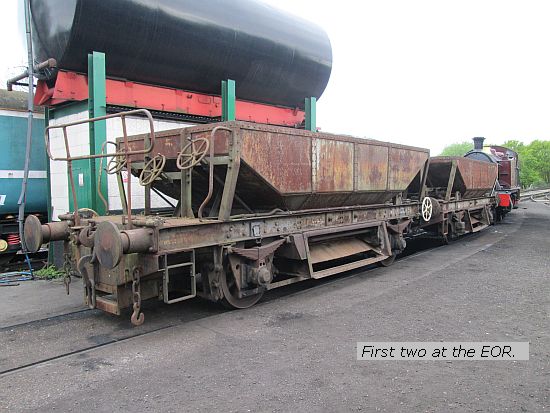
YE2895 was deposited in Darley Dale yard. Meanwhile Adam and Ian had been down to Alresford and collected the first ballast hopper, taking it to High Weald and unloading about 7pm before heading back to Alresford to overnight. At midnight I had a text from Adam to meet him at High Weald with No.2 wagon at 11.30: a pity as I was already tucked up in bed with an early alarm set! Never mind at 11 o'clock I passed them on the M25 and about 11.25 they rolled in to the EOR yard and we deposited wagon no.2. Back on to the M25, down to the M3 and south westward, I left them behind determined to be on site ready but as Adam had to have a break on the way I had time for a tea in the MHR buffet. Actually although I have traversed the M3/M27 many times going to my parents house after they retired, I was looking for an exit signposted for the A31 and ended up overshooting. Still it was an interesting cross country route back to Alresford!
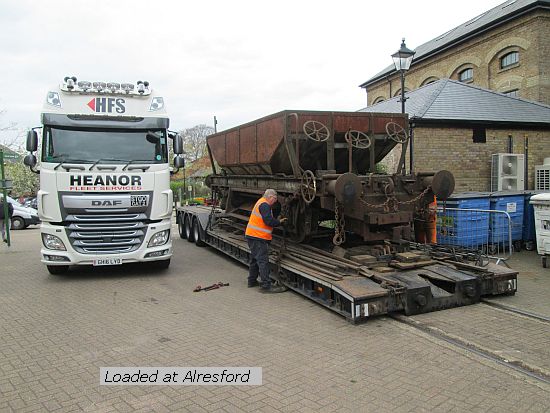
Wagon no.3 was loaded and we tore back up the M3 to the EOR. Despite the rush traffic Adam rolled in at 9 minutes past six and by 6.35 the wagon was off and the ramp stowed away. Actually the wagon rolled to the bottom of the ramp and as the first axle hit level rail we ran out of gravity, so it seemed. It wouldn't roll any further, we tried. Adam was on winch and I was at the wagon end, so we slacked off, I lifted the winch ropehook and turned to drop the hook and rope back on the trailer. When I turned round, the wagon had started rolling on its own! The three of us ran after it and kept it rolling all the way to its two compatriots - much easier than dragging it with the tractor.By seven pm we were on our ways home, Adam ahead: I passed him near Luton. For anyone interested, total mileage for me that day 533, the van turning in 49.5mpg - not bad for a machine that has done the 'ton'.
Friday (Thursday was a recovery day) and I left the van in Andrew's care as Steph and I borrowed his car to head over to Wales. Destination for the day was Tywyn to see some people on business, but it was as much a reminiscing trip as anything. I wish I could somehow recapture those smells and experiences from when I first visited the Welsh n.g. back in 1963. Having had Railway Adventure read to me by my father (as I lay in bed with chicken pocks) I had campaigned for a holiday there and my first sights of the Talyllyn at Wharf were magical. It was not the Wharf of today, with the large sales and catering areas, the canopy over the platform, but rather the adapted slate transfer terminal with the brick office trying to fulfill all roles at once.
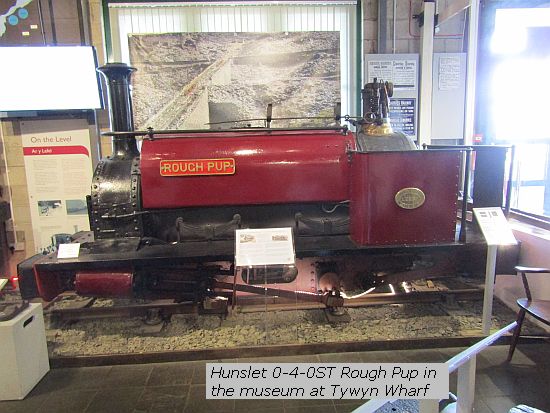
After my meeting I had a look in the museum at Wharf: a tour interrupted by a phone call to advise me that 03 901 - sorry D2128 - was in mechanical trouble, which I passed over to Andrew. Steph and I had a wander around Tywyn before meandering north along the coast road. On that 1963 family visit we had come this way - a BR 2-6-4T had been on a ballast train near Aberdovey, and that first view over Fairbourne, as the railway seems to emerge from underneath you and plunge down on an embankment while the road twists inland and descends to hug the original cliffs, brought back memories. At Fairbourne we turned into the village to follow the miniature line to the Penrhyn Point. It was about 5pm by now and as we stood in the dunes a 158 could be seen running south into Barmouth, then creeping out from the buildings, down and round onto Barmouth Bridge and all the way across before disappearing behind trees. We drove back, reaching the Fairboune crossing not long after it had crossed and begun that climb back up to the cliffs and Llwyngwril.
But our destination for the night was Dolgellau. In 1963 Dolgellau was a classic bottleneck, its narrow streets gridlocked as vehicles vied to get across the bridge over river and railway, but the railway has gone and its route surrendered to become a through road that takes all but local traffic away.
Saturday morning we were off up to Llanuwchllyn. We had been invited to attend a book launch. In May 1972 George Barnes laid the first rails on what was to become Rheilffordd Llyn Tegid and that August the first trains had run over a mile down to the lake shore. That is 50 years ago and to celebrate the half-century they were publishing a book.
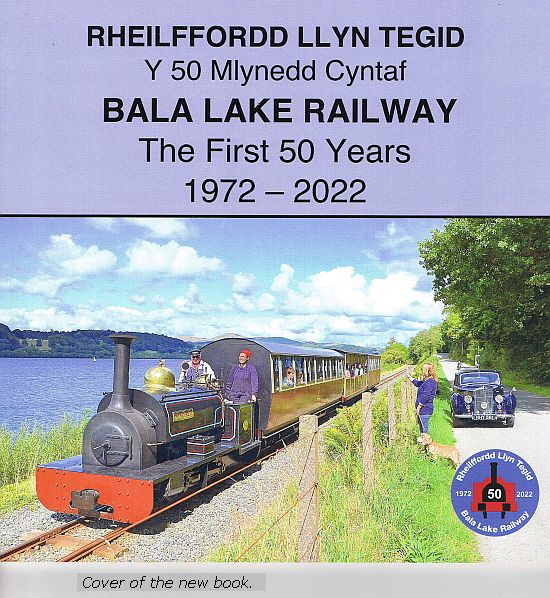
Apparently some of my pictures are in it, though I'd have to do a lot of digging to work out which are mine. I am however to be found as subject material in several pages, with Steph also to be seen and Jennifer (our daughter) as both a girl and mature young woman. I haven't spotted Andrew yet but he might well be there too.
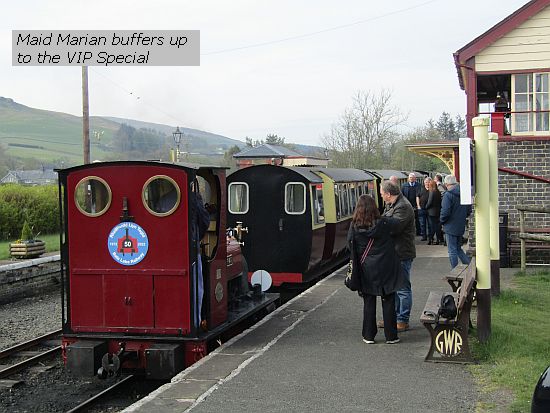
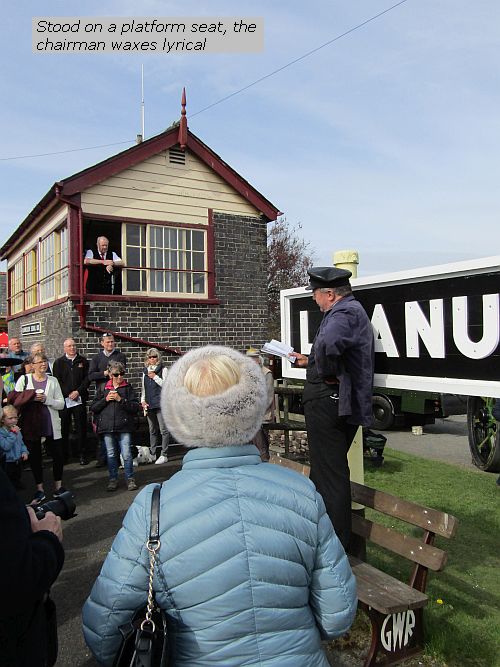
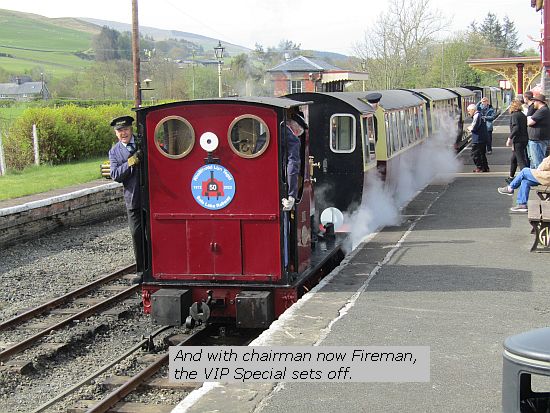
I forwent the 'VIP special' and was curious to note that they were operating on a 'staff and ticket' system even though I had manufactured a pair of divisible staffs back 25 years ago. Maybe they've been lost. The second train duly set off to pass it at Llangower on its return trip. Bob Davies. the Baguley Drewry diesel I reguaged from metre and made sundry mods to before selling it to them at cost, is featured in the book as its naming ceremony was to honour the long-standing ex GWR/BR signalman Bob, then a guard on RhLLT, and was named by a BR executive on a day when BR signalmen were all on strike! Having been sat in the carriage shed it suddenly roared off down the line and news came through that the loco of the VIP special had a problem. Speculation that it might be poor quality coal was later denied, but the diesel pilotted steam back and you can gauge the gradient of Dolfawr Bank by a couple of these...
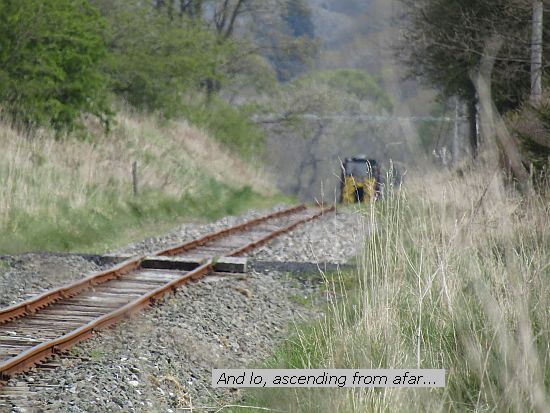
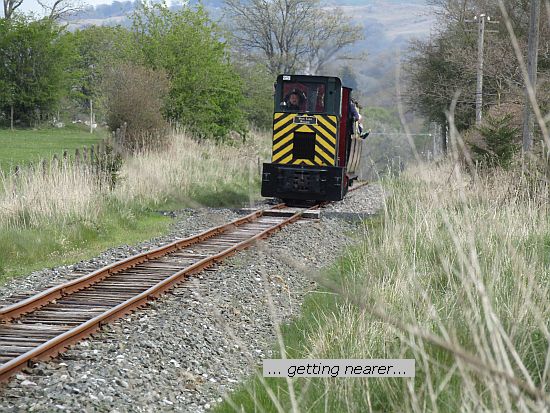
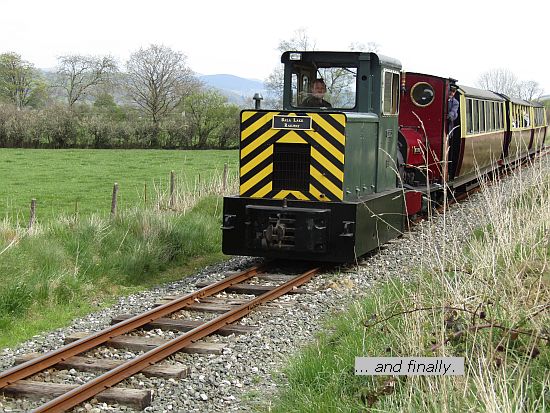
Later on Steph and I walked around Bala, recalling places and people from when we had been regular visitors before heading back to the drudgery of our everyday lives. And that everyday drudgery has seen me back at the shed today. First task was to get the HaTRAMM back in action. During the week the new toothed belts had arrived and also out of the blue a secondhand 2 groove alternator pulley. Andrew had spent part of Saturday under the HaTRAMM tryng to remove one of the single-groove pulleys, only to work out that that alternator was the one which would not line up as it was mounted slightly farther forward. Unfortunately that is the one that provides the signal for the tacho, but as I've said to him if we are confident on running on only one alternator then we need to alter the wiring anyway, so transfering the signal feed to the opposite side will have to be done.
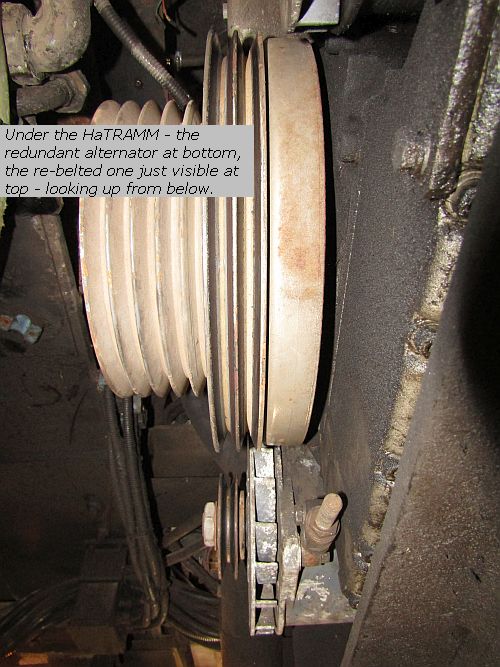
Today with Big Mak deployed the left hand side alternator was tackled, the lock nut removed, only to find a taper lock pulley behind which gave some resistance before finally undoing. Andrew then fitted the 'new' 2 groove pulley, added the belts and tensioned them, finally driving the locknut tight with Big Mak such that it actually barred the engine over through the belts. The HaTRAMM was re-started and touch wood, all appears to be functioning and charging as it should. The rest of the day was concerned with bits and bobs. A replacement front axle assembly for the (temporary) resident JCB which Andrrew had collected yesterday, was unloaded from the van and the old one ceremoniously added to the scrap bin. A german flat wagon had casing parts lifted off and spare floor-planking laid on its chassis (they'll be properly mounted and trimmed in due course) and other casing bits lifted off locos. All rather tedious stuff which I never got around to photographing, so you'll have to content yourselves with the pot pouri above.
And what's in store for this week? Andrew wants me up early in the morning as we're off to diagnose a fault on a friend's loco, Wednesday has us back at Elsecar pulling the loose parts from YE2895 together ready for collection, and then I think Thursday Friday has more moves in prospect. In between I've month end to finish, a VAT return to complete and a host of other jobs to get on with. What will I actually get to do? Come back next week. See ya then.