
Of never getting better if you Peckett
7th November 2021
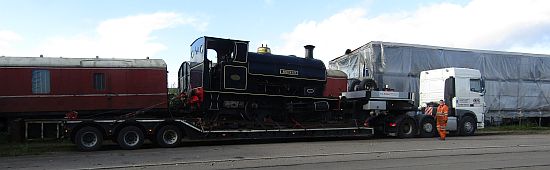
'Twas yet another early start on Monday: I was aiming to be at Lydney for 10 to 10.30 but in the end traffic got the better of me and I arrived a few minutes later, just after both Phil G and the loco we were due to collect, the Peckett 'Rocket'. We cracked on with loading and getting on our way. I had pushed the speed coming down and fuel consumption showed it, so ambled back up the M5/M54 to try and recover it and still arrived at the Telford Steam Railway a while ahead of the lorry, which drove up at about 4.15. The nights of course are drawing in and we just managed to get the loco off with some vestiges of daylight, before blasting our ways back up the M54 and homeward.
Tuesday was a day of admin catch-up, a game which never seems to end. Wednesday and it was an early start again, this time the destination was the Chatham Historic Dockyard and again Phil G got there before me, though in my defence Adam's yard is an hour further south than I am. The Peckett 0-4-0ST this time, works number 1903, was waiting outside for us and soon the ramp was built up and the loco hauled aboard.
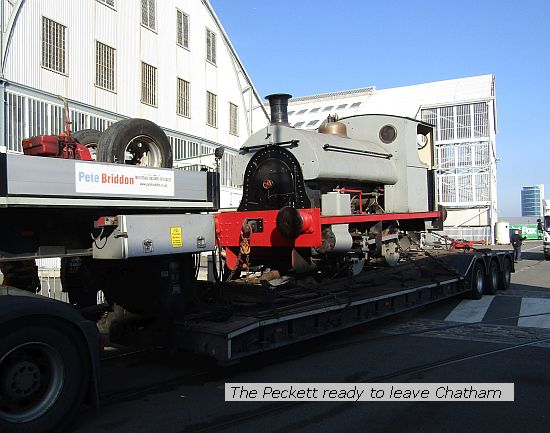
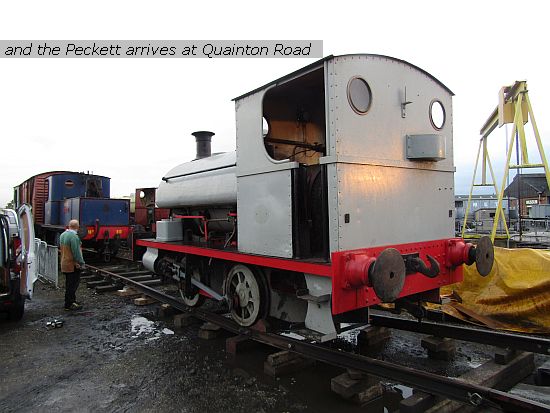
By noon we were on our way back along the A2 to Dartford, through the tunnel and round towards Aylesbury. The Buckinghamshire Railway Centre, aka Quainton Road, is split in two halves by the railway passing through the middle, and the adjacent bridge has had a 3ton weight restriction applied. But on the western side is the massive linear construction site called HS2 and the access road permissible for our low loader is closed off , but special permission had been obtained to traverse it. Phil tried telling the security staff that he was delivering their new works loco and insists they were dumb enough to believe him (almost) but true or not, as the light began to fade he rolled up on site and we unloaded direct to a track end, using a box van and Mike Hart's 'Gervase' as barrier wagons.
Getting out (in the dark) was more entertaining as the manual steering chose to pack up again but we turned round outside and I set off back to Thurrock, while Phil spent the night in a layby near Aylesbury. Later that evening, in a Premier Inn, Andrew joined me as he had taken Thursday off to collect 144V.
If you haven't read all about it in last week's edition, shame on you. Andrew was a little unhappy about my reporting it lest by doing so I jinxed its departure, but at 08.15 Thursday morning we returned to ICG. By the very nature of chemical works they are even more safety-conscious than the average factory and each of Andrew's visits had required a 'RAMS' (Risk Assessment and Method Statement) outlining what was planned to be achieved. So far each of the previous visits had gone to plan, but the actual collection relied on the wheels going round and our concerns were that the drive chains would prevent that happening. The fall-back position was either to cut a link with a battery grinder or call on a fitter at ICG to come over with oxy, but either would require a hot-work permit and we were keen to avoid that delay if possible.
Yet the Works Manager and several seniors wanted to see it load, and whilst I explained that the actual 'exciting bit' would only occupy about 3 minutes, it was agreed we'd get it all ready, do a quick test pull to see if it budged and then call them down to watch. Because the ground conditions were not ideal we were ready to make an extra-long ramp if required but in the end settled on a 25ft run from the ends of the bullheads we'd slid under it last week.
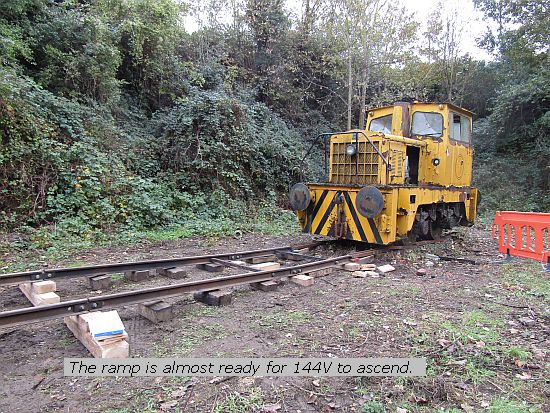
The winch rope was payed out, hitched on to the front of the loco and the tension taken up. 144V moved immediately, only an inch or two but sufficient to know that it would co-operate and the call was made.
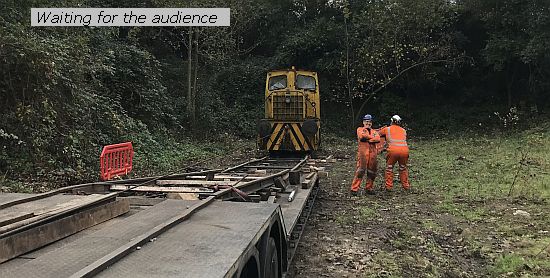
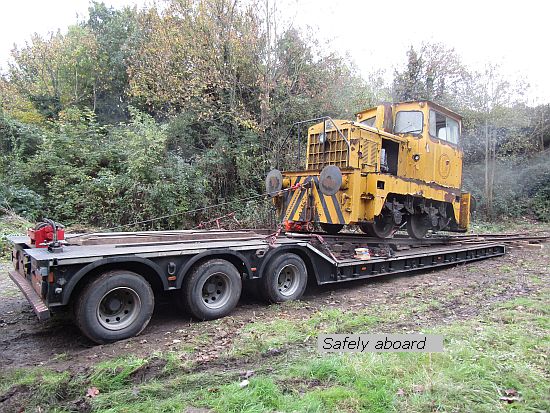
We waited while 3 managers walked over and then the loco was solemnly hauled up on the trailer while phones and cameras recorded it all for posterity. Admittedly as I watched debris - dirt, foliage, rust - dropped from the axle sprockets and chains but it didn't seem that anything was amiss.
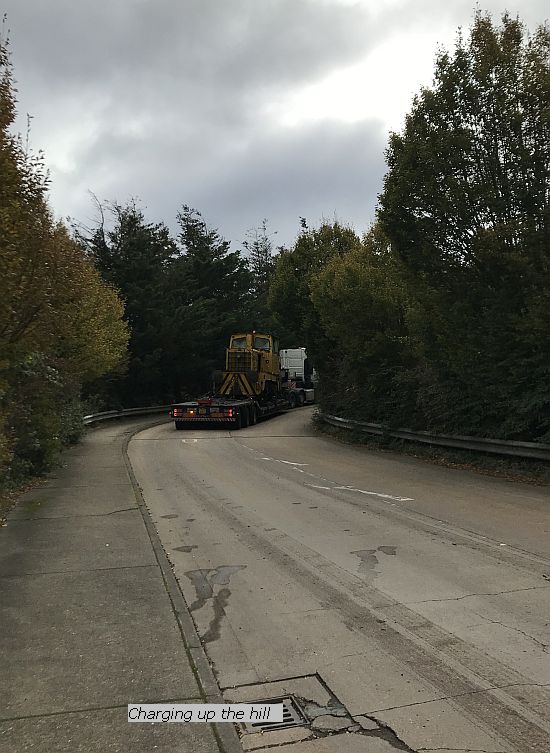
The last part of our RAMS planned that when ready to leave site, the entrance road would be blocked at the top so that Phil could take a run at the twisty, steep zigzag lane without encountering anyone coming the other way. So Wayne and I took ourselves up to the top, phoned down that all was clear and Phil's DAF tractor unit came up at full bore, watched by 10 or 12 employees from the ICG Transport Office.
I held up road traffic to get him out, said goodbye to Wayne and chased after Phil, following him down the A13 and on to the M25. Little bits of flaking paint, the odd bit of moss or dead ivy blew off for several miles as the loco travelled faster than it had for many a year.
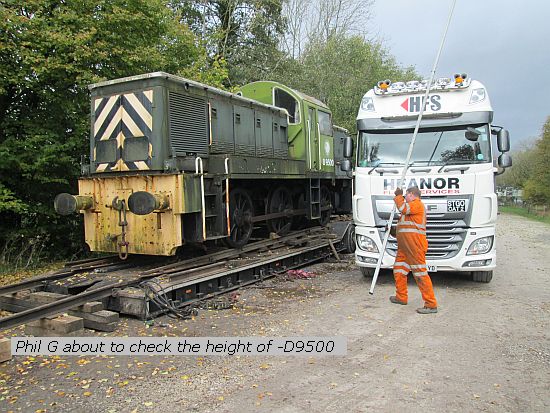
Friday: up at Peak Rail Harvey - our regular pilotman - had to deal with a man servicing fire extinguishers so we had arranged to move Tom and the departing D9500 up first thing but haul 144V back late in the afternoon, giving plenty of time for a check over before moving it on rails such a distance. D9500 just fitted on the trailer after a bit of re-positioning of the rails and packings, and the low loader headed back to Heanor's yard for the weekend.
Meanwhile I had all 144Vs axlebox covers off. I was pleasantly surprised at the journals on the right hand side of the loco, but those on the left, especially the front which had a cover that was already cracked, were not so good and a small manual pump was used to suck as much water out of the boxes as possible and copious amounts of bearing oil added to ease the journey south to Darley Dale.

The chains too received attention from the oil can and some of my time was directed at the access panel in the cab floor, which I aimed to raise so as to open up the RF25 gearbox and slide the dog into a neutral position, else the journey would involve 144V's converter output turning. But try as I might the access panel wouldn't yield, and with time ticking on had to abandon that plan and just take it slow. For one thing, despite the additional oil, the front left bearing was screaching pityfully, and although I kept Tom at walking speed, by Church Lane the bearing was distinctly warm, though the other three were cool. It was nearly dark by the time I propelled forward over the crossover into the yard, and shut Tom down. You could still touch the axlebox but it was very warm.
Saturday and I decided to take another look at 144V now it was on home turf. With the battery grinder I sliced through the bolts holding the two budget locks on the front casing doors that had defied us back in Essex: Andrew had expressed the opinion that the loco had been properly protected for storage when it arrived at ICG (some of the bags are still present) and this was borne out when I got access to the dog on the front of the crankshaft and the engine turned easily. Eventually I even managed to break the hold of the rust and retract the access panel, open the gearbox cover plate and move that sliding dog into mid position at last, but the gearbox internally was clean, lubricated and free of rust.
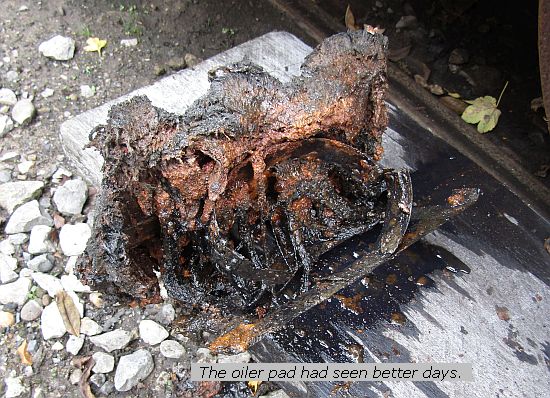
I turned my attention to the noisy axlebox, dropped the bottom half of the box and was confronted with an axlebox oiler pad that was, shall we say, FUBAR'd. But it looked suspiciously like the same as that fitted to a Sentinel 34tonner, and in fact, the whole assembly might be a copy, save that the cover plate says VANGUARD rather than SENTINEL. Andrew hunted out a spare brand new oiler pad (bought many years ago in a job lot of parts allegedly ex Shell Stanlow) and sure enough they matched, so I cleaned out the bottom half of the 'box, refitted it, filled it with fresh oil and left it to soak in. When we came to shunt it again on Sunday the bearing was quiet, though the journal will require some attention.
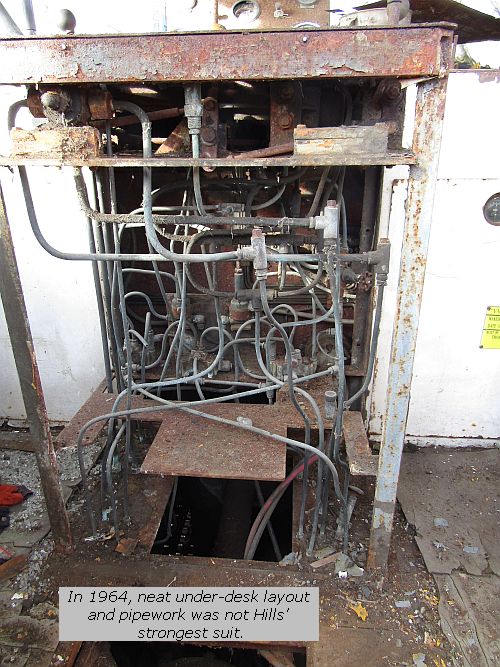
Before leaving the topic of 144V, see what we will have to deal with in due course. I opened up the undersde of the desk to get access to the seized throttle linkage - by judicious force and pen' oil that now moves, but being a flameproof loco with a fully pneumatic control system this was Hills' early years without the experience of making desks neat and tidy for access - that's rigid piping forming a cat's cradle under there.
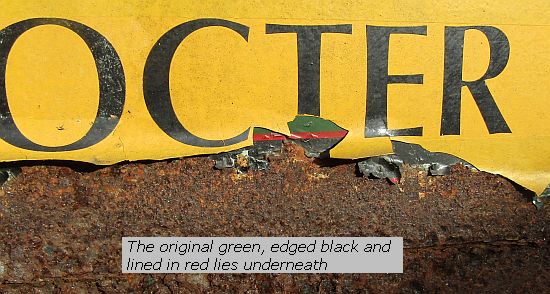
Although the paintwork is flaking, in some places there are signs of the original (1964) livery of dark green, edged in black and lined in red.
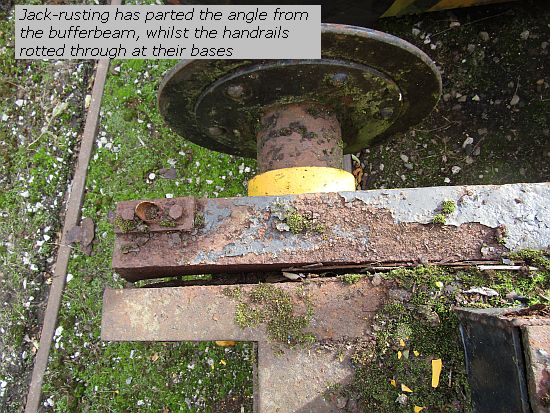
And then there are the obvious damaged areas, like the angle that holds the handrails on the back, where corrosion has split the welds and distorted the angle: that will have to come off and be renewed, complete with new handrails both at front and back.
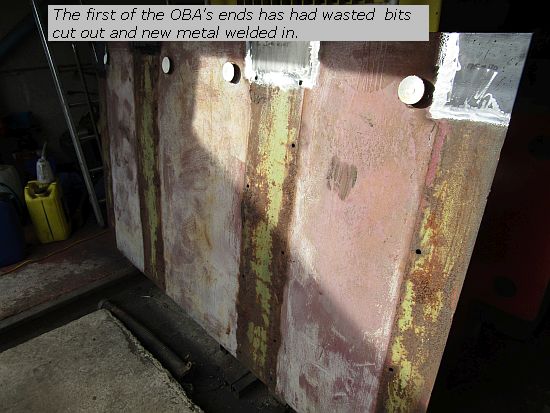
But for now we may leave 144V while other jobs take precedence, but I suspect we will return to it before too long. On other fronts work has been proceeding on the OBA, with the upper frame members largely cleaned and primed. The end plates had corrosion in various places along the lower edge, these have been cut out and new pieces welded in on the first end, the second awaits similar attention.
And finally work resumed on the cement van, with two of the 3 end (plywood) panels fitted and sealed, but the centre one requires a bit of a trim to fit properly and as the light faded, this was postponed until later.
And thus yet another edition of Weekend Rails draws to a close. D9500 heads north tomorrow but I am pleased to say I am not involved and can return to mundane matters of admin, chasing up parts, etc. So until next week, see ya then.