
Of getting a lift
27th December 2021
2021 is nearly over. Roll on 2022.
It's strange writing this edition. For one thing it's bright outside. That's not to say that I can't, or never, write the blog when I can see out the office window but during summer months we tend to work later and during winter, well, it's just black. No, for once in several years I did not sit down on Sunday night to compose another edition of Weekend Rails and instead am writing it on Monday morning. As this is the last edition of WR for 2021, the customary expectation is to spend most of it 'looking back' over the year. This is usually due to the fact that in the run up to Christmas 'not much happens' so there may otherwise be little to set down. But this is Briddon country where the opposite occurs. It has been a frequent occurrence that over the festive period, I am esconced somewhere wiring up a control panel or two. Last year we popped in to workshops on Christmas day to check all was well, and returned to work on Boxing Day - ths year?
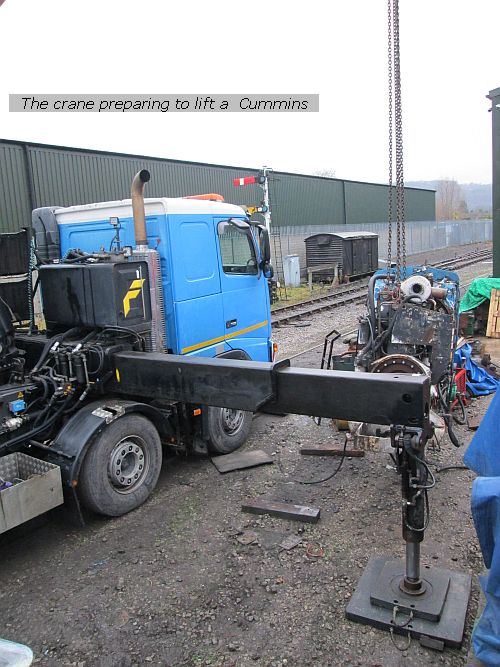
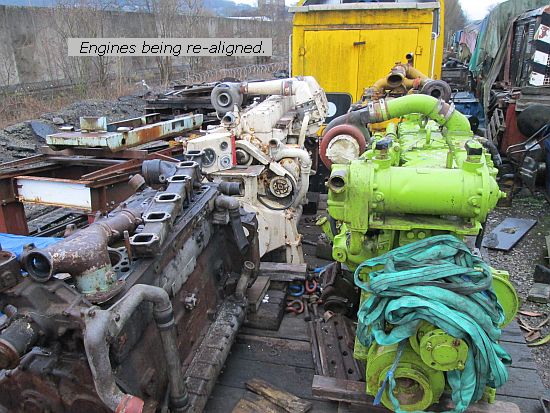
Well before we get to that there is the first part of the week to get through. Andrew had booked Monday off and arranged a crane from our friends for the morning. He had a long list of lifts to get through in descending priority: those towards the bottom came in to the WIBNI category that we wouldn't lose sleep over. He was a touch late up so it fell to me to get down, unlock, let the crane in and give the driver a cuppa whilst Tom was fired up to start shunting things around. Andrew had cleared a space for the crane to hunker down on where he figured everything could be reached, or brought to within crane radius, so saving the time of de-stabilising and re-locating. On the original German flat is a collection of engines, one of which - the Rolls CV12 - is due to head north and be installed into D9500 in its new home. Meanwhile we had a Cummins 855 and radiator on the floor and Andrew had decided that several engines should be turned so instead of being transverse, they were longitudinal. He has concluded that the chances of them topling off as I charge around curves at DD less likely than toppling each other over, domino-style, under sudden braking or acceleration. So that wagon came down first and a lot of lifts took place while not seeming to make much difference.
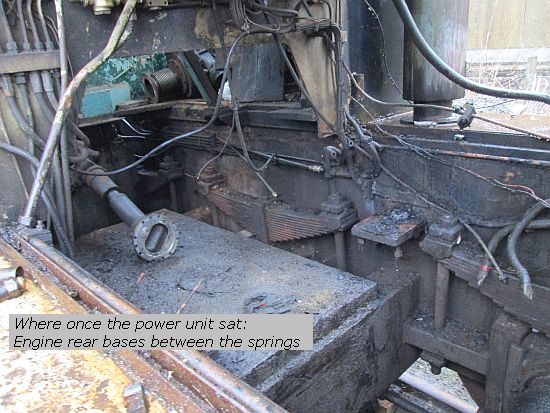
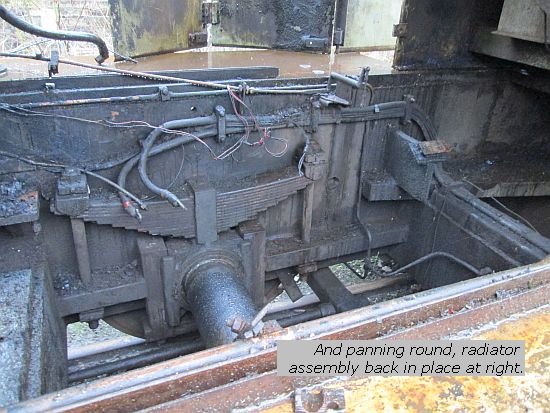
But the next priority on the list was the ex EKR EE, whose power unit was ready (bar the actual engine mountings) to be lifted out. So that was shunted down and while Andrew cracked on with lifting the casing top off and putting it one side, I undid most of the bolts around the nose cone so that it could be lifted up and forwards.
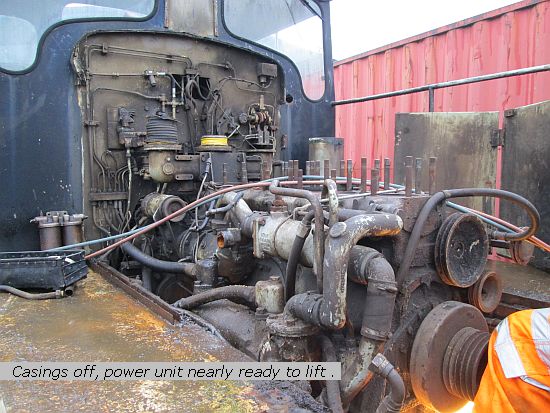
The engine mounting bolts were then attacked with gas. Although I much prefer the EE chassis to a Sentinel, their engine installations have never impressed me much. The Dorman engine is long for its hp and consequently the converter is located under the cab front bulkhead, with a 'power bulge' under the desk. Back in RMS days our MD, faced with a converter leaking on a hired one, put another loco in to cover and pulled the EE back in order to get the engine power unit out. He could see no other way to do it, and was aghast when I explained that you remove the power bulge, detach coverter from drive train. lift it out into the cab and as the doors aren't wide enough, exit it by taking out one of the side windows. Yes, a faff in a confined space but quicker than removing the complete power unit (and cheaper tan bringing it home!) And if you think I'm just critical of one of the Stephenson designs, have a look at one of the remaining 0-6-0DHs that they built for Corby with the Paxman 8RPHLX. They needed a shoehorn to get that engine in, and being a V8 it has two starter motors. The only way to swap them on a loco is to bave someobody underneath with spanners while a second person supports the motor on ropes or strops which pass through the tiny gap between the side of the cylinder blocks and the running plates, sliding the motor along, in or out.)
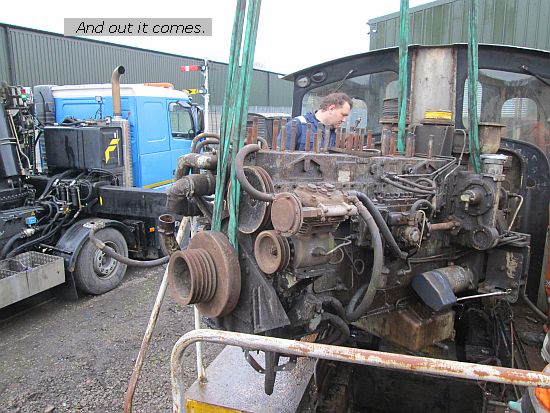
The only problem with gassing the mounting bolts is that sometimes one fights back, hanging on to the bitter end and then letting go when such force is applied that the power unit moves suddenly and unexpectedly. That happened, but being still half under the cab bulkhead it merely brought a pipe into rapid and unexpected contact, resulting in a fractured flange. The power unit was lowered down, the nose cone and casing top replaced (for tidyness) and as our 4 hours were by now nearly up, we called it a day and dropped the remaining items on the list.
The crane packed up and departed and we started to shunt things back. Tom suddenly died. It was just like before: that feeling that it wasn't responding, that the revs were dieing away and a second or two later, silence. So either the filters are miraculously blocked again or the fundamental problem is in the pump itself and its recent good behaviour was to lull us into complacency. Not that its behaviour has been entirely good: we've suspected for a while that it might have a t/c oil leak and this is now apparent and appears to be one end of the heat exchanger. Indeed, we are having something of a heat exchanger crisis, with several of the twin-stack Covrad type leaking. But Tom has the more usual (for a Sentinel anyway) of the Serck single tube we refer to as the 'torpoedo' because it's about 5ft long and a two-man lift. I suspect his will have to be addressed early in the New Year.
Anyway, back to Monday. After a few minutes Tom started up again and I had all but finished the shunt when it died again. We went off for a cup of tea and when we returned it started almost immediately. There is, on this age of pump, a 'last ditch' filter within the pump itself, basically a felt pad through which the fuel flows and intended to catch any particles that made it through primary and secondary fitration that preceeded it. It may be that this is reaching saturation, or it may be wear in the governor linkages, but either way, Tom must get some TLC in the new year.
After lunch and a discussion with Andrew, I put an enquiry on one of my suppliers to reassemble and test the two twin-stack heat exchangers we have stripped before and their price seemed very reasonable so on Wednesday the first was consigned in to them, ready for a start to be made in early January. I would have taken them both but I couldn't see the other anywhere and it went Wednesday not Tuesday as I had another supplier to get to for whom my job was the last before their Christmas shutdown. Thursday I had a day out on a service job, and on Friday (Christmas Eve of course) I started the monthly chore of paying suppliers and raising invoices: what better way to say 'Merry Christmas' than with a nice bill? It only goes to show that Christmas isn't commercialised.
Christmas Eve afternoon Steph started putting up the Christmas Tree, late even for us. The plan that she and I would go and collect grandson on Boxing Day was kaiboshed since he had over-indulged on chocolates and cola and made himself well and truly sick, but we had to make sure that it wasn't anything more sinister, which is why I am free to write the blog today as Andrew and Steph are driving out and back. So Christmas Day morning was met with a lie-in and a bed-tempered rabbit (whose routine was thus disturbed) and after an early-ish lunch (which followed on from a late breakfast) of salad we headed down to the shed. Andrew worked outside removing assemblies from the Dorman before the carcass goes into the scrap bin, while I was mostly inside stripping bits off a torque converter ready for a wash down. We did though wrap up around half-five as the temperature fell.
Boxing Day too we were in the shed. The second steel end of the OBA was dried out and primed, and work was proceeding on the casing sifde frames for D1387. One of Hudswell's weaknesses was that they created a casing door hinge by welding pieces of tube to door and frame and putting a mild steel pin through. If the door gets left for a while it starts to seize up and sooner or later somebody forces the door open and the pin shears. The only thing to do is to heat the tube (not too much or the pin swells as well) and drift the broken bit out. Part way through this exercise (I think six or seven pins in the casing frames, and the same number on the doors need treatment) and we ran out of acetylene. So I wonder whether Energas are open this week?
Back inside I found the body and tube stacks from the second heat exchanger - we think RS8's original - at one end of the workshop and eventually Andrew uncovered the end caps on a workbench down at the opposite end. Logically the various fixings should be somewhere midway but so far they've eluded us. The end caps look a little corroded: this is the limiting factor on these exchangers and maybe time to think about a pattern to cast more, they are not my preferred way to cool a converter but the alternatives take a lot more engineering. Meanwhile work proceeded on the exhauster baseplate for D1120 and its hydraulic reservoir as I try to get all outstanding commercial work progressed. Andrew is officially off this week (he was 'on call engineer' over Christmas) but has his son to look after though I daresay the shed won't be left out in the cold. Indeed I even got as far as putting 25 litres of kerosene in the space heater though I see it is forecast to be 'unseasonably warm' by New Years Eve. So no 2021 retrospective, and probably more of the same at the usual time next week. I'll wish you all a very Happy and prosperous New Year, and see ya then.