
Of dealing with trees
31st October 2021
An environmentally conscious edition? Maybe a little....
Regular readers will know that I try to maintain a high mpg when out in the van. I may need to use fossil fuels to get around for business but minimising what I burn is good on all counts. The short fact is that basic physics tells us that other things being equal, to move an object at higher speed requires more energy, and I find about 60mph a reasonable compromise between travel time taken and fuel consumed, and in this case gives me about 50mpg.
But I wasn't expecting that when I set off on Monday, for aside from having Andrew on board I also had about 30ft of bullhead rail, a fair amount of timber packing, 7 big hydraulic jacks of various sizes and weights and sundry other things. Andrew was supposedly having a day off work but was fielding telephone calls and e-mails much of the day: I won't go into details, it's nothing to do with me but he was being presented with a problem that had two suppliers blaming each other and a third party reporting their observations. Meanwhile he had to come up with a solution that resolved the problem, got the job back under way and get to the bottom of what had actually happened in the first place. It was amazing that actually we got anything done at all.
It was amazing too that despite traffic delays and a detour off the M25, we arrived at our destination with the van recording just over 46 mpg. We had to go through an induction (I have done so many of these over the years that they all tend to merge into one big mudge) before we could get out to the loco, and it was thus just after noon before I finally laid my eyes on this machine for the first time in almost 43 years. (I know, it depressed me too, where did it all go?)
So let's get back to the beginning. Back when I was at Thomas Hills in 1978, one of my jobs was to write up dynamometer test reports for customers. I've described these in past editions so I won't go over the details again, suffice it to say that this one stuck out in my memory as being the only time the test was carried out using a fireless steam loco. The client was Procter & Gamble at West Thurrock, and based on my report, we submitted proposals for a 30ton 4 wheeled diesel to replace the fireless. The loco concerned was not new, but an overhaul, and as P&G were some sort of chemical works, we had selected a 'Noddy' Vanguard(*) which had been built with a certain amount of flameproof fittings for a chemical works at Port Clarence on Teesside. The loco had been vandalised as the works had closed, but around September 1978 it rolled in to Kilnhurst on what would have been a Sunters low loader looking a little the worse for wear.
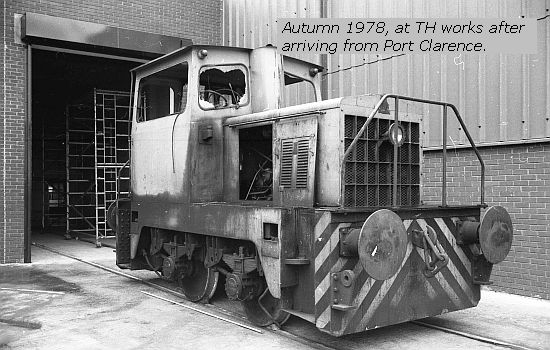
By Christmas 1978 it was spruced up and had that 'new loco' smell as it was made ready to head down to Thurrock.
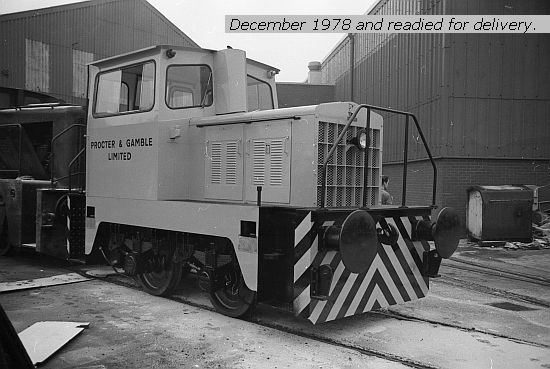
And then my contact with it ended. I now know that until 1992 it served its masters well and received a fresh coat of paint, but then P&G gave up rail (the timing of course being in the run up to privatisation when BR were required to dispense with any loss making trafficks) and stood around idle until it was sold in mid 1996. The new owners had plans to introduce rail to their works and bought it in anticipation, but having parked it in a corner of the site, it gradually disappeared into the foliage. Andrew had had his eyes on it for some time and when a tip-off came that it might be available, he didn't hesitate, having me scan some of the pictures you see above to establish his credentials. A price was agreed and de-foliating the area began.
Our first job on Monday was to cut through a not inconsiderable tree-trunk that had grown up and out through an aperture in the side skirts that gives access to the sandbox, preparatory to jacking each end of the loco up and sliding bullhead rail (on its side) underneath. For the last 25 years the loco has been sat on timbers, and the wood has decayed under the weight of 7.5 tons per wheel so that the loco was dug well in to them. We had hoped that we might be able to make the loco move a bit through judicious jacking: not that we have any reservations about the wheels rotating, but the drive chains have not moved in a quarter century and they look dry and individual links might be seized. But we had no luck (the uneven timbers underneath were giving gradients to our bullheads) so will have to wait until a straight-line pull can be applied.
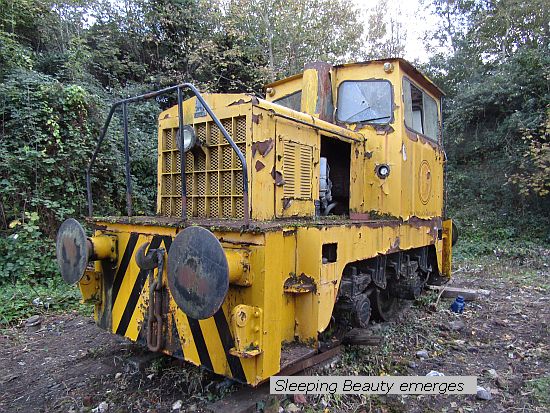
If they do turn out to be seized we'll have to cut them out for transport, but once immersed in diesel or oil for a week or two the chains usually recover and a couple of split links will get them back into one. So all being well next time we go back it will be to assist in ramping back on to a low loader and bring it north for a second round of de-vandalising. On the plus side, it does look as though at some time it was properly bagged and protected for storage, so there is a reasonable chance that its old engine may yet run again before too long.
Adam had several other days work booked and I was content to catch up a bit on admin work, including picking up materials and such, but we had a job booked for Friday which went ahead with Phil G at the helm. Now, my usual route out from the Briddon Country Pile when going north and the M1, particularly if I'm low on diesel, is to go straight up Sydnope Hill which climbs steeply out from Darley Dale in a north-easterly direction. On Thursday to my chagrin I found the road closed, not that I had seen any prior warning signs, and had to dodge back north to take the alternative, narrow and abtly named Bent Lane and when I got to the Shell station that was closed too. So Friday morning I took no chances and headed straight for Bent Lane when setting off just after 06.00. I had only made the first quarter mile or so when I came up against a tree - or most of one - across the road. Should I back up, take my chances that Sydnope Hill was re-opened? Go to Rowsley and take the road up from there or further south and go up through Farley?
It was dark, raining and I didn't fancy backing downhill. I did however have a hacksaw in the back (I'd taken the wood saws that we'd used on Monday out) so chopped away until the van could squeeze past. My destination was Wolsingham, home of the Weardale Railway and an outstation of RMS Locotec. Years ago under the auspices of ECT, the yard had been dominated by RMS but the boot is now on the other proverbial foot and Locotec use one track in the shed plus a pair of sidings outside. We were to collect a ballast regulator, made by Matisa, which had been shunted out ready. I had a while to wait for Phil, traffic had been bad on the way up and he arrived about 10.15.
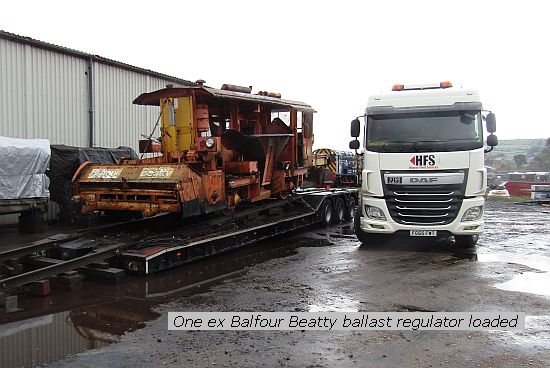
We loaded the Matisa without incident and I headed south, but traffic was bad even for a Friday (half term?) and several times I was slowed or stopped on the A1. In to Sheffield to pick up some bits at a supplier's I headed back home to grab a fresh cup of tea and then off over to Wirksworth to make sure someone would still be there when we arrived. I needn't have worried, the EVR was in full flow with Halloween events running on up to nine o'clock at night, so I donned my ovvies and walked up to the centre of Wirksworth and waited.
You might recall when Charlie was brought over that we had some difficulty negotiating the 150 degree turn in the middle to get on to Cauldwell Lane. Although I had suggested to Phil that he came in from the south, his official movement order had him coming up the hill from Cromford and down from the north, so we had that bend to take again, admittedly with the slightly more flexible 6 x 2 rather than Adam's 8 x 4. The trouble is also that in the centre of Wirksworth is a chippy, and despite a single yellow line customers pull up outside it. As Phil reached Cromford he phoned me. One car had just left, leaving a gap which I went and stood in, repelling all who tried to park there. There was still a Merc slightly downhill, but I had seen the driver return from further down the street and go in to the chippy, so figuered she would move it soon. In the midst of all this one of the owners of a machining company I use suddenly said 'it is you, isn't it?' and 'what are you doing here?'. I explained while watching out of one eye for more prospective parkers or the low loader itself.
He remembered machining up the new steering track rods for me and as we reached that conversational breakthrough, I suddenly saw flashing orange lights reflecting off cars up the road and sure enough Phil appeared, swung in to the bend, stopped and thrust the steering umbilical into my hands, telling me to steer the back down to the station. The lady came dashing out of the chippy and moved her Merc. I trotted after Phil, tweeking the steering to and fro to miss the parked cars on either side. By now it was just after five-fifteen, and light was falling. We lined up and unloaded the regulator, unaware that one of Wirksworth's webcams had us in its sights and Andrew was watching us from Darley Dale - I did think it strange that I hadn't had one of his 'how are things going?' calls.
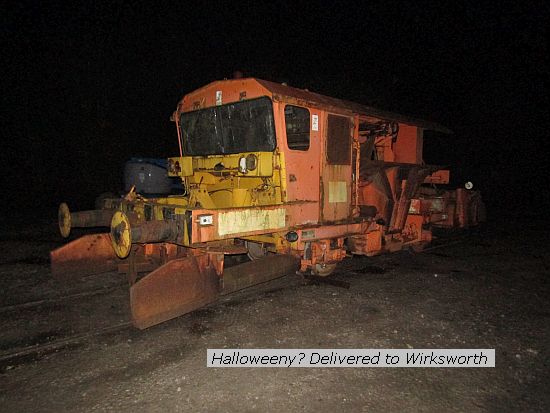
By the time it was off it was pitch dark, and we reconnected the tractor to trailer and contemplated how to depart. Two attempts at turning within the station were thwarted by parked cars or plant, remember the EVR Halloween services were still in full flow and screams could be heard from the station entertainment. As I have said before I don't get much practice at steering the trailer: Friday I got loads.
We backed all the way out of the station and it would have been easy to have steered the trailer to the left onto the road that leads ultimately to Whatstandwell but some kind soul had parked their car on the opposite side of the road just down from the station entrance and right where the trailer wanted to go. Phil and I agreed a strategy - bear in mind cars are now backing up in both directions - I reversed the steering from left to right, and Phil pulled back forwards until the trailer passed over the pavement and almost to the wall, then I pulled the steering back to full left and he reversed again, gaining a couple of feet in the process. We gradually moved down the length of the car until the trailer passed its rear, Phil was able to get the tractor out on to the road and we pulled forward to let the cars through. It was by now well after 7pm, but I wasn't finished yet, again I had to run the gauntlet between the cars on the street with only inches on either side of the trailer, but after that Phil set the steering straight and back to auto, and set off for the yard. I collected the van and headed home.
On Saturday Andrew was taking grandson back to his mothers and I awarded myself a rest day. Today the weather was foul first thing, and when it came to shunting the OBA wagon back outside the shed Tom was struggling to grip (pulling 4 other locos) and hand-sanding was the order of the day. The rain did let up and much prep work continued on the wagon, as well as work on locos inside the shed, though little that I can class as photogenic enough to record here. Last job in the afternoon was to apply a first undercoat to the end panels for the cement van. To speed the job up, we have decided that although the vent cowl will be refitted (for appearance), the vent itself will be omitted, partly for speed, partly because the van has one at the other end and partly because as this end faces the prevailing wind, it is probably better off without it! Either way he will be trying to get additional under- and top- coats on with a view to weather-proofing the van next weekend as the additional dry storage would help free up space in the shed that is cluttered. So that's about it for this week. Work is scheduled for the next few days starting with a trip to Gloucestershire tomorrow and I need my beauty sleep.
If you care to return next week, same time, same website, I'll tell you all about it. See ya then.
(* Footnote: The 'Noddy' in its various guises - both as new builds and rebuilt from Sentinel steam loco chassis - once attracted the attention of the model railway manufacturers. In the days when the principle brands were Triang and Hornby Dublo, there had been a new entrant - Playcraft as I recall - who got as far as tooling up for an 00 model.. Sadly it didn't go in to production, but a prototype lingered in the Field Sales office when I started. I wonder what happened to it.)