
Of bonfires and stout miners
(17-10-2021)17th October 2021
Not quite a thousand miles trhis week - just 700 plus.
Well, what can I say about my birthday? Was I having a lazy day, celebrating another year in which I had managed to avoid Covid and the Grim Reaper? No, I was out of bed at about 05.00 and on the road north to meet up with Adam and Ian to collect a loco. Except when I got there, I couldn't believe it. In fact I could see the loco before I arrived, so to speak, as it wasn't where it was supposed to be and certainly not anywhere we could load it. A few minutes after me a loco driver arrived, he too had come a long way but unlike me had his suspicions that the loco had not been parked where it was supposed to have been.
Adam by now was just arriving on site, so parked up and went on a 'break' before turning back for home. Meanwhile I was getting phone calls from our next pick up, planned for Tuesday, to the effect that they were alarmed about this haulier they'd never heard of as their access was to say the least unique and loading would not be straightforward. So I hit the road back south, diverting into northern Manchester to the premises of Ian Riley and Sons. There I was able to see first hand that the access was not too serious for Adam and my trailer but loading might be, although I reckoned if some machinery was moved (as they said they were going to) then we could load in the usual way. My hosts however didn't believe me, and as I wasn't 100% sure myself I agreed that we would come armed with 30m extension hoses so the tractor (and with it the swan neck, Lister engine and pump) could be that distance away from the trailer. By the time I got to my suppliers in Sheffield, they were waiting for me.
Tuesday, and I'm up at much the same time (well ok a little later) and back over to Heywood. Adam has arrived just before me and we soon swing in to the factory entrance - easier it seems than certain other hauliers (though admittedly with much larger trailers - I'm not interested in hauling Black 5s anywhere). Once inside they shut the roller shutters. Had we stopped right there we could probably have loaded in the usual way, but we moved forward another metre or so, thus the front of the trailer now sat just shy of a second doorway and Adam couldn't quite get past the trailer front to get to the back. No matter, I got out the hoses, which I had not up to that point, inspected, and perhaps should have done, but it had been my birthday and I had just had rather a lot of driving. Anyway, the hoses had been made up as female one end and male the other, and the quick-release connectors (that made it possible to insert them between our existing hose ends and the winch control valve) were all female, meaning I needed a pair of male-male connectors, known as a nipple (no giggling at the back there) to connect the female hose end to the female quick release. I acquainted our hosts of my problem and was duly transported across to a hydraulic suppliers somewhere on the outskirts of Bury (they said I'd never find it on my own) to collect some..Once assembled the loading was straightforward, the loco (a Junty chassis and boiler) being 'floated' over to us on a little Hovercraft.
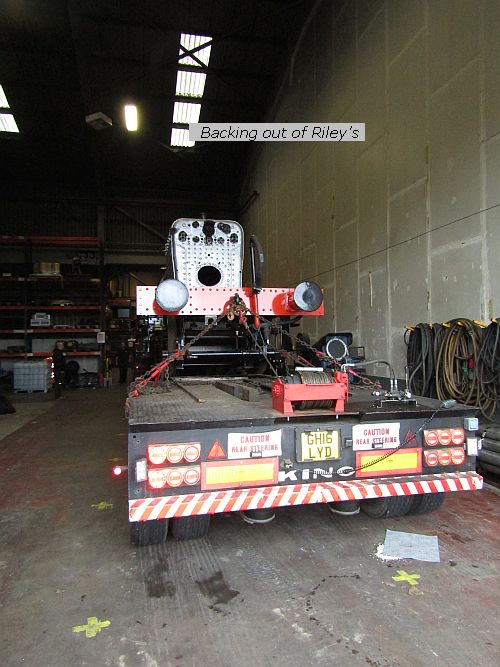
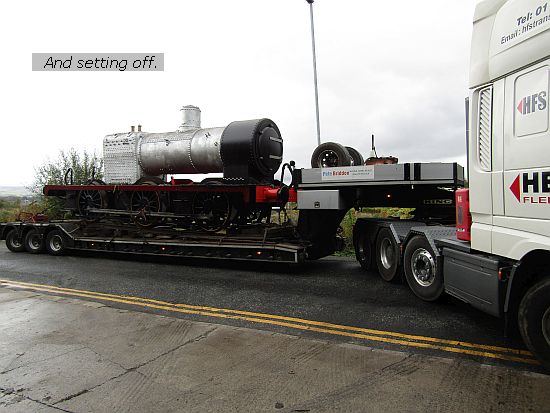
By early afternoon we were backing out and on our way. As usual I dashed on ahead to get things organised at our unloading point, Butterley, where we were to drop off the Jinty chassis and collect a Hudswell Clarke 0-6-0DM, similar mechanically to Ashdown but looking somewhat less 'modern'. Knowing the access Adam came round via Ripley and arrived without warning, but we soon lined up and were rolling the chassis down the ramp on to MR-B rails, after which it was pulled away and clear of a turnout by a dumper truck.
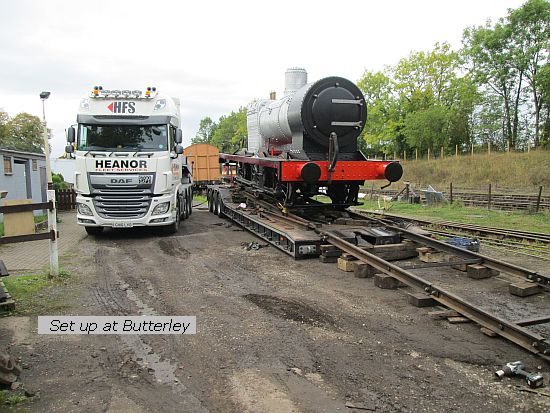
In due course a convoy comprising a gronk, the Hudswell and a Barclay 0-4-0DH arrived from Swanwick Junction. The Barclay whisked away our Jinty, the gronk delivered the Hudswell for us to haul aboard and then remained to shunt some carriages.
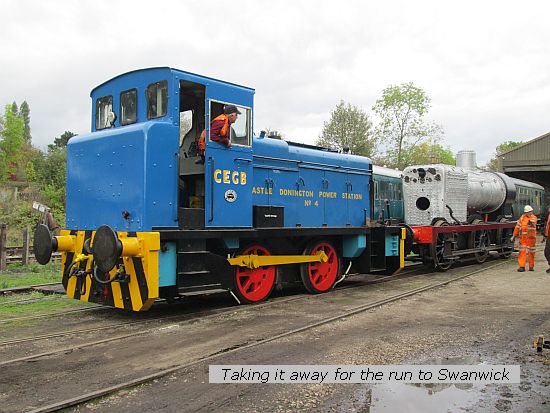
By arrangement we finished loading and left the trailer on site overnight.
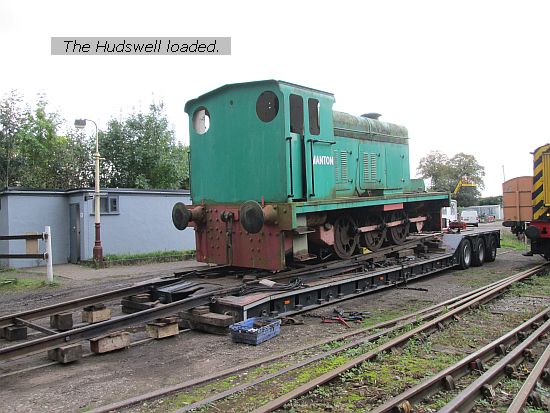
Wednesday, and I'm up a little later again but then I only have to get to the National Coal Mining Museum outside Wakefield. I arrived ahead of them and was introduced to about half-a-dozen stout ex-miners there to assist us in any way. They wanted to start by laying out the rails to form the plinth that the loco would stand on, but I explained politely that I'd rather they waited while we got lined up and put our tracks down and then they could place theirs butting up. Adam and Ian arrived and we got into position.
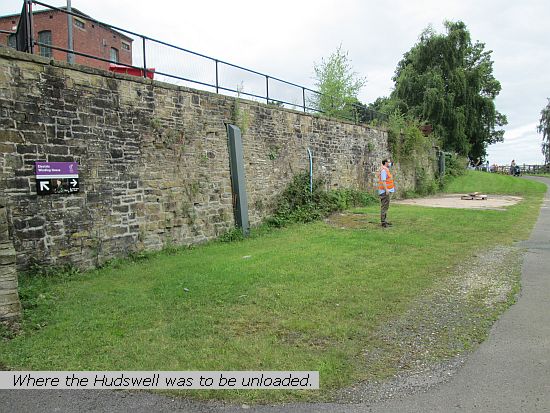
Unloading was unusual in that the trailer was actually downhill from the concrete area (in other words the trailer was backed right up to the wall at the left of this shot, taken last August when I came in to assess it) so gravity gave up on us rather early and the loco had to be aided with the tractor unit.
We reassembled and re-positioned ouselves. Up in a stores compound at the back of the site was a Hunslet 0-6-0DH. It waa sat on two lengths of 35lb yard n.g. rail and some bits of timber.
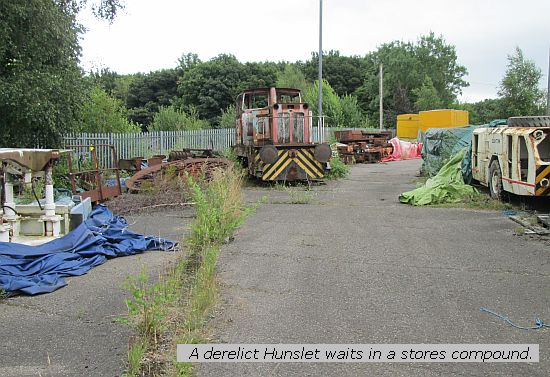
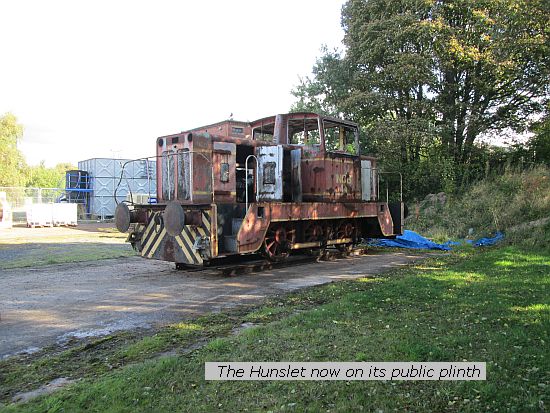
If I describe it as derelict, you must forgive me, but it has no windows, the casing doors are stuck open, bits of engine are missing and the cab floor is non-existant, oh and some of its handrails have been re-sculpted. When I had inspected it in August some rather woe-begone wagons blocked our line of loading, but these had since been moved and with a bit of a shuffle (difficult to line up when there is no track to line up over and you can't sight-line the trailer to the loco when the tractor unit is in the way) and plonked the trailer down on a spray line I had put on the tarmac to give us the correct length for a ramp rails. We had a slight crisis at this point as the loco brake appeared to be seized and the blocks applied. But the six stout miners went into action and soon the handwheel had been forced round and chisels persuaded between brake blocks and wheel treads. This Hunslet might look like a Cinderella but it could now go to the ball.
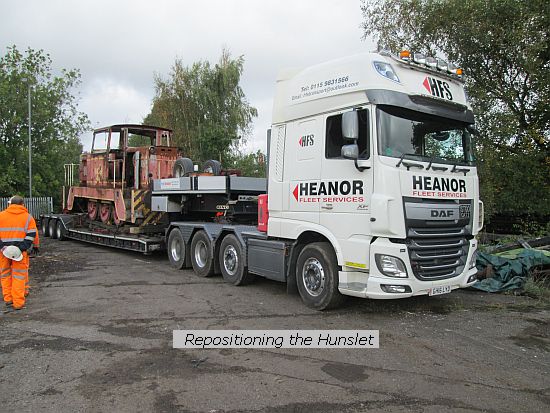
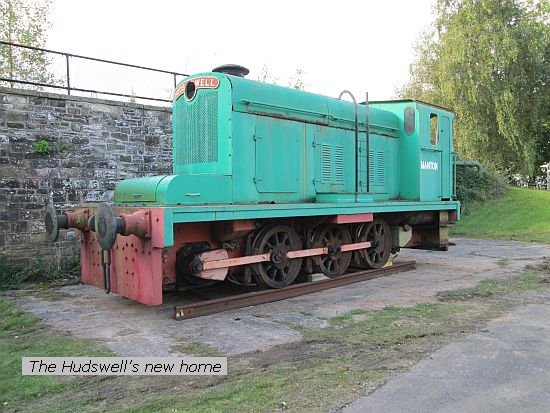
We dragged it on to the trailer, set things back up and delivered it to another hard-standing area barely 200 yards away from its previous resting place. And here we got careless. It was after all our third ramp-build of the day and we thought we'd get away with just a pair of 10ft rails to reach the NCMs plinth rails, but we had under-estimated the overhangs on the Hunslet and the departing buffer beam ground on to the rail heads and no amount of effort would budge it further. Nothing for it but to winch it back on, push their plinth rails back and insert two 5ft rails to ease the angle. I grabbed a crow bar and started barring their rails back on the tie bar. One stout miner came over to 'give me a hand' and a second nudged me out the way and took over! After inserting the additional ramp rails, the Hunslet rolled down onto its new rails and a place where the public can see it, and no doubt some stout miners will be deployed to make it more presentable.
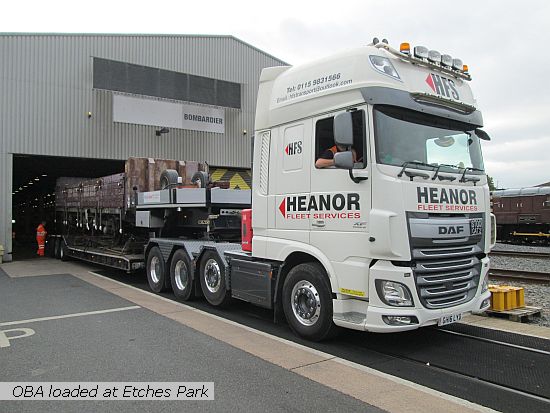
Thursday was a much more relaxed start, as all we had to do was meet at Etches Park, Derby for about 10 o'clock. At nine that morning there had been a formal handing-over ceremony for an OBA wagon from EMR to the National Wagon Preservation group, and through Andrew we were to collect it, bring it to Darley Dale and carry out some minimal repairs before it goes on to a new home. Loading wagons is easy (well easier) as they can take a steeper ramp angle and Andrew's 'lightweight' tips, so it was soon on and heading north.
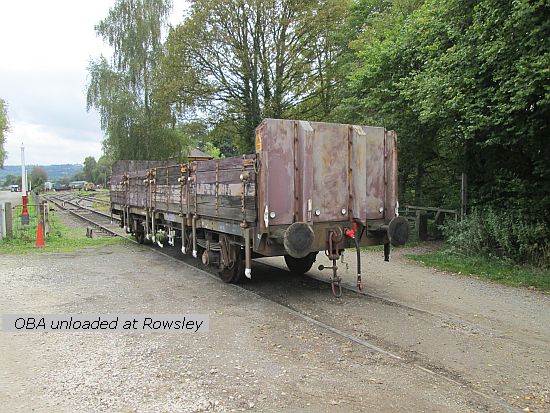
At Rowsley we unloaded and Adam departed, while I went back for some late lunch and then down to Darley to get Tom fired up.
You weill recall that a few weeks ago we changed the stop solenoid on Tom and we had subsequently agreed that it needed adjustment as although it appeared to be working satisfactorily, the linkage was pulling the lever right over and almost in line with the solenoid. I also explained that if the solenoid didn't travel fully and open the switch at the bottom, the big 'pull in' coil would burn out after about 10 minutes. Well, we were passing over Church Lane crossing northbound when I smelt burning, saw the ammeter zip over into the red and realised that for some reason the solenoid hadn't opened its contact today. Clear of the crossing one of the main fuses went and the engine stopped. Smoke emanated from the stop solenoid, and all my tools were back at the shed. After a few minutes of panic I managed to disconnect the now defunct solenoid both electrically and mechanically by brute force and got the engine restarted by swapping fuses over. We went on to Rowsley, collected the OBA and brought it back to Darley Dale without further incident.
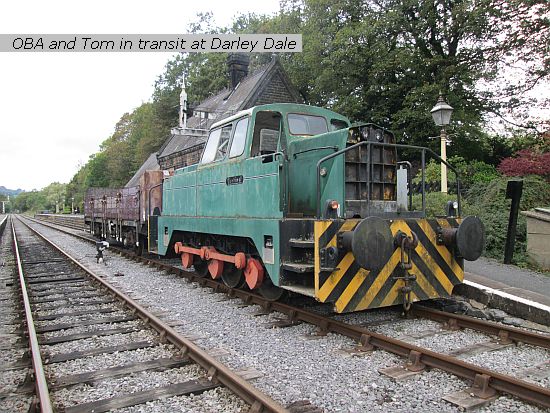
So Saturday it was back to 'normal' if anything can be called normal at the Briddon Country Pile. A representative of the National Wagon Preservation group arrived at the shed to go over a scope of work on the wagon, which was used latterly at Etches Park as a mobile waste bin, with rotten pallets, sleepers, bits of old iron, drinks cans, paper cups, etc thrown in. Most of the contents, together with its rotten floor, were only fit for burning and a bonfire was duly started that burnt right through the day. I managed to get some time in on a commercial re-wire job but not a lot else. Today it was more of the same, in fact the bonfire, though quiet, was not out and soon flared up again as more combustible bits - mostly rotten fragments of disintegrated floorboards, were added on. I got to look at Tom (which on Saturday during a bit of shunting had proceeded to blow two more fuses, suggesting an earth fault somewhere) as I was not happy with having to start it using a piece of wire across the starter. For now whatever it was causing the fuses to blow has been disarmed, but I can still see a negative earth fault somewhere, just cannot determine where. While investigating I decided also to add a fuse into the alternator positive feed (Hills never put one in on their wiring schemes, I prefer the extra protection) and then on a whim, trace a serious air leak that extends the time taken to build air up.
To do this I had to remove the right hand side of the desk assembly (this is one of the earlier 'tinplate' Sentinel desks, not the later glass fibre moulding) to examine the throttle pilot valve, only to discover that the leak was actually from the midget cylinder that locks the clutch control lever. Although I have a spare cylinder (and can refurb the original) to get at it means much more dismantling of the desk than I had time for today, so as a temporary measure I've disconnected the cylinder and blanked off the port on the pilot valve. Meanwhile Andrew was at work on D9500, removing the last two lumps that had been sold (to the K&ESR) long before the rest of the loco's recent sale took place.
So that's about it. A couple of moves scheduled for next week, but nothing tomorrow so I can have a lie in? (No, I don't think so either). What will there be report next week? Who knows. See ya then.