
Of a weekend of ends
14th November 2021
An end is but a beginning looked at from the other side...
There are two ways of runnng a business. You can be self-employed and you do everything, or you can employ others and sit back and relax while they earn you dosh. Except you can't. Because once you have others working for you their future is in your hands and you need to ensure that you have the cash coming in when you need to pay them and future business in the pipeline for when they finish what they're doing now. And that's before you have any internal conflicts, mistakes made in production, or any of the other issues that as a self-employed person you would not have suffered from.
In YEC days I employed several who were ex miners, and took another on without a thought. It didn't occur to me that my existing employees were Yorkshire (NUM) and that the new guy was Nottinghamshire (UDM) - that did not work out well!. Then there was another guy whom I took on who was at the time unemployed. At his interview he described himself as an electrician and fitter. As the six month probation period came to a close I was minded to get rid of him. The mistakes he made and his lack of understanding ('I'm not a fitter', he wailed as I reprimanded him) made him the worst employee I had. Told to check the oil on his van during a journey home one Friday afternoon, he stopped at Leicester Forest East, decided he 'couldn't read' the dipstick so 'put some more oil in just in case' with the result the sump oil was ingested into the engine. The resultant smoke caused three motorists to report it as on fire, while he pulled over and exited through the passenger door. The Fire Brigade attended and the vehicle had to be recovered back to Rotherham and went for repairs. I forget how much this all cost but the guy seemed quite content to be fired: he liked being on the dole and living at home. At this point his wife rang me, in tears. She didn't want him home, she liked the fact that he was an employed person and presumably felt that there was some stigma in their surroundings that her husband couldn't hold on to a job. For her sake I agreed to keep him on. No, I shouldn't have
I only recount all this because last Monday, unlike previous Mondays when it has been up at some ungodly hour dashing off somewhere, I stayed at home with a long list of admin stuff to deal with while the lowloader, with Adam and Ian at the helm, headed north, and I had that feeling, however temporary, of sitting back and relaxing while someone else earns your dosh for you. Our envisaged timetable for the week was that the loco (D9500) would be unloaded some time Tuesday afternoon, and return via Aln on Wednesday and arrive back at Rowsley on Thursday.
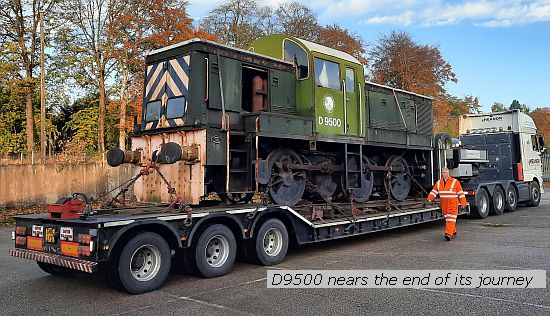
Unfortunately, despite (or because of?) my not being there, they unloaded first thing Tuesday morning, and collected the loco at Aln on Tuesday afternoon and rolled up at Rowsley on Wednesday. The loco (a Ruston 165) was unloaded but had to be left until Thursday when we had arranged to come up and collect with Tom.
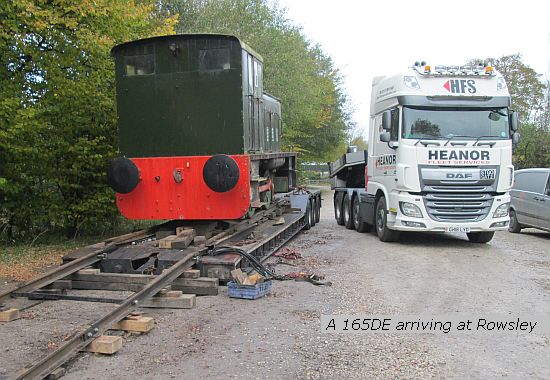
Allegedly this 165 has a 'running' engine - being defined as 'it ran when last we tried to run it' though quite when this had been wasn't clear as apparently a large volume of water was subsequently extracted from the sump.
On Friday I had to go to Sheffield (supplier) and then Rotherham for a meeting, meanwhile plywood for the OBA arrived and as I was driving back Andrew rang to see where I was and we eventually met up, parked his car and headed back together in the van to a 'late night timber merchants'. If that sounds like the classic Mike Harding gag about a 'night-repairer of Church rooves' it wasn't: rather the guy said he wouldn't be there until tea time when he got back from a job and by then it was pitch black at this rather run-down lock-up. Andrew selected 30mm and 50mm thick oak boards and I stacked them in the van before returning home.
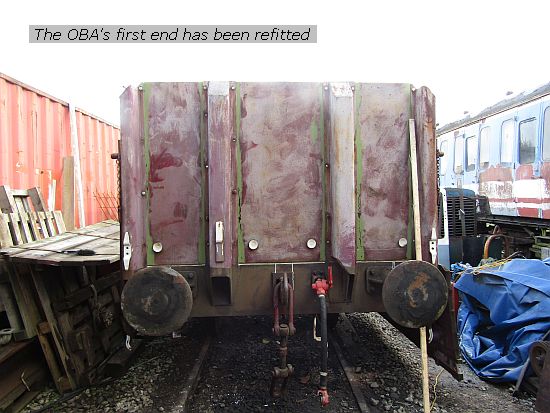
Saturday and we're back down to the shed. Work began on the OBA, refitting the first end with temporary bolts (the proper ones haven't arrived yet) and cutting ply to form the facings to the steel ends.
Meanwhile, following on from a conversation Andrew and I had had during the week, I rigged up a combination of air hoses with a view to testing the pneumatics on 144V, connecting through the air receiver drain tap. Now, inevitably the air receiver drain is where all the moisture congregates: if it didn't it wouldn't be effective as a drain. But by the same token it is likely to be the place at which corrosion is most prominent. When I came to turn the air on, it started escaping from a hole in the pipe imediately behind the ball valve. When I tried unscrewing that valve from the pipe end, the latter disintegrated.
Next in line was a crane coupling, but I had neither the strength nor the space under the loco to get a swing on this, so tried unscrewing the pipe to it which also snapped off. Finally I got the entire crane coupling itself turning which revealed a cast nipple with some semblance of integrity. I found another ball valve and re-connected. This time air pressure did start to rise, and the two needles in the cab duplex gauge moved for probably the first time in a quarter century (I had first extracted the broken glass so that they could!). But 25-30 was as far as they got, for up front another air leak could be heard but not traced, though likely it is on the pipe that connects the two air receivers together and leads to the drain connection. For now though, I could see air brake pressure rising (though the rigging was still inert) I could operate the forward/reverse 5 way valve and the gearbox clunked home satisfactorily and opened the lock for me to put the valve into the 'clutch in' position although there was way insufficient pressure to pull the clutch over even if the cylinder was minded to.
The driver's brake valve appeared to function (though the auto-emergency was holding the brake pressure on so it was only influencing the pipe down to the shuttle valve) but that was pretty much it. The mechanical flags for forward/reverse in the desk (basically midget cylinders whose piston rods peep up to show direction engaged) didn't move, nor did much else. Disheartened that more steel pipework will have to be renewed before we go much further, I packed up, returned to Andrew and we switched our attention to the cement van. Here the first task was to trim the end panel down a bit (we decided on about 5mm each side) so that it would slot between the side panels fitted last week. We had already removed one of the floorboards Jagger bolted in some weeks ago without making allowance for the ends, now we had to remove a second as the centre panel could not be slid into place the way its counterparts on either side had. But twilight was upon us and the final fitting job was left for Sunday.
With a second reasonable weather day in prospect, we got down fairly early and resumed work on the cement van. At my suggestion the centre panel was sealanted up, pressed into position and boards that go behind (in t&g) knocked into place to hold it whilst the ply and t&g were drilled together from the outside, countersunk on the inside and then the bolts put through and tightened with the Big Mak. Getting the t&g to engage with its matching board on either side was slightly problematic but all went reasonably well and the wagon end is now effectively weathertight once again.
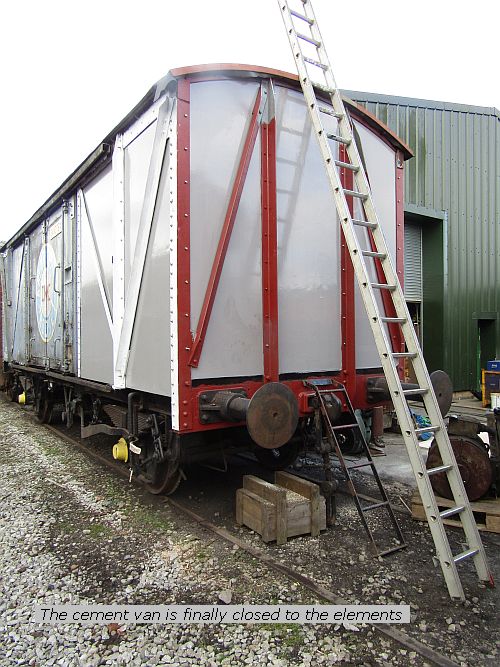
Jagger arrived and the end floorboards, one trimmed down, were re-secured after which we cracked on trimming, drilling and bolting floorboards until we met with the ones laid earlier. A splicing piece was cut to fill the gap and the steel reinforcement across the doorways fitted at both sides before a time to tidy-up was declared. From Andrew's point of view the next task is to put racking down the sides of the Matlock end of the vehicle whilst mine is to get the lighting and 240/110 transformer installed as being without windows it is pitch black in there and hardly suitable to work in unless you have the doors wide open! Andrew and I had a conference and agreed where the striplighting can go.
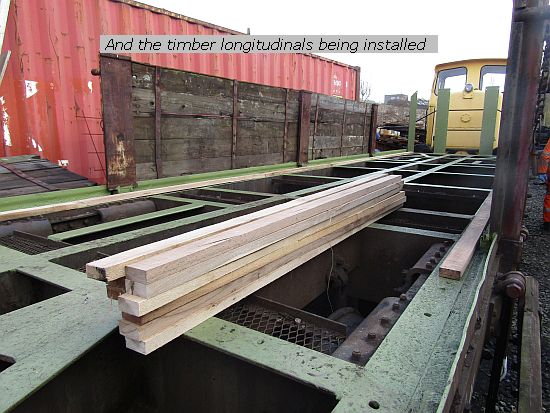
Meanwhile work on the OBA progressed - many of the 30mm planks had been cut to narrower lengths with the circular saw and were laid out and drilled ready to receive proper bolts when they arrive. These form bearers on which the wagon's floorboards will rest - curiously, Andrew is adamant that the old bearers that came out, judging from their weight and condition, were softwood whereas those we are installing, being Oak, are hardwood.
As a weekend it was the end too of the 'season' for Peak Rail, at least until Santas traffic in December, but having explained all this to several car loads of visitors who turned up expectantly on Wednesday while we were unloading the 165, it didn't happen as for some reason all services were cancelled with sufficient warning that the rostered blockman didn't show, but a passing Peak Rail volunteer asked if we knew why no trains were running. We didn't.
And what's in store for this week? Actually I'm not too sure. Maybe a chance to catch up on outstanding work both admin and down on commercial jobs? I'll have to see, and you can find out by returning next week. See ya then.