
Of a Brush with nostalgia
5th December 2021
Yep, one of those enigmatic titles again.
I'll admit that the beginning of this week did not go to plan. Monday, yes. I headed down to Loughborough to look over the bits available on auction at Brush's premises. There is history for me here: not that I wish to kiss the ground where Class 47s and 60s were built. No, years ago when I was at Hills I was head-hunted by a Birmingham agency for a post at Brush. This was probably in the early 1980s and we were determined to break into overseas markets which meant diesel-electrics. For a loco manufacturer whose total experience on DE was repairing Janus locomotives we cut out the development stages of starting with DC:DC and going through to AC:DC (I trust you're following me here - DC:DC is DC generator DC traction motor. AC:DC is alternator with DC traction motor) instead we went straight for perfection and reached agreement with Brown Boveri for their AC:AC traction equipment, or AC:DC if the customer specified.
[Later - much later - I went for a job at BREL Their interview panel asked me 'given that it takes 2 years to design a locomotive, how are you going to get us the specifications 2 years before the customer comes out to tender?' My jaw probably dropped. If their premise that design work must be completed in detail before tendering and takes 2 years, then they had no chance of getting any job because clearly they weren't prepared to take any commercial risks I knew you would get 4-6 weeks to submit your tender, that unless you had invested £000s in sending your Overseas Sales Reps (or a similar amount engaging 'local agents' on the ground to represent you - in practice you probably needed both and it was easier for the agent to broach the subject of backhanders so as to get advanced drafts of the specs) that still wouldn't get you much firm intel in advance. Your best bet therefore was to have certain building blocks designed and costed (so a 'typical' bogie design, a 'typical' frame design and budgets on casings and cabs, etc.,) and throw it all together when you'd read the spec in whatever combination would meet it. But I'm digressing again.]
My old boss had told me how every year the RIA (Railway Industry Association) had a weekend get-together and socialised. My boss and his wife would attend, usually with our then MD and his wife and probably Mr and Mrs Hill (junior). There'd be a block hotel booking, day trips for the wives and plenty of time to chat with competitors. My boss (he's dead but I'm not sure about the MD so I won't name them) assured me he had to stay sober as Brush's Dennis Minckley would ply our MD with booze and once lubricated, if not chaperoned our MD would start blabbing what Hills were up to. Thus I was conditioned to be suspicious of Brush's motives and when out of the blue these headhunters approached me I went to talk to them but I held back on what I could say suspecting nothing more than a fishing exercise. Whether I was right or wrong I heard nothing more.
Years later, I went after a job at Loughborough (I was at Locotec then and my salary was poor) and had a works tour plus a second interview with Brush's then MD. He told me that he had stopped bidding on new build as they made no money at it: he was convinced that profit lay in rebuilding existing ex-BR kit though he conceded that his shopfloor employees were still coming to terms with working on things that weren't scrupulously clean. He also bragged how everyone had to be at their desks at 08.00 and that he waited at his office window, noted any latecomers and sent them a memo asking them to explain their tardiness. Apart from thinking that I had travelled back into the Victorian era, I also feared that rebuilding other people's locos and rolling stock was a job that almost anyone could do and without the reputation of building new equipment, innovating and improving, Brush would not have a long term future.
Did I foresee this outcome? A bit, but certainly not the detail nor the timescale. After I had gone self-employed I got an introduction to the Test House Manager (who had charge of Brush's two diesel-hydraulic shunting locos) and was given a competitors quote and asked to submit an alternative. At the time one loco was out of action as it 'wouldn't start'. I brought it back to Darley Dale and with Andrew's aid, we flattened several sets of batteries and still it wouldn't go. Then by a fluke we detached the exhaust system and it proceeded to crank twice as quickly. The loco had had a water-wash system but it had been removed and a silencer fitted instead; but whoever did it had used one way too small. Consequently it created back-pressure in the exhaust. As the back pressure increased it caused poor cylinder combustion resulting in sooty carbon deposits (what some mis-guided diesel fans revere as 'clag') which clung to the pipes and reduced their effective diameter, further increasing the back pressure until even turning the engine over was almost too much for the batteries.
With a new exhaust it was rejuvenated and soon I was their go-to person with any problem with the shunters. During 2019 I had them both back to Darley Dale to fit spring-apply/pressure release parking brakes and deadmans vigliance systems and the first clue I had that anything was amiss was early in 2020 when I had to get through to the Finance Director in order to get paid. (One of my friends in the Test House gave me his direct number on condition I never admiitted how I had it!) So although my trip on Monday was to wander through the two remaining workshops to find the various lots Andrew wanted further detail on, I also strayed down to the Test House offices, where I would usually have found 4 of the regular supervisors, with their computer screens, papers and progress boards around the walls. There had been a big track plan of the sidings with pictograms of every vehicle and its position. Even getting in to the office could be a problem, as not being an employee I did not have a key and having signed in I often had to make pleading faces at somebody in the mess room to come and open the locked doors. No difficulty on Monday: the lock had been removed, leaving a sad round hole in the door. The lights clicked on automatically as I entered. The tables were still there but were empty, the wall charts and plans blank. The silence struck me as I looked around, remembering all the times I'd been in ascertaining what the fault was I'd been called in to deal with, or reporting a succesful fix. I could see them all, and I could sense the loneliness of their absence.
And to cap it all on the one lot we really did want, Andrew was outbid.
I had a trip to Carlisle this summer to deliver a customer's loco. The hire terminated a month or so ago but when we went up again it had been left somewhere where we could not access it with the low loader. We'd been waiting for updates since and finally a week ago I was asked to get it uplifted and was able to arrange a date for Thursday. Adam said he'd see me there at noon and I was congratulating myself on my time-keepng as I reached the top of the M6. Now regular readers will know that I don't like sat-navs as in much the same way that calculators have ruined our ability to do mental-arithmetic I like to read maps and can usually find my destination using my own servicable brain cells, all six of them. But I lost count of which junction I was at and as it didn't look like the one where I came off so I went on to the next one. Passing a 'rest area' it suddenly registered that I was too far north, and had to go all the way to Gretna Green in order to turn back. Foot down I still made it just after noon and ascertained the loco was indeed ready and correctly placed before Adam and Ian arrived.
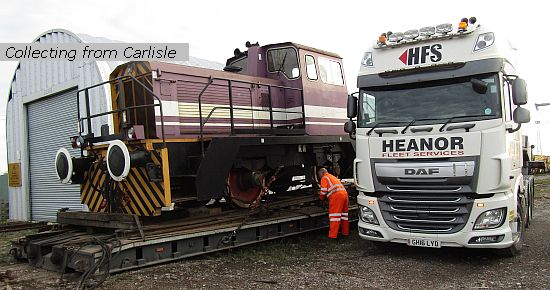
The loading took the usual 90 minutes and having confirmed that they did not anticipate reaching the customer's premises that day (driver's hours) I tore off back south, conscious that I had some parts to pick up in Manchester and if I could make it before five it would avoid having to make a special trip on Friday.
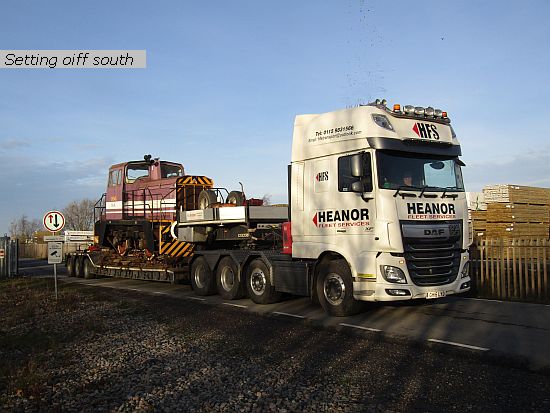
By the time I got to Manchester it was dark, and I was coming in from the north east whereas usually I'm approaching from the south-east. I had almost conceded that I was lost for the second time that day and maybe I should ask Santa for a Satnav to save those few remaining brain cells when suddenly I recognised where I was and five minutes later I was triumphantly ringing the supplier's doorbell. The brain cells may have been celebrating too, or maybe they'd gone for a lie-down.
First thing Friday I was back out to help unload. The loco is a Thomas Hill, albeit 'rebuilt' by LH, and has received a forward-reverse gearchange system that outwardly looks like the system we developed for Ravenscraig, and put on the MoD Steelman locos, with a big red button that reverses the loco from whatever direction it is in now. When we rolled the loco off, it was sat at the end of the ramp and we needed to move it clear in order to disassemble the ramp and re-connect the tractor. So I fired the loco up, and once air pressure was raised, flicked the switch to bring the clutch in. Nothing. I pressed the big red button,. Still nothing. I knew this should work - after all I had driven the loco the few feet up to the ramp before we loaded it yesterday. But although I had driven it in reverse, it was not now showing either forward or reverse on the panel lights and I concluded that without knowing which way it was set now, it didn't know which way to go so didn't do anything. In rolling it down the ramp we had managed to put the gearbox slightly out of 'fully home'.
At this point the customer's staff arrived and I explained that they would need a T key to check the gearbox by opening the access panel on the casings. They did, but seemingly had no luck. Politely I asked if I could look, pulled the manual gearbox handle one way and felt it go tooth-on-tooth, went the other and after a moment it slid all the way to the stop. 'Check it now,' I called and a cry of delight from the cab told me that it was now working. Off went the loco and we got back to packing away. Two more suppliers to visit in Sheffield and it was home for lunch.
Saturday, and we had had a request from a potential visitor - Andy M - (there are too many Andrews around here, not that we have seen much of AndyH since he turned to the dark side [15 inch gauge]) for a look round and with windy wet weather in prospect the chances of working outside on the OBA were slim. I got down first and at the end of the tour he suddenly asked if we 'accepted volunteers' and never one to turn down free assistance I said yes and he's been with us all weekend. We stayed inside on Saturday - the rear engine mounts were welded in to place on D1387, the front engine mount afixed to the engine, which was then lifted in to place, its mating frame part back-marked so that it could be welded to the loco's frame before the engine was dropped back in and bolted down.

Andrew also plasma cut some bits for me but that was about it for the day.
This morning we were back again: overnight I had checked my drawings now that the engine was secured and determined that the compressor base can move back a bit to ease what will be quite a tight installation around the front. So the compressor base was welded in, and the exposed bits painted while Andrew moved on to weld up the big hole in the cab back where the headlight used to be. (It's obsolete, incandescent and anyway it had rusted through). The loco's radiator (the one from Louth) was brought in from outside and new mounting feet cut and drilled. As the weather was rather less inclement I got out to the cement van, and joined by AndyM, we finished connecting up a second fluorescent over the workbench, mounted the 220-110V transformer (having first checked which way round to wire it!) and cabled it up to a socket above the bench. The new twin tube is an emergency type, meaning that one tube stays lit when the mains goes off thanks to internal Nicad batteries. What state they are in I don't know - a fresh set is supposed to last 3 hours - but it does mean that as you unplug the shore line and try to lock up there will be some light to guide you.
Which brings us back to Sunday night and the prospects for this week with transport work at the beginning and I don't know what thereafter. I'll be back as usual if you care to join, see ya then