
Of springs and bogies
18th July 2021
Back to nitty-gritty engineering work again...
First thing on Monday a large lorry turned up at Darley Dale. An interesting beast in itself, it was an eight wheeler, with two wheels under the cab and 6 under the deck, but of those 6 the middle two drove and the two either side took weight and steered. Consequently it had no problems backing in or pulling out of the yard gates. It took with it one of our Matterson posts back to its birth-place for a check over. The post had been vibrating quite a bit and although the currents drawn were consistent with the other 3, we concluded it was time it had a look-over.
On Tuesday I was running around and in between paperwork on Wednesday I had to watch out for a Cummins 855 which was on auction. Not ebay for a change, this was another on-line auction site, one of those where you can't dash in in the closing seconds and snatch the deal. Here if you put a bid in within the last few minutes, the clock resets back to 10 minutes and so gives other bidders time to increase their offers. It can be frustrating but is probably better for the sellers. The result in this case was that I won the engine at (hopefully) a very good price and it'll be arriving here sometime this next week. Now don't start asking me which loco it is for: I don't know, we sometimes obtain these things and a project later presents itself.
On Thursday it was aother silly o'clock start to load the same wagon as Monday with some carriage drawgear parts and wave it on its way for a tour of Wiltshire and Hampshire. I was denied a lie-in on Friday too, as it returned nice and early with bits of North British MAN engine from Wiltshire and a wheelsets freshly profiled for the PCV. For although the PCV finally departed some weeks ago, it did so on accomodation bogies whilst its original bogie frames sat in a pile obstructing access to the scrap bin. Now at last, the wheelsets were here and it was arranged with the lorry company that its Hiab would be utilised to position the wheelsets and drop the bogie frames on top.
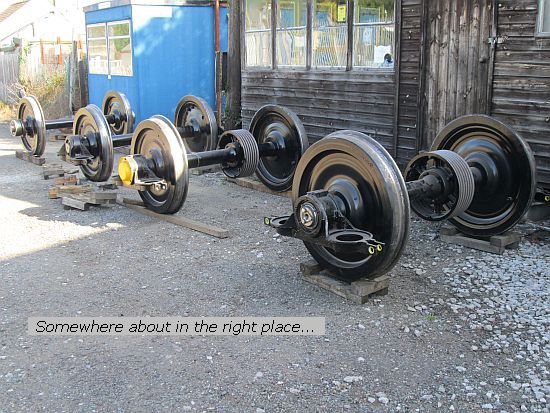
The only place we could do this was on the north side of the shed, hardly convenient but only temporary. So I laid the 'sets out as accurately as I could but in hindisght to get them spot-on for wheelbase and in the same axis was asking a bit much, even without the heat that was building up as the morning began in earnest.
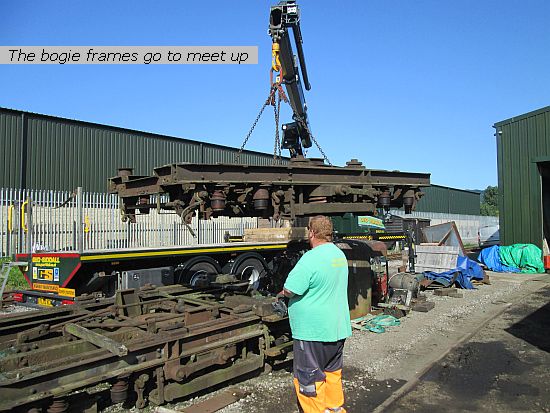
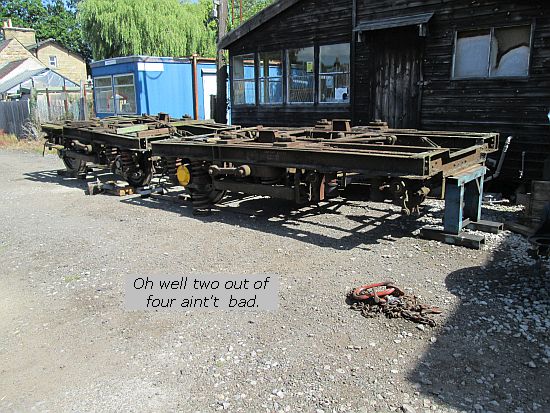
Eventually I cheated, took one wheelset out the way and put the bogie frames with a stand at the other end. We can lift them, and get the wheelsets positioned with the forklift in due course.
It would have been nice, or nicer, to have spent the weekend inside the shed out of direct sunlight. Scarcely cooler (the temperature gauge inside the shed showed 27.4 deg C this morning at about half-eleven) but Andrew had decreed that we must blitz the two front springs on Charlie. Actually his plan was to blitz them both on Saturday, but with the heat and repeated tea breaks to re-hydrate it took much longer. So first job on Saturday was to shunt round and bring Charlie down to just outside the shed. The front left spring turned out to have 3 broken leaves which we could replace with leaves from the spring we dismantled last week. Getting it out, however, proved not as simple as I expected, and to be honest, the high regard in which I have held Thomas Hill designers was rather dented.
The spring is held on the axlebox by 4 studs, with nyloc nuts. But the buckles and spring leaves are so close to the nuts that you cannot use anything but an open-ended spanner, and several put up a fight even when that spanner was either hit with a hammer or 'extended' with a long combi spanner through its opposite jaws. And when we did get them to move, in 3 out 4 the stud unwound from the axlebox casing, though they could - sorta - be wangled out eventually when they did. We had of course jacked the front of the loco up as the other ends of the leaves just bear on wear pads.
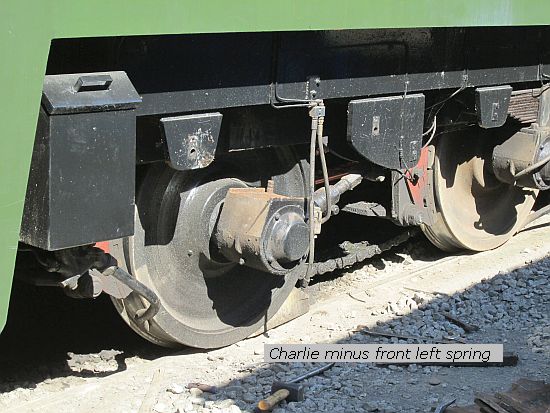
To prevent the springs dropping if the loco is lifted or derailed, there are two safety pins through the housings under the top leaves. One of these came out without too much difficulty, but the front one turned out to be bent and in the end, had to be gassed through. It took to mid-afternoon to get the spring out and on the floor ready to be dismantled. The clamping arrangement on the top was a grub screw that had been welded in. I ground out as much of the weld as I could but attempts to turn the screw by hand weren't succesful. I got out Big MaK, pushed the button, the machine chattered and within seconds the grub screw was out and on the floor.
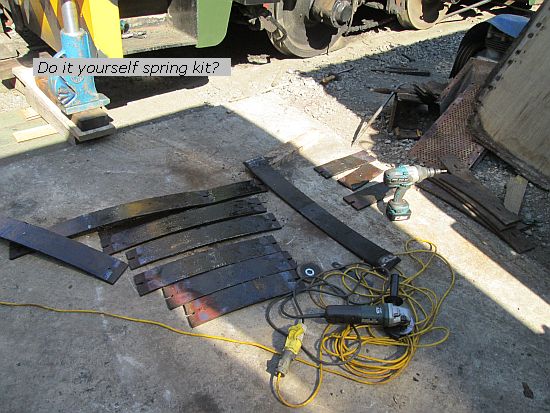
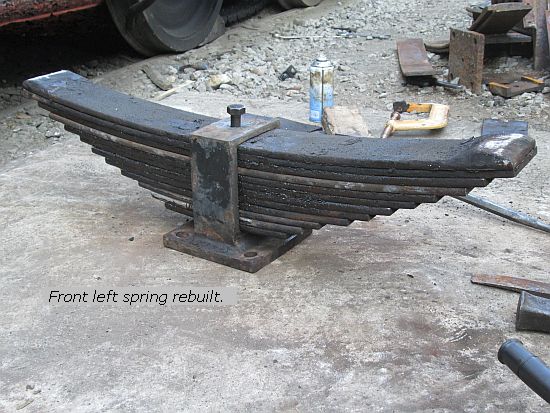
The grub screw was a coarse thread, which doesn't give much in the way of grip through the thickness of the buckle, so we cleaned it all off and drilled the hole out 11/16 and tapped it 3/4 UNF. For now an ordinary bolt has been used to clamp the reassembled spring together (each leaf is 'nibbed' to enable this) but must be replaced with a new grub screw before the loco is lowered back down, as there is not much clearance between the top of the buckle and the underside of the frame ballast. By the time our spring was re-assembled and clamped we'd had enough and called it a day.
Before we did though I glanced up and saw a gentleman taking an interest in our bogies. It turned out he'd been on the train and was interested in what he'd seen and come to take a look. I did the usual (socially distanced) guided tour but judging that he wasn't the sort to suggest making a donation, persuaded him to buy a copy of my book.
First thing Sunday Andrew had it in his head to visit the Newark auto-jumble, so I drifted down about 11 o'clock and was loading the van ready fror Monday when a car breezed in and two lads got out, asking if they could look around. So the guided tour was duly performed and Andrew arrived part way through, but I didn't manage to get anything out of these two.
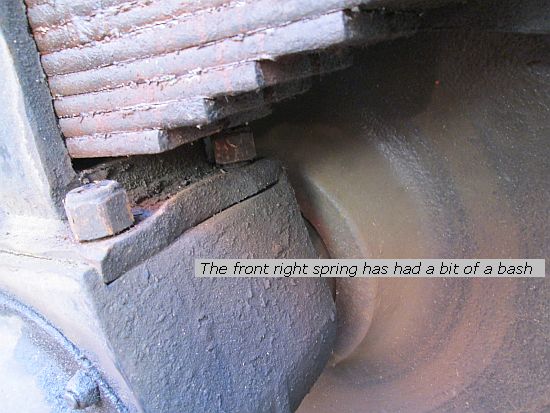
Anyway, back to the spring. The problem with the front right spring was that all leaves were intact, but the clamp bolt was the normal hex-headed type and I suspect had been head-butted into the ballast block destroying the thread. Thus the leaves were not held and would slide across from time to time.
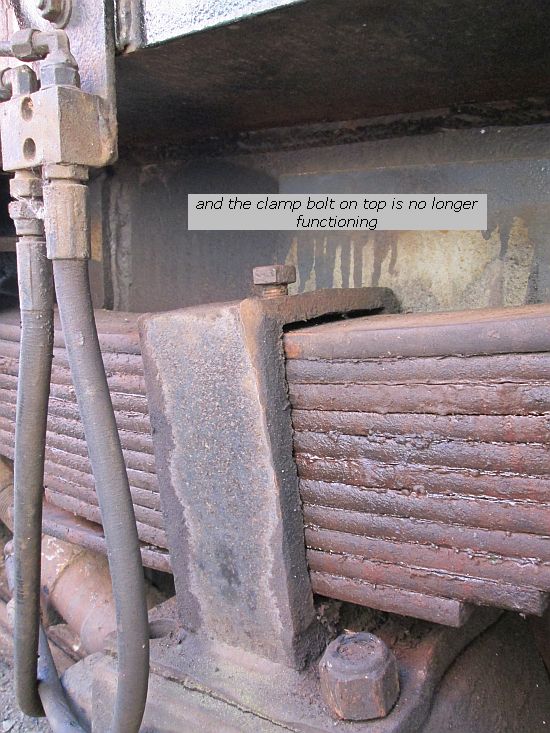
Andrew had had to slip back home leaving me to undo the four studs between spring and axlebox, 3 of which undid and one resolutely refused to budge. The safety pins both came out and knowing that the leaves would slide on their own, I decided to give them a helping hand and dismantle the spring in situ. Various blacksmith's punches and a club hammer were succesful in that. That gave enough space around the nut so I got Big Mak out again and it proceeded to unwind this one stud that had totally defeated me in normal ways, without the slightest difficulty. Notwithstanding that this buckle has seen some abuse in the past, Andrew opted to re-use it as he wants to make up a complete spare spring for Charlie with our new buuckle so after he'd cleaned it, I drilled it out and tapped it 3/4UNF as the other.
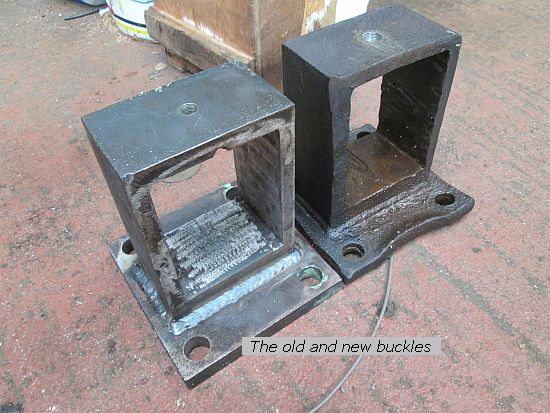
The spring was duly reassembled and is ready to go back under, but with the heat and re-hydration breaks, plus a couple of valves that wanted cleaning and testing for a customer, it was as far as we got.
I'm off again tomorrow with a wagon to move: Adam is on holiday so it will be Phil driving. We're back up to strength again as the troublesome Merc has gone to auction and instead Adam has added a 150ton tractor from his preferred make, DAF, which I daresay you'll see shortly. So that's about it: I should be here, same time same place next week, will you? See ya then.