
Of one in one out
19th September 2021
- well one in, anyway.
I've been down at the shed quite a bit this week so there has been a fair amount of progress and several events to catch up on. One of my concerns with Tom now that it is back in action was that the base pressure on the converter seemed to be high. For those not familiar with Twin Disc converters the manuals will tell you that base pressure - the pressure of fluid being delivered into the converter from your reservoir - should always be between 40 and 60 psi. That's roughly 2.5 to 4 bar but don't ask me what it is in mPA's as that's a scale I cannot get my head around, I have to look it up each time.
Anyway, in practice any base pressure is sufficient to permit the converter to run reasonably efficiently but no base pressure at all and you have to rev the engine way up to get any effort out of the converter. Years ago, not long after Andrew got his first Hudswell Clarke 0-4-0DH, we arranged a vist to Brush one Saturday morning to see Sprite. They had not long had the engine out for repair and we were told it wasn't pulling all that well now it was refitted. Sure enough, they were revving the engine up and it - shall we say - lacked enthusiasm. That could have been a slipping clutch of course, but you'd smell the distressed linings and besides, I could see no base pressure on the gauge. Quizzed further, it was recounted that the engine repairer had taken the converter with the engine and was concerned to find it was full of diesel - he seemed to think it had leaked in there from the engine! When the power unit returned he'd filled the converter with a hydraulic oil, but lacking knowledge, he had attempted to plumb the charge pump direct from the cooler.
In reality the charge pump creates its pressure against the orifice in the return line from the cooler, but on a Hudswell this innocuous device was sited on the back wall of the cab and was still there - the charge pump was trying to create a pressure against its own suction. As our visit came to a close I sat down and sketched out the converter oil circuit, explaining how it worked (this of course was years before I was converted to running converters on hydraulic oil). We received a number of Brush freebies in return (I've still got my hat somewhere but was told I couldn't show the Brush badge when we did Scrapheap Challenge back in 2004) and Brush replumbed the circuit so it worked properly - well they were diesel electric people after all.
So anyway, no base pressure is bad, low base pressure is not serious but high base pressure? The weak spots on a Twin Disc are the shaft seals - they may leak slowly even when new, you do not want to over-pressure them if you can avoid it, and Tom, if the gauge was true, was running at about 7 bar. So one of my jobs early in the week was to strip an old charge pump down and liberate its relief valve assembly on the assumption that Tom's might be sticking. Out on Tom, I undid the cap on the valve and its components slid out more readily than the old one I'd stripped. The spring was intact, nothing apparently amiss, but rather than put it straight back again I assembled it with a second washer under the cap, being that which I had recovered from the first pump. That should have the effect of reducing the spring pressure on the plunger. And voila, when it was started up on Wednesday morning base pressure was steady at 4 bar.
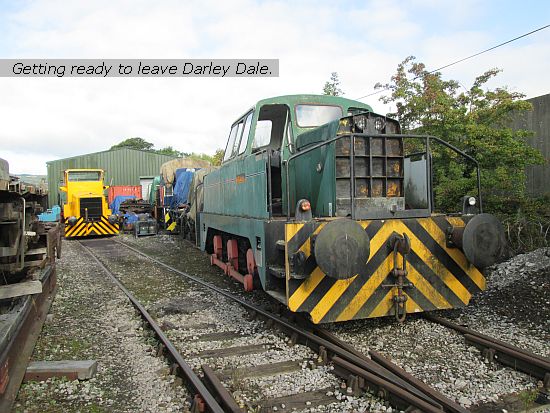
The reason Tom was required was trailed in the last edition, namely that a further acquisition was arriving on my low loader. Adam and Ian had said 08.30, and by the time I had got there, with one of the German flats in attendance, they had unloaded the loco and were waiting for me to pull it clear so that they could hook back up again. So it was straight up to the unloading pad and draw the EE away.
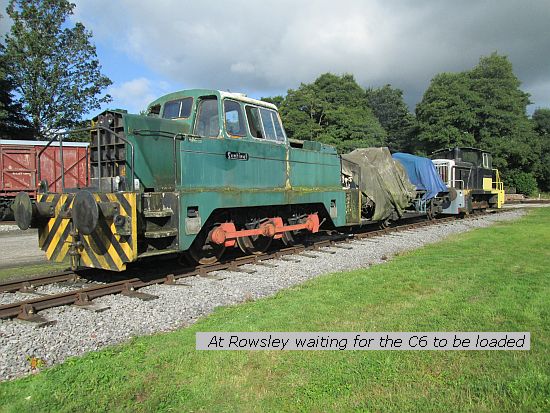
This was first time I'd seen this loco since about 2012 when I supplied brake blocks for it, and they are still fitted, though to be fair it has been out of action a few years since its engine failed. Anyway, once the EE was clear I moved over to the level crossing at Rowsley where one of the staff was waiting with an old RR C6 engine on a telehandler and which was duly lowered into the gap recently vacated by the Cummins we stripped a week or so ago. After strapping it securely in place it was gently back towards Darley Dale, especially so as Andrew had reported that the handle on the back of the RF11 would go round and round but wasn't engaged with the sliding gears so the box could not be de-meshed. Although I took photos in my usual places, Andrew was on hand at Church Lane and Darley Dale crossings to add to the variety and so you have the pleasure of me on the wrong side of the lens again.
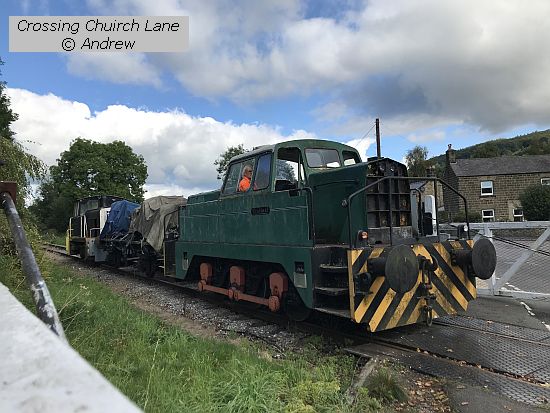
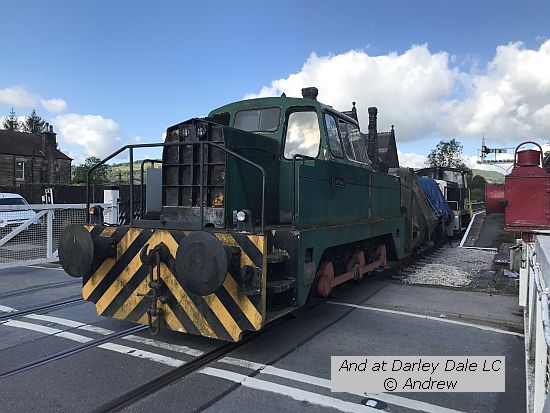
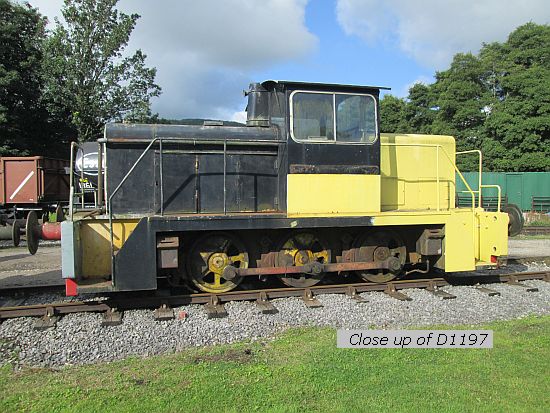
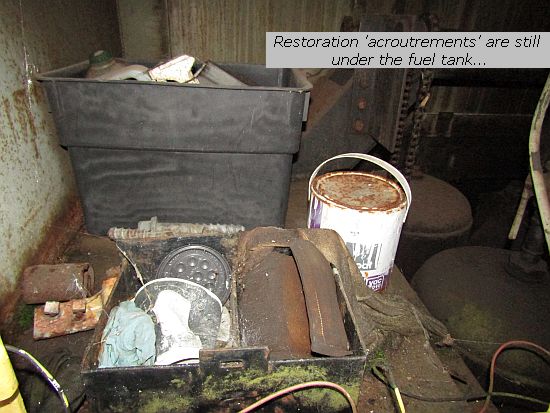
This Stephenson was built in 1967 as EE's works number D1197 and at the East Kent Rly was named Richborough Castle, though those nameplates have been retained by the EKR. That its engine repairs were stopped sort of 'mid flow'is evident by the varied collection of 'useful objects' in the cab and and under the fuel tank.
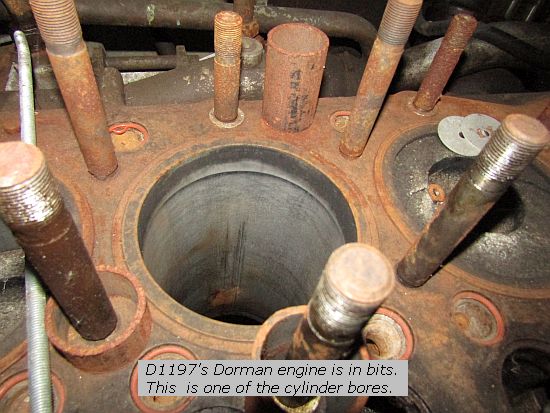
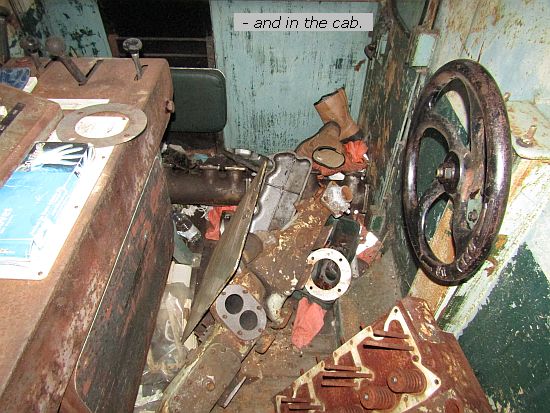
The Rigger boots are not my size. Andrew's plan is to discard the Dorman 6QT and instead fit a Cummins 855, which, being a shorter engine, will bring the converter forward (at the moment it's roughly under the cab front bulkhead and there's a removable 'power bulge' under the desk) and be more accessible. (If you need to take the converter off this sort of loco on site you seperate it and bring it out under the desk and through the cab side window). Quite where D1197 fits in the priority queue has yet to be determined.
Back nearer in the workshops, the Cab on Hudswell 1387 has progressed steadily. With virtually all the original pipework removed, the big slot in the cab front (old instrument panel) was plated over, and the console fabrication arrived from the fabricators. After much wire wheeling and some sanding, Andrew dug out the pressure pot and applied a layer of zinc phosphate primer to the cab internals, radically improving its appearance. Here's a photo of the finished result with the console in place.
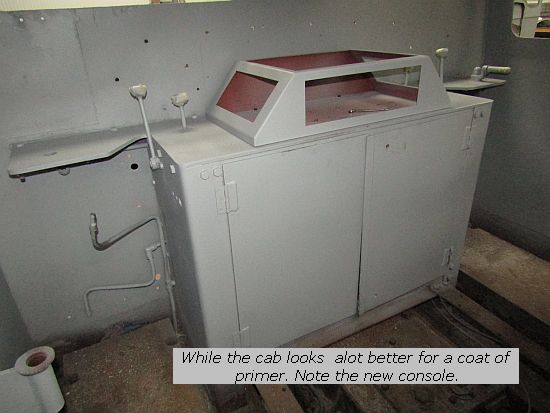
The instrument panels themselves have been ordered so maybe next week you'll get a bit of a preview as to how it will look. Or maybe not, as Andrew favours spraying a coat of Buttermilk all over the cab internals before I am allowed to start wiring things 'up top'. For now I must be content with some of the control air pipework inside the desk.
Of course, one of the threads from last week's edition concerned the seals for the transmission cooler on RS8 (which was why I was taking Tom rather than RS8 on Wednesday) and whether the firm were processing my order without demanding money up front. I was uneasy about this as it seemed a little unusual - most firms use any excuse to get cash in - and chased them early in the week. A very apologetic sales guy came back saying they'd 'missed' my e-mail telling them to proceed. Aagh! A pro-forma was forwarded and settled but a week has been lost which was not what I had expected.
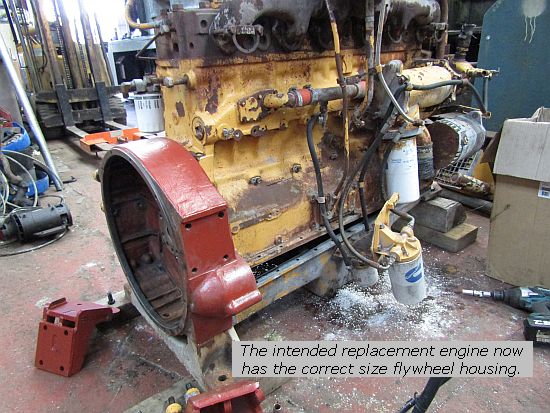
The power unit for 1387 has now had its flywheel housing changed to SAE 1 and its mounting brackets test-fitted. A little bit of grinding was required to the one that sits over the starter motor bulge and some minor clean ups required elsewhere on both until they will fit snugly, but we are getting nearer to dropping that in.
On the cement van font, the side sheets (plywood) are now laid out horizontal everywhere Andrew can find and are receiving a first coat of white undercoat. A second is planned and then at least one coat of gloss grey before they are installed to the van. Meanwhile the end sheets we trialled last weekend received a visit from Dr Ben with his router, who removed the bottom edges as much as required for them to sit over the end angles and butt up to the frames. Andrew assures me that the sides must go in before the ends, so the ends still await further priming and undercoating.
One loco new to the collection, but one will be leaving. This week has seen the sale of D9500 go through, together with the Rolls-Royce CV12 we bought to repower it. It is over 10 years since a phone call from Harry Needle one night to say that he'd acquired D9500 in part exchange and in view of its condition, if we didn't take it on he'd send it for scrap. But in that decade while we may have achieved a lot, D9500 has languished and Andrew felt that it might be better if someone else took it on. The 2HAP too is under re-evaluation, but if the latter departs it must be to someone who will use it, not strip it for parts.
Back nearer home this blog is due for a facelift shortly, so don't be alarmed if it comes through in a week or two looking different. My daughter and son-in-law have started a campaign that I should stop blogging and instead develop a Youtube 'channel' as 'people don't read as much nowadays.' Not sure whether I'd have the time to film everything we do, it's hard enough remembering to get stills sometimes. Should I or shouldn't I? I was going to say 'answsers on a postcard' but I suppose that should be answers on a Zoom call or some such now.
Silly o'clock start in the morning as Adam gets up early and I'll start an hour behind him, and still lots to do, so I'll finish it there and say that I'll be back next week, as before, see ya then.