
Of H&S and sump plugs
12th September 2021
Is it me or has it been a bit hot this week?
So, having heard nothing more from the seal company in Sheffield, I had put an enquiry on another firm down south for exactly the same items and sure enough, they came back to me within 24 hours with prices though their lead times looked slightly worse than what I'd been lead to expect from Sheffield. The latter though did finally get back to me and I had to scribble down their prices - over £9 for one of the o-rings (that's about 50p a circumferential inch) that rather took me aback. I went over the prices with Andrew and placed an order on the other firm: although I invited them to send me a pro-forma they haven't done as yet, looks like they'll charge when the rings are to hand. Hopefully that'll be soon, and if all goes well that will probably kick the Sheffield firm into touch.
Progress has been maintained on various jobs during the week. The brackets you saw last week have all been primed and the sa/pr caliper bracket has been trialled - a packer piece is neccessary to get it positioned just right but as the caliper and cylinder are still not here (but overdue - probably awaiting a lorry-driver) it isn't too critical.
On Tuesday it was back into the saddle for a transport job, put off from Monday as the big DAF tractor wasn't back from the painters so instead of it being taken direct to the destination it was routed back to the yard. Here it is, about to leave the depot where it has been working for some months.
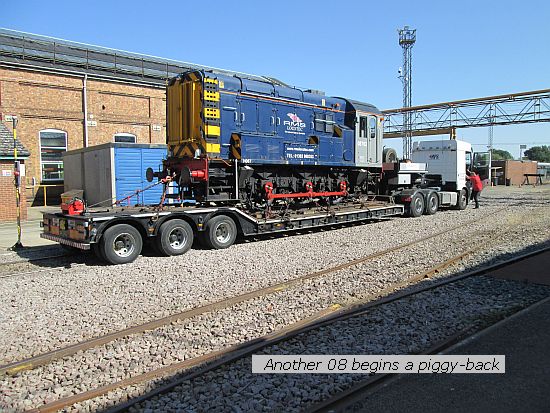
Wednesday it was back in the workshops (mostly) with time spent (amongst others) on a loco re-wire job and changing the brake blocks on an 0-6-0. However Adam's big DAF was back and so on Thursday it was time to hit the familiar trail south east, the A17 past Boston to Kings Lynn and beyond. One of these days I'll have enough time to stop off and view the sites of the various n.g. agricultural railways that proliferated along that stretch a century ago, but then it was dash down to meet up with Adam just outside the seaside to assist in unloading. In fact I overtook him somewhere (he'd stopped for his legally-required break) and in temperatures touching 30 degrees we unloaded it, taking rather longer as the unloading area is off a curve (so you have to judge tangential alignment whilst not being able to see the trailer rails, and can't derive benefit from the track to support the ramp) and with an infill that was not compacted nor firm, so as the loco came down the ramp it depressed the ground and the ramp moved out of alignment. After about 3 attempts we finally got the first axle onto permanent track whereupon it would roll no further, so Adam pulled it with the tractor while I rode the handbrake. Here it is after unloading with Adam getting ready to head south.
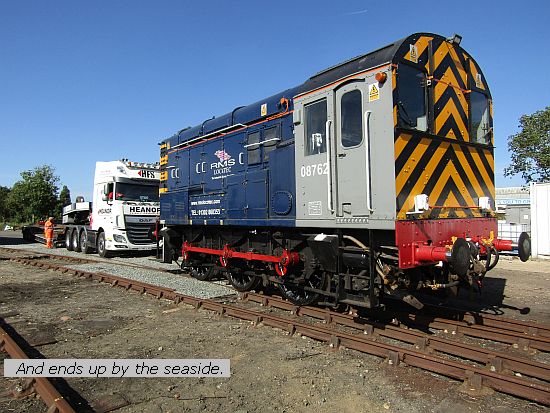
For he had agreed to go collect the next loco without me, as I didn't fancy the additional driving plus hotel (or maybe another rough night in a coach) for what is not a commercial job, as he was going to pick up Andrew's latest acquisition. As Adam was also putting off another customer until the big DAF was back ready, that loco is currently sitting at his yard and will not sojourn further until later in the week, so no pictures yet.
Friday I was therefore back home, trying to catch up on some admin, including detail design on the new control system for 1387. You might ask, why isn't 1387 merely having its old control sytem restored. Each loco manufacturer tended to have their own pet system. Actually, that's not entirely true - Planet and Fowler diesel-hydraulics both used a Westinghouse pneumatic control system, which Hills too were known to fit in the early years. The Hudswell system though was unique. Three valves in the desk provided clutch 'in' and forward-reverse, and these valves were cam-operated as you moved the direction lever from one to the other in the desk. There was no throttle idle detection, nor standstill detection (presumably Hudswells regarded drivers as having higher standards whereas one effect of the H&S Act is that we all now tend to work to the lowest common denominator). It was the clutch cylinder that was unique, and its Achilles heel. Specially made by Hudswells, it was permanently connected to main air pressure on the 'out' direction but the clutch 'in' air supply only came on when the desk valve provided it. Of course, if you have equal pressure on either side of the piston, nothing happens. Well no, only if the areas of the piston on both sides are equal, and in any cylinder one side is smaller in area by the section of the piston rod. (You might like to ponder what effect that has on any steam loco...)
Anyway, Hudswell's cylinder had a very large piston rod, such that equal air pressure on Clutch in, the 'complete' side of the piston, readily overcame the same pressure acting on the limited side of the piston with sufficient excess to put the clutch in and when that clutch' in' air was removed, the constant air side would bring the clutch straight back out again. This however meant that air was on the clutch cylinder continuously (most control systems put air to the cylinder to put the clutch in, but then empty the cylinder after a few seconds as constant load causes wear to the clutch pivot pins.) To take the load off the clutch mechanism, the piston rod thus acts on a stop, which needs adjustment as the clutch wears, and as this was most easily achieved on a bracket mounted on top of the running plate, the big heavy piston rod is thus horizontal, and as I think I recounted once before, the continuous air pressure on that side of the piston creates a continuous air leak as the shaft seal deforms under the constant load of the piston rod.
So pretty much all of Hudswell's control system has gone into the scrap bin (a few spares are around for 'Grace') and I'm starting from scratch with a largely clean slate. Hudswell's control layout on the other hand, is marginally better than Hunslet's, which was next door. Like Hunslet, they seemed to be stuck in the steam loco mentality where all the controls were located on or around the boiler back head and to drive in reverse requires you to have double-jointed arms to function behind you. A complete new desk would be nice but beyond the budget and besides, the cab isn't really long enough to put in a Thomas Hill/Sentinel side arrangement, so I'm retaining the brake lever, throttle and sand levers and that's about it. Even the central instrument panel is going. I have never understood the logic of having (say) a single speedo at one side of a control desk when there are two driving positions. At best, the driver must take his eyes off the track and lean a bit in order to read the gauuge: and if the sun is at the wrong angle, that might mean leaning some way to avoid the glare. Far better, thought I, that there is duplicate gauge close at hand, that he can just glance down and read before returning his attention to the line ahead.
Clearly I am not alone in thinking this, for the Class 14 desk contains the same common sense layout (GW enthusiasts mutter 'good old Swindon' no doubt). But dear old Hudswell not only had a single instrument panel, it was let into the cab front bulkhead where it was unpleasantly close to radiated heat off the exhaust pipe. That hole you could see in last weeks picture of the cab front and is due to be filled. Instead, adjacent to the driver's position will be a small console carrying the essentials - diirection and clutch control buttons (iluminated to show their state) a parking brake button, a horn button, a duplex pressure gauge, a speedo and lastly two warning lights - one for the vigilance/deadmans system the customer wants and another to give a general 'OK' indication. That gives him all the information he needs for general driving, but a large single panel across the front will give him the start up/shut down, temperaure and pressure gauges, fault warnings and light switches, plus mile and hour counters. This will all be contained on a new fabrication that sits on top of the old flat desk and will keep the electrical bits nice and dry but accessible, with (I hope) a nice decorative panel on top for him to put his lunch, paperwork, etc for the day. (Unlike many locos cabs, Hudswell put coat hooks but no cupboard space.) I was hoping this fabrication would be ready late last week, alas no, but shortly you will see all this start to take shape.
On Saturday Andrew and I returned to that rather rusty Cummins you saw us begin last week. Off came the flywheel housing, exposing the last few screws that enabled us to lower the sump. Sadly the state of the sump leaves something to be desired: it has been open to atmosphere for far too long and requires a lot of cleaning. Worse still, some of the valve rockers on top, and the big ends below were badly rusted and having pulled no less than two bent push rods out, we decided that this engine was not fit for further use. So instead we recovered what was worthwhile (charge cooler, water pump, etc) and presented the carcase to the scrap bin, complete with its skid frame that would only suit that particular configuration. The sump and flywheel housing are due to go on to another engine for 1387, and this came into the workshop so that I could make a start.
Meanwhile Andrew went back outside with a welder and tacked down the floor plate in the cement van, and proceeded to apply sealant to all the joints to seal them in. The Cummins I was on, meanwhile, was fitted with one of those drain valves on the sump that I've seen more often on Deutz. Basically it is rather like a tubular non-return valve, but the outside has a thread on it for a cap. Take off the cap and present an adaptor with a pipe on, and as you screw the adaptor on, it opens the diaphragm and the oil flows down your pipe. I have never understood why in the face of H&S legislation and used motor oil having known carcinogens, manufacturers are allowed to get away with nothing but a plug resulting in an uncontrolled exodus, frequently over the poor fitter unscrewing it. Indeed, some manufacturers, employing pressed steel sumps (for weight reduction) forbid you to put anything else in other than their plug, and to make it difficult, use UNS threads (That's Unified Specials for the cognoscenti) for them. When I managed to probe the drain valve to open (I have no adaptor for it anymore) - out came water (er?) but it was clean and sitting under the oil, which has not emulsified, so is almost certainly rainwater that has got in during storage, but we'll check to be certain.
Today I was back at this, finishing draining oil and removing other bits either not required or that must be changed. Andrew returned to the cement van, cutting the radius for the roof on the three end boards and trying them in place to check, and mark where they must be routed out a bit to fit snugly over the new angle at the bottom. Here's one of them in position.
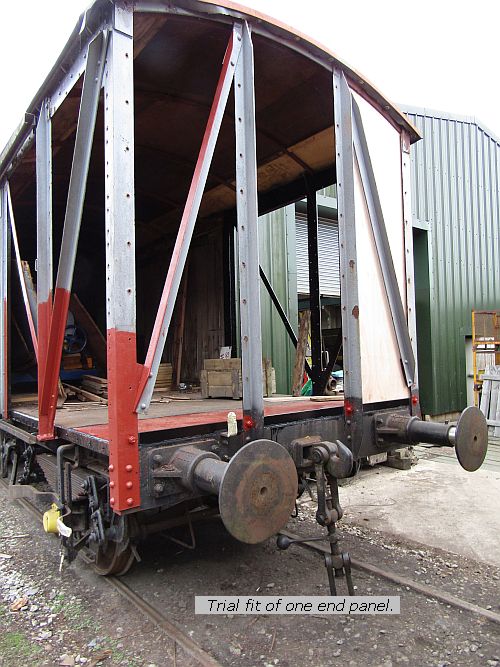
The plan is to get these primed, undercoated and a first gloss coat before they are bolted up into place, so that is the next chore in the repair sequence.
So that's about all for this week. I have more transport work imminent (apart from bringing Andrew's 0-6-0 along) and much to progress, so provided I remember to point a camera at things now and again, there should be something of interest. If all else fails I'll continue the technical review of industrial shunting loco control systems. Rivetting stuff. Who can say? I will, same time, same day, see ya then.