
Of fuses and suspension
29th August 2021
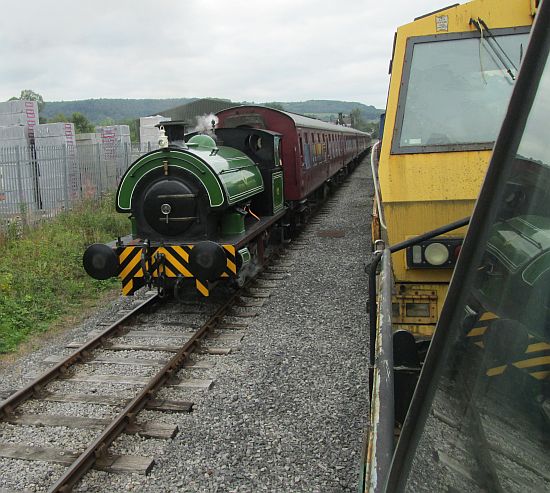
(I was sat in Tom's cab as the PR train went by)
There are some weeks where nothing much seems to have happened but I have loads of pictures to pad it out. And then there are other weeks when I feel as though much has gone on but I have next to no pictures as I've been too busy (or too lazy) to record it all. I think this last week has been one of the latter, having spent a couple of extra days down there.
An early candidate for attention was Tom. In truth, it didn't take much to find out what was wrong. Of the two main fuses, both were 16 amp Pullcap type. One was bridged with two pieces of rather thin fuse wire, and I was under the impression that Andrew had checked the other on Sunday with a test meter and pronounced it sound. When I came to check it it wasn't and when I swapped the other one over and jabbed the starter button everything responded. I searched high and low for spare fuses (I'm still convinced I've got some, somewhere) but settled for putting them on my 'to get list'. With that resolved rather more quickly than I had anticipated it was back into the shed and progress other commercial work.
Hudswell 0-4-0DH 1387 is being slowly cleared of redundant or defective components which effectively means almost every bit of conduit and pipework. Out came the cab floor (which after a couple of years lacking windows in the cab, had largely succumbed to the weather and didn't put up much of a fight) and underneath was revealed all manner of debris including and accumulation of coal dust/slack never removed since it went into preservation. As it will have a seperate reservoir for the transmission oil I had removed the original converter filter, draining the filter bowl into a paint tin: this settled to leave a thick layer of coal dust on the bottom of the tin, and the diesel was still black with what remained in suspension. I've commented in the past how every loco we get involved with that has an NCB background we find the fuel contaminated with coal dust. It would be nice to think that the heavy concentration in this filter bowl reflected what the filter element has prevented passing through but I fear we might need to flush the tank through.
Talking of things in suspension, when we left it last week the consignment that had been brought to the Country Pile both on Saturday and Sunday afternoons and taken away again, when I looked it up on Monday, said it was 'suspended' at their depot, but I hung around most of the day in the hope that it might, after all, be third time lucky. It wasn't, and when I looked on Tuesday morning the website told me that it was being returned to the supplier. I drafted an e-mail immediately, recounting the events, pointing out that supplier had not forwarded any tracking details on despatch (as they had said they would) and I had not expected it until Monday anyway. Within 30 minutes of pressing Send I had a response from the supplier's Commercial Manager. He too was surprised that they had attempted to deliver over the weekend as they had only booked for 'next working day' and that would mean Monday. He promised to turn it round when it arrived and send it back up! Later in the week it arived.
Jagger is back on shift work so has been with us for a couple days during the week, so work on the cement van has progressed with chassis and body members primed and painted. The end angle has been marked up and awaits drilling: Andrew intends using M14 countersunk bolts rather than the flush faced rivets that were drilled out, mainly because rivetting is not a skill we've ever acquired, even though I helped build up a rivet-heating oven back in my days at RMS
Late on Friday afternoon, Andrew popped in to Wirksworth to get an hour-counter reading from Charlie. He walked in to a crisis, they were literally ringing him as he drove down the road. After a couple of unexplained cut-outs, Charlie had refused to start. Needless to say he got on the phone to me, and initially I was a bit slow on the uptake - well my mind was on something completely different at the time. Charlie is a loco to which I have fitted a 3-colour LED across the oil pressure switch. Effectively it means that if the engine is at rest, the light shows red, and if it has oil pressure, it shows green. Eventually I asked Andrew what it showed and he told me it wasn't lighting up at all. That meant that nothing was coming back from the oil pressure switch so off he went to invesitgate and found that the 24Volt feed crimp had fractured as the ducting to the air intake was resting on it. A new crimp put the loco back into operation, though a bit of attention to the ducting and cabling to prevent a recurrence will have to be scheduled.
Some of my time this week has been involved with sourcing components and sundry other activities. For example, I sent a photo of the transmission residing on the back of the 855 that arrived last weekend over to my favourite transmission repairers with a query as to what it was. They confirmed that it was an old Clark torque converter, and they'd be interested in buying it if it was in reasonable nick. Thus second task of the day on Saturday was to seperate the Clark from the Cummins, though this did mean first removing the (bent) air cleaner from over the back, so that we could, when ready, support it from the forklift.
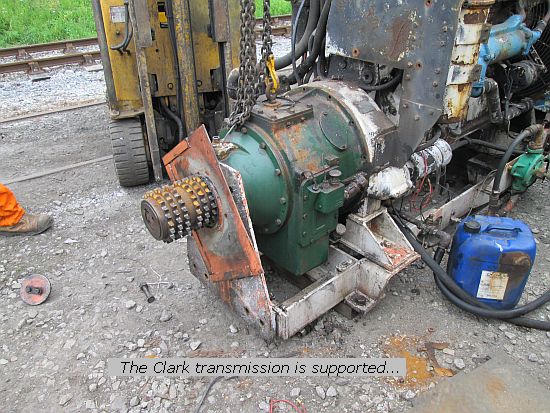
But first task there was to drain it of oil, so we seperated various oil lines and drained about 3 gallons of ATF into a drum, before attacking the flywheel housing screws with Big Mak. But I'm getting very mixed up in my timeline. Along with the Pullcap fuses I ordered a lot of other components required for 1387, but having sorted them out, the first job on Saturday was to renew both fuses on Tom and remove the old stop solenoid. The solenoid had a distinctly burnt-out smell, and the two wires to it, which I had only put in in 0.75mm wire on the assumption that it would only pull 40 amps for very brief periods, had fused together and might have actually shorted: either way it seems odd that the old Pullcap fuses, which were 16Amp rated, did not blow sooner unless of course they are in the 'wrong part of the circuit' and the alternator could deliver the excess current without interruption.
This came home to me once twenty years ago when a loco we had delivered had a sharp edge on the end of some electrical trunking which fretted its way through the cable insulation on the alternator wires, resulting in a short circuit that could only be broken by the battery isolator. Ever since then I have put a high-current fuse in the alternator connections, in addition to breaking down the supplies to the loco systems, (e.g. lighting, engine feeds, control desk circuits, and so forth) through smaller fuses so that any individual faults take out that fuse and leave the rest of the loco functional: it speeds fault finding. Of course this isn't unique to me - Hills and Hunslet locos used circuit breakers in much the same way, while 1387's original electrical box had Slydlock fuse holders which I think Baguley-Drewry also used. You might expect that having been Hills-trained, I'd default to circuit breakers, but aside from the fact that they are the most expensive solution, I was told how up at Ravenscraig steelworks several engines on Hunslet locos got written off because the drivers' response to a circuit breaker tripping was to hold it down by placing a heavy spanner on top of it.
Besides which, there are fuseholders on the automotive market that actually incorporate LEDs so that if the fuse blows, an LED bridging it lights up showing you which one needs replacing. That would have been useful the day in 2014 when 14 901 was rolling in to the platform at Rowsley when the engine suddenly shut down: the loco and train brakes applied and brought everything to a stand. I visually inspected the fuses - nothing apparently wrong - and only after I'd popped home to pick up a test meter did I find the culprit - an LED glowing red at me would have been much quicker. (Why did I not find it first time? Usually a ruptured fuse fails in the centre, this one had failed right at one side side, indicative of a vibration failure rather than over-current.)
Anyway, Andrew pulled out a new stop solenoid from the stores and I cabled it up with 1.5mm wire this time and reconnected it: he put the mechanical linkage back on and we tested it by running the loco for 5 minutes or so and checking that the new solenoid was still cool. Today we fired Tom up again and moved the train back so that the forklift could get around the 855 and remove the Clark transmission. The last two flywheel housing bolts came out without argument, and we had already detached the support plate from the back of the skid frame, so it came off reasonably easily and I followed it up by removing the drive ring from the engine flywheel itself.
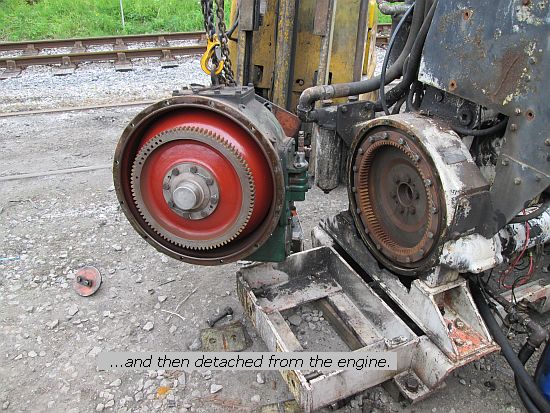
Andrew then burnt off one of the plates (the orange one in the previous picture) which enabled us to remove it, and to our surprise off came the sprocket wheel too: the white support plate was easily unscrewed and added to the growing collection in the scrap bin. Plans have been hatched to run the Cummins before going much farther: that would require replacing a brass oil nipple on the turbo that got damaged in extraction, but Andrew found a not-inconsiderable end-float in the crank, so that might be put on hold and instead big ends and thrust faces get renewed. It's all in the timing, as the loco it is earmarked for is due in in a couple of weeks and Andrew would like to get it back into running condition in short order.
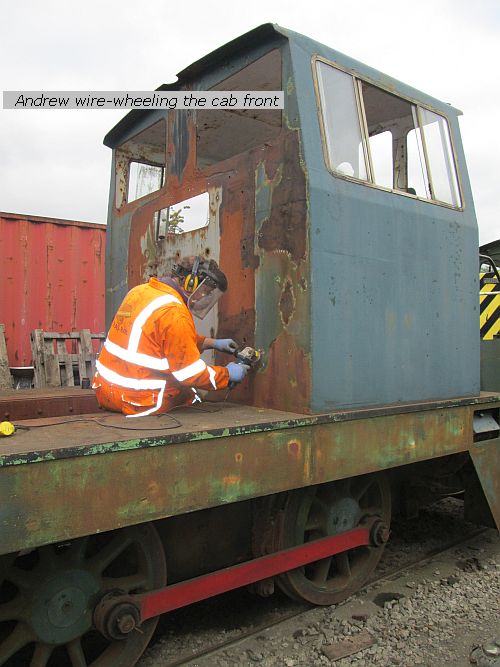
Back round to 1387 and with the cab front now stripped of all un-necessary ironwork, Andrew wire-wheeled the front sheet down where rust had taken hold. At the end of the day we put everything back into normal places and I remembered to double check that Tom's new solenoid was still cool.
So that's about it for this week: many other tasks are not recorded but would seem like a tedious list if I did. As for this next week, other than I look like being at the shed all or part of Monday, Tuesday and Wednesday, I really haven't the foggiest. But I'll be here once again next Sunday, I suppose. See ya then.