
Of seal and hose
14th March 2021
Back to tales nearer home this week.
Fairly early on Monday morning an e-mail came through to tell me that the clutch cylinder seal for Claire had finally arrived, which was quite fortuitous as I was already arranging to take the automatic lubricator back to the supplier. I've mentioned this before, but to recap, back when Andrew first owned Claire, out of the 3 Hudswell Clarkes of this design he owned, only Claire had plain bearings. When asked to run long distances at Wirksworth, one bearing ran hot and we dropped the bottom half of the axlebox to find a rather sad example of a journal lubricating pad and adapted another we had in stock to take its place. (It was this that inspired the oiler pad incident in The Railway to Merhead.) Thus Claire was restored to 4 cool bearings, but lubrication was still this rather hit-or-miss principle of oil reservoirs and drip-feed using worsted wool wicks. I say hit-or-miss because it relies firstly on someone bothering to top-up the reservoirs (4) regularly and the 'science' behind wick feeding talks about different numbers of strands in summer and winter (colder air, thicker oil, less inclined to feed) and bothering to extract the condensate that miraculously found its way in. (The old WD Drewry was a so-and-so for that, I did start to modify a lilo air pump into a hypo for extracting the water from under the oil.) In years gone by there was sufficient pride in the job to expect that a driver would tend to that - but today?
I had previously had experience with a couple of locos installing automatic lubricators. One was a Ruston, where I fitted a PLC control system, and incorporated a software logic of a squirt of oil to each axle bearing as the clutch engaged and then after so many seconds of total motion unless another clutch-in cycle reset it. Up to then, whenever you moved off, there was a noticeable need to up the power to get the loco moving, but installing the lubricator had the effect of forcing a film of oil between bearing shell and journal as you let the brakes off, and I'd defy you to be able to tell whether it was a plain bearing loco or a roller bearing one.
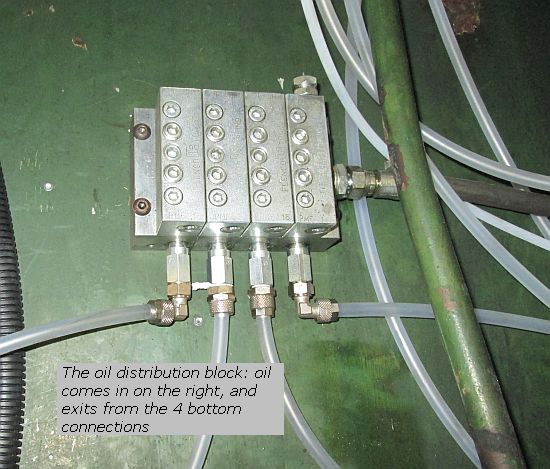
So we splashed out on a lubrication set-up for Claire, but before we cuuld get it installed, Andrew was compelled to sell the loco and the kit went in to store. With Claire now being readied we dug the kit out and installed it, but although the pump was evidently delivering oil to the distribution block, nothing was coming out, and after lengthy guidance from the supplier, it was agreed that the block would come back for investigation. And so it was that I dropped off the block at the supplier's place and went on into Sheffield to collect the seals for Claire's clutch cylinder, and returning was able to pick up the rectified block (an element of which had simply stuck from disuse and resisted a not inconsiderable force of oil trying to make it move again) ready and waiting.
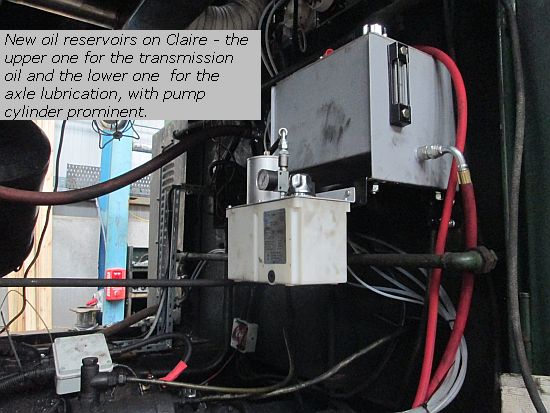
So on Tuesday I got back in the workshops and reassembled the clutch cylinder. Putting air on I could not hear a shaft leakage but the original Enots connection on top, which was a tee with a plug in its uppermost port did leak (in the foreground of the picture above) and I hunted around the workshop and found a 1/2 BSP hydraulic elbow which fitted the cylinder port and decided to recover the Enots nipple from the tee and add an isolating cock for emergencies. (Why not renew the pipe? The other end is also an Enots tee and I simply don't have the fittings to convert it.)
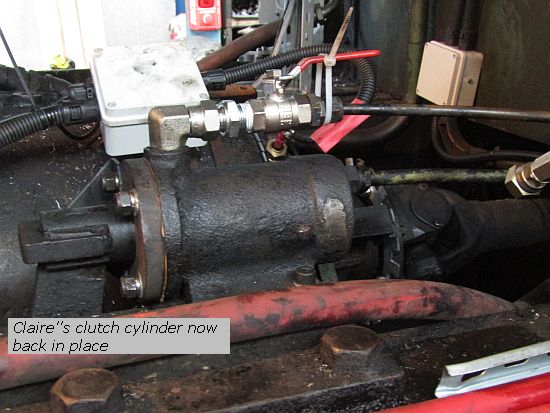
As you can see I've tie-wrapped the handle, as if it were 'accidentally' operated under normal circumstances it would be impossible to get the clutch to disengage. The cylinder is now held firm by 3 M10 capscrews (before it had one screw and a bent stud) and with its new shaft seal and joint on the cylinder cover it appears not to leak any more. On Wednesday I pottered about in the morning and after lunch Steph drove me down to the surgery for my first Covid jab. After finding out the side effects Steph had suffered after hers, I had planned Thursday to be free, but apart from a sore arm and a slight headache (which might just as easily have been from a lack of fresh air) I can't say I had any, though my pulse was elevated Thursday morning reading that 2 Scandinavian countries were suspending Astra-Zenica jabs after possible related cases of blood clots. I had just had an A-Z jab, and my mind started inventing minor aches through my body that might be imminent clots. There's only one clot and it's me.
So back to it on Friday and first thing was to purge the lubricator distribution block, as the supplier had used grease to free it all up and it was still full of it. I had a tyre-inflator hooked up to the oil pump and each time I squeezed the trigger a shot of air pushed the piston down, a slug of oil passed through the delivery pipe and 4 exit ports squerged out a black, gooey yuck mostly on to a piece of rag sat on top of the propshaft. Not every time though: after a while I learned that even the slightest residual air pressure in the cylinder prevented the pump re-cycling and nothing would happen. That's no bad thing as I am setting it up on Claire that each time the clutch indicates it is 'in' the valve will admit air to the pump cylinder and it will stay on until the clutch comes out again. That may mean that sometimes it doesn't re-cycle quick enough to deliver a fresh slug of oil at every reversal. If it did, then it would tend to deliver too much oil and leave a trail evetywhere it goes. Unfortunately I don't have the PLC on Claire to control the delivery parameters. Once the emerging yuck had gained a sufficiently liquid conistency, I reconnected the individual feed lines and started charging the pipes to the axlebearings, so when Claire does start working again (quite soon) the fresh oil will be close at hand.
Talking of working again, Andrew and I have had discussions about Ludwig. The decision to stand the loco down was perhaps unneccessarily pessimstic. We caught the problem before it had time to cause too much damage to the engine (well, it's still in one piece) and if we drain the coolant, remove the two heads - maybe only one if we're lucky first time - that appear to be where the problem lies, we can assess the damage, remove the cause and the engine - perhaps weakened - may be fit to run again for now. And this investigation might have been started on Friday or over the weekend had the weather not kept us well and truly in the shed. Claire's train hoses had arrived, and the 4 train cocks were overhauled and fitted, together with the hoses. Traditionally (if I can talk about train air that way) you installed hoses with 'dummy couplings' that hung on chains fixed to the buffer beaams. Their purpose was not to seal the hoses (like vac dummioes) but to keep the hose ends clean when not in use. But when the dummies were not in use they banged around on the front of the loco, chipping away at your paint and anyway hardly anyone ever bothered to put them on. Far more useful was a fixed bracket with a slot in the top edge into which the coupling would slot, providing some protection to the hose end and being sufficiently simple that train crew would actually use them. Andrew has a pile of these recovereed from some main line loco or other and 4 are allocated to Claire, being placed by using the new hose to determine where to drill and tap. So here's pictures of Claire's front and rear, with hoses being installed and the finished job with brackets mounted.
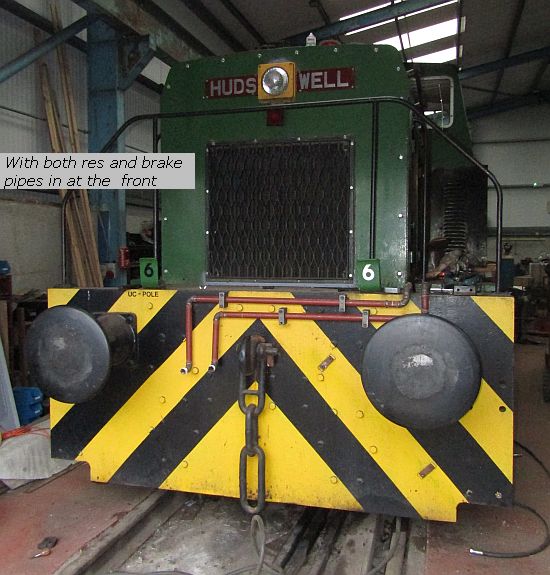
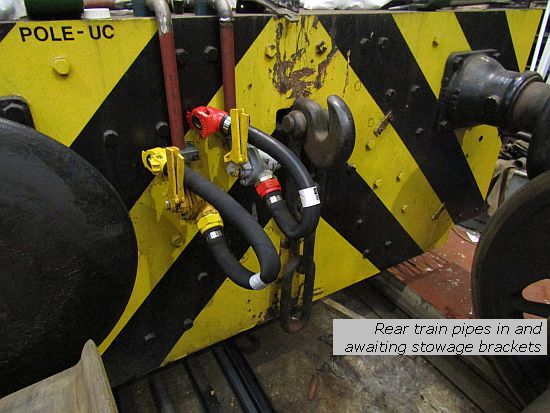
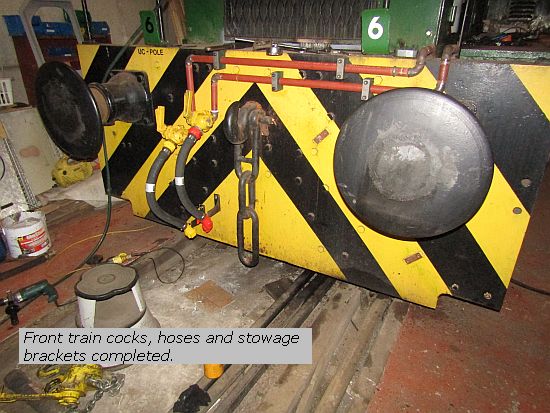
Today we were back on air testing: up to now we have been dealing with one bit at a time, but now was the turn of the train air system, which is isolatable thanks to a cock just in front of the gearbox. Of course it found us a few crane couplings that were not tight, and a small pin-hole on one of Andrew's welded pipe elbows that must be ground out and re-welded. From my point of view, it revealed that I had the main res pipe and brake pipe connections crossed over at the the duplex gauge - the brake pipe was rising with main air pressure while the res pipe apparently stayed at 5 bar until I operated the driver's brake valve, whereupon it fell and restored in response. Ah well, once vented off (part of the low air pressure protection safety test) swopping the gauge lines over was easy, meanwhile the auto-emergency reservoir held the loco brakes on.
So that's about it for the week. Over in the Hope Valley, Phase 2 of Network Rail's capacity improvements plan, to install additional loops to enable easier intermingling of ex-Buxton stone trafficks with the passenger services together with the resignalling that entails is about to get underway, and I hear that a 'bumper' train of 39 wagons for 2 different destinations, starting off from Tunstead with 3 locos, one as a banker, will trial this week. It is not that long ago, that someone advocating the re-instatement of the line through Bakewell claimed that freight was to be banned from the Hope Valley in order to speed up passenger trains. Even if the Buxton traffic were to be re-routed away from the Hope valley, the very existence of Hope Cement works, mandated to shift much of its production by rail because of its location within the Peak Park, meant that a freight-ban on the Hope Valley was impossible. At first sight, this phase of modernisation - costed at £137m - doesn't make sense compared to the £80-120m banded about as the cost of re-instating the line from Blackwell Mill to Rowsley, but apart from that being a figure now over 15 years old, it didn't take account of resignalling and upgrading that would be required between Rowsley and Ambergate, nor did it consider that once through to Totley, today's southbound freights can take the Erewash valley route and so avoid the Derby bottleneck. Some people sadly have blinkered thinking.
Andrew has been out and about a lot this week with silly o'clock starts in order to ride with EMR's 360's on test trains out of Kettering and including runs at 90mph or more up Sharnbrook: Midland Railway enginemen would be amazed. And so on that reflective note I'll leave you for this week. I hope you'll find your way back here in 7 days - see ya then.